
Aircraft hangar · KS
Aircraft Hangars in Kansas
Kansas is more than just agricultural land; it is a global hub for aviation. With Wichita famously serving as the 'Air Capital of the World,' the demand for aircraft hangars here is rooted in a deep cultural and economic legacy. On a farm base that averages 804 acres per operation, the opportunity for private airstrips and on-site hangars is a unique Kansas reality. Across the state's 81,758.7 square miles, planning a hangar requires balancing the open space of the High Plains with the severe wind and hail hazards identified by FEMA. Whether you are building in the humid east or the semi-arid west, the honest story is about protecting an aviation asset in the heart of the country.
Cultural Heritage
Building in the Air Capital's Orbit
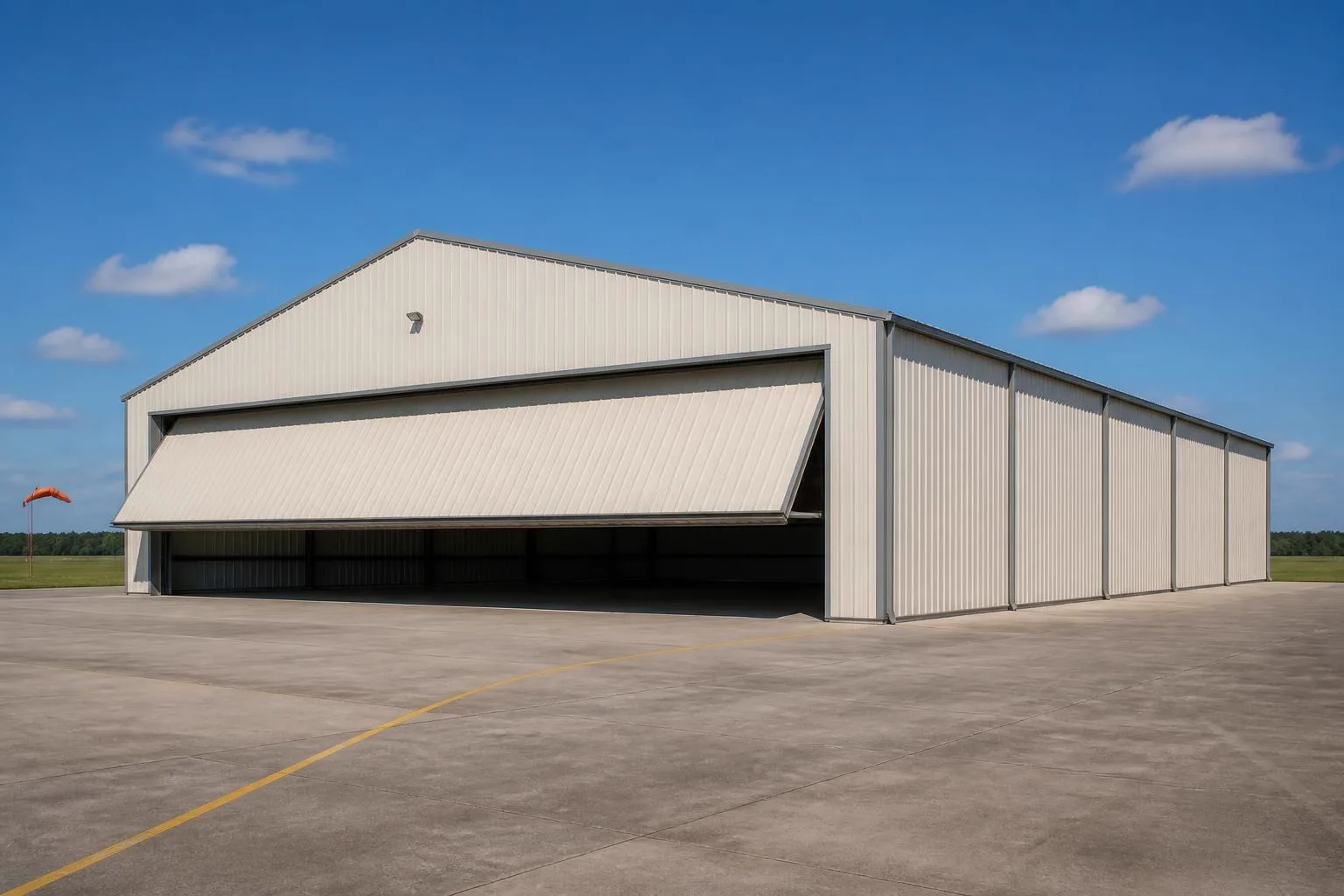
Kansas isn't just a place where planes fly; it's a place where they are born. The legacy of Wichita as the 'Air Capital of the World' influences every hangar build in the state.
From the historic presence of companies like Beechcraft and Cessna to the modern operations at Eisenhower National Airport, Kansas has a density of aviation expertise that is unmatched in the central U.S. For a hangar buyer, this means that local builders and engineers are often more familiar with the specific requirements of aircraft storage than their counterparts in other states. This expertise is vital when dealing with the large spans and high-load door systems required for aircraft.
On the 804-acre average Kansas farm, aviation is often a practical tool for surveying crops or traveling between remote holdings. The flat terrain of the High Plains, while ideal for runways, offers no protection from the severe wind and hail that FEMA NRI identifies as significant hazards. A Kansas hangar must be more than a shed; it must be a fortress for a high-value asset, designed to withstand high-velocity gusts that can turn a large hangar door into a structural liability.
Engineering
Managing the Plains Environment
The Kansas climate transition and the rocky Flint Hills substrate create two distinct engineering paths for aircraft hangars.
In the eastern part of the state, particularly in the humid transition zone, the primary enemy of an aircraft is moisture. Humidity can wreak havoc on avionics and airframes over time. Hangars in this region require robust vapor barriers, high-performance insulation, and often dedicated HVAC systems to maintain a stable environment. In the west, however, the NOAA NCEI describes a semi-arid zone. Here, the challenge is dust and heat. Tight seals around the bifold or hydraulic door are critical to prevent fine Kansas dust from infiltrating the airframe, and high-reflectivity roof coatings are necessary to manage internal temperatures during the blistering High Plains summers.
Geology also plays a role. The Kansas Geological Survey's description of the Flint Hills highlights thin, rocky soils and Permian limestone. Because hangars require heavy, reinforced concrete pads to support the weight of aircraft and the torque of large door systems, the presence of rock near the surface can significantly impact foundation design. In these regions, a slab-on-grade approach must be carefully engineered to distribute loads across the rocky substrate without cracking.
- Door Loading
- Kansas wind gusts place extreme pressure on large hangar doors; prioritize reinforced headers and robust locking mechanisms.
- Site Orientation
- Siting the hangar door away from the prevailing northwesterly winter winds can prevent snow drifts and reduce wind load.
- Clear Span Logic
- On 800+ acre parcels, build for the plane you want next; a 50-foot clear span is a common future-proof starting point.
Site Selection
Where in Kansas You Build Changes the Hangar Brief
Kansas's 81,758.7 square miles span three distinct siting contexts for a private hangar, each with a different foundation and access story.
South-Central (Wichita Corridor)
Proximity to the Air Capital's supplier and maintenance network means shorter lead times for specialized door systems, but also denser airspace; buyers here should confirm proximity to controlled approach paths before siting a strip.
Flint Hills
Thin, rocky Permian-derived soils (Kansas Geological Survey) can force a shift from deep post footings to a reinforced slab-on-grade, adding site-prep time that eastern or western buyers rarely encounter.
High Plains (West)
Deeper, well-drained soils simplify excavation, but the lack of windbreak trees means a hangar's broad door wall is fully exposed; orienting the door away from the prevailing northwest winter wind reduces both heat loss and wind loading.
Protect Your Aviation Asset in Kansas
Built for the Air Capital's legacy and the High Plains wind. Get a quote for a steel aircraft hangar today.
Buyer Decision
Private Hangar vs. Airport T-Hangar Rental
On an 804-acre Kansas farm, the calculus for owning a private hangar versus renting a municipal T-hangar space is different than it is for a suburban pilot.
A pilot on a large Kansas operation already has road access, power, and often an existing turf or gravel strip; the marginal cost of adding a private hangar is largely the structure itself, not new infrastructure. That tips the math toward ownership for anyone flying more than occasionally, since a municipal T-hangar near Wichita or a regional field still requires the drive time that a farm-sited hangar eliminates entirely.
The tradeoff is liability and insurance. A private strip on agricultural land typically falls outside FAA-controlled airport oversight, which means the buyer, not an airport authority, carries responsibility for runway condition, lighting, and any obstruction clearance. Buyers should talk to their insurer before committing to a private-strip hangar, since some carriers price agricultural aviation risk differently than they price hangar space at a certificated airport.
Application
Kansas Hangar Configurations
Styles adapted for private and agricultural aviation in the Sunflower State.
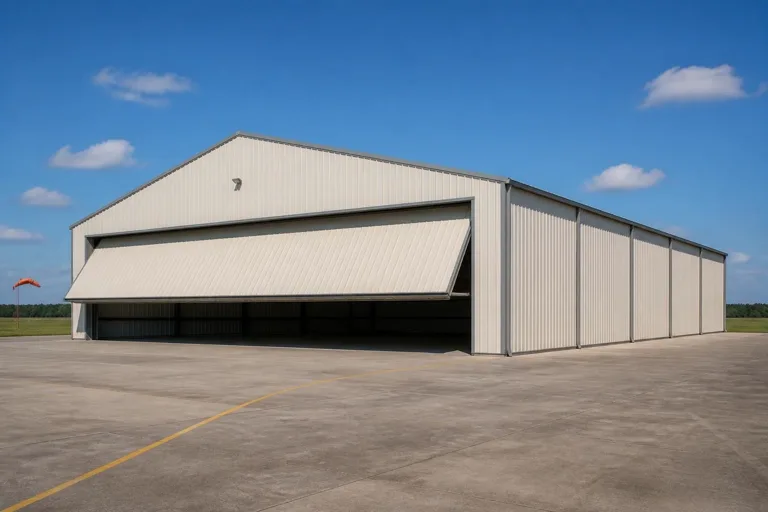 Private Box HangarIndependent steel structures for single or twin-engine aircraft on private 800-acre strips.Ag-Aviation ShedSpecialized hangars for crop-dusters, including chemical storage and mixing areas.T-Hangar RowMulti-unit storage for municipal airports or shared private strips in metro Wichita.
Example Configuration — for planning purposes only.
Scale
Footprints for Kansas Aviation
Reflecting the needs of recreational and operational aircraft.
40′ × 40′
1,600 sq ft
A compact box hangar for a single light aircraft.
50′ × 50′
2,500 sq ft
The 'Kansas Standard' for a single aircraft with room for a workshop.
60′ × 60′
3,600 sq ft
Professional-grade hangar for twin-engine planes or multiple light aircraft.
Example Configuration — for planning purposes only.
Width refers to the door-facing side; ensure your door opening is at least 5-10 feet wider than the aircraft wingspan.
Questions
Kansas Aircraft Hangar FAQ
Honest answers for aviation enthusiasts in the Air Capital's home.
It means that the infrastructure for aviation—including skilled labor, engineering, and parts—is more readily available in Kansas than in most states. This local expertise translates to better-designed and more resilient hangar structures.
Qualitatively, you must focus on the door. Hangar doors are massive sails. In a state with severe wind hazards (FEMA NRI), your hangar should have a reinforced frame and a door system that is specifically rated for high-velocity gusts.
Yes, but your foundation will likely be more expensive. The Permian limestone substrate means you'll need specialized foundation work to support the heavy, concentrated loads of a hangar and its aircraft.
Not necessarily. On many 804-acre Kansas farms, turf or gravel runways are common. The flat High Plains terrain is naturally suited to private aviation, but you must ensure your hangar is sited at a point that allows for safe approach and departure.
If your parcel already has road access and open land for a strip, ownership usually beats a T-hangar rental in the long run, since you avoid the drive to a certificated field. Just confirm with your insurer how they treat liability for a private, uncontrolled strip versus airport-based hangar space.
Sources for the Kansas facts on this page
This page states no code requirement, wind speed, snow load, permit rule, price or supplier claim. The state-specific facts it does use are listed with their publisher below.
NWS Wichita publishes official 1991-2020 annual climate normals for temperature and precipitation for the Wichita (Eisenhower National Airport) station.
National Weather Service (NOAA), Wichita KS office · 1991-2020 · Tier 1
https://www.weather.gov/ict/yearlyKansas had 44,794,702 acres of land in farms in 2022, an average farm size of 804 acres — the largest average farm size figure among the four-state group reviewed here (IL, IA, KS, LA).
USDA NASS · 2022 · Tier 1
https://www.nass.usda.gov/Publications/AgCensus/2022/Full_Report/Volume_1,_Chapter_1_State_Level/Kansas/st20_1_001_001.pdfKansas's total land area was measured at 81,758.7 square miles as of the 2010 Census.
U.S. Census Bureau · 2010 Census · Tier 1
https://www.census.gov/geographies/reference-files/2010/geo/state-local-geo-guides-2010/kansas.htmlNOAA NCEI's State Climate Summary for Kansas states the state is a region of transition between the humid conditions to the east and semi-arid conditions to the west, and that temperatures have risen about 1.5°F since the beginning of the 20th century, with greater warming in winter and spring than summer and fall.
NOAA National Centers for Environmental Information (NCEI) · State Climate Summaries series, 2022 · Tier 1
https://statesummaries.ncics.org/downloads/Kansas-StateClimateSummary2022.pdfFEMA's National Risk Index dataset assesses 18 natural hazards (including tornado, hail, drought, and severe wind, all historically significant to Kansas) at the county and Census tract level via its interactive online tool.
Federal Emergency Management Agency (FEMA) · Current NRI release · Tier 1
https://www.fema.gov/about/openfema/data-sets/national-risk-index-dataKansas had 44,794,702 acres of land in farms in 2022, an average farm size of 804 acres — the largest average farm size figure among the four-state group reviewed here (IL, IA, KS, LA).
USDA NASS · 2022 · Tier 1
https://www.nass.usda.gov/Publications/AgCensus/2022/Full_Report/Volume_1,_Chapter_1_State_Level/Kansas/st20_1_001_001.pdfThe Flint Hills region, running north-south through east-central Kansas, is one of the few large remaining areas of unplowed tallgrass prairie in North America because the region's thin, rocky (chert-bearing) soils formed from eroded Permian-age limestones and shales were historically too hard to plow, so the land has mainly been used for cattle grazing rather than row crops.
Kansas Geological Survey, University of Kansas · KGS reference material · Tier 2
https://www.kgs.ku.edu/Physio/flinthil.html