
Auto repair shop · MI
Auto Repair Shops in Michigan
A Michigan repair shop is built around the salt season. From the first treated road in November to the last thaw, the vehicles coming through the door carry brine, slush and corrosion, and that single fact shapes the bay layout, the floor and drainage detail, the ventilation, and how much heated customer space you need. The state's benchmark climate normals at Detroit Metro Airport sit near 34-35 inches of annual precipitation with mean January and February snowfall around 12-14 inches each, and FEMA's National Risk Index scores winter weather, ice storm and severe/strong wind among the hazards across Michigan's 83 counties. This page covers what those conditions change about the building — not how to run a shop.
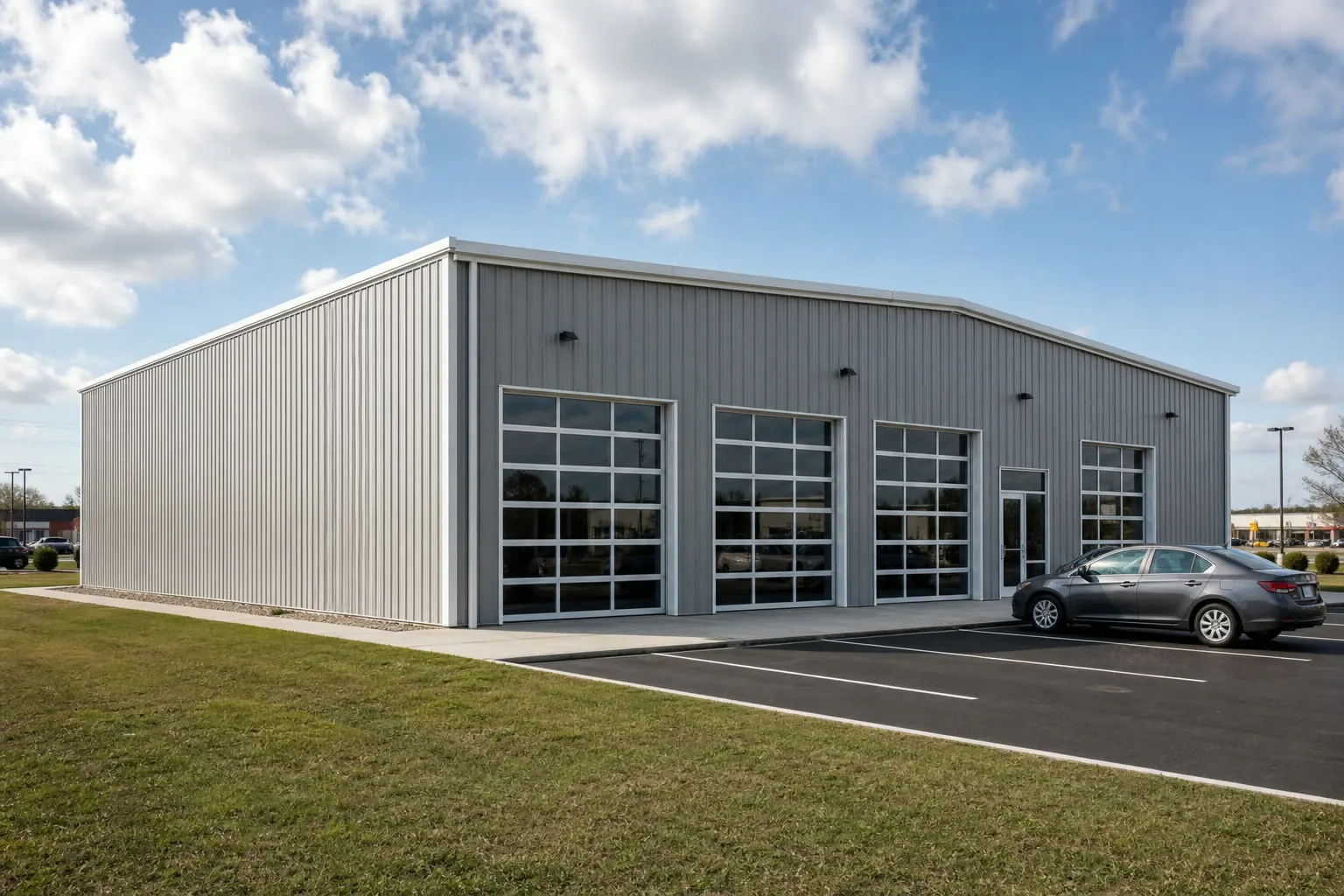
Design the Building Around the Salt Season
Ask a Michigan shop owner what the building needs and the answer is rarely about steel. It is about what happens between November and March: vehicles arriving covered in brine, floors that never dry, a customer who will not stand outside, and bay doors that dump the shop's heat every time a car moves. NWS Detroit/Pontiac maintains a Southeast Michigan climate page referencing 1991-2020 normals against a record that starts in 1874, and those normals — roughly 34-35 inches of precipitation and 12-14 inch mean snowfall in each of January and February — describe the mildest corner of the state. A shop designed for those five months works comfortably in the other seven; the reverse is not true.
Floor Strategy
The Floor Is the Michigan Decision
In a Michigan repair shop the floor has to shed meltwater, resist brine, stay safe when wet and route fluids to whatever the local authority requires — and those requirements are confirmed locally, not assumed.
Every vehicle that comes off a salted road brings a load of snow and brine into the building with it. In a busy winter shop that means the floor is wet for months, and a slab detail chosen for a dry-climate shop performs badly: standing meltwater at the low point of the bay, brine wicking into unsealed concrete, and a slip hazard right where technicians move most. Slope, sealing and a defined collection point are the practical answers, and they need to be designed before the pour rather than corrected after it.
Where that water and any workshop fluid then goes is a regulatory question with real consequences, and it is one this page will not answer for you. We hold no sourced Michigan rule on floor-drain discharge, oil-water separators or waste-fluid handling, and inventing one would be worse than useless. Put the question to your local authority and the state environmental agency early, because the answer can change the slab layout, not just the plumbing.
Corrosion management inside the building matters too. Brine tracked onto a slab and splashed onto column bases and door tracks is a slow, cumulative attack on the parts of the building nearest the floor. Michigan shops that last tend to have specified protection at the base of the structure and at door hardware, and to have made washing down the bay a practical option rather than an obstacle course.
Layout
Michigan Layout Decisions Worth Making Early
These are the layout choices where a Michigan shop diverges from the same shop in a mild state.
- Fewer bay doors, better placedEvery cycle of a bay door in winter empties the heated volume. Michigan layouts tend to favour a smaller number of doors positioned out of the prevailing wind, with drive-through arrangements considered carefully because they double the openings.
- A real airlock on the customer sideA vestibule keeps the waiting area habitable and stops the reception counter becoming the coldest seat in the building. It is cheap in the original layout and awkward to add later.
- Heated, separated customer spaceFor four to five months a year the alternative to a warm waiting room is losing the wait-for-it customer entirely. Separation also keeps noise and fumes away from the people you are trying to keep comfortable.
- Somewhere to thaw a vehicleUndercarriage work on a frozen, salt-caked vehicle is slow and unpleasant. A dedicated bay or a wash position where a vehicle can be cleaned and warmed pays for itself in labour hours during a Michigan winter.
- A parking and snow-storage planCustomer parking, vehicle staging and the plough windrow compete for the same ground. Decide where the snow goes before the site plan is finalised or you will lose the bays you need for staging.
- Ventilation sized for a closed-up buildingIn a mild state the doors stay open. In Michigan they do not, so exhaust extraction and general ventilation have to work with the building sealed for months at a time.
Get repair shop quotes for your Michigan site
Give suppliers the bay count, whether you need a wash or thaw position, and your local department's design values. Shell quotes without those are not comparable.
Site Context
Where a Michigan Shop Sits Changes the Brief
USGS describes Michigan as two peninsulas, and the practical shop brief differs across that geography as much as the weather does.
Metro and suburban Lower Peninsula
Higher vehicle density, more competition for site frontage, and approvals dominated by zoning, parking counts and signage. The building question here is usually how many bays fit on a constrained commercial lot with a workable customer approach and snow storage.
Rural Lower Peninsula
Larger parcels and easier staging, but longer parts logistics and a customer base that expects to be able to leave a vehicle. Buyers often want a larger footprint with more indoor storage of waiting vehicles — which is itself a winter decision, because vehicles left outdoors need clearing before work can begin.
Northern Michigan and the Upper Peninsula
Seasonal traffic swings, a much shorter construction season, and freight distance from southern-Michigan and northern-Indiana fabrication. The building has to earn its keep across a demand curve that spikes with tourism and with the first hard freeze.
Footprints
Bay Counts That Work in a Michigan Winter
Michigan shops usually need one more indoor position than the bay count suggests, because vehicles cannot be staged comfortably outdoors for five months.
40′ × 60′
2,400 sq ft
A two- to three-bay shop with room for an indoor staging or thaw position rather than staging every vehicle outside.
50′ × 80′
4,000 sq ft
Four bays plus separated, heated customer space and parts storage — the common Michigan independent-shop footprint.
60′ × 80′
4,800 sq ft
Adds a wash or thaw bay and interior vehicle storage, which is where the winter labour savings actually appear.
Example Configuration — for planning purposes only.
Bay dimensions and lift clearances belong to the type page; occupancy requirements come from your local department.
Evidence Position
What We Do Not Assert
No Michigan code edition, permit threshold, environmental rule, structural design value or price appears on this page.
The sourced Michigan material used here is limited to NOAA 1991-2020 normals referenced by NWS Detroit/Pontiac, FEMA's National Risk Index as the federal hazard tool for the state's 83 counties, USGS's description of the two peninsulas, and Census authorisation of 21,750 privately-owned housing units in Michigan in 2024 — the last of which matters only as a signal of how contested the construction schedule is.
Repair shops carry more regulatory surface than almost any building in this catalogue: occupancy classification, fire separation, ventilation, fluid handling and disposal. Every one of those is answered by a Michigan authority for your specific site, and a supplier quoting a shell has not answered any of them.
Questions
Michigan Auto Repair Shop Questions
What Michigan shop owners ask that a general repair-shop page cannot answer.
Usually less than buyers expect. A repair shop is a commercial occupancy whatever the parcel looks like, and Michigan enforces locally across 83 counties. A rural site may ease zoning and parking pressure, but the occupancy, fire and fluid-handling questions remain.
By design, not by mopping. Slope the slab to a defined collection point, seal against brine, and confirm with the local authority and the state environmental agency what your drains may discharge and what separation is required. We do not publish those rules because we hold no sourced Michigan figure for them.
Fewer than a warm-state layout would suggest, and placed out of the prevailing wind. Door cycling is the largest heat-loss path in a winter shop, so a drive-through layout should be justified against the heating cost it creates.
If you want wait-for-it business between November and March, yes. It also needs to be separated from the bays for noise and fumes, and it works far better with a vestibule between the door and the seating.
Construction season, freight distance and demand seasonality. UP projects should book the foundation slot early, and the building often needs more indoor vehicle storage because outdoor staging is impractical for longer.
Pricing is delegated to the cost silo. The Michigan-variable drivers are the slab and drainage detail, the heating and ventilation package, and the site work — all of which are seasonal here.
Sources for the Michigan facts on this page
This page states no code requirement, wind speed, snow load, permit rule, price or supplier claim. The state-specific facts it does use are listed with their publisher below.
Detroit Metro Airport's NOAA 1991-2020 climate normals show total annual precipitation of roughly 34-35 inches, with January and February mean snowfall near 12-14 inches each.
NOAA National Centers for Environmental Information (NCEI) · 1991-2020 · Tier 1
https://www.ncei.noaa.gov/access/services/data/v1?dataset=normals-monthly-1991-2020&format=pdf&stations=USW00094847NWS Detroit/Pontiac maintains a Southeast Michigan Climate Information page and issues monthly climate reports referencing the 1991-2020 normal period against an observation record dating to 1874.
National Weather Service (NOAA), Detroit/Pontiac MI office · 1991-2020 · Tier 1
https://www.weather.gov/dtx/monthlynormalsFEMA's National Risk Index is the federal tool for county- and state-level natural hazard exposure data for Michigan's 83 counties, covering 18 hazard types including winter weather, ice storm, and severe/strong wind.
Federal Emergency Management Agency (FEMA) · Current NRI release · Tier 1
https://www.fema.gov/flood-maps/products-tools/national-risk-indexBuilders in Michigan were authorized to construct 21,750 new privately-owned housing units in 2024, of which 15,045 were single-unit structures.
U.S. Census Bureau · 2024 (final annual estimates) · Tier 1
https://www.census.gov/construction/bps/stateannual.htmlUSGS describes Michigan as consisting of two peninsulas -- the Upper Peninsula and Lower Peninsula, separated by the Straits of Mackinac -- and notes it is the only U.S. state touching four of the five Great Lakes, giving it the longest freshwater coastline in the country.
U.S. Geological Survey · 2021 · Tier 1
https://pubs.usgs.gov/publication/fs20213047