
Workshop · MI
Workshops in Michigan
A workshop in Michigan is judged by one question: can you work in it in February? The state's baseline climate normals at Detroit Metro Airport put annual precipitation near 34-35 inches with mean January and February snowfall around 12-14 inches each, and those are the mild numbers — the Upper Peninsula and the lake-effect belt on the western Lower Peninsula run far harsher. That makes the Michigan workshop an envelope-and-heat problem before it is a steel problem. The second Michigan-specific factor is where these buildings land: with 45,581 farms across 9,472,069 acres, buyers routinely site a trade or hobby shop on a rural parcel that reads as agricultural, which changes how the local department classifies the building and what it inspects.
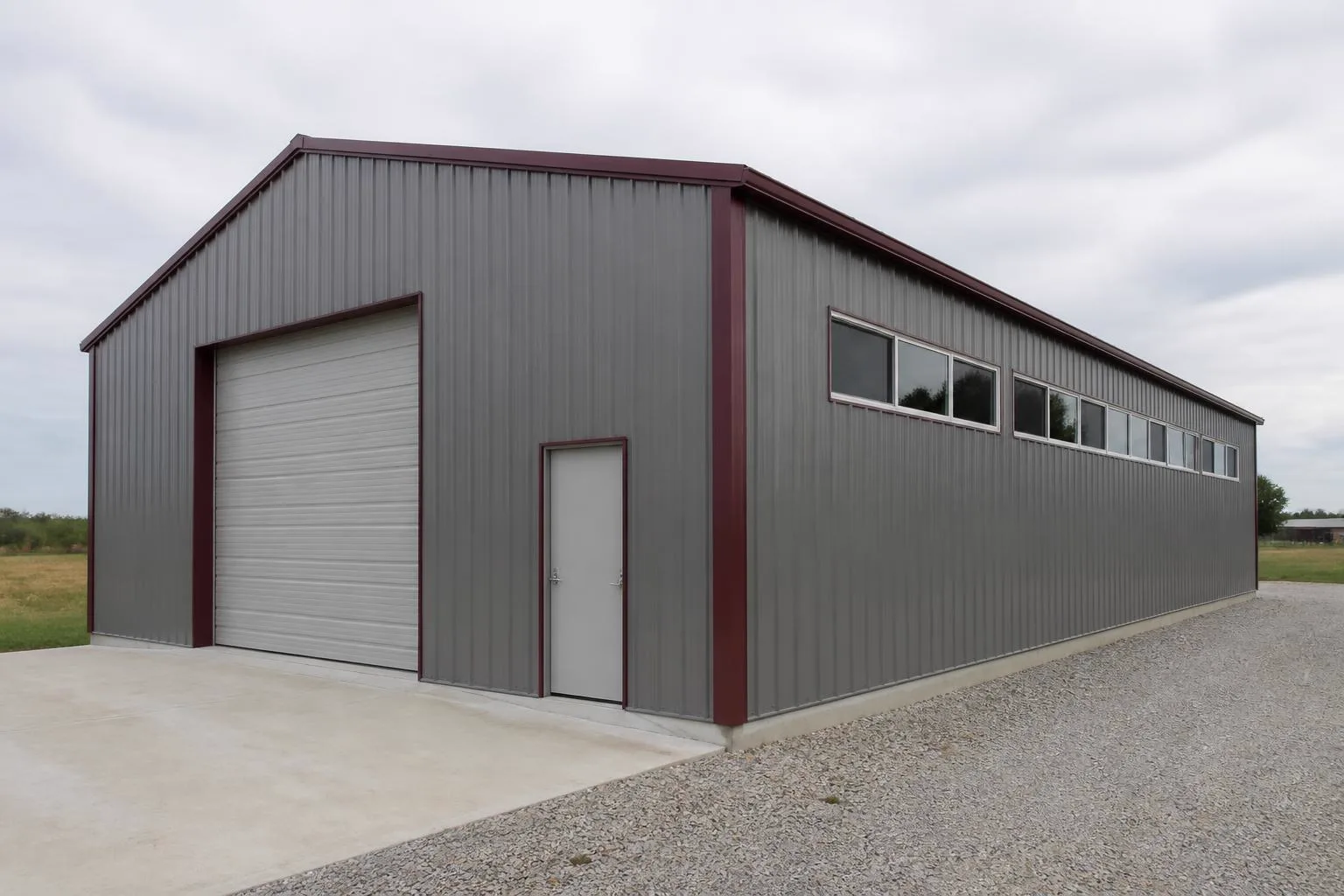
The Michigan Workshop Is a Winter Building
Most workshop guidance is written as though the building will be used in mild weather with an open roll-up door. In Michigan that describes about four months of the year. NWS Detroit/Pontiac maintains a Southeast Michigan climate page against an observation record reaching back to 1874, and the 1991-2020 normals it references put Detroit Metro Airport near 34-35 inches of annual precipitation with mean January and February snowfall around 12-14 inches each. Those are the state's benchmark numbers from one of its mildest corners. A Michigan workshop therefore has to be specified as an occupied, heated, ventilated space that happens to be made of steel — and the decisions that follow from that are different from the ones a buyer in a warm state makes.
Envelope Logic
Heat, Vapour and the Michigan Condensation Trap
In Michigan the workshop's insulation and ventilation strategy is the project. Specify them together, because heating an unventilated steel shell in a Michigan winter creates a condensing roof.
The physics are unforgiving in a cold, damp climate. A steel roof panel with warm, moisture-loaded shop air beneath it becomes the coldest surface in the building. Michigan workshops are typically loaded with exactly the activities that release moisture — a snow-covered vehicle brought inside, a kerosene or propane heater, wet lumber, a parts washer. Without a continuous insulation layer and a deliberate air path, that moisture condenses overhead and drips onto the work you are trying to protect. Buyers who treat insulation as a comfort upgrade rather than a structural-protection measure discover this in their first January.
The practical sequence for a Michigan build is: decide the heated hours first, then the insulation system, then the ventilation, then the door schedule. A shop heated only on weekends behaves very differently from one held at a working temperature all winter, and the difference shows up in the insulation depth you need and in whether an unvented radiant heater is a sensible choice. A shop that is warmed for a Saturday and left to freeze on Sunday cycles through the dew point twice a week; a shop held at a low background temperature does not.
Doors deserve their own Michigan paragraph. Every overhead door cycle in winter dumps the heated volume and pulls in cold, dry air that then has to be re-conditioned. Michigan workshop owners tend to be happier with one large door plus a personnel door than with two large doors, and with a door position that is not on the prevailing-wind face of the building. This is also where the FEMA National Risk Index matters as a planning prompt rather than a design value: winter weather, ice storm and severe/strong wind are among the 18 hazard types scored across Michigan's 83 counties, and ice on a door track is a real service issue, not a theoretical one.
Site Context
Three Michigan Siting Contexts, Three Different Shops
USGS describes Michigan as two peninsulas separated by the Straits of Mackinac. The Detroit-area normals are the state's benchmark, not its worst case, so the same workshop brief resolves differently in each context.
Southeast and South-Central Lower Peninsula
This is the baseline the state's published normals describe, and it is the easiest logistical context: sites are close to fabrication and delivery routes, lots are often smaller and suburban, and township setback and accessory-structure rules tend to be the binding constraint rather than the weather. Workshop briefs here are usually about fitting a serviceable footprint onto a constrained lot without triggering a variance, and about noise and hours if the shop is used for trade work.
The Lake-Effect Belt on the Western Lower Peninsula
Proximity to Lake Michigan raises both the snowfall and the humidity a workshop has to manage, and the humidity is the part buyers underestimate. Sustained damp air affects tool and stock storage, coating performance on the frame and the way an unheated shop behaves in a shoulder season. Roof geometry and how snow sheds relative to doors, walkways and any lean-to matter far more here than in the southeast.
The Upper Peninsula
Across the Straits the brief changes in kind, not degree. The build season is shorter, so a delayed slab pour can cost a year; steel delivery runs further from southern-Michigan and northern-Indiana fabrication, so freight and scheduling become part of the decision; and any assumption imported from the Detroit normals is unsafe. UP buyers should get local design values in hand before they finalise a roof profile, and should plan the workshop's heat source around the possibility of multi-day outages.
Get workshop quotes for your Michigan parcel
Share your county, your intended use and whether the shop needs to be heated through the winter. Suppliers can then quote an envelope that matches the local design values rather than a generic shell.
Before You Order
Settle How Michigan Will Read Your Workshop
Michigan's 45,581 farms and 9,472,069 acres in farms mean many workshop sites sit on rural land, but the building is classified by the use you put in it — so decide the use before you buy.
Step 1
Write the actual use down, honestly
Hobby fabrication, personal vehicle work, a licensed trade business, or genuine farm implement service are four different conversations with a local department. A building described as agricultural but used to run a business is a recurring Michigan workshop problem, and it usually surfaces at insurance or resale rather than at permit.
Step 2
Confirm which department has jurisdiction over the parcel
Michigan has 83 counties and enforcement is handled locally. Identify the specific county, city or township department for your parcel and ask them, in writing, what they need for your stated use. We do not publish Michigan permit thresholds or code editions here because they are set locally and change.
Step 3
Ask for the local snow load and frost depth in writing
This is the single most valuable number a Michigan workshop buyer can obtain, and it is the one this page will not guess at. It drives the frame, the roof profile and the foundation detail, and it varies substantially between the peninsulas.
Step 4
Fix the machine list before the slab
A two-post lift, a mill, a welding table and a wood dust collector impose different point loads, anchor patterns and power needs. Slab thickness and reinforcement are cheap at the design stage and expensive afterwards, and in Michigan they interact with frost-protected detailing at the perimeter.
Step 5
Plan the electrical service before the pad
Rural Michigan parcels frequently need a service upgrade or a long trench run for a working shop, and trenching schedules collide with frozen ground for several months of the year. This routinely determines whether a shop is usable in its first winter.
Step 6
Decide the snow-shed zone around the building
Where roof snow lands governs door placement, walkway routing, propane tank siting and how you approach the building with a plough. It is a free decision on paper and an annual nuisance if it is made by accident.
Footprints
Workshop Footprints That Suit Michigan Sites
Michigan's mix of constrained suburban lots in the south and large former-farm parcels elsewhere pushes buyers toward two distinct footprint bands.
24′ × 36′
864 sq ft
The common Lower Peninsula home-shop footprint: one vehicle bay plus a heated bench and storage wall, small enough to keep the heated volume affordable through a Michigan winter.
30′ × 40′
1,200 sq ft
Adds a second working bay and room to keep a project vehicle indoors from November through March without shutting down the rest of the shop.
40′ × 60′
2,400 sq ft
The rural-parcel trade shop: equipment access down the centre, benching along both walls, and enough clear length that a trailer can come inside rather than sit under snow.
Example Configuration — for planning purposes only.
Footprint pages carry the dimensional and layout detail. Roof profile and frame specification for any of these depend on the local design values your department provides.
Evidence Position
What This Page Will Not Tell You About Michigan
We publish the sourced figures we hold and route everything else. Michigan snow loads, frost depths, adopted code editions, permit thresholds and pricing are not asserted anywhere on this page.
The Michigan figures used above come from named federal sources: NOAA 1991-2020 normals referenced by NWS Detroit/Pontiac, USDA NASS 2022 Census of Agriculture farm counts and acreage, USGS geographic description of the two peninsulas, and FEMA's National Risk Index as the federal hazard tool covering the state's 83 counties. Each is listed with its publisher and link.
What we do not hold is any verified statewide structural design value for Michigan, and we will not manufacture one. A Michigan workshop that is engineered to a number found in a marketing brochure is the most expensive mistake in this category, because the failure shows up under a snow load rather than at inspection. Get the number from the department that will inspect the building.
Questions
Michigan Workshop Questions
The questions Michigan workshop buyers ask that a general workshop page cannot answer.
You can occupy it, but you will not enjoy it and you may damage what is stored inside. With mean January and February snowfall near 12-14 inches at the Detroit baseline station and colder conditions further north, an uninsulated steel shop swings with the outdoor temperature and condenses moisture overhead when you heat it. If year-round use is the point of the building, the insulation and ventilation package belongs in the original order.
Not automatically. Michigan has 45,581 farms across 9,472,069 acres, so a great many workshop sites are rural, but classification follows the use you intend, not the parcel's history. Describe the real use to your local department before you order, particularly if any part of it is commercial.
We deliberately do not publish one. Michigan spans two peninsulas with very different winter conditions and enforcement is local across 83 counties, so the only safe number is the one your county or municipal building department gives you for your parcel. Ask for the snow load and the frost depth together.
Yes. The build season is shorter, steel freight runs further from southern fabrication, local design values are harsher than the Detroit-area normals, and outage-tolerant heat is a genuine planning item. Treat a UP project as its own brief rather than as a Lower Peninsula shop moved north.
Away from the roof's snow-shed line and, where the site allows, off the prevailing-wind face. Ice on a track and a drift across a door approach are the two things that make an otherwise good Michigan shop unusable for days at a time.
This page does not carry pricing. Cost varies with the insulated package, foundation work, site access and the electrical service, all of which are Michigan-variable — trenching and pours are seasonal here. Use the cost silo and a quote for your parcel rather than a per-square-foot rule of thumb.
Sources for the Michigan facts on this page
This page states no code requirement, wind speed, snow load, permit rule, price or supplier claim. The state-specific facts it does use are listed with their publisher below.
Detroit Metro Airport's NOAA 1991-2020 climate normals show total annual precipitation of roughly 34-35 inches, with January and February mean snowfall near 12-14 inches each.
NOAA National Centers for Environmental Information (NCEI) · 1991-2020 · Tier 1
https://www.ncei.noaa.gov/access/services/data/v1?dataset=normals-monthly-1991-2020&format=pdf&stations=USW00094847NWS Detroit/Pontiac maintains a Southeast Michigan Climate Information page and issues monthly climate reports referencing the 1991-2020 normal period against an observation record dating to 1874.
National Weather Service (NOAA), Detroit/Pontiac MI office · 1991-2020 · Tier 1
https://www.weather.gov/dtx/monthlynormalsUSGS describes Michigan as consisting of two peninsulas -- the Upper Peninsula and Lower Peninsula, separated by the Straits of Mackinac -- and notes it is the only U.S. state touching four of the five Great Lakes, giving it the longest freshwater coastline in the country.
U.S. Geological Survey · 2021 · Tier 1
https://pubs.usgs.gov/publication/fs20213047Michigan had 45,581 farms in 2022, down from 47,641 in 2017.
USDA National Agricultural Statistics Service (NASS) · 2022 (with 2017 comparison) · Tier 1
https://www.nass.usda.gov/Publications/AgCensus/2022/Full_Report/Volume_1,_Chapter_1_State_Level/Michigan/st26_1_001_001.pdfMichigan had 9,472,069 acres of land in farms in 2022, an average farm size of 208 acres.
USDA NASS · 2022 · Tier 1
https://www.nass.usda.gov/Publications/AgCensus/2022/Full_Report/Volume_1,_Chapter_1_State_Level/Michigan/st26_1_001_001.pdfFEMA's National Risk Index is the federal tool for county- and state-level natural hazard exposure data for Michigan's 83 counties, covering 18 hazard types including winter weather, ice storm, and severe/strong wind.
Federal Emergency Management Agency (FEMA) · Current NRI release · Tier 1
https://www.fema.gov/flood-maps/products-tools/national-risk-index