
Auto repair shop · UT
Auto Repair Shops in Utah
Before an auto repair shop owner in Utah draws a bay layout, there is a prior question most other states don't force: is this parcel actually private, commercially zoned ground? A Congressional Research Service dataset on federal land ownership shows federal acreage dominating Utah's land base, and the Utah Trust Lands Administration (SITLA) separately manages state trust land granted by Congress to fund schools and institutions — land that is not the same thing as an open commercial lot even when it looks similar on a map. Utah's Division of Professional Licensing and the Uniform Building Code Commission then administer one statewide code structure under the State Construction and Fire Codes Act, which is a genuinely consistent permitting backdrop. Once the parcel and code path are confirmed, the building question becomes which of Utah's climate zones — desert, steppe or highland — the site sits in. This page works that sequence in order.
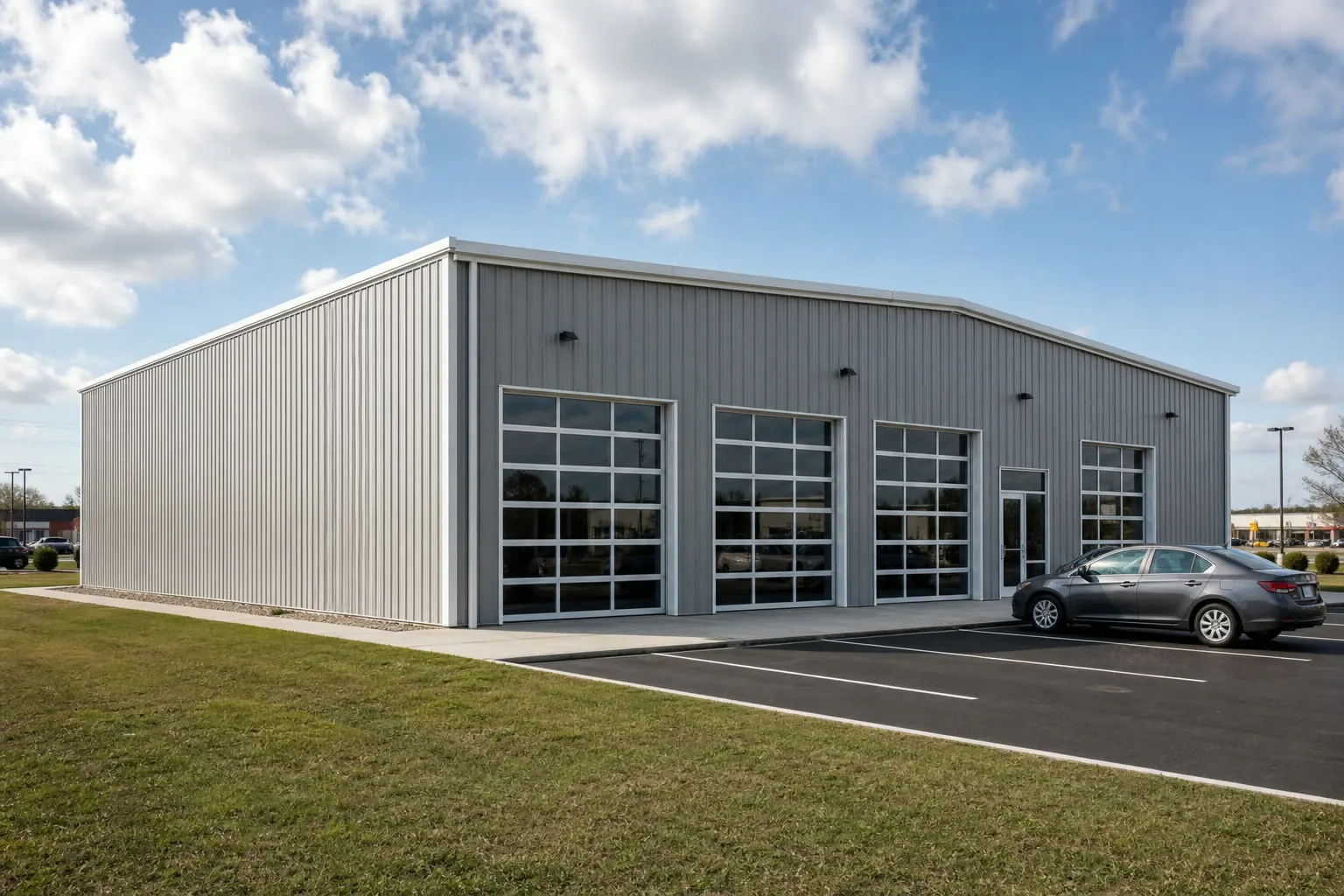
Confirm the Ground Before You Plan the Bays
In most states a repair shop's first planning question is layout. In Utah it's land status, because the Congressional Research Service's federal land ownership dataset shows federal acreage dominating the state's total land base. Add SITLA-managed state trust land — granted by Congress specifically to fund Utah schools and institutions rather than sold as open commercial ground — and a buyer can be looking at a parcel that reads as available but is administered under a different set of rules entirely. Settle that question first. Everything else on this page, from code path to climate zone, only matters once the parcel is confirmed as private, developable, commercially zoned land.
Land Status
What to Confirm Before You Commit to a Utah Parcel
These four checks separate a workable commercial site from a parcel that looks available but isn't.
Step 1
Verify the parcel is privately owned
Given how much of Utah's land base is federal per CRS data, don't assume adjacency to open land means the parcel itself is private and buildable.
Step 2
Ask whether the site borders or sits on SITLA trust land
Trust lands are managed by SITLA for school and institution funding, a distinct administrative track from ordinary county-zoned commercial parcels.
Step 3
Confirm commercial zoning with the local jurisdiction
A parcel can be private and still not zoned for a repair shop's occupancy class; check before committing to a layout.
Step 4
Ask your local department which code edition applies to your project
DOPL and the Uniform Building Code Commission coordinate one statewide structure under the State Construction and Fire Codes Act, but your local department still confirms the specific edition and any local amendments in force.
Code Structure
A Statewide Structure, Confirmed Locally
Utah's Division of Professional Licensing and Uniform Building Code Commission administer one statutory framework statewide, which is a more consistent commercial-permitting backdrop than a buyer moving from a fragmented state might expect.
The State Construction and Fire Codes Act, codified under Title 15A, is the statutory basis for how Utah administers construction codes, and DOPL works with the Uniform Building Code Commission to promote uniformity in enforcement across the state. For a repair shop owner, that means the code framework a jurisdiction works from doesn't reset entirely at every county line the way it can elsewhere.
That consistency is a structural fact, not a substitute for a local conversation. Occupancy classification, fire separation for a shop with fuel and fluids on site, ventilation requirements and inspection scheduling are still confirmed by the specific local building department handling your permit. Uniformity in the statutory framework does not mean every local amendment or interpretation is identical.
This page states none of those design values because none is sourced for a specific Utah jurisdiction. What we can say with confidence is that the framework itself is unusually centralized, which is worth knowing when a supplier or contractor tells you code requirements will vary wildly county to county in Utah the way they might in a state without this structure.
Get repair shop quotes for your Utah site
Give suppliers your confirmed parcel status, climate zone, and bay count. Quotes built without land status confirmed aren't comparable.
Site Zone
Once the Land Is Confirmed, Plan for the Zone
Utah is split into desert, steppe and highland climate zones, and a repair shop's ventilation, door placement and customer-space design should follow whichever zone the confirmed parcel sits in.
Desert zone (about a third of the state)
Dust and heat dominate the planning conversation: sealed parts storage, dust management around open bay doors, and cooling for customer space become the priority once the site is confirmed as buildable.
Steppe zone (the largest share of the state)
A wider swing between the site's summer and winter conditions than the desert zone experiences, which pushes toward a shop that handles both a hot dry season and a colder shoulder season without over-building for either extreme.
Highland/mountain zone (about a quarter of the state)
Elevation reaching toward Kings Peak's 13,528 feet at the state's high point changes what a shop needs from heated customer space and winter access; a shop planned for the desert zone would under-serve a highland site badly.
Footprints
Bay Counts for a Utah Repair Shop
Footprint choice should follow confirmed land status and zone, not the other way around; these are common starting points once both are settled.
40′ × 60′
2,400 sq ft
A two- to three-bay shop suited to a confirmed commercial parcel in a steppe-zone town or corridor.
50′ × 80′
4,000 sq ft
Four bays plus separated customer space, a common footprint on a larger confirmed private parcel.
60′ × 80′
4,800 sq ft
Adds an extra bay or interior storage, useful where a highland or desert site needs more indoor space per season.
Example Configuration — for planning purposes only.
Bay dimensions and lift clearances belong to the type page; occupancy and land-use questions belong to your local department and, where relevant, SITLA.
Evidence Position
What This Page Does Not Assert
No Utah wind speed, snow load, seismic category, code edition, permit threshold or price appears on this page.
The sourced Utah material used here is limited to a CRS federal land ownership dataset, SITLA's own description of its trust-land mandate, DOPL's description of its statutory framework and the Uniform Building Code Commission's role, and Utah Agriculture in the Classroom's description of the state's three climate zones. We hold no verified FEMA National Risk Index hazard enumeration for Utah's state profile, and we do not substitute a general claim for that gap.
A repair shop's fluid handling, drainage and fire-separation requirements are confirmed by your local building department under the statewide framework described above, not asserted here. Treat this page as the sequence to work through with your jurisdiction, not a substitute for that conversation.
Questions
Utah Auto Repair Shop Questions
What Utah shop owners ask that a general repair-shop page doesn't address.
Check the county recorder's records and confirm zoning with the local jurisdiction. Given how much of Utah's land base is federal per CRS data, don't assume open-looking land near your site is buildable, and check separately whether SITLA-administered trust land borders or overlaps the parcel.
SITLA is Utah's Trust Lands Administration; it manages land granted by Congress to fund schools and institutions. That land is administered on a different track from ordinary county-zoned commercial parcels, so confirm status with SITLA if your site is adjacent to or historically part of trust land.
The statutory framework under DOPL and the Uniform Building Code Commission is unusually consistent statewide, but your local building department still confirms the specific edition, amendments and inspection process for your jurisdiction.
It changes ventilation strategy, bay-door placement and how much heated customer space is worth building, since dust and heat dominate desert-zone planning while elevation and cold shoulder seasons dominate highland-zone planning.
Not automatically. A repair shop is a commercial occupancy regardless of surrounding land use, and the statewide code framework and local zoning review still apply to a shop near farmland the same way they apply to one in a city.
Pricing is delegated to the cost silo. The Utah-variable drivers are land-status confirmation time, zone-specific ventilation and heating choices, and local permitting timelines.
Sources for the Utah facts on this page
This page states no code requirement, wind speed, snow load, permit rule, price or supplier claim. The state-specific facts it does use are listed with their publisher below.
CRS's federal land ownership dataset lists Utah federal acreage at roughly 33.3 million acres (2013 data) against total state acreage of approximately 33.6 million acres.
Congressional Research Service · data as of FY2013, report dated March 3, 2017 · Tier 1
https://www.everycrsreport.com/files/20170303_R42346_95ce191e74ed8e08054bb5476971544bc55823f2.htmlUtah's School and Institutional Trust Lands Administration (SITLA/Trust Lands Administration) manages state trust land granted by Congress to benefit Utah schools and institutions.
Utah Trust Lands Administration (SITLA) · current, accessed 2024 · Tier 2
https://trustlands.utah.gov/Utah's Division of Professional Licensing (DOPL), within the Department of Commerce, administers the Uniform Building Standards Act and works with the Uniform Building Code Commission to promote statewide uniformity in code enforcement.
Utah Department of Commerce, Division of Professional Licensing · current, accessed 2024/2025 · Tier 2
https://commerce.utah.gov/dopl/uniform-building-codes/Utah's State Construction and Fire Codes Act (Title 15A) is the statutory basis for state construction code administration, referencing the Division of Professional Licensing.
Utah State Legislature / Utah State Fire Marshal (hosted copy) · current codified statute · Tier 2
https://firemarshal.utah.gov/wp-content/uploads/2024-State-Fire-Code.pdfUtah has three distinct climate zones: desert (33% of the state), steppe (43%), and highland/mountain (24%), reflecting the valley-to-mountain precipitation and snowfall contrast.
Utah Agriculture in the Classroom · current reference sheet · Tier 3
https://cdn.agclassroom.org/ut/lessons/cc/ut_elevation_precip_maps.pdf