
Auto repair shop · MD
Auto Repair Shops in Maryland
An auto repair shop is a commercial occupancy wherever it is built, but in Maryland that occupancy sits on top of a state with genuinely different ground underfoot depending on where the parcel is. The Maryland Geological Survey names three physiographic provinces — the Atlantic Coastal Plain, the Piedmont, and the combined Blue Ridge, Valley and Ridge, and Appalachian Plateau country to the west — and each behaves differently for a commercial slab, bay layout and site drainage plan. Maryland's 24 jurisdictions each administer their own commercial building and zoning review, and the state authorized 16,823 new privately-owned housing units in 2024, a signal of steady population growth that shapes where a repair shop finds its customer base. This page covers what changes about the building and the site, not how to run a shop.
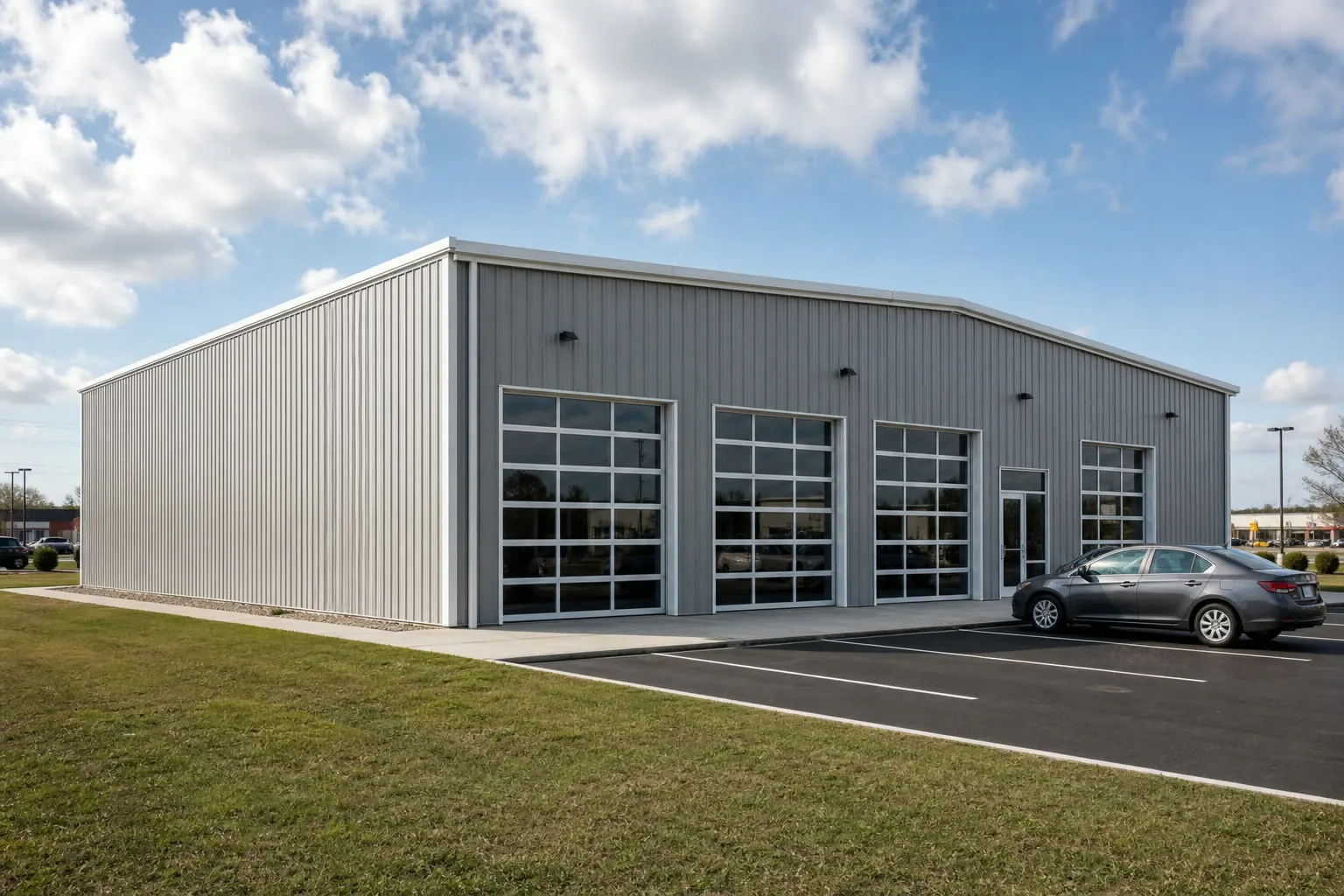
Design the Site Around Maryland's Terrain, Not Just the Building
A repair shop's bay layout and lift clearances do not change because the site is in Maryland. What changes is the ground the pad sits on and who reviews the project. The Maryland Geological Survey describes the state as spanning three distinct physiographic regions from the Atlantic coast to the western mountains, and Maryland's 24 jurisdictions each administer their own commercial building and zoning review rather than routing through one statewide office. A shop plan that assumes flat, easy Coastal Plain ground will need real revision on a Piedmont or western-county site, and vice versa.
Site Strategy
Terrain and Drainage Are the Maryland Decisions
In a Maryland repair shop, grading and floor drainage depend on which physiographic province the parcel sits in, and where fluids ultimately go is a local regulatory question this page will not answer for you.
On the Atlantic Coastal Plain, flat, sandy ground is generally the easiest of Maryland's three provinces to grade for a commercial pad. That ease comes with a caveat: sandy soil and a shallow water table in some Eastern Shore and southern Maryland locations mean floor drainage and fluid containment need real attention rather than an assumption that flat ground drains itself.
In the Piedmont, which covers much of central Maryland including the Baltimore-Washington corridor, rolling terrain and clay-heavy soils shift the site question toward slope management and stormwater runoff rather than water table depth. A shop pad here typically needs more grading work but faces less risk of standing groundwater under the slab.
In Maryland's western mountain counties, spanning the Blue Ridge and the Valley and Ridge and Appalachian Plateau provinces named by the Maryland Geological Survey, steeper terrain and longer access roads are the dominant site variables. Excavation and access planning deserve attention earlier in the process here than in the state's flatter provinces.
Where shop floor fluids and drainage ultimately discharge is a regulatory question with real consequences, and it is one this page will not answer for you. We hold no sourced Maryland-specific rule on floor-drain discharge or oil-water separators, and inventing one would be worse than useless. Put the question to your local jurisdiction and the Maryland Department of the Environment early, because the answer can change the slab layout, not just the plumbing.
BWI-area NOAA climate normals show roughly 44-46 inches of annual precipitation spread fairly evenly across the year, rather than concentrated in a short wet season. That pattern argues for a site drainage plan built around routine year-round wet weather, not a single storm event.
Site Context
How Maryland's Three Provinces Change a Shop Site
The Maryland Geological Survey's province split matters for a repair shop's pad, drainage and access just as much as it does for any other commercial building.
Atlantic Coastal Plain
Flat, sandy terrain across the Eastern Shore and southern Maryland; easy grading, but confirm water table depth and floor drainage before finalizing the slab.
Piedmont
Rolling terrain through central Maryland and the Baltimore-Washington corridor; stormwater management and slope grading are the main site cost drivers.
Western mountain provinces
Blue Ridge, Valley and Ridge, and Appalachian Plateau country; steeper grades and longer access roads make excavation and delivery logistics the early planning priority.
Get repair shop quotes for your Maryland site
Tell us your county, which physiographic province your parcel sits in, and your bay count. We route it with the Maryland and repair shop context already attached.
Layout
Maryland Site and Approval Steps Worth Confirming Early
These are the state-conditioned steps where a Maryland shop project diverges from a generic commercial build.
Step 1
Confirm your jurisdiction's commercial review process
Each of Maryland's 24 jurisdictions administers its own zoning and building review; find out which county or municipal office owns your approval before finalizing a plan.
Step 2
Name your physiographic province
Coastal Plain, Piedmont or the western mountain provinces each change the site-prep scope; telling your builder which one applies helps the site conversation start correctly.
Step 3
Resolve fluid handling and drainage with the state environmental agency
Oil-water separation and floor-drain discharge are Maryland Department of the Environment and local questions, not something a shell quote answers.
Step 4
Plan the floor for year-round wet weather
BWI-area precipitation normals run 44-46 inches spread evenly through the year, which favors a drainage plan built for routine rain rather than one storm season.
Footprints
Bay Counts That Fit a Maryland Shop Brief
Maryland shops typically size around local customer density and jurisdiction-specific parking requirements rather than a single statewide pattern.
40′ × 60′
2,400 sq ft
A two- to three-bay shop suited to a suburban or exurban Maryland lot.
50′ × 80′
4,000 sq ft
Four bays plus separated customer space and parts storage — a common independent-shop footprint.
60′ × 80′
4,800 sq ft
Adds a wash or additional service bay for higher-volume Baltimore-Washington corridor locations.
Example Configuration — for planning purposes only.
Bay dimensions and lift clearances belong to the type page; occupancy requirements come from your local jurisdiction.
Evidence Position
What We Do Not Assert
No Maryland code edition, permit threshold, environmental rule, structural design value or price appears on this page.
The sourced Maryland material used here is limited to the Maryland Geological Survey's three-province description, BWI-area NOAA precipitation normals, U.S. Census Bureau housing authorization figures, and FEMA's National Risk Index reference to Maryland's 24 jurisdictions — the last of which matters only as confirmation that commercial review is handled locally.
Repair shops carry more regulatory surface than almost any building in this catalogue: occupancy classification, fire separation, ventilation, fluid handling and disposal. Every one of those is answered by a Maryland local authority for your specific site, and a supplier quoting a shell has not answered any of them.
Questions
Maryland Auto Repair Shop Questions
What Maryland shop owners ask that a general repair-shop page cannot answer.
No. Maryland's 24 jurisdictions each administer their own commercial building and zoning review. Confirm the specific county or municipal process for your parcel before finalizing a plan.
It affects site-prep cost more than eligibility. The Maryland Geological Survey names three physiographic provinces, and Coastal Plain, Piedmont and western mountain sites each bring different grading, drainage and access considerations.
By design, confirmed locally. Slope the slab to a defined collection point and confirm with your local jurisdiction and the Maryland Department of the Environment what your drains may discharge. We do not publish those rules because we hold no sourced Maryland figure for them.
Permit requirements depend on your specific jurisdiction and site. That is a question for your local building department, not something this page can answer generically.
Pricing is delegated to the cost silo. The Maryland-variable drivers are site grading by province, the drainage detail, and local approval requirements.
Sources for the Maryland facts on this page
This page states no code requirement, wind speed, snow load, permit rule, price or supplier claim. The state-specific facts it does use are listed with their publisher below.
The Maryland Geological Survey describes the state as spanning three distinct physiographic regions -- the Coastal Plain, the Piedmont, and the combined Blue Ridge, Valley and Ridge, and Appalachian Plateau provinces -- extending from the Atlantic coast to the western mountains.
Maryland Geological Survey · MGS reference material · Tier 2
https://www.mgs.md.gov/geology/geology_of_maryland.htmlBuilders in Maryland were authorized to construct 16,823 new privately-owned housing units in 2024, of which 10,885 were single-unit structures.
U.S. Census Bureau · 2024 (final annual estimates) · Tier 1
https://www.census.gov/construction/bps/stateannual.htmlFEMA's National Risk Index is the federal tool for county- and state-level natural hazard exposure data for Maryland's 24 jurisdictions, covering 18 hazard types including coastal flooding, hurricane, and winter weather.
Federal Emergency Management Agency (FEMA) · Current NRI release · Tier 1
https://www.fema.gov/flood-maps/products-tools/national-risk-indexThe BWI Airport (Baltimore/Annapolis area) NOAA 1991-2020 climate normals show total annual precipitation of roughly 44-46 inches spread fairly evenly across the year.
NOAA National Centers for Environmental Information (NCEI) · 1991-2020 · Tier 1
https://www.ncei.noaa.gov/access/services/data/v1?dataTypes=MLY-TMAX-NORMAL%2CMLY-TMIN-NORMAL%2CMLY-TAVG-NORMAL%2CMLY-PRCP-NORMAL%2CMLY-SNOW-NORMAL&dataset=normals-monthly-1991-2020&format=pdf&stations=USW00013752