
Pole barn · MI
Pole Barns in Michigan
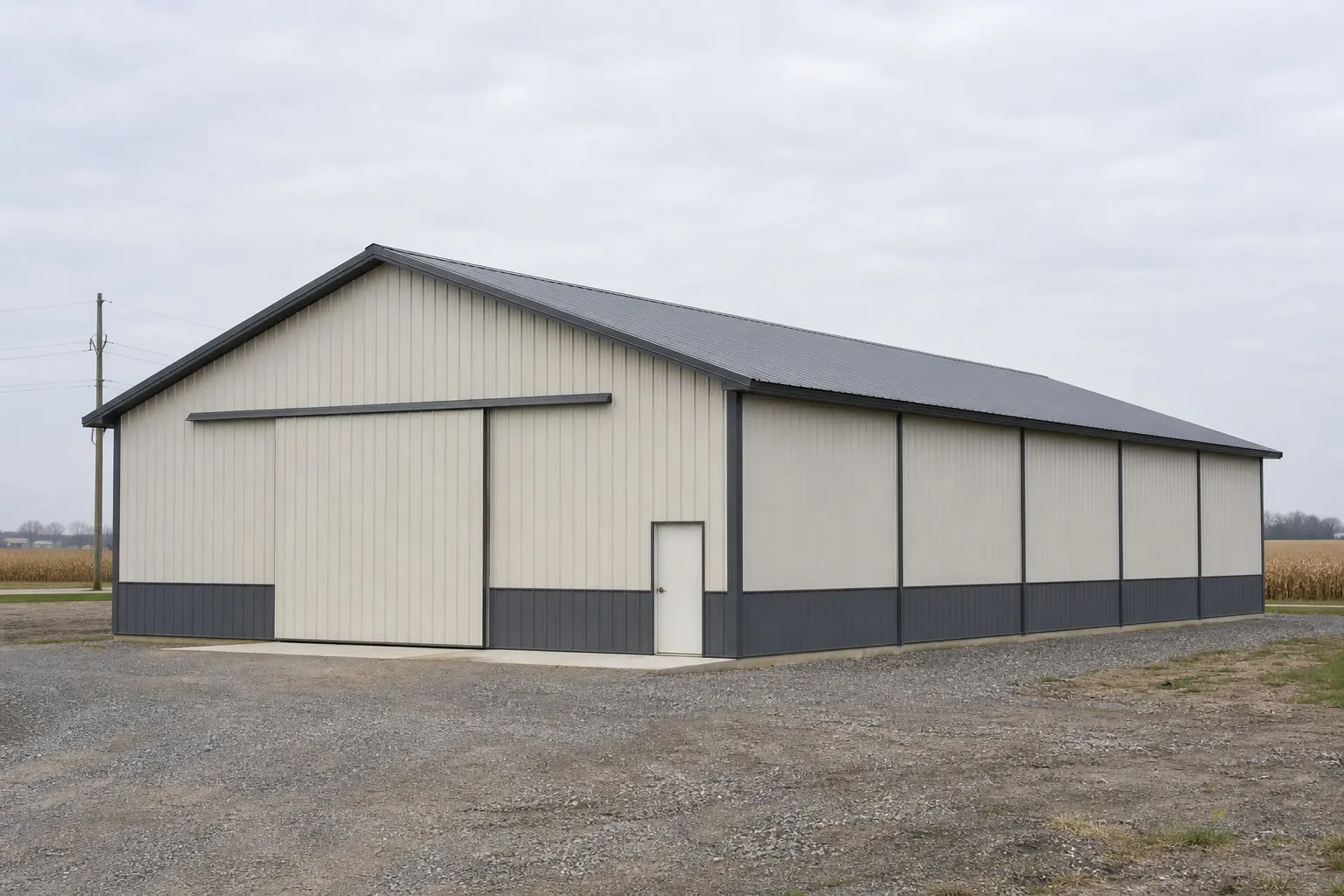
The Michigan pole barn buyer is managing land across two peninsulas and thousands of square miles of hydrologic variation. With 45,581 farms averaging 208 acres each, the need for flexible, high-utility equipment storage is the dominant driver of pole-barn planning. Because Michigan's permitting is decentralized, successful planning starts with identifying the local municipal authority in your specific county, rather than seeking a single statewide pole-barn rulebook.
Geography
Why Michigan pole barn planning is regional
The needs of a farm in the Upper Peninsula differ from those in the Lower Peninsula.
In Michigan, geography determines site utility. A pole barn built for a northern Michigan farming operation often deals with different snowfall and soil-moisture profiles than one in the southern counties. Identifying your parcel's hydrologic province is the best first step to ensuring your structure is properly founded. The two-peninsula geography isn't just a map feature; it defines the logistics of your build. Sourcing materials in the Upper Peninsula can be more complex than in the more populated Lower Peninsula, often requiring longer lead times for specialized steel components.
Since agricultural land management is a primary driver here, the most effective planning involves aligning your building's footprint with the specific machinery needs of your operation. With 45,581 farms, Michigan has a deep tradition of post-frame construction, but modern requirements for heavy-duty storage have evolved. A 208-acre average farm size suggests that many sites have ample room for large-span structures, but siting must account for historical land use. Old agricultural tiling can impact drainage, and proximity to the Great Lakes means addressing lake-effect moisture patterns early in the design.
The climate data from Detroit Metro Airport shows roughly 35 inches of annual precipitation, but this varies significantly as you move toward the lake-effect zones. For a pole barn, this means moisture management is as important as snow load. Uninsulated metal buildings in Michigan are prone to internal condensation (commonly called 'sweating') during the rapid temperature shifts seen in spring and fall. Using high-quality vapor barriers or specialized drip-stop coatings on the roof panels is a standard Michigan practice to protect stored machinery from dripping moisture.
Furthermore, the decentralized nature of Michigan's building oversight means that your local township official (TBO) is your most important contact. While the Michigan Building Code provides the baseline, local interpretations regarding post-frame foundations (such as the use of concrete piers versus continuous footings) can vary. A plan that is approved in Lapeer County might require modifications in Grand Traverse County. This local variance is a hallmark of the Michigan building landscape and should be addressed before any ground is broken.
Siting
Managing your Michigan site prep
Ground conditions and winter access are the primary site-planning hurdles for Michigan pole barns.
Michigan's soil diversity is a direct result of its glacial history. When planning a pole barn, you must account for the hydrologic province of your site. In the sandy regions of the western Lower Peninsula, drainage is rapid, which simplifies foundation work but may require deeper post holes to reach stable ground. Conversely, the heavy clay soils found in the Thumb region retain moisture, necessitating robust gravel pads and curtain drains to keep the building's interior dry. Without proper site prep, a Michigan pole barn can suffer from frost heave, which can rack the frame and cause doors to misalign.
Access is the second critical component of Michigan site planning. On a typical 208-acre farm, the pole barn is often sited well away from the main road for operational convenience. However, this creates a long-term maintenance challenge during the winter months. Siting the building with a southern exposure can help with natural snow melt around the large overhead doors, while positioning the driveway to take advantage of prevailing winds can reduce snow drifting. In a state that sees significant annual snowfall, these small siting decisions can save hundreds of hours of tractor work over the life of the building.
Finally, don't overlook the impact of the Great Lakes on your site's microclimate. Sites within a few miles of the coast experience higher humidity levels and more frequent light precipitation events. For a pole barn, this means your choice of fasteners and protective coatings is more critical. Using stainless steel or high-grade galvanized fasteners can prevent the premature corrosion that often plagues metal buildings in coastal Michigan counties. This is a level of detail that generic planning guides often miss but is essential for Michigan owners.
- Soil Analysis
- Check your local USGS hydrologic province to determine if you are building on clay, sand, or glacial till.
- Winter Orientation
- Orient large doors away from prevailing winter winds to minimize snow accumulation in front of the building.
- Drainage Infrastructure
- Ensure your site plan includes adequate perimeter drainage to handle Michigan's heavy spring melt.
Trends
The evolution of the Michigan farm barn
Pole barns are shifting from simple storage to multi-use agricultural hubs as Michigan farm sizes stabilize.
The shift in Michigan agriculture—evidenced by the slight decrease in the number of farms to 45,581—has led to a consolidation of resources. The modern Michigan pole barn is often larger and more complex than its predecessors, serving as a combination of equipment storage, workshop, and even office space. This multi-use trend requires a more sophisticated approach to insulation and lighting. A building that will be occupied for long hours in January needs more than just a metal shell; it needs a thermal envelope that can handle Michigan's sub-zero temperatures efficiently.
Another trend is the integration of larger equipment. As Michigan farms average 208 acres, the machinery used is often quite large, requiring clear-span widths and tall eave heights that were once reserved for industrial buildings. Planning for these spans in Michigan means paying close attention to the truss engineering, especially when considering the potential for heavy snow loads and ice storms. FEMA's hazard data reminds us that ice is a recurring threat in Michigan, and the weight of ice on a large-span roof can be catastrophic if the trusses aren't designed for it.
Finally, there is a growing awareness of the environmental impact of these large structures. Many Michigan owners are now incorporating rainwater collection systems or solar panels into their pole barn designs. The state's ample freshwater resources are a point of pride, and managing the runoff from a large metal roof is an important part of being a good steward of the land. Whether it's directing water to a retention pond or using it for livestock, the way you handle water on your Michigan site is a key part of the modern planning process.
Michigan Pole Barn Quotes
Request quotes for your specific Michigan location.
Footprints
Pole Barn Footprints Suited to Michigan Parcels
Michigan's mix of large farm parcels and rural residential lots pushes buyers toward wide, tall clear spans rather than compact footprints.
30′ × 40′
1,200 sq ft
A starter equipment barn for a single tractor and implements, sized to stay under many townships' simpler accessory-structure review.
40′ × 60′
2,400 sq ft
The common Michigan farm-utility footprint: clear-span equipment storage with room for a workbench wall.
60′ × 100′
6,000 sq ft
A commercial-scale ag or multi-use barn for larger machinery, sized for the 208-acre-average Michigan farm parcel.
Example Configuration — for planning purposes only.
Truss engineering and clear-span limits depend on your local snow-load and wind values; confirm them before finalizing a footprint.
Before you order
A buyer checklist for a Michigan pole barn
Michigan's township-level zoning, frost depth and lake-effect exposure vary enough that a few confirmations up front prevent expensive redesigns.
- Confirm township zoning before you size the buildingMichigan permitting sits largely with townships rather than a single county desk, so setbacks, accessory-structure limits and driveway approach rules differ across a short distance. Check with the township office that governs your parcel before you commit to a footprint.
- Get the frost depth and soil bearing for your parcelPost embedment depends on local frost depth and on whether your ground is glacial sand, clay or organic soil. Sandy northern sites drain well but hold posts differently than the heavier clays across the southern tier, and that changes post diameter, concrete collar and pad detailing.
- Ask your supplier to engineer to your site's design figuresConfirm with your local building department which design wind and snow figures apply, then have the truss and bracing package engineered against those numbers rather than a catalog default. Lake-effect belts near Lake Michigan and Lake Superior sit under a different exposure picture than inland farmland.
- Decide on winter occupancy before framingA barn that will be worked in during January needs a condensation strategy, insulated envelope and heat plan designed in from the start. Adding a thermal envelope to an uninsulated shell after the fact costs far more than specifying it during the original order.
FAQ
Michigan Pole Barn Questions
Practical answers for Michigan land owners.
This depends entirely on your local frost depth and soil type. While 48 inches is a common starting point in many Michigan counties, your local building official and a site-specific soil test are the only ways to be sure.
In many Michigan jurisdictions, agricultural buildings are exempt from certain zoning rules but still require structural permits. You must verify your status with your local township or county office.
It is possible, but much more difficult. If you plan to use the building in the Michigan winter, installing a vapor barrier and planning for insulation during the initial build is much more cost-effective.
Sites within a few miles of the coast see sustained higher humidity, which accelerates ordinary fastener corrosion. Many Michigan coastal-zone owners upgrade to stainless or higher-grade galvanized fasteners for this reason.
Expect a shorter construction season, longer freight distance from southern-Michigan fabrication, and local design values that diverge from the Detroit-area baseline. Book your foundation work early in the season.
Sources for the Michigan facts on this page
This page states no code requirement, wind speed, snow load, permit rule, price or supplier claim. The state-specific facts it does use are listed with their publisher below.
Michigan had 45,581 farms in 2022, down from 47,641 in 2017.
USDA National Agricultural Statistics Service (NASS) · 2022 (with 2017 comparison) · Tier 1
https://www.nass.usda.gov/Publications/AgCensus/2022/Full_Report/Volume_1,_Chapter_1_State_Level/Michigan/st26_1_001_001.pdfUSGS describes Michigan as consisting of two peninsulas -- the Upper Peninsula and Lower Peninsula, separated by the Straits of Mackinac -- and notes it is the only U.S. state touching four of the five Great Lakes, giving it the longest freshwater coastline in the country.
U.S. Geological Survey · 2021 · Tier 1
https://pubs.usgs.gov/publication/fs20213047USGS Water-Resources Investigations Report 91-4120 delineates named hydrologic provinces across Michigan's Upper and Lower Peninsulas, prepared in cooperation with the Michigan DNR Geological Survey Division.
U.S. Geological Survey, in cooperation with Michigan Dept. of Natural Resources · 1991 · Tier 1
https://pubs.usgs.gov/wri/1991/4120/report.pdfDetroit Metro Airport's NOAA 1991-2020 climate normals show total annual precipitation of roughly 34-35 inches, with January and February mean snowfall near 12-14 inches each.
NOAA National Centers for Environmental Information (NCEI) · 1991-2020 · Tier 1
https://www.ncei.noaa.gov/access/services/data/v1?dataset=normals-monthly-1991-2020&format=pdf&stations=USW00094847FEMA's National Risk Index is the federal tool for county- and state-level natural hazard exposure data for Michigan's 83 counties, covering 18 hazard types including winter weather, ice storm, and severe/strong wind.
Federal Emergency Management Agency (FEMA) · Current NRI release · Tier 1
https://www.fema.gov/flood-maps/products-tools/national-risk-index