
Hobby shop · MI
Hobby Shops in Michigan
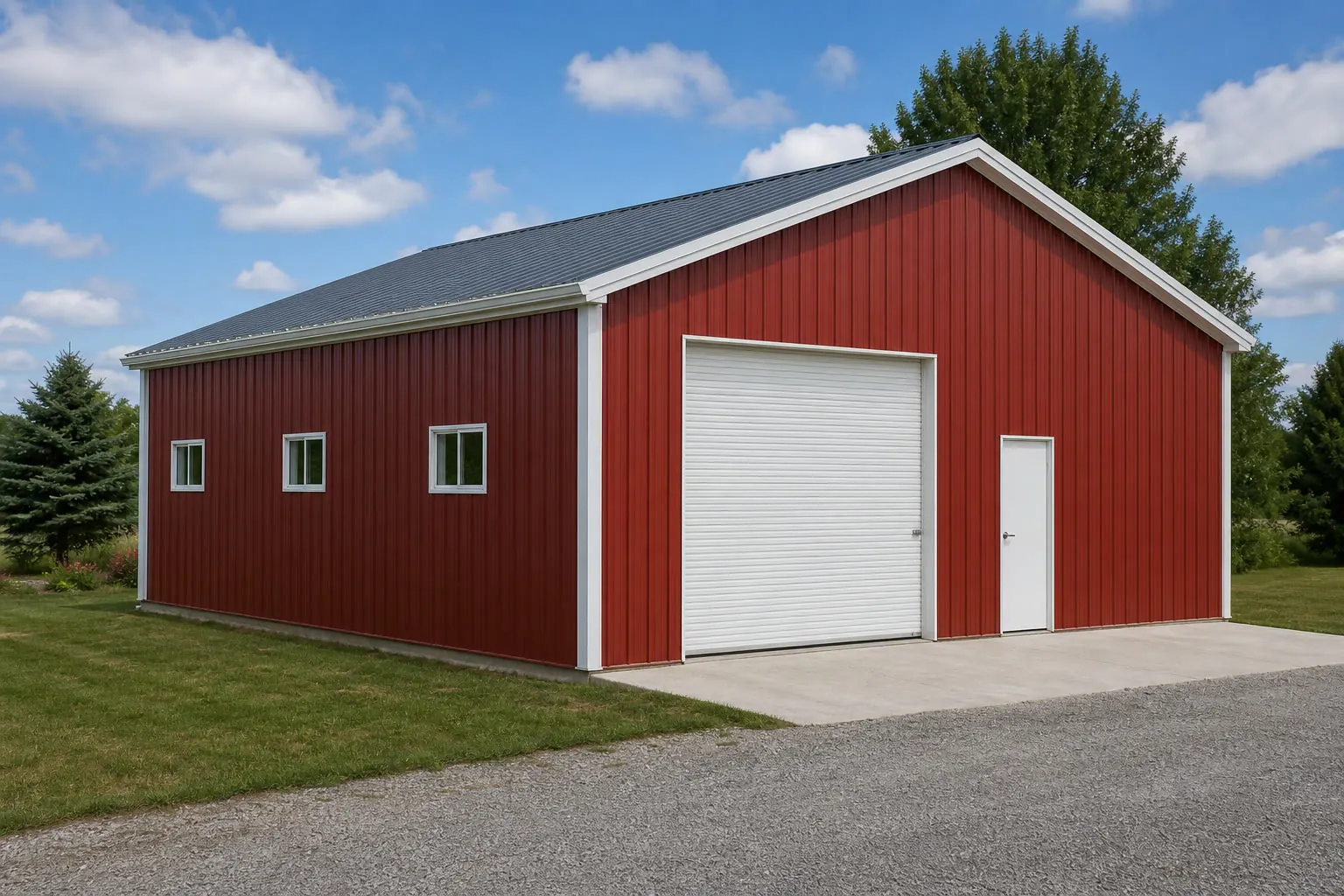
A hobby shop in Michigan needs to function year-round, which makes climate-resistant envelope design and local code compliance the top planning priorities. From the snow-heavy Upper Peninsula to the varied southern regions, your site location will drive your foundation and material requirements. Start by coordinating your site plan with your local building jurisdiction.
Climate
Building for a four-season hobby shop
Michigan winters demand more than standard hobby shop construction.
A Michigan hobby shop is often more than just a storage building; it's a sanctuary during the long winter months. However, making a steel building comfortable in January requires a sophisticated approach to the thermal envelope. The data from Detroit Metro Airport shows roughly 35 inches of annual precipitation, but the real challenge is the extreme temperature fluctuation. For a hobby shop, this means you must address both insulation and ventilation. Using closed-cell spray foam is a popular Michigan choice because it provides a high R-value and acts as an air seal, preventing the cold Michigan wind from whistling through the building's joints.
FEMA's hazard data for Michigan identifies ice storms and winter weather as significant risks for all 83 counties. For a hobby shop, this means your roof design is critical. A standing-seam metal roof is often preferred in Michigan because it handles the expansion and contraction of ice more effectively than a screw-down roof. Additionally, you should consider the placement of your shop's entry. Locating your main door on the side of the building that receives the most sun can help keep the area clear of ice and snow, while avoiding the north-facing side can reduce the amount of heat lost every time the door is opened.
Ventilation is the final piece of the climate puzzle. In a tightly sealed, insulated Michigan hobby shop, indoor air quality can quickly degrade, and humidity can build up from activities like woodworking or automotive repair. Installing a Heat Recovery Ventilator (HRV) is a smart way to bring in fresh air without losing all your expensive heat. This is especially important in the humid Great Lakes environment, where moisture management is a year-round battle. A dry, well-ventilated shop is not only more comfortable to work in but also protects your tools and projects from the rust and mold that a damp Michigan winter can cause.
Engineering
Groundwork in the two peninsulas
Michigan's diverse geography and hydrologic provinces dictate your hobby shop's foundation strategy.
Michigan's two-peninsula structure means that the ground you are building on can vary wildly. If you are in one of the state's sandy hydrologic provinces, your site will drain well, but you may need to go deeper to find stable soil. In the clay-heavy provinces of the southern Lower Peninsula, you'll need to focus on preventing frost heave. Because the frost line in Michigan can reach four feet deep in some northern areas, a simple slab-on-grade may not be sufficient for a high-end hobby shop. Many Michigan owners opt for a thickened-edge slab or even a full frost-wall foundation to ensure the building doesn't move during the seasonal freeze-thaw cycles.
Siting your hobby shop on a typical Michigan 208-acre parcel gives you plenty of options, but you must consider the long-term logistics. How will you get power and water to the site? In Michigan, utilities must be buried deep to avoid freezing, which can add significant cost to your project if the shop is located far from the main house. Additionally, you must ensure that your site plan complies with local township zoning. While Michigan is generally building-friendly, with 21,750 units authorized in 2024, every municipality has its own rules about how close a detached building can be to the property line or how tall it can be.
Don't forget to account for Michigan's 'fifth season'—mud season. During the spring thaw, the ground in many Michigan counties becomes incredibly soft and saturated. If your hobby shop doesn't have a properly engineered gravel or asphalt approach, you may find yourself unable to access the building for several weeks each year. Investing in a robust sub-base for your driveway and around the building's perimeter is a practical Michigan-specific step that will pay dividends every spring. This is part of the 'hydrologic' planning that USGS data emphasizes for the state.
- Frost Line Awareness
- Check with your local building department for the exact frost depth requirement in your Michigan township.
- Drainage Infrastructure
- Use French drains or perimeter tiling in clay-rich provinces to protect your foundation from hydrostatic pressure.
- Utility Trenching
- Ensure all water lines are buried at least 12 inches below the local frost line to prevent winter freezing.
Usage
Designing for your Michigan hobby
Whether it's for cars, wood, or boats, your shop should reflect Michigan's recreational culture.
Michigan has a deep connection to the automotive industry, and many hobby shops here are designed for car restoration. This requires thinking about floor strength and clearance. A reinforced concrete slab that can handle the weight of a two-post or four-post lift is a common requirement. Additionally, you'll want to ensure you have enough vertical clearance—typically 12 to 14 feet—to fully raise a vehicle. Given the high humidity of the Great Lakes region, installing a high-quality floor coating (like polyaspartic or epoxy) is a smart way to protect the concrete from the salt and moisture that will inevitably be tracked in during the Michigan winter.
For woodworkers, the Michigan hobby shop presents a different set of challenges. Wood is sensitive to humidity changes, which are extreme in Michigan. A shop that is bone-dry in January but humid in July can cause wood to warp and crack. This makes a consistent climate-control system even more important. Many Michigan woodworkers also integrate dust collection systems that exhaust to the outside, but you must ensure that your system doesn't create a negative pressure that pulls cold air into the building. A 'make-up air' system is a sophisticated but necessary addition for a serious Michigan wood shop.
Lastly, many Michigan hobbyists use their shops for boat maintenance and storage. With the longest freshwater coastline in the country, this is a natural fit. Planning for a boat means having a door that is wide enough and tall enough to accommodate a trailer. A 12-foot wide door is often the minimum for modern watercraft. Also, consider adding a floor drain (if local code allows) to handle the water that will drip off the boat after a day on the lake or during a spring cleaning. These small design choices make your Michigan hobby shop a truly functional and valuable part of your property.
Hobby Shop Quotes
Request quotes tailored to your Michigan project.
Before You Order
Michigan Hobby Shop Planning Checklist
Confirm these locally before finalizing a floor plan; none of them are set by a single statewide rule.
Step 1
Verify the frost-wall or thickened-slab requirement with your township
Michigan's frost line varies by hydrologic province, so the foundation detail that satisfies one county's building department can be undersized in another.
Step 2
Plan utility trenching depth before the site plan is finalized
Water and power lines run to a detached hobby shop must be buried below the local frost line, which adds cost the farther the shop sits from the house on a large Michigan parcel.
Step 3
Size the concrete slab for your intended lift or equipment
A vehicle lift or heavy woodworking machinery needs a reinforced slab spec confirmed against manufacturer load requirements, not a generic garage floor.
Step 4
Build in a make-up air path if you add dust collection
An exhausting dust collector in a tightly sealed Michigan shop can pull cold outside air back in through gaps unless a dedicated make-up air inlet is planned.
Footprints
Hobby Shop Footprints Common in Michigan
Michigan hobbyists tend to size a shop around a specific vehicle, boat, or workbench wall rather than open storage alone.
24′ × 30′
720 sq ft
A single-project car or woodworking bay with room for a workbench wall, common on suburban Lower Peninsula lots.
30′ × 40′
1,200 sq ft
Enough clearance for a two-post lift plus a dedicated finishing or dust-collection area.
40′ × 60′
2,400 sq ft
A boat-and-vehicle combination shop suited to a rural Michigan parcel with room for wide doors.
Example Configuration — for planning purposes only.
Confirm your township's detached-structure height and setback limits before selecting a footprint.
FAQ
Michigan Hobby Shop FAQ
Practical answers for Michigan hobbyists.
Radiant floor heat is highly efficient and comfortable, but overhead infrared or forced-air heaters are more common due to their lower installation cost.
For a simple steel building, a qualified contractor and engineered plans from the manufacturer are often enough, but check with your local building department for their requirements.
A combination of proper insulation, a vapor barrier, and a dedicated dehumidifier or ERV system is the most effective approach.
It depends on your local frost depth, which varies by hydrologic province and can run deeper in the north than near Detroit. Confirm the figure with your township before the foundation is designed.
Yes, but the concrete slab must be specified for the lift's load rating, and you'll want at least 12 to 14 feet of clearance to fully raise most vehicles.
Sources for the Michigan facts on this page
This page states no code requirement, wind speed, snow load, permit rule, price or supplier claim. The state-specific facts it does use are listed with their publisher below.
FEMA's National Risk Index is the federal tool for county- and state-level natural hazard exposure data for Michigan's 83 counties, covering 18 hazard types including winter weather, ice storm, and severe/strong wind.
Federal Emergency Management Agency (FEMA) · Current NRI release · Tier 1
https://www.fema.gov/flood-maps/products-tools/national-risk-indexUSGS describes Michigan as consisting of two peninsulas -- the Upper Peninsula and Lower Peninsula, separated by the Straits of Mackinac -- and notes it is the only U.S. state touching four of the five Great Lakes, giving it the longest freshwater coastline in the country.
U.S. Geological Survey · 2021 · Tier 1
https://pubs.usgs.gov/publication/fs20213047USGS Water-Resources Investigations Report 91-4120 delineates named hydrologic provinces across Michigan's Upper and Lower Peninsulas, prepared in cooperation with the Michigan DNR Geological Survey Division.
U.S. Geological Survey, in cooperation with Michigan Dept. of Natural Resources · 1991 · Tier 1
https://pubs.usgs.gov/wri/1991/4120/report.pdfDetroit Metro Airport's NOAA 1991-2020 climate normals show total annual precipitation of roughly 34-35 inches, with January and February mean snowfall near 12-14 inches each.
NOAA National Centers for Environmental Information (NCEI) · 1991-2020 · Tier 1
https://www.ncei.noaa.gov/access/services/data/v1?dataset=normals-monthly-1991-2020&format=pdf&stations=USW00094847Michigan had 9,472,069 acres of land in farms in 2022, an average farm size of 208 acres.
USDA NASS · 2022 · Tier 1
https://www.nass.usda.gov/Publications/AgCensus/2022/Full_Report/Volume_1,_Chapter_1_State_Level/Michigan/st26_1_001_001.pdfBuilders in Michigan were authorized to construct 21,750 new privately-owned housing units in 2024, of which 15,045 were single-unit structures.
U.S. Census Bureau · 2024 (final annual estimates) · Tier 1
https://www.census.gov/construction/bps/stateannual.html