
Storage building · AL
Storage Buildings in Alabama
A personal storage building in Alabama is usually a small, single-owner structure on a residential or small-acreage lot, and the two things that change it from one Alabama site to the next are moisture and ground. NOAA National Centers for Environmental Information describes Alabama's climate as humid subtropical, with mild winters, hot humid summers, and precipitation shaped by Gulf of Mexico influence, which makes ventilation and moisture protection worth planning for regardless of where in the state you build. The ground underneath varies too: the Alabama Cooperative Extension System maps seven major soil areas statewide, including the dense clay of the Black Belt prairie and the sandier Coastal Plain, which is worth mentioning to whoever prepares your pad. Alabama recorded 20,337 total housing units authorized by building permits in 2023, up 4.3% from 2022, a reasonable signal that residential-adjacent construction, including accessory storage buildings, is an active category statewide rather than a shrinking one.
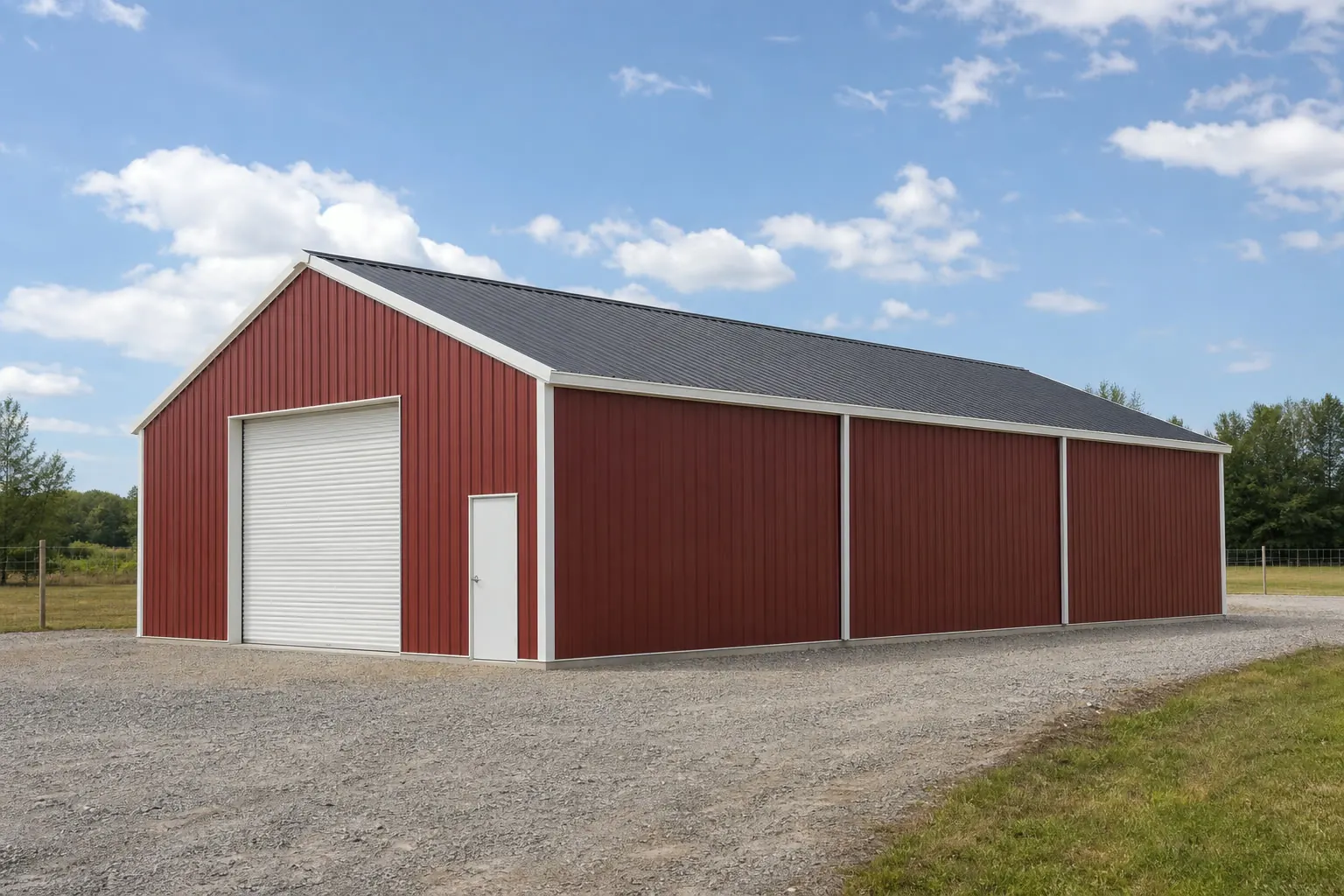
The intersection
In Alabama, humidity and soil shape a personal storage building
A small storage building's main planning variables in Alabama are moisture control from the state's humid subtropical climate and ground condition from its varied soil map.
NOAA's narrative 'Climate of Alabama' describes the state as humid subtropical, with mild winters and hot, humid summers, and precipitation influenced by the Gulf of Mexico. That framing does not give this page a single statewide rainfall number, but it does explain why ventilation and a moisture barrier are worth planning for in a small storage building regardless of exactly where in Alabama it sits — whatever you plan to keep inside, from tools to documents to seasonal equipment, is exposed to that humidity pattern.
Station-level NOAA data for Birmingham Airport's 1991-2020 climate normals give one concrete look at temperature, precipitation and degree-day patterns for the Birmingham area specifically, which is a reasonable proxy for interior north-central Alabama conditions but not a substitute for checking your own area's typical conditions before finalizing ventilation choices.
Ground condition is the second variable. The Alabama Cooperative Extension System's map of seven major soil areas — including the Limestone Valleys and Uplands, the Black Belt / Blackland Prairie, and the Coastal Plain — means a storage building pad in the Black Belt's dense, dark clay is a different preparation job than one on the sandier Coastal Plain. That is a modest, low-cost decision at this building's scale, but worth raising with whoever prepares your site before the slab or pad goes in.
Alabama recorded 20,337 total housing units authorized by building permits in 2023, up 4.3% from 19,499 in 2022, which is a state-level construction-activity signal, not a storage-building-specific figure. It is included here only to show that residential-adjacent building activity was on an upward trend statewide as of that data, not as evidence of how any individual jurisdiction treats accessory structures — that remains a local building department question.
Site context
Regional conditions for an Alabama storage building
The same small structure faces different moisture and ground conditions depending on where in Alabama it sits.
| Region | Typical condition | Storage building implication |
|---|---|---|
| Coastal Plain | Warmer, humid, sandier soils | Prioritize ventilation and consider a raised pad for drainage |
| Black Belt / Blackland Prairie | Dense, dark prairie clay | Well-drained or raised pad reduces moisture wicking into the floor |
| Limestone Valleys and Uplands | Variable rock and soil depth in the north | Confirm ground condition with your site contractor before pouring |
| Piedmont / Appalachian Plateau | Rolling terrain, generally well-drained | Standard ventilation is usually sufficient |
Coastal Plain
- Typical condition
- Warmer, humid, sandier soils
- Storage building implication
- Prioritize ventilation and consider a raised pad for drainage
Black Belt / Blackland Prairie
- Typical condition
- Dense, dark prairie clay
- Storage building implication
- Well-drained or raised pad reduces moisture wicking into the floor
Limestone Valleys and Uplands
- Typical condition
- Variable rock and soil depth in the north
- Storage building implication
- Confirm ground condition with your site contractor before pouring
Piedmont / Appalachian Plateau
- Typical condition
- Rolling terrain, generally well-drained
- Storage building implication
- Standard ventilation is usually sufficient
Site context
How Alabama region changes storage building siting
The Alabama Cooperative Extension System's soil-area map frames what a small storage building's pad and drainage should account for.
Coastal Plain
Sandier, humid ground in the southern half of the state, where a raised pad and roof drainage away from the door are worth planning.
Black Belt
Dense prairie clay running through central Alabama, worth flagging to your foundation contractor.
Limestone Valleys and Uplands
Variable rock depth in the north, where site prep can vary more than expected.
Piedmont Plateau
Generally well-drained rolling terrain in the east, where standard ventilation usually suffices.
Get Alabama storage building quotes
Tell us your region, soil type and what you plan to store, and we route it with the Alabama humidity and siting context already attached.
Configuration
What an Alabama personal storage building is usually asked to do
Most personal storage briefs in Alabama fall into a few recurring uses, and the use shapes ventilation and shelving more than the region does.
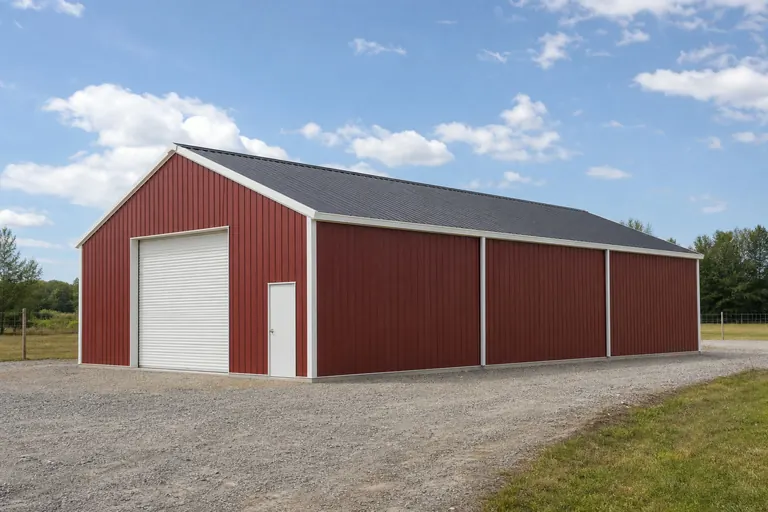 Seasonal and yard equipmentThe simplest use case, where basic ventilation is usually enough regardless of region.Tools and light workshopAdds a workbench or shelving, which benefits from a raised pad in humid or clay-heavy areas to protect metal tools from corrosion.Household overflow storageFurniture, documents and electronics are more moisture-sensitive, which is where the state's humidity matters most.
Example Configuration — for planning purposes only.
Preparation
Before you request an Alabama storage building quote
A handful of details resolved up front keep a small storage project simple.
- Ask your local building department if a permit is requiredSmall accessory structure rules are set locally, not statewide.
- Confirm your soil type before choosing a padBlack Belt clay and Coastal Plain sand behave differently, and it is worth telling your site contractor which one describes your lot.
- Plan ventilation for Alabama's humidityThe state's humid subtropical climate makes moisture protection a reasonable default, not an upgrade.
- Decide on a floor or pad type before orderingA raised pad matters more on clay-heavy or poorly drained ground than on well-drained soil.
- List what you intend to storeDocuments, electronics and furniture are more moisture-sensitive than tools or outdoor equipment, and that should inform ventilation choices.
Footprint
Common Alabama personal storage building sizes
Personal storage buildings in Alabama are typically sized to what a single household needs to keep, which keeps most projects modest regardless of region.
10′ × 12′
120 sq ft
A common small footprint for seasonal items and yard equipment.
12′ × 20′
240 sq ft
Room for larger tools, a small workbench, or overflow household storage.
16′ × 24′
384 sq ft
Suited to combined storage and light workshop use on a residential or small-acreage lot.
Example Configuration — for planning purposes only.
Footprint pages carry layout detail for each size; this page explains only why Alabama regional humidity and soil matter for these dimensions.
Questions
Alabama storage building questions
Honest answers at the state level, with permitting and pricing questions routed to whoever actually owns them.
It depends on your local jurisdiction. Alabama does not centralize accessory-structure permitting statewide, so ask your local building department.
Yes, in general terms. NOAA describes Alabama's climate as humid subtropical with hot, humid summers and Gulf-influenced precipitation, which is a reasonable factor in ventilation planning for whatever you intend to store.
It can. The state's mapped soil areas include the Black Belt's dense clay and the Coastal Plain's sandier ground, so it is worth telling your site contractor which region and soil type describes your lot.
There is no official typical size. Most personal storage buildings run from about 10x12 up to 16x24 depending on what a household needs to store.
We do not publish state-level prices, since cost depends on size, specification and site work. Our cost pages explain what drives the number; a builder quote covers your specific project.
Census data shows 20,337 total housing units authorized by building permits in 2023, up 4.3% from 2022, a statewide signal of growth, though it does not indicate anything about your specific jurisdiction's accessory-structure rules.
Sources for the Alabama facts on this page
This page states no code requirement, wind speed, snow load, permit rule, price or supplier claim. The state-specific facts it does use are listed with their publisher below.
NOAA NCEI publishes a narrative 'Climate of Alabama' describing the state's humid subtropical climate with mild winters and hot, humid summers, and Gulf-influenced precipitation.
NOAA National Centers for Environmental Information (NCEI) · Historical narrative (NCEI climate normals series) · Tier 1
https://www.ncei.noaa.gov/data/climate-normals-deprecated/access/clim60/states/Clim_AL_01.pdfThe Alabama Cooperative Extension System identifies seven major soil areas across the state, including the Limestone Valleys and Uplands, Blackland Prairie, Coastal Plain, Major Flood Plains and Terraces, Coastal Marshes and Beaches, Appalachian Plateau, and Piedmont Plateau, based on an NRCS soil-area map.
Alabama Cooperative Extension System (Auburn University) · ACES reference publication · Tier 2
https://www.aces.edu/blog/topics/crop-production/major-soil-areas-of-alabama/The Alabama Black Belt, named for its dark, rich prairie soils, spans roughly 12 to 21 counties across the central part of the state depending on the criteria used to define it.
Encyclopedia of Alabama (Auburn University / Alabama Humanities Alliance) · Reference article · Tier 2
https://encyclopediaofalabama.org/article/black-belt-region-in-alabama/Alabama had 20,337 total housing units authorized by building permits in 2023, up 4.3% from 19,499 in 2022.
U.S. Census Bureau · 2023 (annual) · Tier 1
https://www.census.gov/construction/bps/pdf/2023annualhighlights.pdfAlabama's total land area was measured at 50,645.3 square miles as of the 2010 Census.
U.S. Census Bureau · 2010 Census · Tier 1
https://www.census.gov/geographies/reference-files/2010/geo/state-local-geo-guides-2010/alabama.html