
RV carport · AL
RV Carports in Alabama
An RV carport footing in Alabama answers to whichever of the state's seven named soil areas the parcel sits in, from Black Belt clay to Coastal Plain sand, and that answer matters more for a taller, longer open structure than it does for a passenger-car carport. Alabama's residential building-permit activity is also rising — 20,337 units authorized in 2023, up 4.3% from 2022 — so an RV carport application is entering a local review queue that is growing, not shrinking. On the farm and rural acreage where the USDA's 2022 Census of Agriculture recorded 37,362 Alabama operations averaging 231 acres, the carport is frequently a semi-permanent fixture next to a home or barn. This page starts from ground and permitting momentum, then works out to the vehicle-clearance decisions that follow.
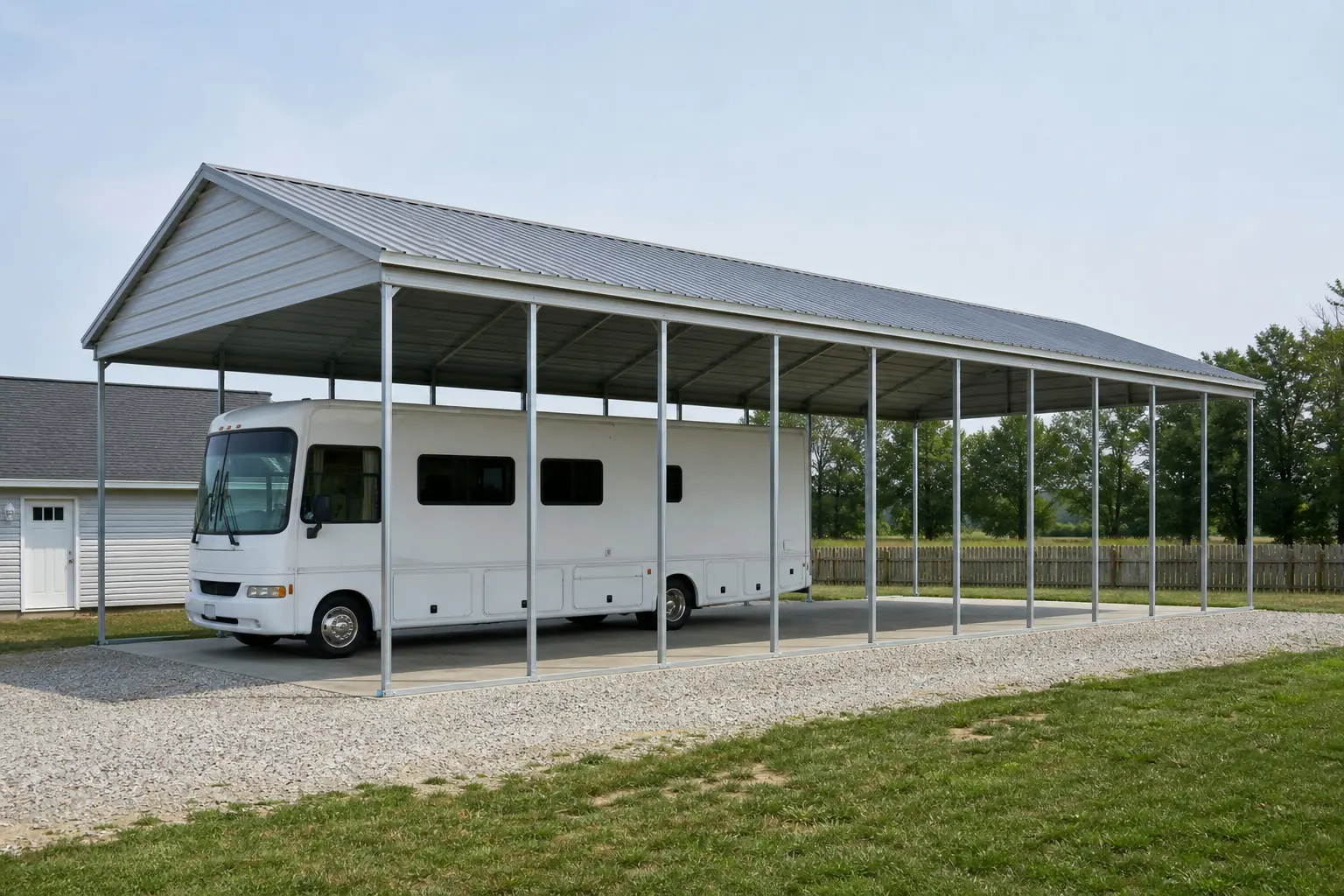
Start With the Soil Area, Not the Vehicle
Most RV carport research starts with vehicle height. In Alabama, start one step earlier: the Alabama Cooperative Extension System identifies seven distinct soil areas across the state — Limestone Valleys and Uplands, the Black Belt prairie, the Coastal Plain, Major Flood Plains and Terraces, Coastal Marshes and Beaches, the Appalachian Plateau, and the Piedmont Plateau — based on an NRCS soil-area map. A tall, long RV carport concentrates load on a small number of posts, so knowing which of those seven areas a parcel sits in changes the footing conversation before a single dimension is chosen.
Preparation
Four Confirmations Before an Alabama RV Carport Quote
Resolving these first avoids a second round of quoting once footing work begins.
Step 1
Name your soil area
Ask your foundation contractor whether the parcel sits in Black Belt clay, Coastal Plain sand, or another of Alabama's seven named soil areas before footing depth is set.
Step 2
Measure the RV including roof-mounted equipment
Clearance needs to account for AC units, antennas and vents, not just body height.
Step 3
Ask your local building department about current queue times
With statewide permit volume up 4.3% in 2023, review timelines are worth confirming rather than assuming a quiet rural process.
Step 4
Pull FEMA's National Risk Index for your county
Hurricane and tornado exposure scores vary by county; check yours before finalizing anchoring.
Step 5
Ask your supplier about haul distance for your county
Alabama spans 50,645.3 square miles from the Gulf Coast to the Appalachian Plateau, so a delivery quote for a long RV carport should confirm actual transit distance and lead time rather than a statewide average.
Configuration
How Alabama RV Carports Get Configured
Configuration depends mostly on the vehicle being covered and whether it shares space with other equipment.
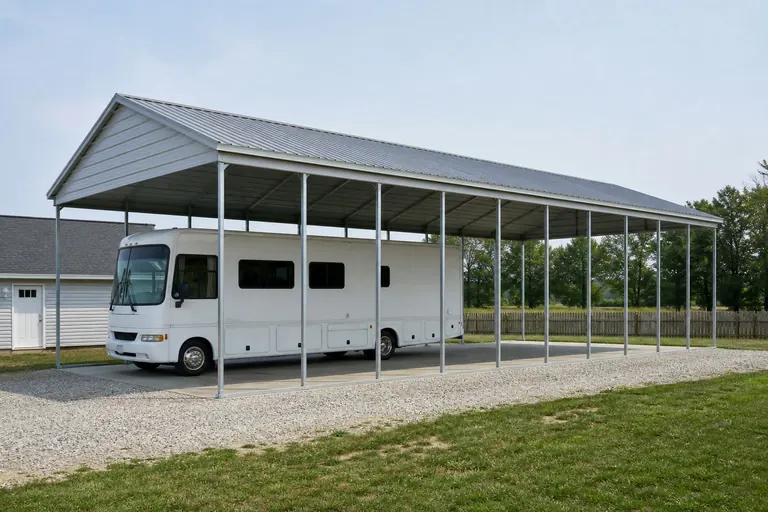 Single RV bayAn open bay sized to one motorhome or travel trailer on a residential or acreage lot.
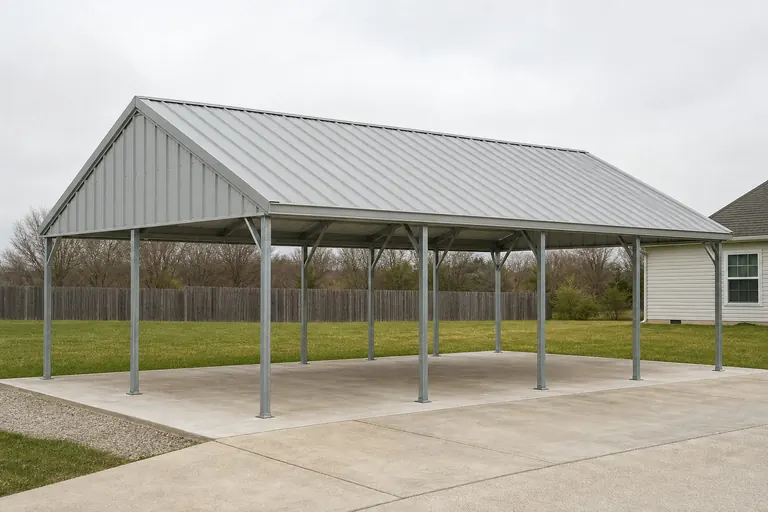 RV plus equipment bayA combined structure covering an RV alongside a boat, ATV, or farm equipment, common on larger acreage parcels.
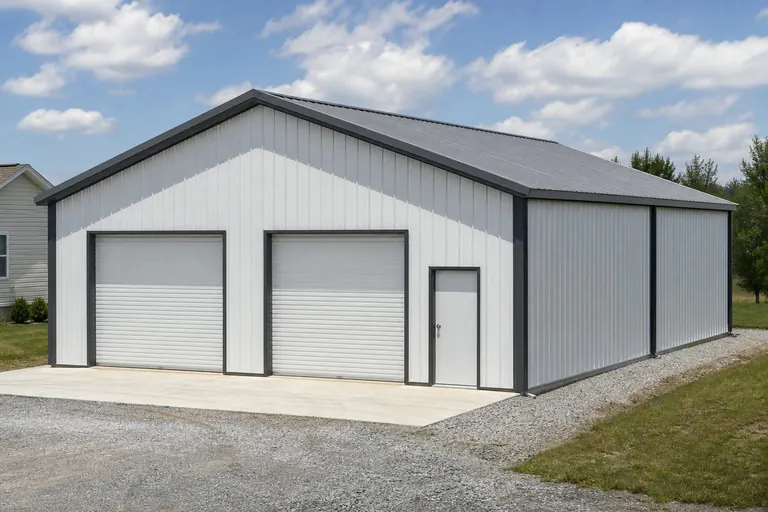 Partially enclosed RV coverOpen on the drive-through end with partial wall enclosure on the sides, offering more weather protection in a humid climate than a fully open carport.
Example Configuration — for planning purposes only.
Get Alabama RV carport quotes
Tell us your RV height, acreage and rough soil description, and we route it with the Alabama context already attached.
Momentum and moisture
A Growing Permit Queue, and a Climate That Rewards Ventilation
Alabama's residential building-permit activity is rising, and its humid subtropical climate makes ventilation planning worthwhile even on an open structure.
The U.S. Census Bureau recorded 20,337 total housing units authorized in Alabama in 2023, up 4.3% from 19,499 the year before. That statewide growth does not set any individual project's timeline, but it is a fair reason to ask a local building department about current review volume before assuming an RV carport application will move quickly simply because it is a small accessory structure.
NOAA NCEI's narrative description of Alabama's climate as humid subtropical, with hot, humid summers and Gulf-influenced precipitation, is a reasonable basis for planning ventilation and moisture management under an RV carport's taller roof plane, even though the structure itself stays open and unenclosed.
Wind is the third variable, and it scales with the structure's size: FEMA's National Risk Index scores Alabama counties across 18 hazard types including hurricane and tornado, and a taller, longer open RV frame presents more surface area to wind than a standard car carport. None of that becomes a stated wind speed here — that figure comes from your builder and local authority — but it is the honest reason anchoring deserves real attention, on top of whatever the soil area already dictates for the footing.
Footprint
Footprints That Fit an Alabama RV Carport
Clearance and vehicle length, not soil area, set an RV carport's footprint, though the footing plan still has to answer to the parcel's ground.
14′ × 36′
504 sq ft
A single-bay footprint sized for one motorhome or long travel trailer.
14′ × 40′
560 sq ft
Added length for a longer Class A motorhome or a trailer with a full-length awning.
24′ × 40′
960 sq ft
A two-bay footprint for an RV alongside a second vehicle or farm equipment.
Example Configuration — for planning purposes only.
Footprint pages carry post spacing and clearance detail for each size; this page explains only the Alabama siting and soil context.
Ground
Alabama's Named Soil Areas Relevant to an RV Carport Footing
The Alabama Cooperative Extension System's soil-area map, drawn from an NRCS classification, is the reference to bring to a foundation conversation rather than assuming one statewide ground condition.
- Limestone Valleys and Uplands
- Black Belt Prairie
- Coastal Plain
- Major Flood Plains and Terraces
- Coastal Marshes and Beaches
- Appalachian Plateau
- Piedmont Plateau
Questions
Alabama RV Carport Questions, Answered Honestly
State-level answers, with anchoring, permitting and pricing questions routed to whoever actually owns them.
It can. The Alabama Cooperative Extension System maps seven named soil areas, from Black Belt clay to Coastal Plain sand, and footing depth or type is a question for your foundation contractor once they know which area your parcel sits in.
Alabama authorized 20,337 housing units in 2023, up 4.3% from 2022, which points to an active permitting environment statewide. That does not set your project's specific timeline; ask your local building department directly.
Clearance depends on your specific RV's height including roof-mounted equipment, plus any local clearance rules. Measure your vehicle and confirm requirements with your local building department and your builder.
Frequently. The 2022 Census of Agriculture recorded 37,362 Alabama farms averaging 231 acres, a scale where a semi-permanent RV carport near the home or barn is a workable arrangement, though suburban and small-lot placements exist too.
We do not publish state-level prices, since cost depends on size, height, specification and site work, including any footing adjustments your soil area requires. Our cost pages explain what drives the number; a builder quote covers your specific project.
Yes. An RV carport is taller and often longer to clear a motorhome or trailer's height, including roof-mounted equipment, which changes clearance, footing and anchoring needs compared with a standard vehicle carport.
Sources for the Alabama facts on this page
This page states no code requirement, wind speed, snow load, permit rule, price or supplier claim. The state-specific facts it does use are listed with their publisher below.
The Alabama Cooperative Extension System identifies seven major soil areas across the state, including the Limestone Valleys and Uplands, Blackland Prairie, Coastal Plain, Major Flood Plains and Terraces, Coastal Marshes and Beaches, Appalachian Plateau, and Piedmont Plateau, based on an NRCS soil-area map.
Alabama Cooperative Extension System (Auburn University) · ACES reference publication · Tier 2
https://www.aces.edu/blog/topics/crop-production/major-soil-areas-of-alabama/The Alabama Black Belt, named for its dark, rich prairie soils, spans roughly 12 to 21 counties across the central part of the state depending on the criteria used to define it.
Encyclopedia of Alabama (Auburn University / Alabama Humanities Alliance) · Reference article · Tier 2
https://encyclopediaofalabama.org/article/black-belt-region-in-alabama/Alabama had 20,337 total housing units authorized by building permits in 2023, up 4.3% from 19,499 in 2022.
U.S. Census Bureau · 2023 (annual) · Tier 1
https://www.census.gov/construction/bps/pdf/2023annualhighlights.pdfAlabama had 37,362 farms in 2022, down 8% from 2017.
USDA National Agricultural Statistics Service (NASS) · 2022 · Tier 1
https://www.nass.usda.gov/Publications/AgCensus/2022/Online_Resources/County_Profiles/Alabama/cp99001.pdfAlabama had 8,629,101 acres of land in farms in 2022, an average farm size of 231 acres, up 9% from 2017.
USDA NASS · 2022 · Tier 1
https://www.nass.usda.gov/Publications/AgCensus/2022/Online_Resources/County_Profiles/Alabama/cp99001.pdfFEMA's National Risk Index is an interactive county/tract-level tool covering 18 natural hazards, including hurricane, tornado, flooding, and wildfire, that can be queried for Alabama counties such as Mobile and Jefferson.
Federal Emergency Management Agency (FEMA) · Current NRI release · Tier 1
https://www.fema.gov/flood-maps/products-tools/national-risk-indexAlabama's total land area was measured at 50,645.3 square miles as of the 2010 Census.
U.S. Census Bureau · 2010 Census · Tier 1
https://www.census.gov/geographies/reference-files/2010/geo/state-local-geo-guides-2010/alabama.html