
RV carport · TX
RV Carports in Texas
An RV carport in Texas covers a taller, longer vehicle than a standard carport, and on the state's abundant acreage — the 2022 Census of Agriculture recorded 230,662 farms averaging 544 acres — it is frequently a permanent fixture next to a home or barn rather than a once-a-year rental cover. Because the open structure has no walls to help carry lateral load, wind exposure is the central engineering conversation, and Texas's recorded 64 direct hurricane hits since 1851 make anchoring and siting worth taking seriously wherever the parcel sits, with an added state insurance layer through TDI and TWIA on the coast. Because Texas has no single statewide building code authority enforcing a mandatory code for most construction, clearance, anchoring and permit questions are answered locally, by your county or municipal building department.
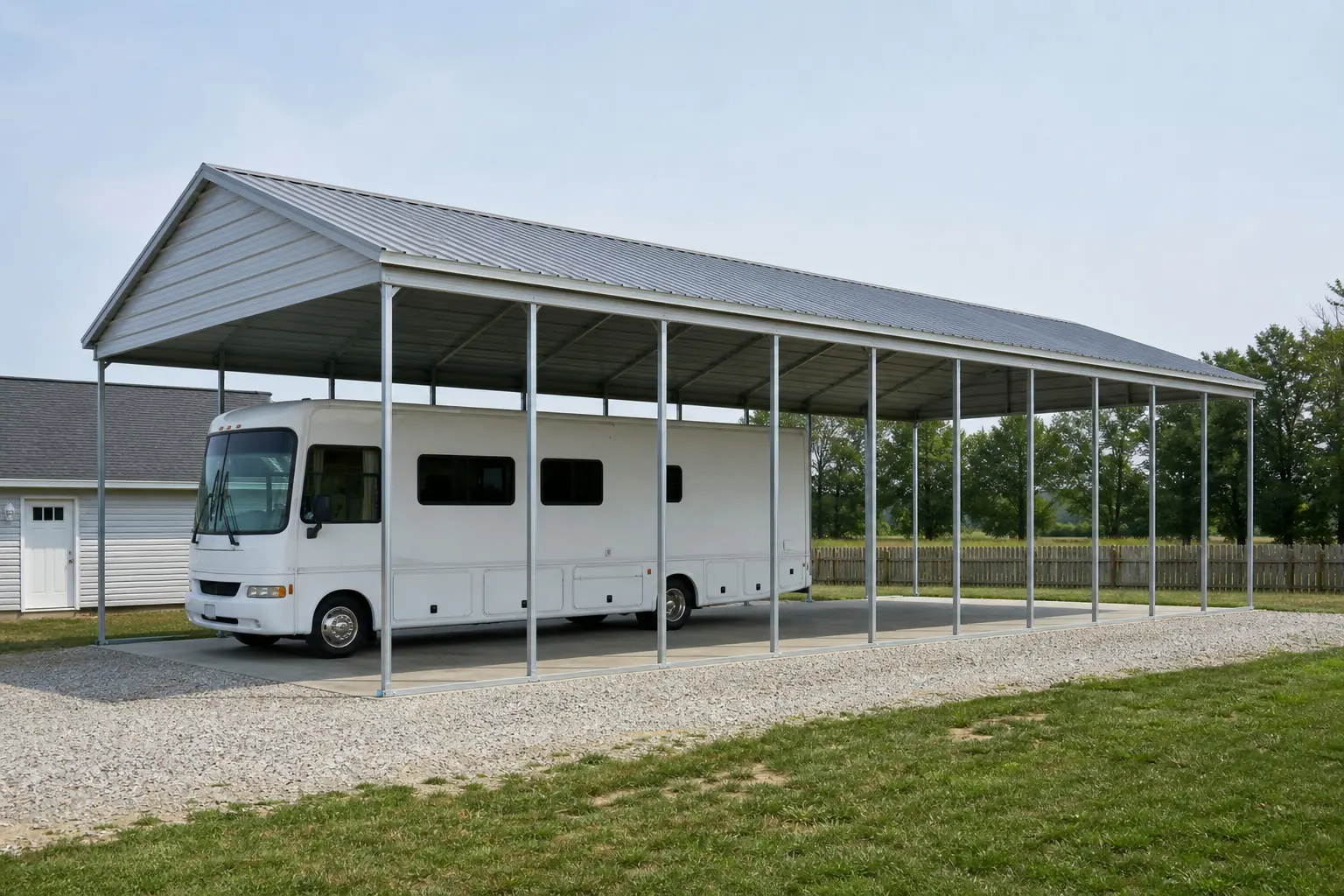
The intersection
In Texas, clearance and wind define the RV carport brief
An RV carport is planned around the height and length of the vehicle it covers and around how much wind exposure that taller, longer open structure presents.
Texas acreage is the backdrop for a lot of RV carport projects. The 2022 Census of Agriculture recorded 230,662 farms in Texas — more than any other state — averaging 544 acres, and on that kind of land an RV or large trailer is frequently kept on-site as a permanent fixture, parked near the home or an existing barn, rather than stored off-site. That changes the RV carport from an occasional convenience structure into a semi-permanent piece of the property, worth siting carefully relative to the house, driveway and any other outbuildings.
Wind is the defining engineering conversation for any open-sided structure, and it matters more for an RV carport than for a standard car carport simply because of scale: a taller, longer open frame presents more surface area to wind and has a taller vehicle profile underneath it acting like a sail. Texas has recorded 64 direct hurricane hits since 1851, second only to Florida, and FEMA's National Risk Index tracks strong wind and hail alongside hurricane among the 18 hazard types it scores for Texas communities. None of that translates into a specific wind speed on this page — that is an engineering value your builder and local authority determine — but it is the honest reason anchoring detail deserves real attention on an RV carport, wherever in Texas it sits.
Administration follows the same local pattern as other open-sided Texas structures. There is no single statewide building code authority enforcing a mandatory code for most construction, so clearance height rules, property-line setback, and whether the carport needs a permit at all are decided by your county or municipal building department. On the coast, inside the designated windstorm catastrophe area, the Texas Department of Insurance's windstorm inspection program and TWIA's certification requirement are also worth checking if you plan to insure the RV or a valuable trailer kept under the structure.
Comparison
RV carport versus standard carport in Texas
The two structures share an open-sided design but answer different clearance and load questions.
| Question | RV carport | Standard carport |
|---|---|---|
| Clearance height | Sized for RV roof-mounted AC units and antennas; a local-permitting and manufacturer-spec question | Sized for a passenger vehicle, typically lower clearance |
| Wind surface exposure | Larger due to height and length; anchoring detail matters more | Smaller footprint and profile, still requires anchoring appropriate to the site |
| Typical siting | Often on acreage, near a home or barn, semi-permanent | Often on a residential driveway or lot |
| Insurance relevance | May relate to RV or trailer insurance in coastal windstorm areas | Typically tied to homeowner's or auto policy |
Clearance height
- RV carport
- Sized for RV roof-mounted AC units and antennas; a local-permitting and manufacturer-spec question
- Standard carport
- Sized for a passenger vehicle, typically lower clearance
Wind surface exposure
- RV carport
- Larger due to height and length; anchoring detail matters more
- Standard carport
- Smaller footprint and profile, still requires anchoring appropriate to the site
Typical siting
- RV carport
- Often on acreage, near a home or barn, semi-permanent
- Standard carport
- Often on a residential driveway or lot
Insurance relevance
- RV carport
- May relate to RV or trailer insurance in coastal windstorm areas
- Standard carport
- Typically tied to homeowner's or auto policy
Configuration
Common Texas RV carport configurations
Configuration depends mostly on the vehicle being covered and whether it shares space with other equipment.
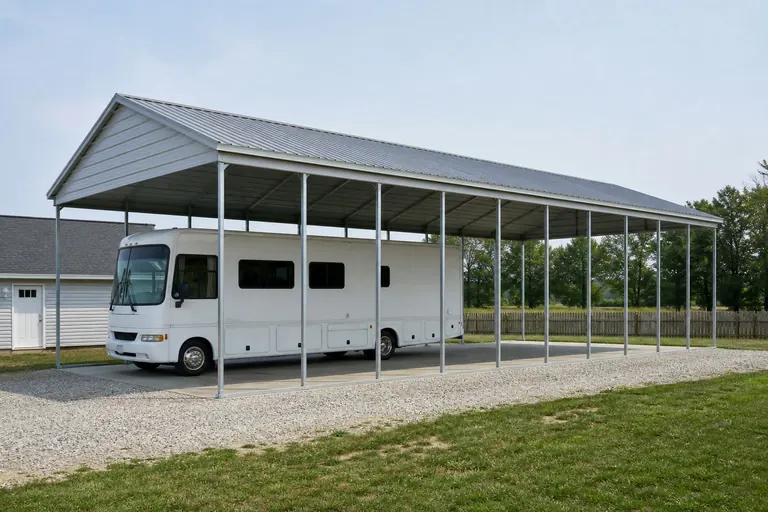 Single RV bayAn open bay sized to one motorhome or travel trailer on a residential or acreage lot.
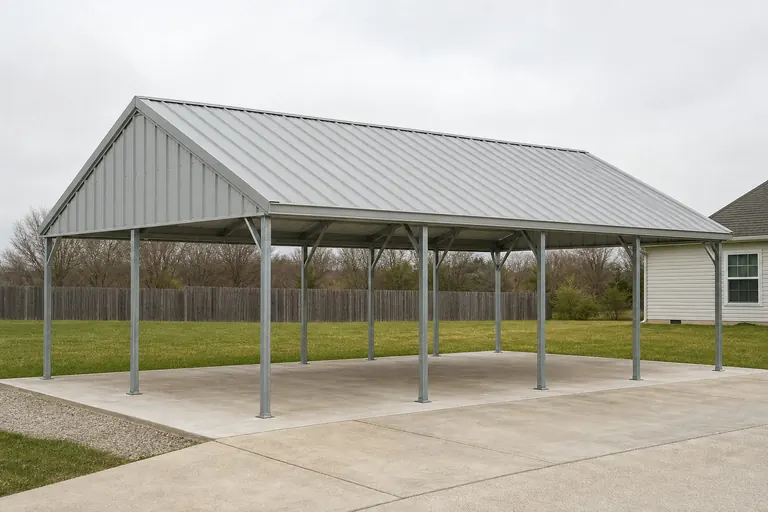 RV plus equipment bayA combined structure covering an RV alongside a boat, ATV, or other equipment, common on larger acreage parcels.
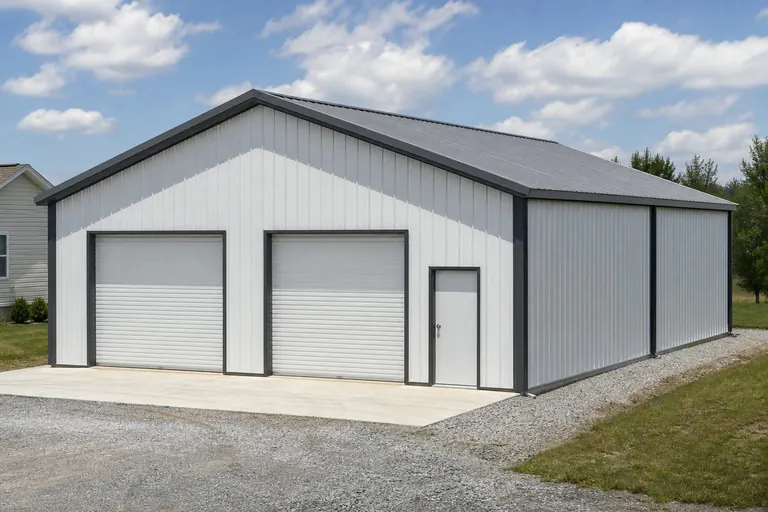 Partially enclosed RV coverOpen on the drive-through end with partial wall enclosure on the sides, offering more weather protection than a fully open carport.
Example Configuration — for planning purposes only.
Get Texas RV carport quotes
Tell us your RV height, region and whether the parcel sits in the coastal windstorm area, and we route it with the Texas context already attached.
Site context
How Texas region changes RV carport siting
The region a parcel sits in changes exposure and access conditions for a tall open structure more than it changes the structure itself.
Gulf Coastal Plains
Coastal humidity and, within the designated catastrophe area, the TDI/TWIA certification track for anyone insuring the RV or the structure.
Interior Plains / Blackland Prairies
Rolling farmland where a large share of the state's acreage sits; expansive clay soils are worth flagging before footings are set.
Great Plains (High Plains)
Flat, consistently wind-exposed ground across the Panhandle, where anchoring gets more attention from a careful builder.
Basin and Range (Trans-Pecos)
More remote, higher-relief terrain where the access road for a delivery truck matters as much as the structure's footprint.
Footprint
Sizes that suit a Texas RV carport
Clearance and vehicle length, not acreage, are what set an RV carport's footprint, though acreage removes any pressure to minimize it.
14′ × 36′
504 sq ft
A single-bay footprint sized for one motorhome or long travel trailer.
14′ × 40′
560 sq ft
Added length for a longer Class A motorhome or a trailer with a full-length awning.
24′ × 40′
960 sq ft
A two-bay footprint for an RV alongside a second vehicle or equipment.
Example Configuration — for planning purposes only.
Footprint pages carry post spacing and clearance detail for each size; this page explains only the Texas siting context.
Preparation
Before you request a Texas RV carport quote
Confirming these details up front helps avoid a second round of quoting on an RV cover project.
Step 1
Measure your RV's full height including roof-mounted equipment
Clearance needs to account for AC units, antennas and vents, not just the body height.
Step 2
Confirm setback and permit rules with your local building department
Requirements vary by county and municipality since there is no statewide standard.
Step 3
Ask about anchoring appropriate to your site and region
Coastal and open-plains sites carry different wind exposure considerations worth discussing with your builder.
Step 4
Check whether the RV or trailer is separately insured
In the coastal windstorm catastrophe area, confirm with your insurer whether the covering structure affects that policy.
Step 5
Plan the approach and turning radius
On acreage, driveway length and turning space for a large RV are common oversights that cause redesigns.
Questions
Texas RV carport questions
Honest answers at the state level, with anchoring, permitting and pricing questions routed to whoever actually owns them.
Permit requirements are set locally, since Texas has no single statewide building code authority enforcing a mandatory code for most construction. Check with your county or municipal building department before finalizing dimensions.
Clearance depends on your specific RV's height including roof-mounted equipment, plus any local clearance rules. Measure your vehicle and confirm requirements with your local building department and your builder.
Texas has recorded 64 direct hurricane hits since 1851, and FEMA tracks strong wind and hail among the hazards scored for Texas communities, so anchoring deserves real attention. Specific engineering values are set by your builder and local authority, not by this page.
Inside the designated windstorm catastrophe area, TDI and TWIA administer an inspection and certification process relevant to wind and hail coverage. Ask your insurer whether it affects coverage for the RV or the structure.
We do not publish state-level prices, since cost depends on size, height, specification and site work. Our cost pages explain what drives the number; a builder quote covers your specific project.
Yes. An RV carport is taller and often longer to clear a motorhome or trailer's height, including roof-mounted equipment, which changes clearance and anchoring needs compared with a standard vehicle carport.
Sources for the Texas facts on this page
This page states no code requirement, wind speed, snow load, permit rule, price or supplier claim. The state-specific facts it does use are listed with their publisher below.
The average farm size in Texas was 544 acres in 2022.
USDA NASS · 2022 · Tier 1
https://www.nass.usda.gov/Publications/AgCensus/2022/Full_Report/Volume_1,_Chapter_1_State_Level/Texas/Texas had 230,662 farms in 2022 per the USDA Census of Agriculture, the most of any U.S. state.
USDA National Agricultural Statistics Service (NASS) · 2022 · Tier 1
https://www.nass.usda.gov/Publications/AgCensus/2022/Full_Report/Volume_1,_Chapter_1_State_Level/Texas/NOAA's Hurricane Research Division data show Texas has recorded 64 direct hurricane hits (all categories) for 1851-2018, second only to Florida.
NOAA Atlantic Oceanographic and Meteorological Laboratory (AOML), Hurricane Research Division · 1851-2018 · Tier 1
https://www.aoml.noaa.gov/hrd/tcfaq/E19.htmlTexas does not have a single statewide building code authority enforcing a mandatory building code for most construction; code adoption and enforcement occur primarily at the local/municipal level.
KHOU 11 (Verify) / Texas State Law Library · current · Tier 3
https://www.khou.com/article/news/verify/verify-statewide-enforced-residential-building-code-texas/285-cc7c6343-cdf1-4751-b855-713601cf6b8bThe Texas Department of Insurance (TDI) administers a Windstorm Inspection Program for coastal construction, established under a 1987 state law, to allow structures to qualify for windstorm coverage.
Texas Department of Insurance (TDI) · since 1988 · Tier 2
https://www.tdi.texas.gov/wind/generalquestio.htmlFEMA's National Risk Index scores U.S. communities, including Texas counties, across 18 defined natural hazard types.
FEMA · current dataset · Tier 1
https://www.fema.gov/about/openfema/data-sets/national-risk-index-data