
RV carport · MI
RV Carports in Michigan
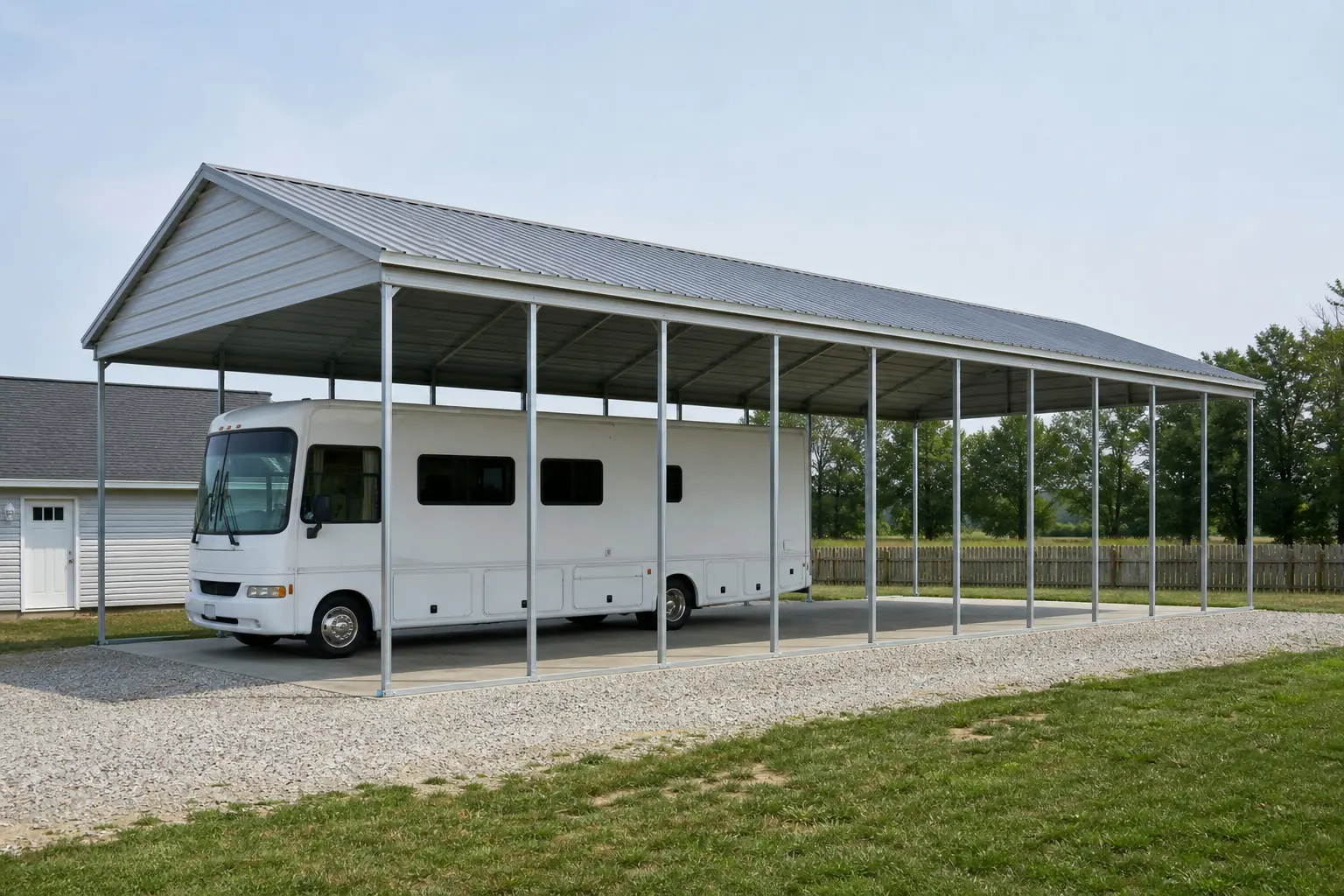
In Michigan, an RV carport is primarily an exercise in weather management. From protection against heavy snow loads to the moisture-heavy climate near the Great Lakes, structural integrity is non-negotiable. Before finalizing your carport size or location, verify the local municipal permit requirements and set-back rules, which vary significantly across Michigan's counties.
Climate
Protecting your investment in Michigan
Structural load and moisture management are the priorities in the Michigan environment.
A Michigan RV carport must be built to handle more than just a typical rain shower. The state's position in the Great Lakes region means it is subject to heavy lake-effect snowfall and, as FEMA's hazard data points out, frequent ice storms. For an RV owner, this means your carport cannot be a flimsy 'shade' structure; it must be a fully engineered building. A collapse due to snow or ice load can result in a total loss of your vehicle. When planning, you should look for a carport with a high-rated snow load capacity that matches the specific historical data for your Michigan county. Don't rely on generic 'midwest' designs; Michigan's needs are unique.
Humidity and condensation are also significant factors in Michigan. The moisture coming off the lakes can lead to 'sweating' on the underside of a metal carport roof, which then drips onto your RV. This constant moisture can lead to mold on the RV's exterior and rust on its frame. To combat this, many Michigan owners choose carports with a Drip-Stop or similar fleece-like coating on the interior of the roof panels. This coating absorbs moisture and then releases it back into the air as the temperature warms, preventing the 'indoor rain' that can plague unprotected metal buildings in the humid Michigan climate.
Wind is the third climatic challenge. Michigan's open agricultural plains—where the average farm size is 208 acres—offer little protection from the strong winds that can sweep across the state. An RV carport, with its high profile and open sides, acts like a giant sail. Proper anchoring is essential. Whether you are anchoring to a concrete slab, asphalt, or directly into the ground, you must use a system that is rated for Michigan's wind conditions. This typically means using more and deeper anchors than would be required in a less windy environment, a detail that your local Michigan building official will likely emphasize.
Siting
Site planning and access in Michigan
Ground conditions and seasonal access determine the long-term success of your Michigan carport.
Michigan's soil diversity, mapped through its hydrologic provinces, means that your site preparation is not a one-size-fits-all process. In the sandy coastal regions, you may need a specialized anchor system to ensure your carport stays put in loose soil. In the clay-heavy provinces of the interior, you'll need a well-compacted gravel base to prevent the structure from shifting during the spring thaw. Without proper site prep, the freeze-thaw cycle can cause your carport to lean, which not only looks bad but can also compromise its structural integrity. A level, stable base is the foundation of a good Michigan carport.
Access for a large RV is a major planning hurdle. Many Michigan sites have plenty of space, but the 'path of travel' from the road to the carport must be carefully considered. An RV is heavy, and in the Michigan spring, a gravel driveway that isn't properly built can quickly turn into a mud trap. You may need to invest in a geotextile fabric and a thick layer of crushed stone to create a stable access point. Furthermore, you must consider the turning radius of your vehicle. A 40-foot RV requires a significant amount of space to maneuver, especially if you are backing it into a carport.
Finally, check your local Michigan zoning ordinances early in the process. With 21,750 new housing units authorized in 2024, many communities have updated their rules regarding detached structures. You may be limited in how close you can build to your neighbor's line or how high the carport can be. In some Michigan townships, there are also rules about the appearance of the carport—requiring that it match the color or style of your home. A simple zoning permit is usually required, and it's much easier to get approval before you buy the building than it is to deal with a violation notice later.
- Soil-Specific Anchoring
- Use anchors designed for your site's specific soil type—sand, clay, or till—as defined by Michigan's hydrologic provinces.
- Clearance Planning
- Allow for at least 2 feet of extra height and 4 feet of extra width beyond your RV's dimensions for safe maneuvering.
- Zoning Setbacks
- Verify the required distance from property lines, which can vary from 5 to 50 feet depending on your Michigan municipality.
Usage
Maximizing your Michigan RV season
The right carport allows you to extend your camping season and protect your vehicle year-round.
Michiganders love their RVs, but the camping season is relatively short. A carport allows you to start your season earlier and end it later by providing a sheltered space to load, unload, and perform maintenance. Instead of struggling with a heavy cover in the wind, you can simply pull under the carport and be protected from the elements. This convenience makes it much more likely that you'll take advantage of those beautiful late-spring or early-fall weekends in Michigan's state parks and private campgrounds.
Maintenance is another area where a carport pays for itself. The intense Michigan sun in the summer can cause the seals and decals on your RV to crack and fade, while the winter ice can expand existing gaps and lead to leaks. By keeping your RV under a roof, you are significantly reducing its exposure to these environmental stressors. This not only keeps your vehicle looking better but also helps maintain its resale value—a critical consideration for any RV owner. A well-maintained RV that has been stored under cover is a high-demand item in the Michigan used market.
Lastly, consider adding some basic utilities to your carport site. Even a simple 30-amp or 50-amp electrical hookup allows you to keep your RV's batteries charged and run the air conditioner or heater while you are preparing for a trip. In the Michigan winter, a small heater can prevent the interior from becoming damp, while a battery tender ensures the vehicle is ready to go in the spring. If local code allows, adding a frost-free water hydrant nearby is another practical touch that makes cleaning and winterizing your RV much easier. These small additions turn a simple carport into a true RV home base.
RV Carport Quotes
Need an RV carport for your Michigan site?
Before You Order
Michigan RV Carport Siting Checklist
Each of these is decided locally in Michigan, not by a single statewide default.
Step 1
Match your anchor system to your soil, not a generic spec
Sandy coastal ground and interior clay till behave differently under wind load; confirm the anchor design against your site's hydrologic province.
Step 2
Plan the approach path before the pad is graded
A gravel driveway that isn't built with a geotextile base and crushed stone can turn to mud under a loaded RV during a Michigan spring thaw.
Step 3
Get the setback and height limit in writing from your township
Detached-structure rules for carports vary across Michigan's municipalities, and appearance requirements sometimes apply near homes in planned communities.
Step 4
Confirm wind-rating expectations with your local building official
An open-sided structure like an RV carport catches wind differently than an enclosed building; ask what anchor count and depth your jurisdiction expects.
Footprints
RV Carport Footprints Common in Michigan
Michigan buyers size an RV carport around their specific coach length plus clearance for Michigan's winter wind and snow load.
14′ × 36′
504 sq ft
A single-coach footprint sized for a mid-size travel trailer with a few feet of side clearance.
16′ × 40′
640 sq ft
The common Michigan choice for a Class A or fifth-wheel RV, with room to walk around the vehicle.
20′ × 50′
1,000 sq ft
A dual-purpose footprint for an RV plus a boat or utility trailer on a larger rural Michigan parcel.
Example Configuration — for planning purposes only.
Confirm your township's setback and height limits before finalizing a footprint; requirements vary by municipality.
FAQ
Michigan RV Carport FAQ
Common questions for Michigan RV owners.
Yes. Fabric carports are rarely rated for the heavy snow and ice loads common in Michigan and often fail during the first severe winter storm.
Usually, yes, but you must ensure the frame is designed to handle the additional wind load that enclosure creates. It's best to plan for this from the start.
While a concrete slab is the most stable option, many Michigan owners successfully use a well-compacted gravel pad with an appropriate anchoring system.
Plan for at least 2 feet of extra height and 4 feet of extra width beyond your RV's dimensions to allow for safe maneuvering and slide-out clearance.
In most Michigan municipalities, an open-sided carport still needs a zoning permit and often a building permit above a certain size. Confirm the threshold with your local jurisdiction before ordering.
Sources for the Michigan facts on this page
This page states no code requirement, wind speed, snow load, permit rule, price or supplier claim. The state-specific facts it does use are listed with their publisher below.
FEMA's National Risk Index is the federal tool for county- and state-level natural hazard exposure data for Michigan's 83 counties, covering 18 hazard types including winter weather, ice storm, and severe/strong wind.
Federal Emergency Management Agency (FEMA) · Current NRI release · Tier 1
https://www.fema.gov/flood-maps/products-tools/national-risk-indexUSGS describes Michigan as consisting of two peninsulas -- the Upper Peninsula and Lower Peninsula, separated by the Straits of Mackinac -- and notes it is the only U.S. state touching four of the five Great Lakes, giving it the longest freshwater coastline in the country.
U.S. Geological Survey · 2021 · Tier 1
https://pubs.usgs.gov/publication/fs20213047USGS Water-Resources Investigations Report 91-4120 delineates named hydrologic provinces across Michigan's Upper and Lower Peninsulas, prepared in cooperation with the Michigan DNR Geological Survey Division.
U.S. Geological Survey, in cooperation with Michigan Dept. of Natural Resources · 1991 · Tier 1
https://pubs.usgs.gov/wri/1991/4120/report.pdfDetroit Metro Airport's NOAA 1991-2020 climate normals show total annual precipitation of roughly 34-35 inches, with January and February mean snowfall near 12-14 inches each.
NOAA National Centers for Environmental Information (NCEI) · 1991-2020 · Tier 1
https://www.ncei.noaa.gov/access/services/data/v1?dataset=normals-monthly-1991-2020&format=pdf&stations=USW00094847Michigan had 9,472,069 acres of land in farms in 2022, an average farm size of 208 acres.
USDA NASS · 2022 · Tier 1
https://www.nass.usda.gov/Publications/AgCensus/2022/Full_Report/Volume_1,_Chapter_1_State_Level/Michigan/st26_1_001_001.pdfBuilders in Michigan were authorized to construct 21,750 new privately-owned housing units in 2024, of which 15,045 were single-unit structures.
U.S. Census Bureau · 2024 (final annual estimates) · Tier 1
https://www.census.gov/construction/bps/stateannual.html