
RV carport · SC
RV Carports in South Carolina
For an RV owner in South Carolina, the primary enemy is the sky. Across 30,064.1 square miles of the Palmetto State, motorhomes and trailers face a relentless combination of intense UV radiation and high humidity. A steel RV carport provides the height and protection needed to shield roofs and seals from the sun's degradation. Whether you are parking in the humid subtropical (Köppen Cfa) Midlands or near the coast where FEMA NRI identifies significant hurricane risks, a South Carolina RV carport requires specialized anchoring and a vertical roof to handle the state's heavy rain and storm cycles.
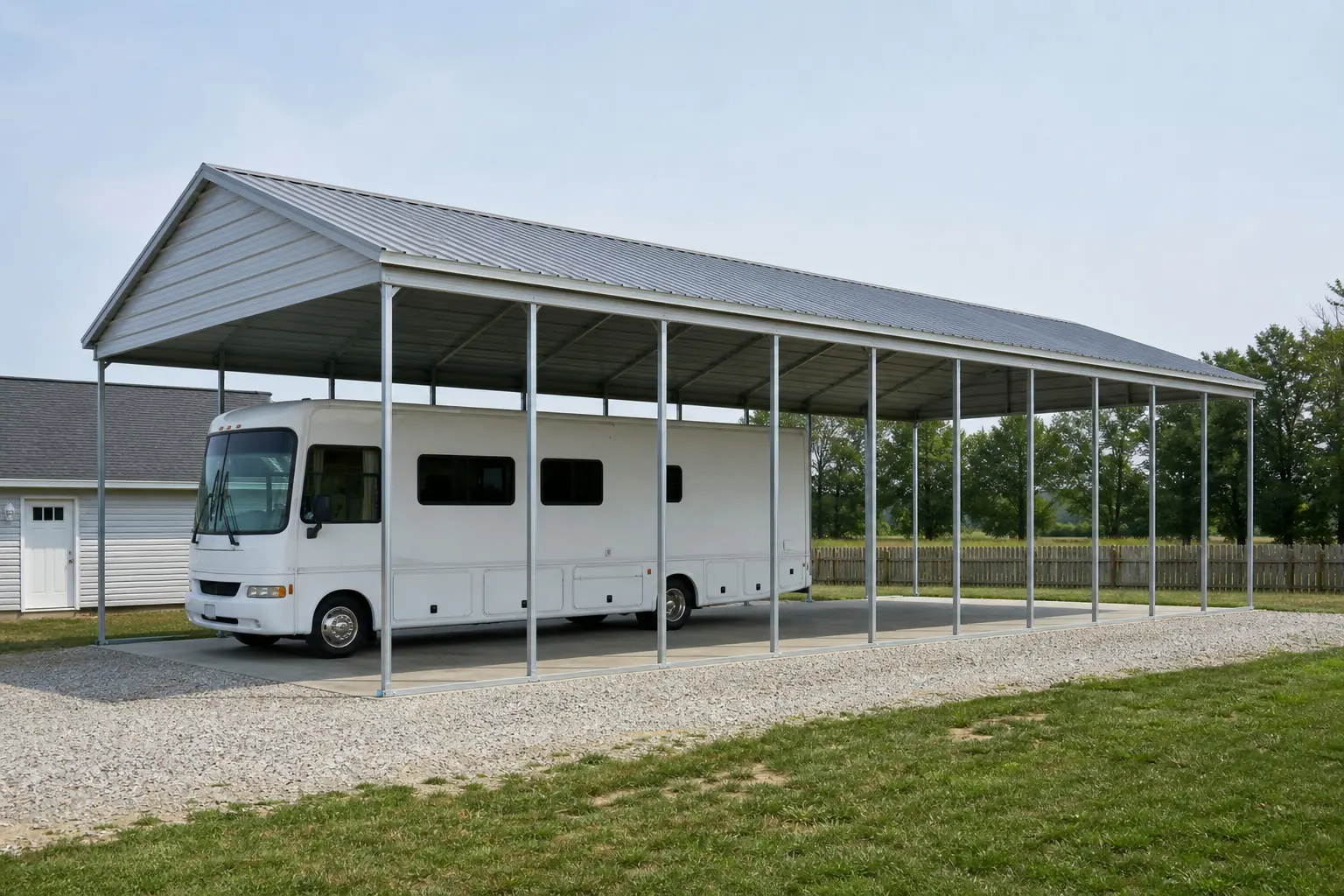
Palmetto Protection
Why South Carolina RVs need steel cover
South Carolina's climate is notoriously hard on RVs, making a dedicated shelter an essential investment for long-term ownership.
If you've ever left an RV uncovered in the South Carolina Midlands, you've seen the results: faded decals, cracked roof seals, and chalking paint. The state's humid subtropical climate is a constant stressor. During the peak of summer, UV radiation is intense enough to bake the life out of rubber and plastic components. A metal RV carport provides immediate relief, keeping the vehicle's surface temperature significantly lower and protecting the expensive roof membranes that keep your RV leak-free.
Humidity is the second threat. In South Carolina, moisture can build up in the interior of a closed RV, leading to mold and mildew. By parking under a carport rather than using a tight-fitting fabric cover, you allow for natural airflow around the unit. This breathability is crucial in a state where the air is often saturated, helping to keep the environment around your RV as dry as possible.
Finally, there is the matter of wind. Because RV carports are tall—often reaching 12 to 16 feet at the eaves—they act as massive sails. With FEMA NRI data highlighting tornado and hurricane risks across all 46 South Carolina counties, a 'lightweight' shelter is not enough. An RV carport in the Palmetto State must be properly anchored into a concrete slab or with heavy-duty ground anchors to ensure it stays in place during a storm.
Clearance
Tailoring the carport to your RV
Ensuring your South Carolina shelter fits your specific vehicle and property.
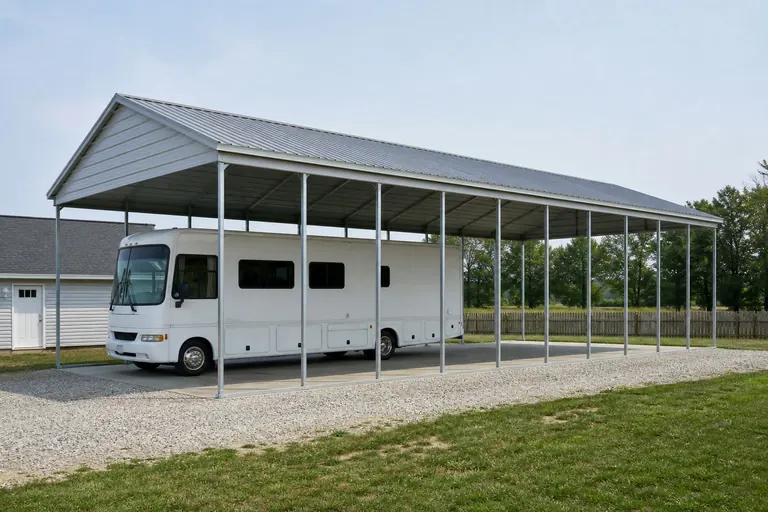 Class A Motorhome CoverTypically 14-16 feet tall and 40 feet long, designed for maximum shade and clearance.Travel Trailer ShelterA 12x30 or 12x40 footprint that provides a buffer against SC's sun and heavy rain.The Coastal Utility BayIncludes one or two side panels to provide extra protection from salt spray and prevailing winds.
Example Configuration — for planning purposes only.
Maintenance
Vertical roofs for the Palmetto landscape
In a state with heavy rainfall and dense tree cover, roof design is a maintenance decision.
We almost always recommend a Vertical Roof for RV carports in South Carolina. The vertical panel orientation allows rain to wash away pine needles, oak leaves, and other debris that are common across the state's 30,064.1 square miles. Horizontal panels can trap this organic material, which holds moisture and eventually leads to rust.
A vertical roof also provides the best performance during the torrential downpours common in the South Carolina Midlands and Lowcountry. By moving water off the roof and away from the RV quickly, you reduce the risk of splashing and ground saturation around your tires and leveling jacks. In a state where inland flooding is a recognized risk, managing water runoff is a critical part of site planning.
- Vertical Panels
- The best choice for shedding the heavy rain and debris common in SC.
- Extended Eaves
- Provide extra shade for the RV's sidewalls, protecting tires and decals from UV.
- Extra-Long Anchors
- Necessary for tall structures to resist the wind leverage in storm-prone regions.
Protect your RV in South Carolina
Get a quote on a tall, durable steel RV carport designed for the Palmetto State's weather.
Regional Planning
RV carport priorities by South Carolina region
The tallest structure on a property behaves differently depending on which part of the state it sits in.
Lowcountry & Grand Strand
Salt air and hurricane exposure dominate; corrosion-resistant hardware and a bolted concrete pad with deep anchors are the standard rather than an upgrade.
The Midlands
Intense UV and heavy summer thunderstorms are the main design drivers, favoring a vertical roof and light-colored panels to reduce heat load on the RV below.
The Upstate
Winter freeze protection for RV plumbing and occasional ice loading on the tall roof structure become the bigger seasonal concerns compared to coastal wind exposure.
Storm Season
RV carports and hurricane-season logistics
A tall RV carport creates a decision most standard carports do not: whether to evacuate the RV itself or ride out the storm under cover.
For owners in the Lowcountry and Grand Strand, where FEMA NRI scores hurricane and coastal flooding among the leading hazards, an RV parked under a carport during a tropical system is exposed to both wind and storm surge risk that a garage-stored vehicle avoids. Many South Carolina RV owners treat the carport as fair-weather and off-season storage, and plan to relocate the RV inland or to a fuel-efficient departure route once a named storm enters the forecast cone, since the carport's open sides cannot stop wind-driven rain intrusion the way an enclosed bay can.
In the Upstate, the seasonal RV concern shifts from wind to freeze protection. An RV stored under a carport through a cold Upstate winter still needs its water lines winterized, because the carport roof sheds precipitation but does not raise ambient temperature the way an insulated building would. The carport's job in both regions is UV and rain protection during the many months an RV is not in active use — not storm defense during the handful of days a hurricane or hard freeze actually arrives.
Questions
South Carolina RV Carport FAQ
Practical advice for protecting your motorhome in SC.
Most RVs require at least 12 feet of clearance, but we recommend measuring to the highest point (usually the AC unit) and adding 2 feet. In South Carolina, having extra height helps with airflow during hot summer days.
While not strictly required, a concrete slab is highly recommended for RVs. It provides a level surface for jacks, prevents tires from sinking into the South Carolina clay or sand, and offers the best anchoring for the tall carport frame.
Yes, a metal roof will block satellite signals if the dish is mounted on top of the RV. You may need to use a portable dish or mount a permanent dish outside the footprint of the carport.
Because tall structures face greater wind leverage, coastal sites generally need deeper anchors or a bolted concrete pad rated for higher wind exposure than an inland site. Confirm the anchoring package with your installer based on your specific location.
Yes. A carport roof blocks precipitation but does not add heat, so plumbing lines should still be winterized before a cold Upstate freeze, the same as if the RV were stored in the open.
Sources for the South Carolina facts on this page
This page states no code requirement, wind speed, snow load, permit rule, price or supplier claim. The state-specific facts it does use are listed with their publisher below.
The South Carolina State Climatology Office (SC DNR) states most of the state falls within the humid subtropical (Köppen Cfa) classification, producing hot, humid summers with mild winters, while portions of the Upstate mountains have a different, cooler climate regime.
South Carolina Department of Natural Resources (SC DNR), State Climatology Office · SC DNR reference publication · Tier 2
https://www.dnr.sc.gov/climate/sco/Publications/SCClimateOverview.pdfThe Census Bureau's current data profile lists South Carolina with a land area of 30,064.1 square miles and a water area of 1,959.4 square miles, ranking it the 39th largest state by area.
U.S. Census Bureau · Current Census Bureau geography data · Tier 1
https://data.census.gov/profile/South_Carolina?g=0400000US45FEMA's National Risk Index is the federal tool providing county-level natural hazard risk scoring (including hurricane, coastal flooding, tornado, and inland flooding categories) for all 46 South Carolina counties; a state-specific hazard narrative from FEMA itself was not directly retrieved in this session.
Federal Emergency Management Agency (FEMA) · Current NRI release · Tier 1
https://www.fema.gov/flood-maps/products-tools/national-risk-indexNOAA NCEI publishes a narrative 'Climate of South Carolina' describing the state's climatic transition from coastal plain to Piedmont to mountainous Upstate terrain.
NOAA National Centers for Environmental Information (NCEI) · Historical narrative (NCEI climate normals series) · Tier 1
https://www.ncei.noaa.gov/data/climate-normals-deprecated/access/clim60/states/Clim_SC_01.pdf