Pole barn · WI
Pole Barns in Wisconsin
A Wisconsin pole barn is being planned on a farm base that keeps consolidating: 58,521 farms in 2022, down 10% from 2017, averaging 236 acres apiece across 13,784,678 total acres in farms. Fewer, larger operations tend to want one mixed-use post-frame building rather than several small ones, and the state's own climatologists publish separate regional climate divisions rather than one statewide figure — so the honest planning conversation is about which region your site sits in and how many jobs the building has to do, not about loads or prices.
The intersection
What a Wisconsin site actually changes about a pole barn
Consolidation and regional climate variation are the two real inputs, not the building's basic design.
USDA's 2022 Census of Agriculture counted 58,521 Wisconsin farms, down 10% from 2017, while land in farms held at 13,784,678 acres and average farm size rose to 236 acres. That is fewer, larger operations, and larger operations tend to specify one bigger, mixed-use pole barn covering equipment, hay and general storage rather than several smaller single-purpose buildings — a real difference from a state where the farm base is fragmenting into smaller parcels.
The second input is regional, not statewide. The Wisconsin State Climatology Office divides the state into distinct climate divisions with separate normals, reflecting real north-south and lake-effect variation. For a pole barn — typically unheated, wide-span, and exposed to full winter conditions — knowing whether your site sits in a northern division or a Lake Michigan-moderated one is worth naming to your builder before roof pitch and eave height are fixed.
NOAA NCEI's broader narrative on Wisconsin describes a continental climate with cold, snowy winters shaped by the Great Lakes and Canadian air masses, and NCEI's 1991-2020 U.S. Climate Normals dataset is the basis local officials use to characterize the freeze-thaw cycle behind foundation and frost-depth decisions. This page does not state a frost depth or design value — that is a local building department question — but a pole barn's typically unheated post-frame construction means its foundation and apron feel that freeze-thaw cycle more directly than a heated structure would, which is worth raising with your builder before footings are set.
Site context
How the site brief differs across Wisconsin
Regional climate divisions and farm density both vary enough across the state's 54,157.8 square miles to matter.
Northern interior
Divisional normals here run colder and generally snowier than the southern divisions, per the state climatology office; a pole barn's roof pitch and eave clearance are worth discussing with a local builder rather than assuming a statewide default.
Southern and central dairy belt
Home to the bulk of the state's 6,216 dairy farms and much of its consolidated acreage; mixed-use, multi-job pole barns are the common brief here.
Lake Michigan corridor
Lake-effect moderation shows up in the divisional data as a distinct microclimate; site-specific advice from a local contractor is worth more than a statewide assumption near the shoreline.
Exposure
Snow-shedding roof geometry is the recurring Wisconsin detail
Roughly 51 inches of annual statewide snowfall, per the state climatology office's 1991-2020 normals, makes roof geometry a planning conversation for a wide-span pole barn.
This is a station normal, not a design value; the actual snow load your building is engineered for comes from your local building department based on your specific site and region, and this page does not state one. What the normal usefully flags is that roof pitch, eave height and where snow sheds relative to doors and equipment access are worth resolving with your builder before the frame is ordered.
Drainage matters just as much once the snow melts: Wisconsin's roughly 34.9-inch statewide annual precipitation means grading and gutter decisions pay off across three seasons, not just winter.
Because a pole barn is typically unheated and open to ambient temperature, the freeze-thaw cycle that comes with a genuine four-season climate also matters for the apron and approach: a concrete or gravel surface that handles repeated freezing and thawing without heaving is worth specifying up front rather than discovering the difference after one Wisconsin winter.
- Roof pitch and eave clearance
- Confirm these against your regional climate division, not a single statewide figure.
- Snow-shed zones near doors
- Site the building so sliding or accumulated snow does not block daily access points.
- Post-melt drainage
- Plan gutter and grading decisions alongside the frame, not after the apron is poured.
Get Wisconsin pole barn quotes
Tell us your climate region, the functions the building serves and your rough footprint. We route it with the Wisconsin and pole-barn context already attached.
Configuration
What Wisconsin pole barns are usually asked to do
Consolidated acreage pushes toward one building doing several jobs.
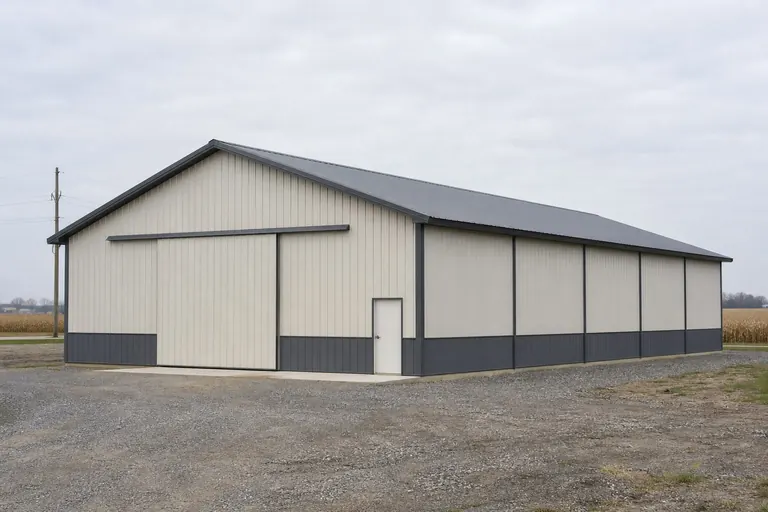 Equipment and hayField equipment sharing a roof with hay storage, divided by a partition wall.
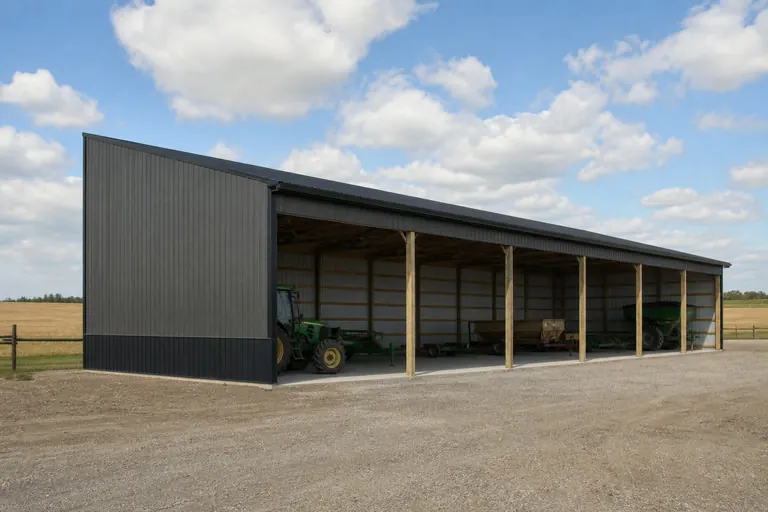 Dairy-support storageFeed and equipment storage adjacent to an active dairy operation, prioritizing wide doors over finished interiors.
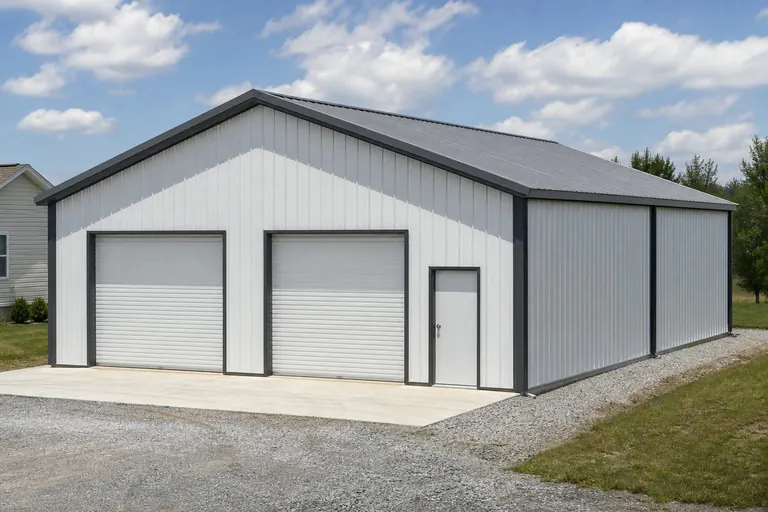 General farm and vehicle storageA mixed building for trucks, trailers and general storage on a smaller remaining parcel.
Example Configuration — for planning purposes only.
Footprint
Sizes that suit a consolidated Wisconsin operation
Mixed-use briefs on 236-acre-average operations tend to specify more width and length than a single-purpose shed.
30′ × 40′
1,200 sq ft
A smaller footprint for a single function on a smaller remaining parcel.
40′ × 60′
2,400 sq ft
The common mixed-use choice dividing equipment and hay storage.
60′ × 80′
4,800 sq ft
Where a larger consolidated operation wants equipment, hay and general storage under one roof.
Example Configuration — for planning purposes only.
Footprint pages carry layout and door detail; this page explains why Wisconsin briefs land in this range.
Preparation
Before you request a Wisconsin pole barn quote
Four things resolved in advance make quotes comparable.
Step 1
Contact your local building department
Snow load, permit thresholds and agricultural exemptions are set locally; ask before finalizing dimensions.
Step 2
Name your climate division
Tell your builder whether the site is northern interior, dairy-belt central, or Lake Michigan corridor.
Step 3
State every function the building serves
A mixed-use brief priced as single-use is a common cause of re-quoting.
Step 4
Fix the daily access path
Where equipment enters and exits sets door sizing and snow-shed siting.
Step 5
Review your county's hazard profile
FEMA's National Risk Index scores 18 natural hazard types at the county level, including winter weather and inland flooding relevant to an unheated post-frame building; check it alongside your building department's requirements.
Questions
Wisconsin pole barn questions
Questions answered honestly at state level; the rest routed to whoever owns them.
Permit requirements depend on your jurisdiction, parcel and use, including any agricultural exemptions. Your local building department is the only reliable source.
We do not state snow load values. Statewide snowfall normals run near 51 inches annually, but your design snow load comes from your local building department based on your site and region.
There is no official typical size. Consolidated 236-acre-average operations commonly specify 40x60 to 60x80 mixed-use buildings, but your program should set the footprint.
The state climatology office publishes different regional climate normals for northern and southern divisions, so it is worth discussing roof pitch and eave clearance with a local builder for your specific region rather than assuming a single statewide answer.
We do not publish state-level prices, since specification, site work and material pricing drive the number. Our cost pages explain what drives cost; a quote covers your building.
Sources for the Wisconsin facts on this page
This page states no code requirement, wind speed, snow load, permit rule, price or supplier claim. The state-specific facts it does use are listed with their publisher below.
Wisconsin had 58,521 farms in 2022, down 10% from 2017.
USDA National Agricultural Statistics Service (NASS) · 2022 · Tier 1
https://www.nass.usda.gov/Publications/AgCensus/2022/Online_Resources/County_Profiles/Wisconsin/cp99055.pdfWisconsin had 13,784,678 acres of land in farms in 2022, an average farm size of 236 acres, up 7% since 2017.
USDA NASS · 2022 · Tier 1
https://www.nass.usda.gov/Publications/AgCensus/2022/Online_Resources/County_Profiles/Wisconsin/cp99055.pdfWisconsin had 13,784,678 acres of land in farms in 2022, an average farm size of 236 acres, up 7% since 2017.
USDA NASS · 2022 · Tier 1
https://www.nass.usda.gov/Publications/AgCensus/2022/Online_Resources/County_Profiles/Wisconsin/cp99055.pdfThe Wisconsin State Climatology Office divides the state into distinct climate divisions and publishes divisional (regional) climate normals for temperature, precipitation and snowfall separately from statewide figures, reflecting the state's north-south and lake-effect climate variation.
Wisconsin State Climatology Office (UW-Madison) · 1991-2020 · Tier 2
https://climatology.nelson.wisc.edu/wisconsin-climate-divisions/climate-normals/Wisconsin's statewide 1991-2020 annual normal precipitation is about 34.9 inches with roughly 51 inches of annual snowfall, per the Wisconsin State Climatology Office's statewide averages.
Wisconsin State Climatology Office (UW-Madison) · 1991-2020 · Tier 2
https://climatology.nelson.wisc.edu/wisconsin-historic-climate-data/statewide-climate-normals/Wisconsin's total land area was measured at 54,157.8 square miles as of the 2010 Census, ranking 25th among states.
U.S. Census Bureau · 2010 Census · Tier 1
https://www.census.gov/geographies/reference-files/2010/geo/state-local-geo-guides-2010/wisconsin.htmlNOAA NCEI publishes a narrative 'Climate of Wisconsin' describing the state's continental climate with cold, snowy winters influenced by the Great Lakes and Canadian air masses.
NOAA National Centers for Environmental Information (NCEI) · Historical narrative (NCEI climate normals series) · Tier 1
https://www.ncei.noaa.gov/data/climate-normals-deprecated/access/clim60/states/Clim_WI_01.pdfFEMA's National Risk Index dataset defines and scores 18 natural hazard types (avalanche, coastal flooding, cold wave, drought, earthquake, hail, heat wave, hurricane, ice storm, inland flooding, landslide, lightning, strong wind, tornado, tsunami, volcanic activity, wildfire, winter weather) at the county level nationwide, including all 72 Wisconsin counties.
Federal Emergency Management Agency (FEMA) · Current NRI release · Tier 1
https://www.fema.gov/about/openfema/data-sets/national-risk-index-data