Pole barn · IA
Pole Barns in Iowa
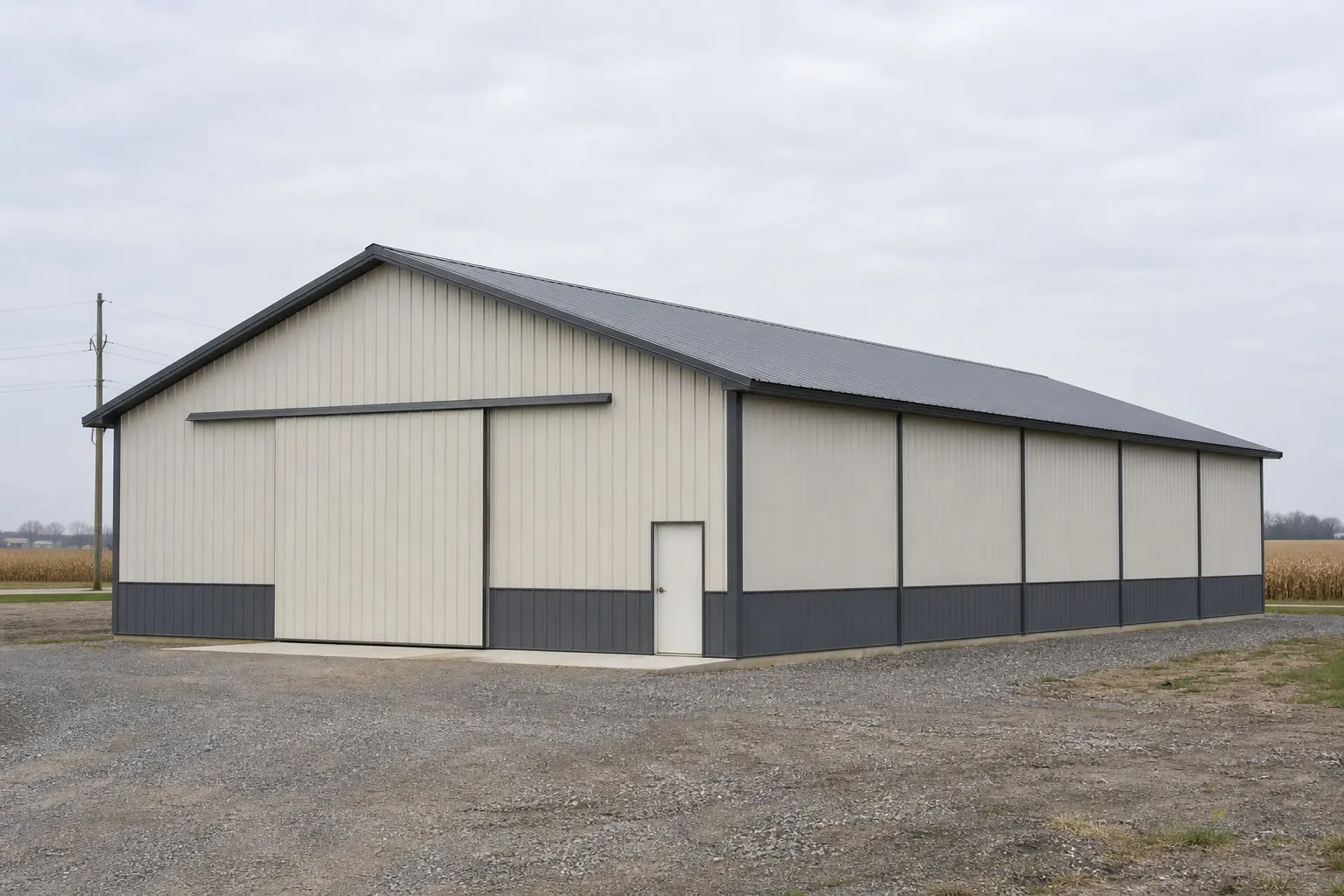
In Iowa, the post-frame 'pole barn' is the backbone of rural infrastructure, serving everything from livestock management to residential workshops. Planning a pole barn in Iowa requires a focus on frost-depth foundation requirements—essential in a state that sees winter lows of -30°F—and a clear understanding of the local county's permitting authority. Whether you are building on the steep bluffs of the Loess Hills or the open plains, your project must be engineered for Iowa's high wind loads and significant snow accumulation, making structural integrity a top priority over simple square footage.
Engineering
Building for the Iowa frost and wind
Iowa’s climate extremes dictate the foundational and structural specifications of a reliable pole barn.
The most critical hidden component of an Iowa pole barn is the depth of the posts. With record lows reaching -30°F, the soil in Iowa can freeze several feet deep. If your posts are not set well below the frost line—typically 42 to 48 inches in most Iowa counties—the cycle of freezing and thawing will 'heave' the posts upward, leading to sticking doors, cracked concrete floors, and eventual structural failure. Always verify the specific frost depth requirement with your local county building official before you dig.
Wind is the other primary environmental factor. Iowa’s flat landscape provides very little resistance to straight-line winds. For a pole barn, this means the large wall surfaces act like sails. High-quality Iowa builders will include extra bracing in the gable ends and use heavier-gauge steel for the roof and wall panels to handle uplift. After the 2020 derecho, many Iowa owners have opted for shorter post spacing (8 feet on center vs. 10 or 12 feet) to increase the building's overall rigidity.
Roof snow is a third consideration, and it varies enough within Iowa that a single statewide number is not useful. A heavy, wet snow followed by a freeze can put real pressure on a pole barn roof, and northern counties tend to see more sustained snowpack than southern ones. Rather than assuming a generic truss package is adequate, check with your local building department for the design snow figure it expects and have your supplier engineer trusses to that figure specifically.
Procedural
Understanding Iowa's county-level permitting
In Iowa, your building permit experience will be defined by the county you choose for your site.
Iowa does not have a mandatory statewide building code that applies to all rural structures. Instead, the authority to regulate construction and issue permits is delegated to the 99 individual counties. This means that a pole barn built in a high-growth county like Polk or Dallas will likely undergo a more rigorous plan review and inspection process than a project in a more rural, western county. Some counties may even offer 'agricultural exemptions' for pole barns used strictly for farming, which can simplify the process.
However, don't confuse an 'exemption' with a lack of rules. Even in counties where a formal building permit isn't required for an ag barn, you must still adhere to zoning setbacks—the distance the building must be from property lines and roads—and floodplain regulations. In the Loess Hills region of western Iowa, additional environmental permits may be required if your site work involves significant land clearing or grading that could impact protected geological areas.
We recommend starting with a visit to the County Assessor's website and then calling the Zoning Administrator. Ask for a list of requirements for 'accessory structures' or 'agricultural buildings.' If you plan to add living quarters to your pole barn (a barndominium or shouse), the permit process will change significantly, shifting from an agricultural to a residential classification with much stricter oversight for fire safety, septic, and electrical work.
Site Analysis
Regional site prep considerations
The topography of Iowa dictates how you prepare your building pad.
The Loess Hills (West)
The 200-foot relief and steep bluffs require careful site selection to avoid erosion. Post-frame buildings here often require terrace-grading and professional soil analysis to ensure the silt-heavy ground can support the building's concentrated post loads.
Des Moines Lobe (Central)
This region is relatively flat but often poorly drained. Site preparation here focuses on elevating the pad above the surrounding grade and installing proper tiling or swales to manage surface water runoff during Iowa's frequent heavy rain events.
Southern Iowa Drift Plain
Rolling hills and deeper valleys mean that site access is a major planning item. You may need to invest more in a gravel driveway that can support the weight of delivery trucks and concrete mixers during the spring thaw.
Build Your Iowa Pole Barn
Connect with local post-frame experts who understand Iowa's soil and climate requirements.
Footprints
Pole barn footprints common on Iowa parcels
Iowa pole barn buyers scale their footprint to whether the building serves row-crop equipment, livestock, or a hobby/storage use.
30′ × 40′
1,200 sq ft
A hobby-scale footprint for a workshop or small equipment storage, common on acreage parcels near Iowa's smaller towns.
40′ × 80′
3,200 sq ft
A working farm-scale building sized for a tractor, implement and general storage, common across the state's central row-crop counties.
60′ × 120′
7,200 sq ft
A large-scale footprint for full equipment lineups or combined livestock and machinery storage, more common on established Iowa operations.
Example Configuration — for planning purposes only.
Post spacing, truss engineering and door placement should reflect your local frost depth and wind-bracing recommendation, not just the footprint size.
Before You Build
A buyer checklist for an Iowa pole barn
Because permitting, frost depth and wind and snow exposure all vary by county in Iowa, a short list of upfront confirmations prevents avoidable change orders.
- Confirm your county's frost depth in writingFrost depth requirements vary by Iowa county and typically fall between 42 and 48 inches; get the specific number before your posts are set.
- Ask about the agricultural exemption before you signSome counties waive the building permit for strictly agricultural use, but zoning setbacks and floodplain rules still apply either way.
- Get a site-specific wind and snow engineering planAsk your builder and a local engineer to confirm bracing, post spacing and truss design against the design figures your local building department uses for your parcel, rather than a generic spec sheet.
- Decide on use before you finalize the layoutLivestock, machinery-only and residential-conversion pole barns each need a different interior plan; settle intended use before construction, since retrofitting ventilation or plumbing later is costly.
Questions
Iowa Pole Barn FAQ
Common questions about building post-frame in Iowa.
Most Iowa counties require a frost depth of 42 to 48 inches. Always check with your local building department for the exact number for your parcel.
Some counties offer agricultural exemptions, but residential or commercial pole barns typically require a full permit. Zoning and setback rules always apply regardless of exemption.
Confirm the design wind speed for your parcel with the local building department, and have your builder document post spacing, gable-end bracing and truss connections against that figure; many Iowa owners also tighten post spacing to 8 feet on center for added rigidity on open, windbreak-free sites.
There is no single statewide figure. Check with your local building department for the design snow figure used in your area, since northern Iowa counties typically see heavier sustained snowpack than southern ones, and have your supplier engineer trusses to that specific number.
Yes. A barndominium or shouse conversion shifts the project from an agricultural to a residential classification in most Iowa counties, which brings stricter review for fire safety, septic and electrical work.
Sources for the Iowa facts on this page
This page states no code requirement, wind speed, snow load, permit rule, price or supplier claim. The state-specific facts it does use are listed with their publisher below.
The Loess Hills of western Iowa rise roughly 200 feet above the flat Missouri River floodplain and form a narrow band running north-south for about 200 miles along the Missouri River, with steep angles and sharp bluffs on their western side.
U.S. Geological Survey (USGS) · USGS reference publication · Tier 1
https://www.usgs.gov/publications/geology-loess-hills-iowaNWS Des Moines climatological records (1878-present) list a record daily high of 110°F (July 25, 1936 and August 4, 1918) and a record low daily minimum of -30°F (January 5, 1884) at the Des Moines station.
National Weather Service (NOAA), Des Moines IA office · 1878-2025 period of record · Tier 1
https://www.weather.gov/media/dmx/Climate/DesMoinesOverallExtremesClimateData.pdfFEMA's National Risk Index dataset covers 18 natural hazards (including drought, tornado, hail, cold wave, and severe winter weather relevant to Iowa) at the county and Census tract level; FEMA has cited Iowa specifically in a published case study describing drought's importance to the state's water-dependent farm economy.
Federal Emergency Management Agency (FEMA) · Current FEMA case study/NRI release · Tier 1
https://www.fema.gov/case-study/drought-hazard-use-caseIowa's total land area was measured at 55,857.1 square miles as of the 2010 Census.
U.S. Census Bureau · 2010 Census · Tier 1
https://www.census.gov/geographies/reference-files/2010/geo/state-local-geo-guides-2010/iowa.html