
Equipment shed · WI
Equipment Sheds in Wisconsin
An equipment shed in Wisconsin is rarely a single-use building. With 6,216 dairy farms operating alongside row-crop and mixed livestock work, and the state's farm base consolidating to an average of 236 acres per operation across 13,784,678 total acres in farms, the shed on a typical Wisconsin operation is asked to house field equipment, dairy-support machinery and seasonal implements in the same footprint. Add roughly 51 inches of annual snowfall statewide, and the honest planning questions become bay count, door clearance and snow-shedding roof geometry — not loads or costs, which belong to your local building department and our cost pages.
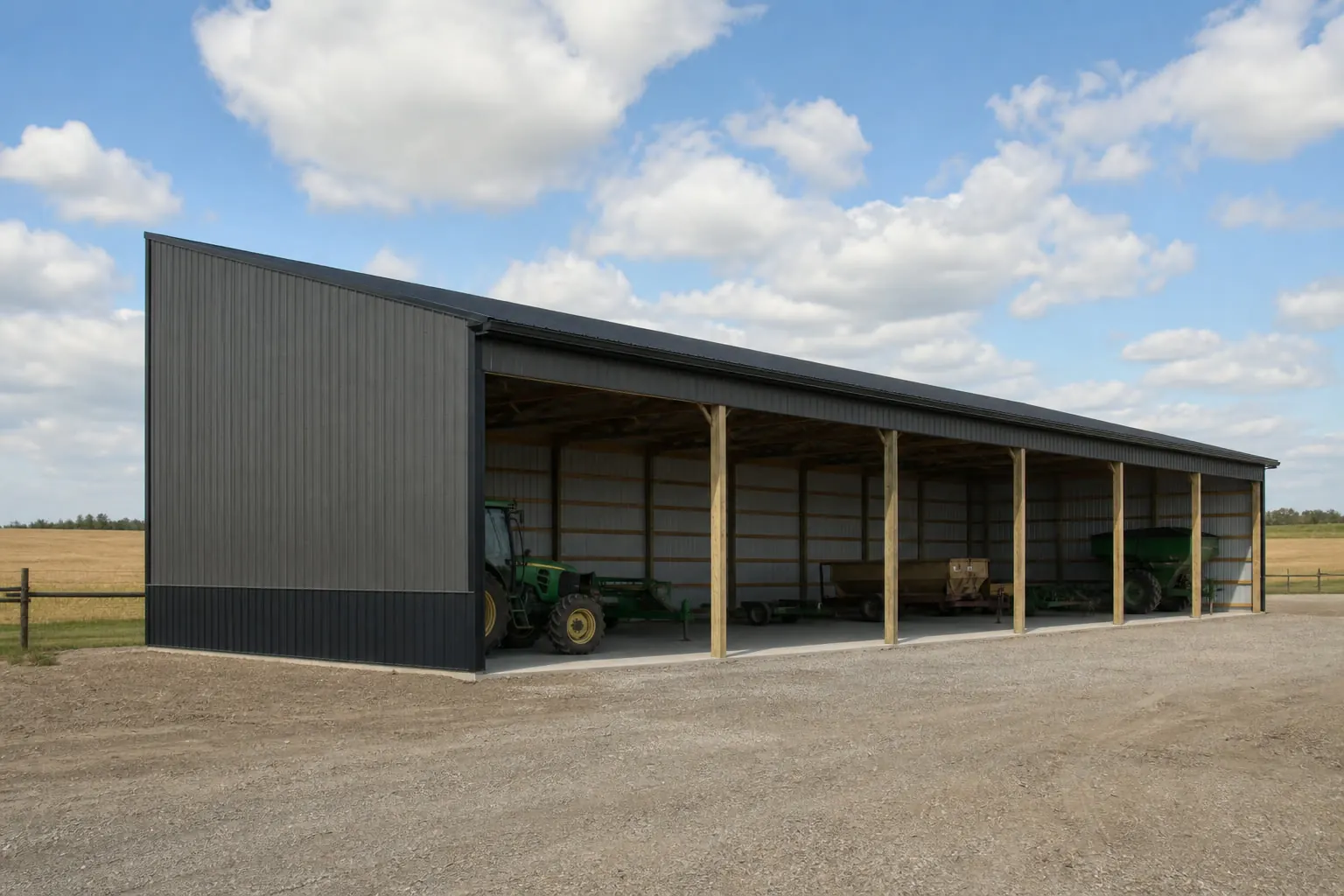
The intersection
What a Wisconsin farm actually asks an equipment shed to do
The shed's job is set by what the operation runs, and Wisconsin's operations skew dairy and mixed-use on consolidated acreage.
USDA's 2022 Census of Agriculture counted 6,216 dairy farms in Wisconsin as of December 31, 2022, with the state producing just over 3.5 billion pounds of cheese that year. Dairy operations run a distinct equipment set — feed handling, manure management and milking-support machinery — alongside the tillage, planting and harvest equipment any row-crop or hay operation needs. A Wisconsin equipment shed brief is disproportionately likely to be storing both categories under one roof, which is a different sizing and bay-division problem than a single-crop operation elsewhere.
That brief sits on a farm base that is consolidating: 58,521 farms in 2022, down 10% from 2017, with land in farms holding at 13,784,678 acres and average farm size rising to 236 acres. Fewer, larger operations tend to specify fewer, larger equipment sheds rather than a scatter of small single-purpose structures, which is the honest reason multi-bay Wisconsin equipment-shed enquiries run wider than a single-implement building.
There is also a foundation-and-apron question specific to Wisconsin's winters. NOAA NCEI's narrative description of the state's climate calls it a continental climate with cold, snowy winters driven by Great Lakes and Canadian air masses, and NCEI's own 1991-2020 U.S. Climate Normals dataset is the basis local building departments use to characterize freeze-thaw behavior for a given site. Nothing here converts that into a frost-depth number — that comes from your local building department — but a shed apron that heaves with repeated freeze-thaw cycles slows daily equipment movement all winter long, not just after one storm, which is a stronger argument for a well-prepared base here than in a milder climate.
Exposure
Snow-shedding geometry is the recurring Wisconsin detail
Statewide normals near 51 inches of annual snowfall, per the Wisconsin State Climatology Office's 1991-2020 averages, make roof pitch and eave clearance a planning conversation, not an afterthought.
This is a station normal, not a design value, and nothing here converts it into a snow load — that number comes from your local building department based on your specific site. What the normal does usefully flag is that an open-bay building storing tall equipment needs enough eave height and roof geometry to shed accumulated snow away from doorways and equipment access, and that drift patterns against a shed's windward wall are worth discussing with your builder before the site is graded.
Door clearance compounds this: equipment stored under a shed roof in a snowy state needs enough vertical clearance to account for accumulated snow at the apron without forcing a slower, more careful approach every time a piece of machinery moves in or out.
- Eave height for tall implements
- Confirm clearance accounts for the tallest equipment stored, plus a margin for apron snow accumulation.
- Drift-aware siting
- Discuss prevailing wind direction with your builder before fixing the shed's orientation relative to other buildings.
- Apron and approach
- The area equipment crosses daily takes the heaviest snow-and-mud wear; plan surfacing alongside the shed, not after it.
Configuration
What Wisconsin equipment sheds are usually asked to store
Dairy-and-field mixed use is the common brief, so bay division matters more than total footprint alone.
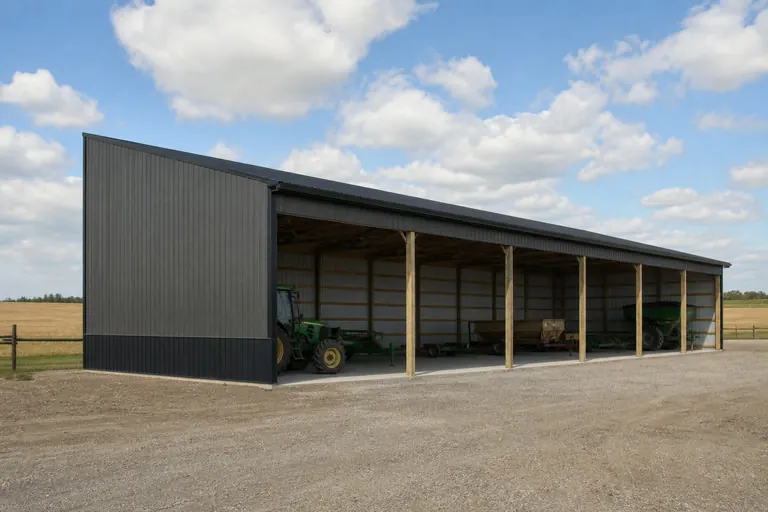 Dairy-support equipmentFeed handling and manure-management machinery, often needing a dedicated wash-down or lower-finish bay separate from cleaner storage.Field and tillage equipmentTractors, planters and harvest implements needing generous door width and depth for seasonal rotation in and out.Combined multi-bay storageA single shed dividing dairy-support and field equipment into separate bays under one roofline, the common brief on consolidated acreage.
Example Configuration — for planning purposes only.
Get Wisconsin equipment shed quotes
Tell us your equipment mix, bay count and rough footprint. We route it with the Wisconsin and equipment-shed context already attached.
Footprint
Sizes that suit a Wisconsin dairy-and-field operation
Multi-use, consolidated-acreage briefs tend to specify width for multiple bays before they specify extra length.
30′ × 40′
1,200 sq ft
A smaller starting footprint for a single-operation shed on a smaller remaining parcel.
40′ × 60′
2,400 sq ft
The common mid-size choice separating dairy-support and field equipment into two bays.
60′ × 80′
4,800 sq ft
Wider footprint for larger consolidated operations storing several equipment classes.
60′ × 100′
6,000 sq ft
Where seasonal rotation of both dairy and field equipment needs generous depth as well as width.
Example Configuration — for planning purposes only.
Footprint pages carry layout and door detail; this page explains why Wisconsin briefs land in this range.
Site context
How the equipment-shed brief differs across Wisconsin
The Wisconsin State Climatology Office publishes divisional rather than one statewide climate normal, and farm density varies enough across the state's 54,157.8 square miles to matter for siting.
Northern interior
Colder, snowier divisional normals mean roof pitch and eave clearance are worth confirming with a local builder rather than assuming the statewide 51-inch snowfall average applies evenly.
Southern and central dairy belt
Home to the bulk of the state's 6,216 dairy farms and much of its consolidated acreage; the dual dairy-and-field equipment brief shows up here more than anywhere else in the state.
Lake Michigan corridor
Lake-effect moisture and snow show up in the divisional climate data as a distinct microclimate; a local contractor's read on site-specific exposure beats a statewide assumption near the shoreline.
Preparation
Before you request a Wisconsin equipment-shed quote
Resolving these in advance keeps the quote comparable to what you actually need.
Step 1
Contact your local building department
Snow-load values, permit thresholds and agricultural-exemption questions are set locally; confirm before finalizing dimensions.
Step 2
List every equipment category by name
Dairy-support and field machinery have different clearance and access needs; naming them prevents an undersized bay.
Step 3
Confirm eave height against your tallest implement
Include a margin for apron snow accumulation, not just the equipment's static height.
Step 4
Plan the apron and approach with the building
Retrofitting surfacing after the shed is built is the more expensive order of operations.
Step 5
Ask your county about hazard exposure
FEMA's National Risk Index defines and scores 18 natural hazard types at the county level, including winter weather and inland flooding relevant to a Wisconsin farm site; check your county's NRI profile alongside your building department's requirements.
Questions
Wisconsin equipment shed questions
Questions we can answer honestly at state level, with the rest routed to whoever owns them.
Permit requirements depend on your jurisdiction, parcel and any agricultural exemptions that may apply. Your local building department is the only reliable source for that answer.
We do not state snow load values here. Statewide normals put annual snowfall near 51 inches, but the design snow load for your specific site comes from your local building department, not a statewide average.
There is no official typical size. Consolidated operations averaging 236 acres commonly specify multi-bay sheds from 40x60 up to 60x100 to separate dairy-support and field equipment, but your program should drive the footprint.
Many Wisconsin operations do separate them, since dairy-support machinery often needs a lower-finish, wash-down-friendly bay distinct from cleaner field-equipment storage. Whether that applies to you depends on your specific operation.
We do not publish state-level prices, since specification, site work and current material pricing all drive the number. Our cost pages explain what drives cost; a quote covers your building.
Sources for the Wisconsin facts on this page
This page states no code requirement, wind speed, snow load, permit rule, price or supplier claim. The state-specific facts it does use are listed with their publisher below.
As of December 31, 2022, Wisconsin had 6,216 dairy farms, and Wisconsin produced just over 3.5 billion pounds of cheese in 2022.
U.S. Department of Agriculture (USDA) · 2022 · Tier 1
https://www.usda.gov/about-usda/news/blog/wisconsin-2022-census-agriculture-highlightsWisconsin had 13,784,678 acres of land in farms in 2022, an average farm size of 236 acres, up 7% since 2017.
USDA NASS · 2022 · Tier 1
https://www.nass.usda.gov/Publications/AgCensus/2022/Online_Resources/County_Profiles/Wisconsin/cp99055.pdfWisconsin had 13,784,678 acres of land in farms in 2022, an average farm size of 236 acres, up 7% since 2017.
USDA NASS · 2022 · Tier 1
https://www.nass.usda.gov/Publications/AgCensus/2022/Online_Resources/County_Profiles/Wisconsin/cp99055.pdfWisconsin had 58,521 farms in 2022, down 10% from 2017.
USDA National Agricultural Statistics Service (NASS) · 2022 · Tier 1
https://www.nass.usda.gov/Publications/AgCensus/2022/Online_Resources/County_Profiles/Wisconsin/cp99055.pdfWisconsin's statewide 1991-2020 annual normal precipitation is about 34.9 inches with roughly 51 inches of annual snowfall, per the Wisconsin State Climatology Office's statewide averages.
Wisconsin State Climatology Office (UW-Madison) · 1991-2020 · Tier 2
https://climatology.nelson.wisc.edu/wisconsin-historic-climate-data/statewide-climate-normals/Wisconsin's total land area was measured at 54,157.8 square miles as of the 2010 Census, ranking 25th among states.
U.S. Census Bureau · 2010 Census · Tier 1
https://www.census.gov/geographies/reference-files/2010/geo/state-local-geo-guides-2010/wisconsin.htmlNOAA NCEI publishes a narrative 'Climate of Wisconsin' describing the state's continental climate with cold, snowy winters influenced by the Great Lakes and Canadian air masses.
NOAA National Centers for Environmental Information (NCEI) · Historical narrative (NCEI climate normals series) · Tier 1
https://www.ncei.noaa.gov/data/climate-normals-deprecated/access/clim60/states/Clim_WI_01.pdfFEMA's National Risk Index dataset defines and scores 18 natural hazard types (avalanche, coastal flooding, cold wave, drought, earthquake, hail, heat wave, hurricane, ice storm, inland flooding, landslide, lightning, strong wind, tornado, tsunami, volcanic activity, wildfire, winter weather) at the county level nationwide, including all 72 Wisconsin counties.
Federal Emergency Management Agency (FEMA) · Current NRI release · Tier 1
https://www.fema.gov/about/openfema/data-sets/national-risk-index-data