
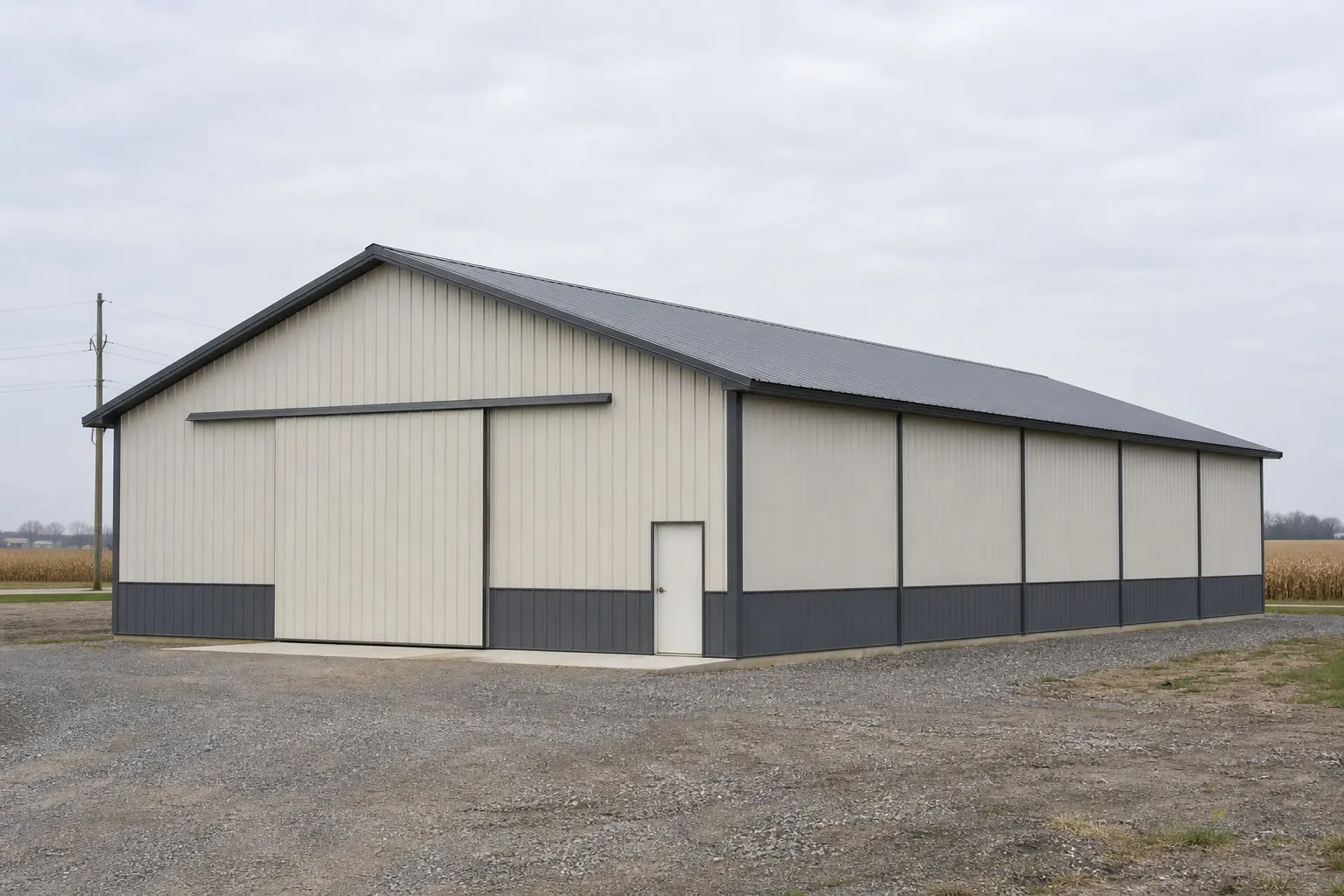
Pole barn · WV
Pole Barns in West Virginia
West Virginia's 22,787 farms average just 156 acres apiece, down from 23,622 in 2017 — a small enough parcel that most owners plan for one flexible pole barn rather than a cluster of purpose-built buildings. Sitting that single building is the harder part of the project: the state splits mainly between the Appalachian (Allegheny) Plateau and the Valley and Ridge province, with karst terrain mapped across specific eastern counties including Greenbrier, Pocahontas, Randolph and Monroe. Getting the pad graded and drained correctly on that ground matters more here than in flatter agricultural states.
Program
Why one flexible pole barn beats several small ones here
West Virginia's average farm has shrunk to 156 acres, tighter than the multi-hundred-acre operations common in larger agricultural states, which reshapes the pole barn brief.
The 2022 Census of Agriculture counted 22,787 farms across 3,549,104 acres in West Virginia, an average of 156 acres per farm — and that farm count is itself down from 23,622 in 2017. On a parcel that size, dedicating separate buildings to equipment, hay and livestock the way a larger operation might is often impractical, since there is less acreage to spread structures across without eating into usable pasture or crop ground; a single building that flexes across two or three uses fits the arithmetic of a 156-acre parcel better than a cluster of purpose-built ones.
That consolidation raises the stakes on layout. Door placement, clear-span width, and where utilities enter the building all have to serve multiple functions well rather than one function perfectly, since there usually isn't a second structure to pick up the slack.
This is a planning consequence of the state's farm statistics, not a fixed rule — a buyer with a larger-than-average parcel may still choose separate buildings. On a site sitting near or below the 156-acre average, though, sizing one adaptable pole barn correctly the first time carries more consequence than it would on a larger, multi-building operation, since a mis-sized single building has no second structure to absorb the overflow.
Site context
Grading and access across West Virginia's terrain
The two dominant physiographic provinces WVGES identifies behave differently once you're trying to get a level post-frame pad in place.
Appalachian (Allegheny) Plateau
Covers much of the state with steep ridges and narrow valleys. Expect cut-and-fill grading and a confirmed delivery-truck access route before finalizing a footprint here.
Valley and Ridge province
Alternates long ridgelines with flatter valley floors; valley-floor sites are often the easier pad-prep option in this province, though they can sit closer to streams draining the surrounding ridges.
Karst-mapped eastern counties
WVGES documents karst terrain in tax districts including Greenbrier, Pocahontas, Randolph and Monroe counties. In these counties, checking for subsurface voids before setting post-hole locations is a reasonable step.
Small Blue Ridge portion (far eastern panhandle)
WVGES names a third, much smaller physiographic province, the Blue Ridge, covering only a sliver of the state's easternmost counties. A pole barn sited there is dealing with the steepest, most mountainous ground in the state rather than the plateau or valley conditions that describe most of West Virginia.
Climate
Planning drainage and ventilation for wet ground
The Charleston Yeager Airport 1991-2020 normal of 46.24 inches of annual precipitation and 31.5 inches of snow is a representative station figure for one part of the state, illustrating why drainage and ventilation planning matters across West Virginia's hilly ground.
Because precipitation varies with elevation across the state's mountainous terrain, no single statewide normal applies evenly; the Charleston station figure is used here as a representative citation rather than a promise for every site. The National Weather Service's Charleston office has tracked this station since 1901, which is long enough to smooth out any single unusually wet or dry year, but it is still one station in a state where higher-elevation Appalachian Plateau sites and lower-elevation valley floors can see meaningfully different totals in the same season. What is consistent regardless of elevation is that a post-frame building on sloped ground needs a drainage plan that moves water away from posts and floor rather than letting it pool against the structure.
Ridge and soffit ventilation, paired with a raised or well-drained floor, keeps stored hay or equipment dry through wet stretches. On karst-adjacent sites, surface drainage can behave unpredictably where water disappears into subsurface features rather than following a visible path, which is one more reason to walk the specific site with your builder before finalizing grading.
- Grade away from the pad
- Direct surface runoff away from posts and the building envelope on any sloped West Virginia site.
- Ventilate for humidity
- Ridge and soffit vents help manage moisture buildup during wet stretches regardless of which part of the state you're in.
Get West Virginia post-frame quotes
Tell us your county, terrain, and the single job the building needs to do; we route it with West Virginia siting context attached.
Process
A permitting environment that has been picking up pace
Census Bureau data shows West Virginia building departments authorizing more new housing units each of the last three years, a signal worth factoring into how you schedule a pole barn build.
The U.S. Census Bureau's Building Permits Survey recorded 3,406 new privately-owned housing units authorized statewide in 2022, rising to 4,014 in 2023 and 4,192 in 2024 — a 17.9% increase over that two-year stretch, with 3,515 of the 2024 total in single-family buildings. A pole barn itself is frequently exempt from residential permitting where it is purely agricultural, but a rising volume of authorized construction statewide is still a useful signal: local building departments, contractors and delivery schedules are all busier than they were two years ago.
Practically, that means asking your county building department for a current estimate of review turnaround rather than assuming last year's timeline still holds, and confirming with your builder whether their crew and material lead times reflect the same statewide uptick. Neither figure predicts your specific project's schedule, but both are reasonable questions to bring to your first planning conversation.
- Ask for a current review turnaround
- Don't assume last year's permit-office timeline; confirm it directly given the statewide increase in authorized units.
- Confirm builder and material lead times
- A busier statewide construction market can mean longer waits for both labor and materials; ask your builder for a current estimate.
Footprint
Sizes that fit a small, flexible West Virginia program
Given the 156-acre average farm and one-building-does-everything pattern, common West Virginia pole barn footprints run smaller than a large-acreage state's typical range.
24′ × 36′
864 sq ft
A compact single-purpose or light-equipment building suited to a smaller graded pad.
30′ × 40′
1,200 sq ft
A common flexible size covering equipment storage plus a small workshop bay.
40′ × 60′
2,400 sq ft
A larger combined building for equipment, hay and general storage on a site with a workable graded pad.
Example Configuration — for planning purposes only.
Footprint choice should follow the buildable, gradeable pad your specific site supports, not just the acreage on the deed.
Planning
Before finalizing a West Virginia pole barn site
These steps address terrain and permitting realities specific to West Virginia.
Step 1
Confirm karst status for your county
If your parcel is in a WVGES-mapped karst tax district, check for subsurface voids before setting post locations.
Step 2
Price grading separately from the shell
On Appalachian Plateau or Valley and Ridge slopes, site work can be a meaningful share of the total budget.
Step 3
Check your county's FEMA NRI score
Look up your specific county's hazard-type scores rather than assuming a single statewide risk level.
Step 4
Confirm delivery access
Verify a delivery truck can reach the pad on graded, sloped ground before ordering materials.
Questions
West Virginia pole barn questions
Answered honestly at state level; county-specific rules are routed to the county.
It depends on your county and how the building will be used. Permit thresholds and residential-versus-agricultural distinctions are set locally, so your county building department is the reliable source for your specific project.
Most of the state sits on the Appalachian Plateau or Valley and Ridge provinces, both of which typically require some grading to create a level pad, so site work is a larger factor in West Virginia than in flatter agricultural states.
WVGES has mapped karst terrain across specific tax districts, concentrated in counties like Greenbrier, Pocahontas, Randolph and Monroe. Check your county against WVGES mapping, and if it's listed, a subsurface check before finalizing post locations is worthwhile.
There is no official standard size. With an average farm size of 156 acres, a single flexible building tends to fit the arithmetic of the land better than several purpose-built structures, which is why common sizes here run from about 24x36 up to 40x60.
The Charleston Yeager Airport normal of 46.24 inches of annual precipitation is a representative figure, not a statewide constant given elevation variation. Regardless of your exact location, planning drainage away from the building and adequate ventilation is a sound practice statewide.
Sources for the West Virginia facts on this page
This page states no code requirement, wind speed, snow load, permit rule, price or supplier claim. The state-specific facts it does use are listed with their publisher below.
West Virginia had 22,787 farms in 2022, down from 23,622 farms in 2017.
USDA National Agricultural Statistics Service (NASS) · 2022 (with 2017 comparison) · Tier 1
https://www.nass.usda.gov/Publications/AgCensus/2022/Full_Report/Volume_1,_Chapter_1_State_Level/West_Virginia/st54_1_001_001.pdfWest Virginia had 3,549,104 acres of land in farms in 2022, an average farm size of 156 acres.
USDA NASS · 2022 · Tier 1
https://www.nass.usda.gov/Publications/AgCensus/2022/Full_Report/Volume_1,_Chapter_1_State_Level/West_Virginia/st54_1_001_001.pdfThe West Virginia Geological and Economic Survey states that West Virginia mainly has two major physiographic provinces, the Appalachian (Allegheny) Plateau and the Valley and Ridge, plus a very small portion of a third, the Blue Ridge province.
West Virginia Geological and Economic Survey (WVGES) · Reference material, current · Tier 2
https://www.wvgs.wvnet.edu/www/maps/pprovinces.htmWVGES maps karst terrain across multiple West Virginia tax districts, concentrated in the state's limestone-rich Valley and Ridge and eastern Appalachian Plateau counties (e.g., Greenbrier, Pocahontas, Randolph, Monroe).
West Virginia Geological and Economic Survey (WVGES) · WVGES reference mapping · Tier 2
https://www.wvgs.wvnet.edu/www/geology/docs/WV_Tax_Districts_Containing_Karst_Terrain.pdfCharleston Yeager Airport's 1991-2020 annual climate normal precipitation is 46.24 inches with an annual normal snowfall of 31.5 inches.
NOAA National Centers for Environmental Information (NCEI) · 1991-2020 · Tier 1
https://www.ncei.noaa.gov/access/services/data/v1?dataset=normals-annualseasonal-1991-2020&dataTypes=ANN-PRCP-NORMAL,ANN-SNOW-NORMAL&stations=USW00013866&format=jsonFEMA's National Risk Index tool provides county- and tract-level composite and hazard-specific risk scores for all 55 of West Virginia's counties across 18 natural hazard types.
Federal Emergency Management Agency (FEMA) · Current NRI release · Tier 1
https://www.fema.gov/flood-maps/products-tools/national-risk-indexWest Virginia builders and developers were authorized (by building permit) to build 4,192 total new privately-owned housing units in 2024 (3,515 in single-family buildings, 50 in 2-unit buildings, 44 in 3-4 unit buildings, and 583 in buildings of 5+ units), following a 17.9% year-over-year increase from 3,406 units in 2022 to 4,014 units in 2023.
U.S. Census Bureau · 2022-2024 · Tier 1
https://www2.census.gov/econ/bps/State/st2024a.txt