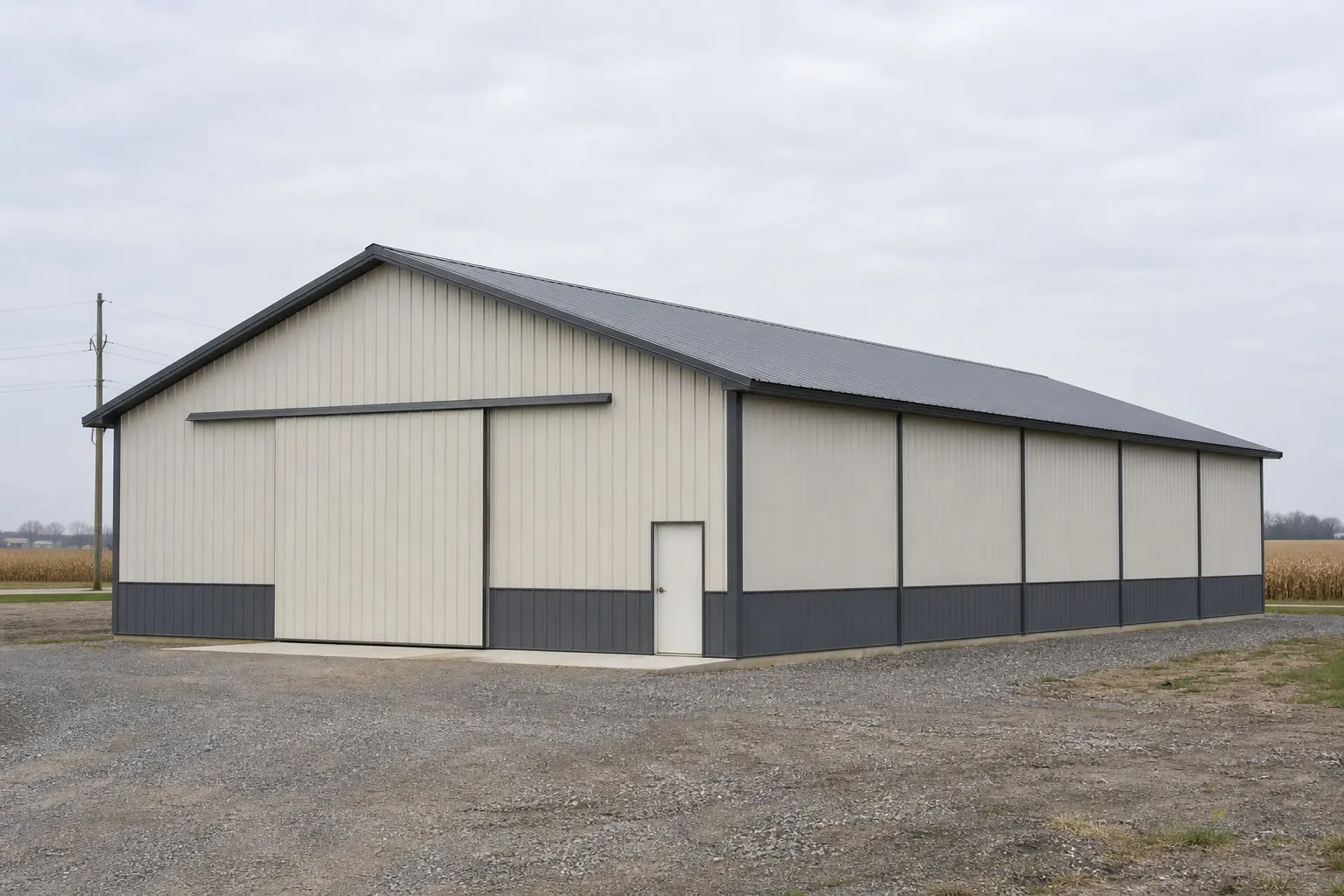
Pole barn · NC
Pole Barns in North Carolina
North Carolina's 42,817 farms, averaging 190 acres apiece, generate steady demand for post-frame storage — but the building program looks different depending on where that farm sits. USGS research maps the state into Coastal Plain, Piedmont and Blue Ridge physiographic provinces with genuinely distinct geologic settings, and NOAA's own narrative traces the state's climate from Atlantic coast to Appalachian mountains. A pole barn holding hay in the Piedmont and one holding equipment near the coast are answering to different soil, drainage and storm conditions even though the post-frame method is the same.
Regional Specs
What changes by North Carolina province
The state's three physiographic provinces set different design priorities for a post-frame building.
| Province | Typical Concern | Design Response |
|---|---|---|
| Coastal Plain | Storm exposure, sandy/high-water-table soil | Confirmed anchoring and elevated footing detail |
| Piedmont | Clay soils, seasonal wet/dry swelling | Deeper post embedment, compacted footing pads |
| Blue Ridge (Mountains) | Steeper grading, colder winters | Level pad prep, roof-load review for snow accumulation |
Coastal Plain
- Typical Concern
- Storm exposure, sandy/high-water-table soil
- Design Response
- Confirmed anchoring and elevated footing detail
Piedmont
- Typical Concern
- Clay soils, seasonal wet/dry swelling
- Design Response
- Deeper post embedment, compacted footing pads
Blue Ridge (Mountains)
- Typical Concern
- Steeper grading, colder winters
- Design Response
- Level pad prep, roof-load review for snow accumulation
Construction Strategy
Why post-frame works across three different soils
Post-frame's embedded-post design adapts well to North Carolina's varied geology, but the embedment and footing details still need to match the province.
Post-frame construction's core advantage — driving load down through a small number of deeply embedded posts rather than a continuous foundation — is well suited to North Carolina precisely because the state's geology is not uniform. USGS research documents the Coastal Plain, Piedmont and Blue Ridge as distinct physiographic provinces built on different geologic settings, and a competent post-frame design accounts for that by adjusting embedment depth and footing size to the site rather than applying one standard spec statewide.
In the Piedmont, clay soils that expand when wet and contract when dry are the more common concern; posts set below the zone of seasonal moisture swing and footed on a compacted pad resist heave better than a shallow-set alternative, an extra step that pays off over the building's working life. Near the coast, the concern shifts toward sandy soils with a higher water table and documented but variable hurricane exposure, which argues for larger footing pads and confirmed anchor connections rather than a minimum-spec approach.
Buyers on North Carolina's larger farm parcels — the state's average sits at 190 acres — often have room to site the building on the most favorable ground on the property rather than the most convenient one. Walking the site with a builder before finalizing placement is worth the extra step when soil and drainage vary this much within a single state.
The state's broader construction pace is worth factoring in too: Census Bureau data shows North Carolina's statewide housing-permit total rising 5.0% from 94,118 units in 2022 to 98,853 in 2023, a sign that a lot of rural land near active residential growth corridors is changing hands or being subdivided. A pole barn planned on the edge of that growth may end up closer to new neighbors and tighter setback scrutiny than the same building would have faced a decade earlier, which is one more reason to confirm current zoning before committing to a site.
Dimensions
Sizes that fit North Carolina farm operations
With farms consolidating onto larger average acreage, many North Carolina buyers are sizing up rather than building multiple small structures.
30′ × 40′
1,200 sq ft
A workable entry size for a single tractor bay plus limited hay or feed storage.
40′ × 60′
2,400 sq ft
A common mid-size choice for combined equipment and feed storage on a working North Carolina farm.
60′ × 100′
6,000 sq ft
Sized for larger operations consolidating storage across multiple pieces of equipment, more common on the state's larger parcels.
Example Configuration — for planning purposes only.
Confirm any agricultural building exemption status with your county before finalizing size, since exemption thresholds and definitions vary by jurisdiction rather than applying uniformly across North Carolina.
Get your North Carolina pole barn quote
Connect with post-frame builders who understand how North Carolina's provinces change site prep and design.
Environmental Resilience
Preparing for North Carolina's range of hazards
FEMA's National Risk Index tracks 18 hazard types at the county level, and North Carolina's geography means exposure varies sharply by location.
Coastal Plain counties
Documented but year-to-year variable hurricane exposure means roof-to-post connections and anchor schedules deserve engineering attention rather than a generic post-frame default; check your specific county's FEMA NRI report rather than assuming a statewide rating.
Piedmont counties
Heavy seasonal rainfall associated with storm systems that track inland after landfall makes site grading and gutter drainage a priority even away from the coast.
Blue Ridge counties
Steeper terrain and a longer cold season shift the concern toward roof snow-load review and freeze-thaw effects on exposed footings, a different profile than coastal wind exposure.
Seasonal Readiness
Protecting equipment and stored feed through the season
An open or semi-enclosed pole barn needs a maintenance rhythm suited to its province, not a single statewide checklist.
- Coastal Plain: pre-season connection checkAhead of hurricane season, inspect truss-to-post connections and confirm anchor hardware has not corroded, particularly on near-coastal sites with documented hurricane exposure.
- Piedmont: drainage swale clearingClear graded swales around the building pad before heavy spring and summer rain, since standing water on clay soil undermines post stability over time.
- Blue Ridge: roof snow-load monitoringIn the mountains, monitor roof accumulation after heavy snow events and clear it where feasible to reduce stress on purlins, a concern that coastal-plain owners rarely face given the milder winter conditions closer to the Atlantic.
- Statewide: wellhead-zone checkWhere the building sits near a private well, confirm stored fuel, fertilizer or chemicals stay outside any recommended wellhead protection distance, given how many North Carolina households depend on groundwater.
Questions
North Carolina Pole Barn FAQ
Common questions from North Carolina buyers planning post-frame storage.
Some counties offer exemptions or streamlined review for bona fide agricultural buildings, but the definition and threshold vary by county. Confirm directly with your local building department before starting construction.
Yes. USGS research treats the Coastal Plain, Piedmont and Blue Ridge as distinct physiographic provinces with different geologic settings, so post embedment depth and footing size should be evaluated for your specific site rather than copied from a build in a different province.
There is no single right answer; it depends on your equipment and storage needs. With the state's average farm size at 190 acres, many owners have room to size up, but the building itself should be sized to your actual equipment list, not the parcel size alone.
No. Hurricane exposure is concentrated toward the coastal plain and is documented as highly variable year to year. Inland Piedmont and mountain counties face different hazard profiles; pull your specific county's FEMA National Risk Index report rather than assuming a statewide figure.
It's worth checking. Since more than half of North Carolina's population depends on groundwater for drinking water, keeping fuel storage, runoff and chemical storage away from wellhead protection zones is a reasonable precaution to confirm with your county environmental health office.
Sources for the North Carolina facts on this page
This page states no code requirement, wind speed, snow load, permit rule, price or supplier claim. The state-specific facts it does use are listed with their publisher below.
North Carolina had 42,817 farms in 2022, down 8% since 2017.
USDA National Agricultural Statistics Service (NASS) · 2022 · Tier 1
https://www.nass.usda.gov/Publications/AgCensus/2022/Online_Resources/County_Profiles/North_Carolina/cp99037.pdfNorth Carolina had 8,128,136 acres of land in farms in 2022, an average farm size of 190 acres.
USDA NASS · 2022 · Tier 1
https://www.nass.usda.gov/Publications/AgCensus/2022/Online_Resources/County_Profiles/North_Carolina/cp99037.pdfUSGS-affiliated research (e.g., Scientific Investigations Report 2009-5149) characterizes North Carolina's Piedmont and Blue Ridge physiographic provinces, distinct from the state's Atlantic Coastal Plain province, based on differing regional geologic settings.
U.S. Geological Survey (USGS) · 2009 USGS report · Tier 1
https://pubs.usgs.gov/sir/2009/5149/NC State Extension publishes reference material describing groundwater conditions across the state's Piedmont and Blue Ridge provinces, noting over half of North Carolina's population depends on groundwater for drinking water.
NC State University Extension · NC State Extension reference publication · Tier 2
https://content.ces.ncsu.edu/ground-water-in-the-piedmont-and-blue-ridge-provinces-of-north-carolinaNOAA NCEI publishes a narrative 'Climate of North Carolina' describing the state's climate progression from the Atlantic coastal plain through the Piedmont to the Appalachian mountains in the west.
NOAA National Centers for Environmental Information (NCEI) · Historical narrative (NCEI climate normals series) · Tier 1
https://www.ncei.noaa.gov/data/climate-normals-deprecated/access/clim60/states/Clim_NC_01.pdfNorth Carolina's statewide total of privately-owned housing units authorized by building permits rose from 94,118 in 2022 to 98,853 in 2023, a 5.0% increase.
U.S. Census Bureau · 2023 (with 2022 comparison) · Tier 1
https://www.census.gov/construction/bps/pdf/2023annualhighlights.pdf