
Pole barn · MD
Pole Barns in Maryland
Maryland farming is small-parcel farming. USDA's 2022 Census of Agriculture counted 12,550 farms across 1,978,036 acres, for an average operation of just 158 acres, well below the scale seen in large commodity-farming states. That scale shapes the pole barn brief directly: instead of one large single-purpose building, a Maryland pole barn is usually asked to combine equipment storage, feed, and a shop bay in one shell. That mixed-use footprint has to sit somewhere across three genuinely different physiographic regions the Maryland Geological Survey names — the flat Coastal Plain, the rolling Piedmont, and the mountainous western Blue Ridge/Appalachian provinces — so the drainage and foundation questions depend on which region the parcel is actually in.
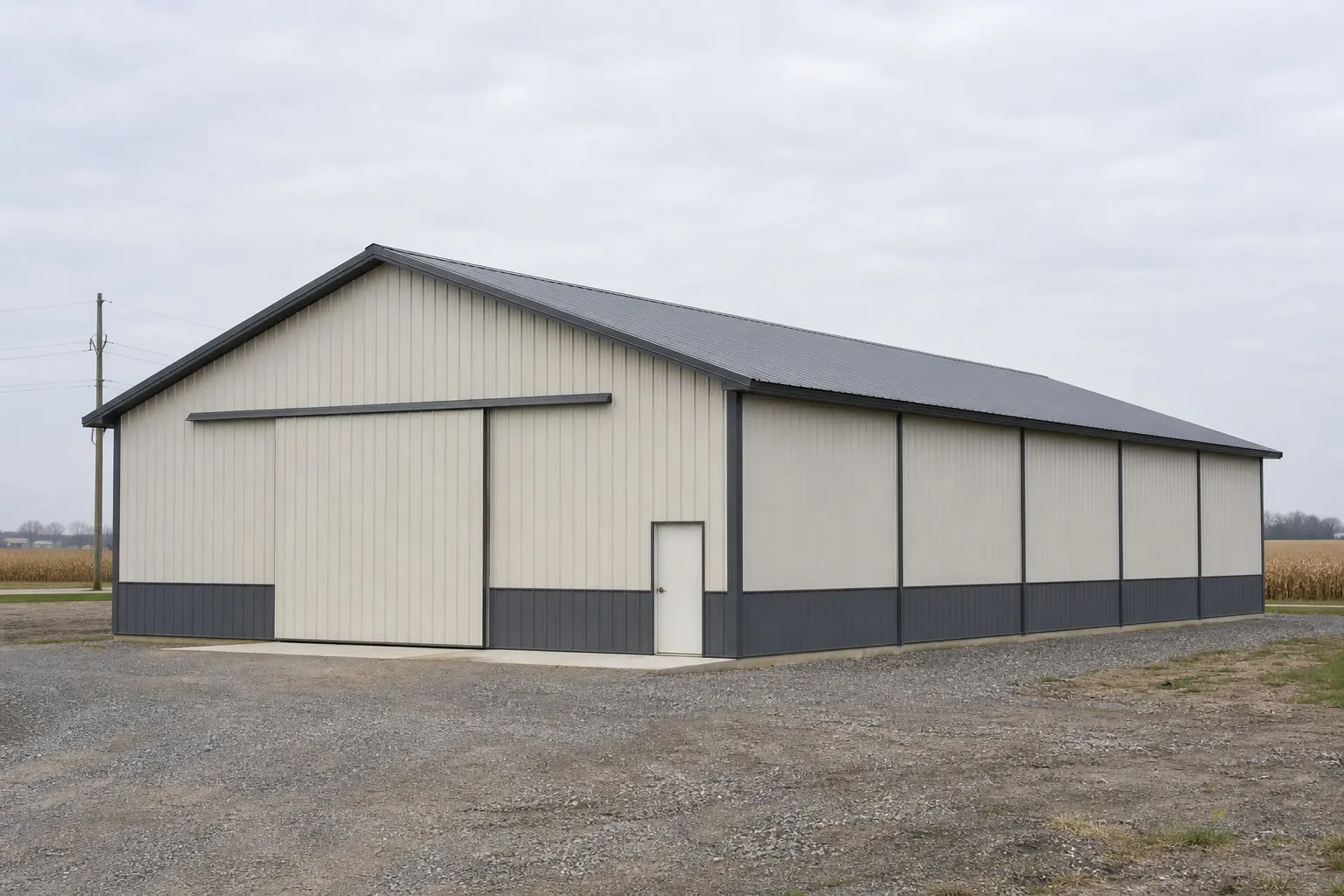
One Building, Several Jobs, Three Terrains
The defining Maryland number for pole barns is 158 acres — the average farm size across the state's 12,550 operations in USDA's 2022 Census of Agriculture. Operations at that scale rarely justify separate buildings for equipment, feed and shop work, so the pole barn becomes the whole farmstead's utility building in one shell. Where that shell goes up also matters more than in a single-terrain state: the Maryland Geological Survey names three genuinely distinct physiographic regions, and the pad, drainage and access-road plan should follow the parcel's actual region rather than a generic assumption.
Layout
Planning a Mixed-Use Pole Barn on Small Maryland Acreage
On a typical 158-acre Maryland farm, the layout question is which functions share the building and how they are separated — not just how big the barn is.
Start with the largest thing that must get inside and the route it takes to reach the barn. On smaller Maryland parcels, especially in Piedmont or western counties, the approach can involve grade changes that a flat Coastal Plain site would not, so turning radius and door clearance deserve a site visit before dimensions are finalized.
Next, decide what must be separated. Feed and equipment coexist reasonably in most farmstead layouts. Livestock and machinery need a real division for safety and air quality, and a shop bay with power and a bench should sit at one defined end rather than being an open corner of the barn.
Then plan the openings against Maryland's climate and hazard profile rather than convenience alone. FEMA's National Risk Index scores coastal flooding, hurricane and winter weather among the hazards tracked for Maryland's 24 jurisdictions, and a wide door facing the prevailing storm direction turns the barn into a wind-catcher when open. Orienting the main opening away from that direction, with a smaller personnel door on the working side, is a low-cost decision at the design stage.
Site context
Why the same pole barn plan behaves differently across Maryland
The Maryland Geological Survey's three-region description means the honest planning unit is the specific region a parcel sits in.
Coastal Plain (Eastern Shore and Southern Maryland)
Flat ground near the Chesapeake Bay and Atlantic coast where standing water and a shallow water table are the recurring pad and drainage concern, and FEMA's coastal flood and hurricane hazard categories are worth checking directly.
Piedmont (central Maryland)
Rolling terrain through the state's center, where grading and pad leveling costs are more likely to appear in a site estimate than on flat coastal ground.
Blue Ridge, Valley and Ridge, and Appalachian Plateau (western Maryland)
Mountainous western counties where slope, rock and access-road grading are the dominant site-work variables for a large-footprint pole barn.
Get pole barn quotes for your Maryland property
Tell suppliers your acreage, your county's physiographic region, and the functions the building must combine. Region and small-farm scale are what make Maryland quotes differ.
Site Work
Detailing for a Wet Coastal-Plain Site
The Baltimore-Washington area's roughly 44-46 inch annual precipitation normal has to be managed off a wide roof and away from the working yard, particularly on flat Coastal Plain ground.
Step 1
Raise the pad
A pole barn built level with surrounding grade collects water in the doorway on flat ground. Building the pad up and sloping away is the single most effective Coastal Plain detail.
Step 2
Decide gutters up front
A wide roof concentrates a large volume of water at the eave. Gutters and a routed discharge keep it out of the door apron and away from posts.
Step 3
Protect the post-to-ground interface
Wet soils and freeze-thaw cycling near the coast are hard on the base of any post-frame structure. Discuss the base detail your supplier uses.
Step 4
Harden the approach apron
The first stretch outside the door takes traffic and roof runoff together; leaving it bare soil is a leading source of year-round mud on flat sites.
Step 5
Check FEMA's National Risk Index for your jurisdiction
Coastal Plain properties near tidal water should check flood and hurricane hazard scores directly rather than assume a general statewide condition.
Footprints
Pole Barn Footprints for Maryland Operations
These reflect the mixed-use reality of Maryland's small-acreage farming rather than commodity-scale agriculture.
30′ × 40′
1,200 sq ft
Equipment plus storage for a small operation — a common Maryland starting point given the state's 158-acre average farm size.
40′ × 60′
2,400 sq ft
Allows genuine separation: equipment bay, storage and a divided shop or livestock end.
40′ × 80′
3,200 sq ft
Where the operation runs several enterprises and county rules allow the longer footprint.
Example Configuration — for planning purposes only.
Confirm setbacks, height limits and any agricultural provisions with your county before sizing.
Evidence Position
Sourced and Unsourced
The agricultural and geographic figures here are federal and state agency data; the regulatory answers are deliberately absent.
Sourced material used above: the 2022 USDA Census of Agriculture counts of 12,550 Maryland farms and 1,978,036 acres in farms, the Maryland Geological Survey's three-region physiographic description, the Baltimore-Washington area's 1991-2020 NOAA climate normal, and FEMA's National Risk Index as the federal hazard tool covering all 24 Maryland jurisdictions.
Deliberately absent: any statement about Maryland agricultural building exemptions, permit thresholds, setbacks, adopted code editions, snow loads, frost depths or prices. Those are county-level determinations, and a farm building sized from a published guess rather than the county's numbers is a costly mistake to unwind.
Questions
Maryland Pole Barn Questions
Maryland-specific answers for small-acreage buyers.
We will not state an exemption. Whether a structure is treated as agricultural, and what that means for review, is decided at the county level — ask your local building and zoning officials directly, and ask what documentation of agricultural use they expect.
With 12,550 farms averaging 158 acres statewide, most operations are small enough that one building needs to do several jobs. A 30x40 covers equipment and storage; a 40x60 allows genuine separation between equipment, storage and a shop or livestock end.
Yes. The Maryland Geological Survey describes three distinct physiographic regions — Coastal Plain, Piedmont, and the combined Blue Ridge/Valley-and-Ridge/Appalachian Plateau provinces — and drainage and foundation planning should follow whichever region your parcel is actually in.
Raise the pad above surrounding grade, gutter the roof and route the discharge away, and harden the first stretch of apron outside the door. The Baltimore-Washington area's roughly 44-46 inch annual precipitation normal has to go somewhere other than your working area.
It can be on Coastal Plain sites near the Chesapeake Bay or Atlantic coast. FEMA's National Risk Index scores coastal flooding and hurricane among the 18 hazard types tracked for Maryland's 24 jurisdictions; check your jurisdiction on the official NRI tool.
Pricing sits in the cost silo. The Maryland-variable costs are site work relative to your physiographic region, the pad and apron, and the foundation detail your local frost depth requires.
Sources for the Maryland facts on this page
This page states no code requirement, wind speed, snow load, permit rule, price or supplier claim. The state-specific facts it does use are listed with their publisher below.
Maryland had 12,550 farms in 2022, up from 12,429 in 2017.
USDA National Agricultural Statistics Service (NASS) · 2022 (with 2017 comparison) · Tier 1
https://www.nass.usda.gov/Publications/AgCensus/2022/Full_Report/Volume_1,_Chapter_1_State_Level/Maryland/st24_1_001_001.pdfMaryland had 1,978,036 acres of land in farms in 2022, an average farm size of 158 acres.
USDA NASS · 2022 · Tier 1
https://www.nass.usda.gov/Publications/AgCensus/2022/Full_Report/Volume_1,_Chapter_1_State_Level/Maryland/st24_1_001_001.pdfThe Maryland Geological Survey describes the state as spanning three distinct physiographic regions -- the Coastal Plain, the Piedmont, and the combined Blue Ridge, Valley and Ridge, and Appalachian Plateau provinces -- extending from the Atlantic coast to the western mountains.
Maryland Geological Survey · MGS reference material · Tier 2
https://www.mgs.md.gov/geology/geology_of_maryland.htmlFEMA's National Risk Index is the federal tool for county- and state-level natural hazard exposure data for Maryland's 24 jurisdictions, covering 18 hazard types including coastal flooding, hurricane, and winter weather.
Federal Emergency Management Agency (FEMA) · Current NRI release · Tier 1
https://www.fema.gov/flood-maps/products-tools/national-risk-indexThe BWI Airport (Baltimore/Annapolis area) NOAA 1991-2020 climate normals show total annual precipitation of roughly 44-46 inches spread fairly evenly across the year.
NOAA National Centers for Environmental Information (NCEI) · 1991-2020 · Tier 1
https://www.ncei.noaa.gov/access/services/data/v1?dataTypes=MLY-TMAX-NORMAL%2CMLY-TMIN-NORMAL%2CMLY-TAVG-NORMAL%2CMLY-PRCP-NORMAL%2CMLY-SNOW-NORMAL&dataset=normals-monthly-1991-2020&format=pdf&stations=USW00013752