
Pole barn · CT
Pole Barns in Connecticut
Connecticut farming happens on small parcels. The 2022 Census of Agriculture counted 5,058 farms in the state working 372,014 acres in total, and the state itself covers only 4,842.4 square miles of land. That scale changes what a pole barn is for. Instead of one large building dedicated to one crop or one herd, the Connecticut pole barn is usually a mixed building: equipment on one end, hay or feed in the middle, a shop bay or livestock at the other. Designing for that mix — in a climate whose benchmark station records about 43 inches of annual precipitation — is what this page covers.
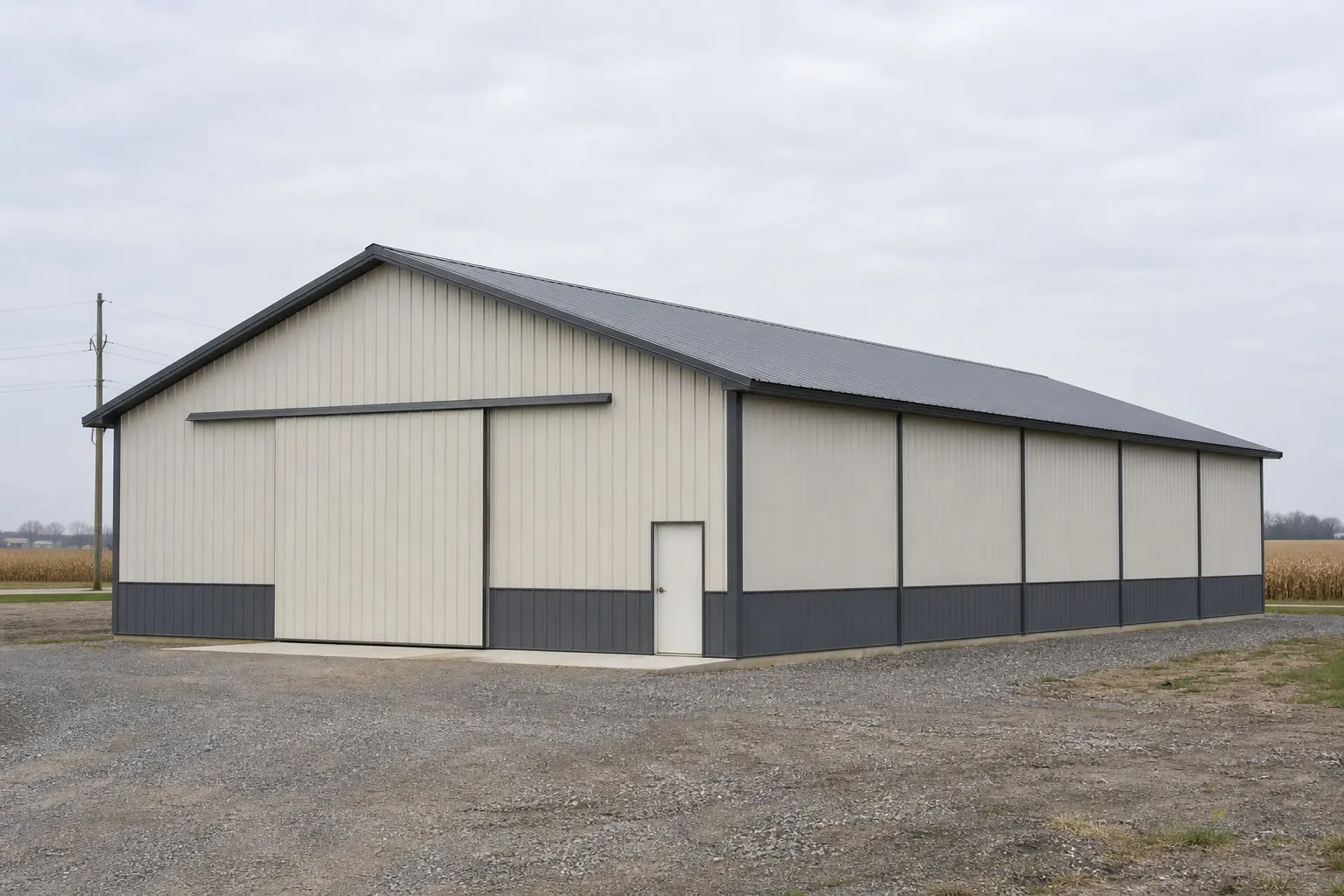
One Building, Several Jobs
The defining Connecticut number for pole barns is 372,014 acres of farmland spread across 5,058 farms. Operations at that scale rarely justify separate buildings for equipment, storage and livestock, so the pole barn becomes the whole farmstead in one shell. That has a design consequence most generic guides skip: the interior has to be divided sensibly, the openings have to be placed for the equipment that actually needs to pass through, and the roof has to be tall enough at the working end without making the storage end wasteful to heat or awkward to load. Getting the mix right at the drawing stage is much cheaper than adding a lean-to two years later.
Layout
Planning a Mixed-Use Pole Barn on Small Acreage
On a Connecticut farm the layout question is which functions share the building and how they are separated — not just how big the barn is.
Start with the largest thing that must get inside and the path it takes to get there. On small Connecticut parcels the approach is often a curved or narrow farm track, and a tractor with an implement needs turning space outside the door as well as clearance through it. Buyers regularly buy enough width and then discover the equipment cannot line up on the approach; the fix is site planning, not a bigger building.
Next, decide what must be separated. Hay and equipment coexist reasonably. Livestock and machinery need a real division for both safety and air quality. A shop bay with power and a bench wants to be dry and, if it is used through the winter, at least partly insulated — which means it should sit at one end with a defined boundary rather than being an open corner of the barn.
Then plan the openings around Connecticut weather rather than convenience. A wide door facing the prevailing storm direction turns the barn into a wind-catcher when it is open, and FEMA scores hurricane and winter weather among the hazards for Connecticut counties. Placing the main opening on a sheltered elevation, and adding a smaller personnel door on the working side, is a cheap decision at design stage.
Site Work
Detailing for a Wet Connecticut Site
About 43 inches of annual precipitation at the state's benchmark station has to be managed off a wide roof and away from the working yard.
- Raise the padA pole barn built level with the surrounding grade collects water in the doorway. Building the pad up and sloping away is the single most effective Connecticut detail.
- Decide gutters up frontA wide roof concentrates a large volume of water at the eave. Gutters and a routed discharge keep it out of the door apron and away from posts.
- Protect the post-to-ground interfaceWet soils and freeze-thaw cycling are hard on the base of any post-frame structure. Discuss the base detail your supplier uses and how it handles persistent moisture.
- Harden the approach apronThe first ten feet outside the door takes the traffic and the roof runoff together. Leaving it as bare soil is a leading source of year-round mud.
- Ask about wetlands reviewConnecticut towns have wetlands commissions with their own jurisdiction. If any part of your site is near a watercourse or wet area, ask early — this can add time.
- Plan the snow shed lineWinter weather is among the hazards FEMA scores for Connecticut counties. Where the roof sheds should not be where you walk, park or open a door.
Get pole barn quotes for your Connecticut property
Tell suppliers your acreage, the functions the building must combine, and your town. Mixed-use requirements are what make Connecticut quotes differ.
Footprints
Pole Barn Footprints for Connecticut Operations
These reflect the mixed-use reality of small-acreage farming rather than commodity-scale agriculture.
30′ × 40′
1,200 sq ft
Equipment plus storage for a small operation — the common Connecticut starting point on limited acreage.
40′ × 60′
2,400 sq ft
Allows genuine separation: equipment bay, storage and a divided shop or livestock end.
40′ × 80′
3,200 sq ft
Where the operation runs several enterprises and the parcel and town rules allow the longer footprint.
Example Configuration — for planning purposes only.
Confirm setbacks, height limits and any agricultural provisions with your town before sizing.
Site Context
Where Connecticut Pole Barns Go Up
The state's farmland is not concentrated in one belt, and each context asks something different of the building.
River valley farmland
The state's most productive ground and also its wettest working conditions in spring. Pad height, apron hardening and drainage are the priorities, and the benchmark precipitation figure of about 43 inches comes from a station in this part of the state.
Northwest hill farms
Colder and snowier, with sloping sites that make the pad and access track the expensive part of the job. Snow loading questions are at their most serious here, and design values should come from the town rather than from a valley figure.
Farms adjoining residential neighbourhoods
With 4,842.4 square miles of land area, Connecticut farms frequently abut houses. Building placement, lighting, noise and odour management become part of the approval conversation, and how the town classifies the structure matters.
Evidence Position
Sourced and Unsourced
The agricultural and geographic figures here are federal; the regulatory answers are deliberately absent.
Sourced material used above: the 2022 USDA Census of Agriculture counts of 5,058 Connecticut farms and 372,014 acres in farms, the Census land-area measurement of 4,842.4 square miles, NOAA NCEI 1991-2020 normals for the Hartford Brainard Field station, and FEMA's National Risk Index as the federal hazard tool covering Connecticut counties.
Deliberately absent: any statement about Connecticut agricultural building exemptions, permit thresholds, setbacks, adopted code editions, snow loads, frost depths or prices. Those are town-level determinations, and a farm building sized from a published guess rather than the town's numbers is a costly mistake to unwind.
Questions
Connecticut Pole Barn Questions
Connecticut-specific answers for small-acreage buyers.
We will not state an exemption. Whether a structure is treated as agricultural, and what that means for review, is decided locally — ask your town's building and zoning officials directly, and ask what documentation of agricultural use they expect.
With 5,058 farms working 372,014 acres statewide, most operations here are small and need one building doing several jobs. A 30x40 covers equipment and storage; a 40x60 allows genuine separation between equipment, storage and a shop or livestock end.
Raise the pad above surrounding grade, gutter the roof and route the discharge away, and harden the first stretch of apron outside the door. About 43 inches of annual precipitation at the state's benchmark station has to go somewhere other than your working area.
It can. Connecticut towns have wetlands commissions with their own jurisdiction, so if your site is near a watercourse or wet ground, raise it before you design. This is a timeline issue as much as a design one.
Away from the prevailing storm direction where the site allows. A wide opening is a wind-catcher, and hurricane and winter weather are both among the hazards FEMA scores for Connecticut counties.
Pricing sits in the cost silo. The Connecticut-variable costs are site work on a sloped or wet parcel, the pad and apron, and the foundation detail your local frost depth requires.
Sources for the Connecticut facts on this page
This page states no code requirement, wind speed, snow load, permit rule, price or supplier claim. The state-specific facts it does use are listed with their publisher below.
Connecticut had 5,058 farms in 2022, down 8% from 2017.
USDA National Agricultural Statistics Service (NASS) · 2022 · Tier 1
https://www.nass.usda.gov/Publications/AgCensus/2022/Online_Resources/County_Profiles/Connecticut/cp99009.pdfConnecticut had 372,014 acres of land in farms in 2022, down 2% from 2017, with an average farm size of 74 acres, up 6%.
USDA NASS · 2022 · Tier 1
https://www.nass.usda.gov/Publications/AgCensus/2022/Online_Resources/County_Profiles/Connecticut/cp99009.pdfNOAA NCEI-sourced 1991-2020 normals for the Hartford Brainard Field station show about 43 inches of average annual precipitation.
NOAA National Centers for Environmental Information (NCEI) station normals, via GeoStat.org compilation · 1991-2020 · Tier 2
https://www.geostat.org/data/hartford-ct/climateConnecticut's total land area was measured at 4,842.4 square miles as of the 2010 Census, the third-smallest of any US state.
U.S. Census Bureau · 2010 Census · Tier 1
https://www.census.gov/geographies/reference-files/2010/geo/state-local-geo-guides-2010/connecticut.htmlFEMA's National Risk Index is an interactive county/tract-level tool covering 18 natural hazards, including winter weather, coastal flooding, and hurricane, that can be queried for Connecticut's counties.
Federal Emergency Management Agency (FEMA) · Current NRI release · Tier 1
https://www.fema.gov/flood-maps/products-tools/national-risk-index