
Pole barn · MN
Pole Barns in Minnesota
A Minnesota pole barn brief starts with which kind of farm is asking for it. USDA's 2022 Census of Agriculture shows 65,531 Minnesota farms, down 5% since 2017, but the size distribution beneath that number is genuinely split: 22,948 farms (about 35%) sit in the 180-plus-acre classes, while 4,401 farms (7%) are just 1 to 9 acres. That is not one farm base — it is two different buyers, one wanting a large mixed-use building for a consolidated operation and the other wanting a modest hobby or small-acreage structure. Add glacial till, outwash and loess soils that a University of Minnesota reference documents county by county, and the honest planning conversation is about your farm-size class and your ground, not a single statewide pole-barn spec.
The intersection
What a Minnesota site actually changes about a pole barn
Farm-size class and county-level soil are the two real inputs, not the building's basic design.
USDA's 2022 Census of Agriculture counted 65,531 Minnesota farms, down 5% from 2017, spread across 25,442,625 acres of land in farms. What that headline number hides is a genuinely bimodal size distribution: 22,948 farms (about 35%) sit in the 180-plus-acre classes, while 4,401 farms (7%) are just 1 to 9 acres. Those are two different pole-barn buyers. The larger-acreage group, absorbing land as smaller operations exit, tends to specify one bigger, mixed-use building covering equipment, hay and general storage. The small-acreage group more often wants a modest single-purpose structure sized to a hobby or supplemental operation, not a scaled-down version of the big farm's building.
The second input is ground, not climate alone. A University of Minnesota Agricultural Experiment Station reference, 'Soils and Land Surfaces of Minnesota,' documents glacial till, outwash and loess-derived soil parent materials county by county across the state. For a pole barn, whose structural integrity depends on post footings bearing correctly in the ground beneath them, knowing which parent material your county sits on is worth raising with your builder before footing depth and diameter are fixed — even though this page does not state a specific frost depth or bearing value, both of which are local building department questions.
The Minnesota DNR's Ecological Classification System gives a concrete way to talk about region: naming sections like the North Central Glaciated Plains or the Eastern Broadleaf Forest Province is more useful to a builder than a generic 'Minnesota' reference, since terrain and drainage genuinely differ between them.
Site context
How the site brief differs across Minnesota
Farm density, soil parent material and regional climate all vary enough across the state to matter for siting.
North Central Glaciated Plains
A DNR-named section where glaciated terrain and till soils shape drainage and footing decisions differently than in unglaciated areas; confirm soil type with a local contractor rather than assuming a statewide default.
Consolidated southern and western farm belt
Home to much of the state's 180-plus-acre farm class; mixed-use, multi-job pole barns are the common brief here.
Small-acreage and hobby-farm parcels
Concentrated wherever the 4,401 farms in the 1-9 acre class sit; briefs here tend toward a single-purpose, smaller-footprint building rather than a mixed-use one.
Northern forested counties
Represented separately in the DNR's Ecological Classification System; site-specific soil and drainage advice from a local builder is worth more here than a statewide assumption.
Exposure
Snow-shedding roof geometry and ground bearing are the recurring details
The Minneapolis-St. Paul station's 51.2-inch annual snowfall normal and county-level soil variation both shape a pole barn's design conversation.
The MSP normal is a station figure, not a statewide design value, and the state's own evidence gap flags that northern Minnesota differs materially from it. What the normal usefully signals for the southern half of the state is that roof pitch, eave height and where snow sheds relative to doors and equipment access are worth resolving with your builder before the frame is ordered — your actual design snow load comes from your local building department based on your site.
Ground bearing matters just as much. The University of Minnesota's soils reference documents glacial till, outwash and loess-derived parent materials that differ county by county, which means the post-footing detail suited to one county is not automatically suited to its neighbor. Because a pole barn is typically unheated and its posts bear directly into native or engineered ground, confirming your county's general soil character with your builder — and your specific site's condition with a local excavator — is worth doing before footings are set.
- Roof pitch and eave clearance
- Confirm these against your regional climate and your local building department's design snow load, not the MSP normal alone.
- Footing depth and bearing
- Ask your builder what soil parent material is typical in your county before finalizing the foundation detail.
- Snow-shed zones near doors
- Site the building so sliding or accumulated snow does not block daily access points.
Get Minnesota pole barn quotes
Tell us your county, the functions the building serves and your rough footprint. We route it with the Minnesota and pole-barn context already attached.
Configuration
What Minnesota pole barns are usually asked to do
Your farm-size class shapes the brief more than any single design preference.
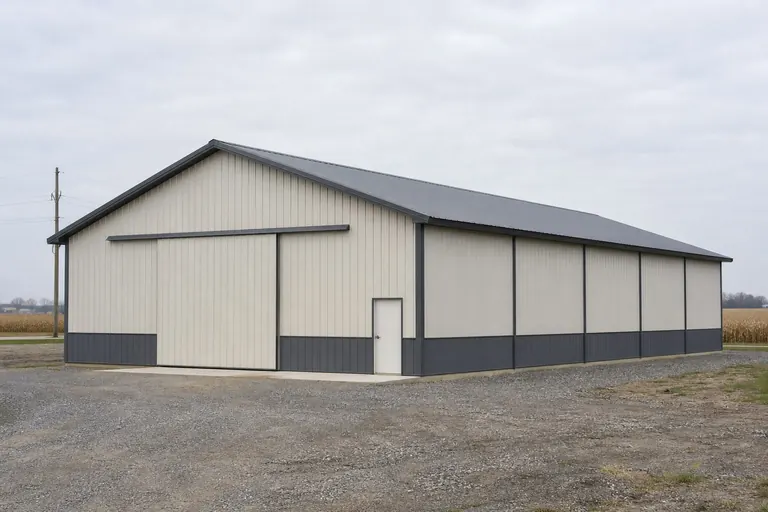 Equipment and hay, consolidated operationField equipment sharing a roof with hay storage, divided by a partition wall, on a 180-plus-acre operation.
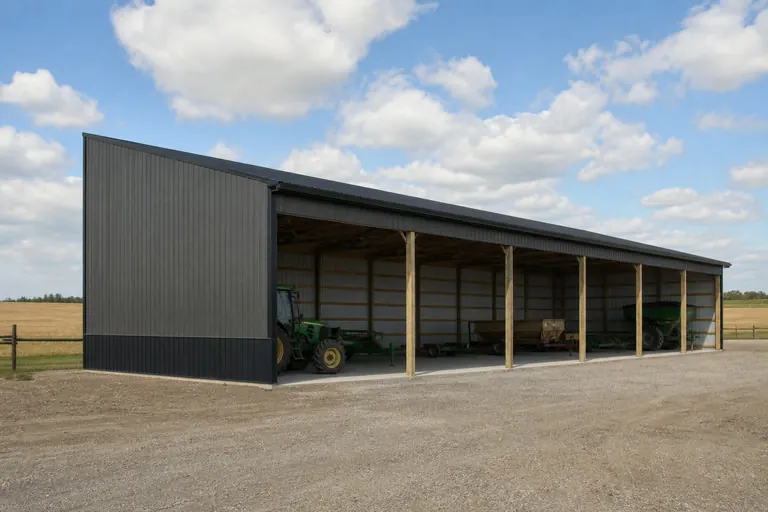 Hobby or small-acreage storageA modest single-purpose building sized for a 1-9 acre parcel's equipment and general storage needs.
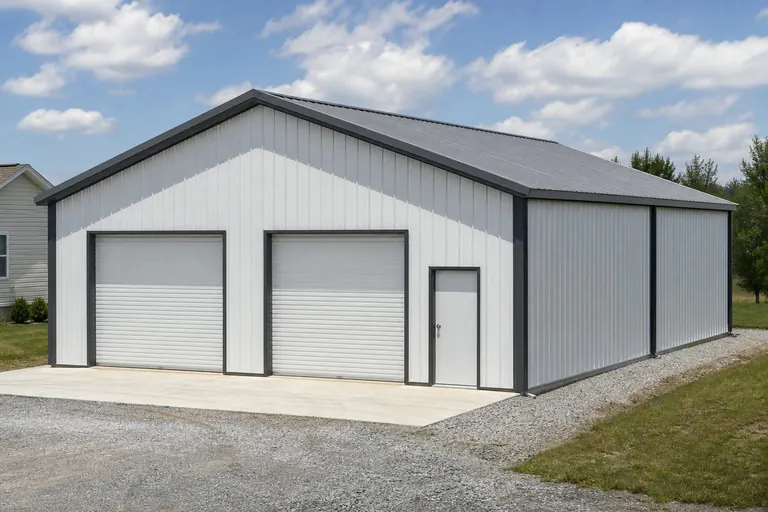 General farm and vehicle storageA mixed building for trucks, trailers and general storage on a mid-size remaining parcel.
Example Configuration — for planning purposes only.
Footprint
Sizes that suit either side of Minnesota's farm-size split
The 180-plus-acre class and the 1-9 acre class specify very different footprints.
24′ × 36′
864 sq ft
A common choice for the state's smaller-acreage class wanting single-purpose storage.
40′ × 60′
2,400 sq ft
The common mixed-use choice for a consolidated operation dividing equipment and hay storage.
60′ × 80′
4,800 sq ft
Where a larger 180-plus-acre operation wants equipment, hay and general storage under one roof.
Example Configuration — for planning purposes only.
Footprint pages carry layout and door detail; this page explains why Minnesota briefs split across this range.
Preparation
Before you request a Minnesota pole barn quote
Five things resolved in advance make quotes comparable.
Step 1
Contact your local building department
Snow load, permit thresholds and agricultural exemptions are set locally; ask before finalizing dimensions.
Step 2
Identify which farm-size class you're building for
A 180-plus-acre mixed-use brief and a small-acreage single-purpose brief are priced and sized differently; be specific with your builder.
Step 3
Name your DNR ecological section or region
Tell your builder whether the site is in the North Central Glaciated Plains, the Blufflands, or another named section.
Step 4
State every function the building serves
A mixed-use brief priced as single-use is a common cause of re-quoting.
Step 5
Review your county's hazard profile
FEMA's National Risk Index reports a mean composite score of 42.4 across the state's 87 counties, but individual counties vary; check yours specifically alongside your building department's requirements.
Questions
Minnesota pole barn questions
Questions answered honestly at state level; the rest routed to whoever owns them.
Permit requirements depend on your jurisdiction, parcel and use, including any agricultural exemptions. Your local building department is the only reliable source.
We do not state snow load values. The Minneapolis-St. Paul station's normal is 51.2 inches of annual snowfall, but northern Minnesota differs materially, and your actual design snow load comes from your local building department based on your site.
There is no single typical size. USDA data shows a bimodal farm-size split — 35% of farms at 180-plus acres and 7% at 1-9 acres — so briefs range widely; your program should set the footprint, not a statewide norm.
Yes, in principle: a University of Minnesota reference documents glacial till, outwash and loess-derived soils that vary by county. We do not state a specific foundation spec here; ask your builder and local building department what your county's soil requires.
The state's own evidence indicates the Minneapolis-St. Paul climate normal does not represent northern Minnesota well; discuss your specific region's exposure with a local builder rather than assuming a single statewide figure.
We do not publish state-level prices, since specification, site work and material pricing drive the number. Our cost pages explain what drives cost; a quote covers your building.
Sources for the Minnesota facts on this page
This page states no code requirement, wind speed, snow load, permit rule, price or supplier claim. The state-specific facts it does use are listed with their publisher below.
Minnesota had 65,531 farms in 2022, a 5% decrease since 2017.
USDA National Agricultural Statistics Service (NASS) · 2022 · Tier 1
https://www.nass.usda.gov/Publications/AgCensus/2022/Online_Resources/County_Profiles/Minnesota/cp99027.pdfOf Minnesota's 2022 farms, 22,948 (about 35%) fall in the 180+ acre size classes, while 4,401 farms (7%) are 1 to 9 acres.
USDA NASS · 2022 · Tier 1
https://www.nass.usda.gov/Publications/AgCensus/2022/Online_Resources/County_Profiles/Minnesota/cp99027.pdfMinnesota had 25,442,625 acres of land in farms in 2022, with an average farm size of 388 acres, up 5% since 2017.
USDA NASS · 2022 · Tier 1
https://www.nass.usda.gov/Publications/AgCensus/2022/Online_Resources/County_Profiles/Minnesota/cp99027.pdfMinneapolis-St. Paul's 1991-2020 annual normal precipitation is 31.62 inches with 51.2 inches of annual snowfall.
NOAA National Centers for Environmental Information (NCEI) · 1991-2020 · Tier 1
https://www.ncei.noaa.gov/access/services/data/v1?dataset=normals-annualseasonal-1991-2020&stations=USW00014922&format=json&dataTypes=ANN-PRCP-NORMAL,ANN-SNOW-NORMALA University of Minnesota Agricultural Experiment Station reference, 'Soils and Land Surfaces of Minnesota,' documents the state's glacial till, outwash, and loess-derived soil parent materials county by county.
University of Minnesota Agricultural Experiment Station / MnGeo · 1980 reference publication · Tier 2
https://www.mngeo.state.mn.us/pdf/Cummins&Grigal%20soils.pdfThe Minnesota DNR's Ecological Classification System divides the state into named provinces and sections such as the Eastern Broadleaf Forest Province, the North Central Glaciated Plains Section, and the Blufflands Subsection in the southeast.
Minnesota Department of Natural Resources (DNR) · DNR reference material · Tier 2
https://www.dnr.state.mn.us/ecs/index.html