
Carport · MN
Carports in Minnesota
A Minnesota carport project starts from one of the more demanding winter climates in the country. NOAA's 1991-2020 normal for Minneapolis-St. Paul shows 51.2 inches of average annual snowfall against 31.62 inches of annual precipitation, and the National Weather Service's Duluth office notes that International Falls, in the state's north, routinely records some of the coldest January temperatures anywhere in the contiguous 48 states. Add a landscape the Minnesota DNR divides into named ecological provinces shaped by glacial till, outwash, and loess, and a carport here is planned around genuine snow-load and site-drainage questions that a milder or flatter state simply does not raise.
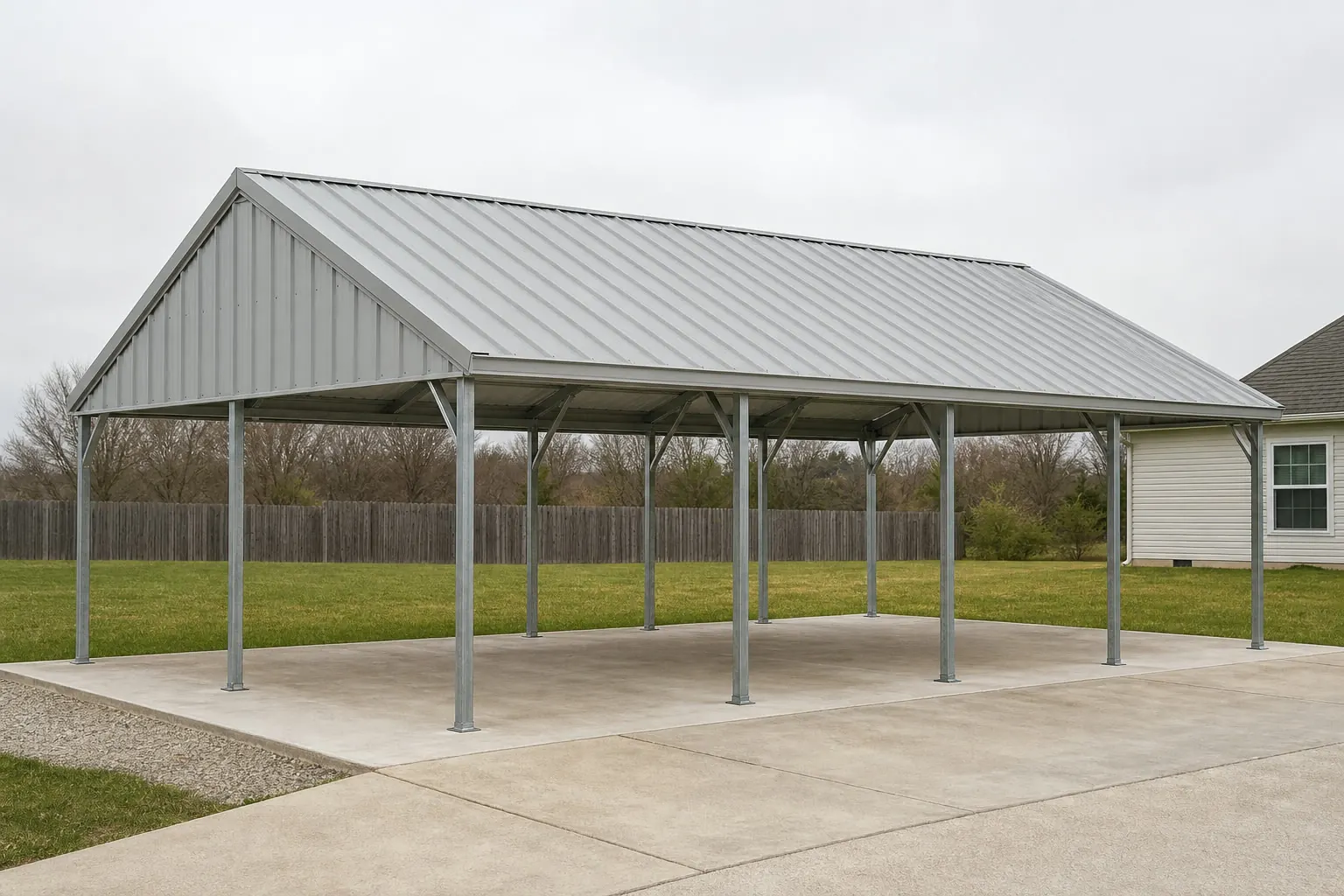
The intersection
What a Minnesota site changes about a carport
The carport itself is a standard open-sided steel structure everywhere. What differs in Minnesota is how much winter its roofline has to survive and what kind of ground it lands on.
NOAA's 1991-2020 normals for Minneapolis-St. Paul show 51.2 inches of average annual snowfall against 31.62 inches of annual precipitation. That is a heavier snow year than most of the country experiences, and an open-sided carport has no walls to redirect the load, which makes roof pitch and shed direction a real engineering conversation rather than an afterthought.
The severity is not uniform statewide. The NWS Duluth office's climate reporting notes that International Falls, in far northern Minnesota, routinely records some of the coldest January temperatures anywhere in the contiguous 48 states, with a period of record back to 1895. A carport sited near the Twin Cities and one sited near International Falls are not planning for the same winter, even though both are technically 'Minnesota' sites.
The ground itself also varies by design, not accident. The Minnesota DNR's Ecological Classification System divides the state into named provinces and sections — the Eastern Broadleaf Forest Province, the North Central Glaciated Plains Section, and the Blufflands Subsection in the southeast among them — reflecting genuinely different glacial till, outwash, and loess-derived soils documented by University of Minnesota soil scientists county by county. A carport pad on glaciated plains ground and one on southeastern blufflands terrain need different grading and drainage planning, which is why describing your specific location to a builder matters more than a single statewide description would suggest.
Site context
How Minnesota's ecological provinces change carport siting
The DNR's named provinces and sections are the clearest way to anticipate ground conditions before requesting a quote.
North Central Glaciated Plains (west and southwest)
Flatter, glacially shaped terrain with fertile till soils; generally easier grading but check drainage on low-lying ground.
Eastern Broadleaf Forest Province (central and east-central)
Mixed forest and prairie transition zone with variable soil types; a site visit clarifies grading needs quickly.
Blufflands Subsection (southeast)
Steeper, dissected terrain shaped by ancient river valleys; footing depth and slope stability deserve more attention here than on the plains.
Exposure
Snow shed and cold-weather materials are the two recurring variables
Almost every Minnesota carport conversation returns to how the roof sheds and how the structure handles sustained cold.
With 51.2 inches of average annual snowfall at the Twin Cities and materially colder conditions farther north, an open-sided carport's roofline should be oriented to shed snow away from the parked vehicle and any adjacent walk path. Deciding this at design time — not after the first heavy snowfall — is the difference between a structure that holds up all winter and one that needs constant clearing.
Sustained sub-zero cold, especially in northern Minnesota near International Falls, also affects material behavior and fastener performance differently than a milder climate. Raising this with your builder during design, rather than assuming a standard specification transfers directly from a warmer state, avoids surprises after the first deep-freeze stretch.
Because the state's glacial-till landscape varies by named DNR section, confirming your local soil and drainage conditions before finalizing a slab or gravel pad is worth the extra step, particularly on blufflands or forested transition ground where drainage is less predictable than on the open plains.
- Roof shed direction
- Confirm which way the roof sheds before fixing the carport's placement and orientation.
- Regional cold-weather exposure
- A northern Minnesota site faces materially colder conditions than a Twin Cities-area site; describe your location specifically.
- Soil and drainage by DNR section
- Glaciated plains, forested transition zones, and blufflands terrain each drain differently.
Get Minnesota carport quotes
Tell us your site's region, snow exposure, and whether this is a residential or farm-scale build. We route it with the Minnesota and carport context attached.
Configuration
What Minnesota carports are usually asked to do
Given the state's large average farm parcels and severe winters, most Minnesota carport inquiries fall into a few recurring briefs.
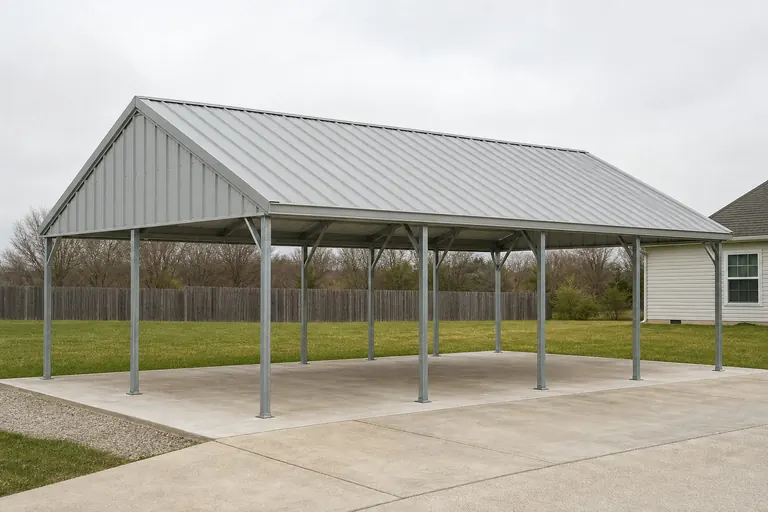 Farm equipment and vehicle coverCommon on the state's 388-acre-average farm parcels, where open ground supports equipment cover without a tight-lot constraint.Residential vehicle protectionCovered parking that eliminates daily snow-clearing on a Twin Cities-area or suburban lot.
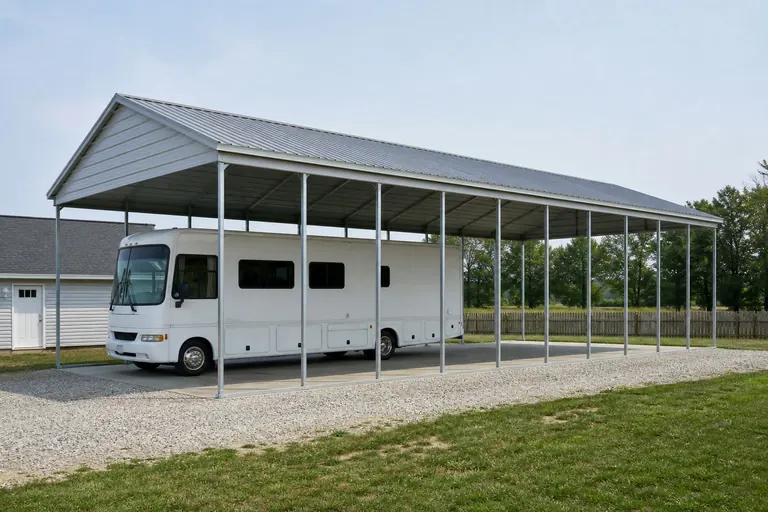 Seasonal equipment or trailer coverTaller clearance for boats, snowmobiles, or trailers common in a state with long, snowy winters.
Example Configuration — for planning purposes only.
Footprint
Sizes that fit a Minnesota site
Whether the site is a rural farm parcel or a suburban driveway changes which footprint makes sense.
12′ × 24′
288 sq ft
Single-vehicle coverage that fits a suburban driveway or tighter residential lot.
20′ × 24′
480 sq ft
Two-vehicle coverage on an established residential or small rural lot.
24′ × 36′
864 sq ft
Vehicle plus farm equipment coverage suited to a larger rural parcel.
30′ × 40′
1,200 sq ft
Multi-bay equipment and vehicle coverage where the parcel supports it.
Example Configuration — for planning purposes only.
Footprint pages carry the post spacing and layout detail; this page explains why Minnesota briefs range from residential retrofits to farm-scale coverage.
Preparation
Before you request a Minnesota quote
These items address frequent re-quote triggers for a Minnesota carport.
Step 1
Check setback and permit rules with your local building department
Requirements vary by municipality and county; confirm before fixing a footprint near a property line.
Step 2
Fix roof shed direction against snow load
Decide this before posts go in, with Minnesota's heavier snow years in mind.
Step 3
Describe your DNR ecological section, not just your town
Glaciated plains, forested transition, and blufflands terrain drain and grade differently.
Step 4
Confirm cold-weather material specs with your builder
Sustained sub-zero conditions, especially in northern Minnesota, are worth a direct conversation.
Questions
Minnesota carport questions
Honest state-level answers, with jurisdiction-specific items routed to the office that owns them.
Permit requirements depend on your municipality and county. Your local building department is the only reliable source; ask before finalizing dimensions.
We do not state design loads on this page. Minneapolis-St. Paul's NOAA normal of 51.2 inches of average annual snowfall is planning context only; your engineer and local building department determine the actual design requirement for your site.
Yes, meaningfully. The NWS Duluth office documents International Falls as routinely recording some of the coldest January temperatures in the contiguous 48 states, so a northern Minnesota site should be described to your builder as its own exposure profile rather than assumed to match a Twin Cities-area quote.
Yes. The Minnesota DNR's Ecological Classification System documents genuinely different glacial-till, forest, and blufflands terrain across the state, so grading and drainage needs vary by location — a site visit or your local building department can confirm specifics.
There's no official typical size. Inquiries range from 12x24 residential retrofits to 30x40 farm-equipment coverage, depending on the site rather than any statewide standard.
With an average farm size of 388 acres in 2022, many rural Minnesota carport sites have more open ground to work with than in states with smaller average parcels, which can simplify placement decisions.
Sources for the Minnesota facts on this page
This page states no code requirement, wind speed, snow load, permit rule, price or supplier claim. The state-specific facts it does use are listed with their publisher below.
Minneapolis-St. Paul's 1991-2020 annual normal precipitation is 31.62 inches with 51.2 inches of annual snowfall.
NOAA National Centers for Environmental Information (NCEI) · 1991-2020 · Tier 1
https://www.ncei.noaa.gov/access/services/data/v1?dataset=normals-annualseasonal-1991-2020&stations=USW00014922&format=json&dataTypes=ANN-PRCP-NORMAL,ANN-SNOW-NORMALThe NWS Duluth office's climate reports show International Falls, MN routinely records some of the coldest January temperatures in the contiguous 48 states, based on the 1991-2020 climate normal period and a period of record back to 1895.
National Weather Service (NOAA), Duluth MN office · Period of record 1895-present; normals 1991-2020 · Tier 1
https://www.weather.gov/dlh/threadexThe Minnesota DNR's Ecological Classification System divides the state into named provinces and sections such as the Eastern Broadleaf Forest Province, the North Central Glaciated Plains Section, and the Blufflands Subsection in the southeast.
Minnesota Department of Natural Resources (DNR) · DNR reference material · Tier 2
https://www.dnr.state.mn.us/ecs/index.htmlMinnesota had 65,531 farms in 2022, a 5% decrease since 2017.
USDA National Agricultural Statistics Service (NASS) · 2022 · Tier 1
https://www.nass.usda.gov/Publications/AgCensus/2022/Online_Resources/County_Profiles/Minnesota/cp99027.pdfBuilding permit offices in Minnesota authorized construction of 25,667 new privately-owned housing units in 2023 (12,770 single-family buildings plus multi-unit structures).
U.S. Census Bureau · 2023 (final annual) · Tier 1
https://www2.census.gov/econ/bps/State/st2023a.txt