
Pole barn · DE
Pole Barns in Delaware
A pole barn in Delaware is almost always a Coastal Plain building: the Delaware Geological Survey places all but the northern New Castle County hills in the low-relief Atlantic Coastal Plain, which describes essentially all of Kent and Sussex counties, where most of Delaware's working farmland sits. Delaware counted 2,158 farms in the 2022 Census of Agriculture averaging 242 acres — larger holdings than many neighbouring states — concentrated in Sussex County (1,053 farms, 262,079 acres, 32% of farmland-in-use irrigated) and Kent County (770 farms, 187,248 acres, land in farms up 3% since 2017). That combination of larger average acreage and significant irrigation is what actually shapes a Delaware pole barn brief, not a generic farm-building template.
The intersection
What a Delaware site actually changes about a pole barn
The framing system does not change across state lines. What changes in Delaware is the farm scale it usually serves and the near-uniform Coastal Plain ground it sits on.
Delaware's 2022 Census of Agriculture counted 2,158 farms covering 522,834 acres, an average of 242 acres — a larger average holding than the small-acreage pattern found in some neighbouring states. That scale matters for a pole barn because a 242-acre operation is more likely to run larger equipment and need genuine machine-shed spans, rather than a single mixed-use building serving a handful of small tasks.
Sussex County, Delaware's largest farm county by acreage, had 1,053 farms on 262,079 acres in 2022, with 32% of farmland-in-use acres reported irrigated. Irrigation infrastructure — pumps, controllers, fittings — is real building-adjacent equipment that often needs a dry, secure space near the field, and it is worth naming explicitly when you brief a builder rather than folding it silently into 'general storage.'
Kent County adds a second data point: 770 farms on 187,248 acres in 2022, with land in farms up 3% since 2017 even as the number of farms fell 6%. That is consolidation — fewer, larger operations — which tends to increase rather than decrease the size of equipment a barn needs to house.
Site context
Where Delaware pole barn sites actually sit
Delaware's farmland is concentrated in two counties on one physiographic province, which is a simpler site picture than many states offer.
Sussex County (Coastal Plain)
Delaware's largest farm county: 1,053 farms, 262,079 acres, 32% of farmland-in-use irrigated. Expect flat, low-relief ground and irrigation infrastructure to be a real factor in siting and access.
Kent County (Coastal Plain)
770 farms on 187,248 acres, with land in farms up even as farm count fell, indicating larger consolidated operations. Equipment size, not acreage count, is the planning variable here.
New Castle County (mostly Coastal Plain, Piedmont in the north)
Delaware's smallest farm base of the three counties and the only part of the state with Piedmont hill terrain in its northern reaches; a pole barn sited here is more likely to need grading than one in Kent or Sussex.
Exposure
Drainage planning on flat Coastal Plain ground
At roughly 45.3 inches of annual normal precipitation with about 20.2 inches of annual snowfall recorded at Wilmington, a Delaware pole barn spends much of its life shedding water across ground that does not slope much to help it.
That figure is a 1991-2020 NOAA station normal for Wilmington's New Castle County Airport, not a design value, and nothing here converts it into a load or a specification. Used correctly, it is a prompt: on the low-relief Coastal Plain ground that covers nearly all of Delaware's farmland, water does not drain away on its own the way it can on sloped terrain, so pad height and roof-water routing are worth deciding deliberately rather than assuming gravity will handle it.
In practice that means agreeing on finished pad height relative to surrounding grade, deciding whether gutters and downspouts are in scope from the start, and routing roof discharge away from access aprons and any adjacent irrigation infrastructure. None of this is Delaware-specific engineering; it is the detail most often skipped on flat ground and most often felt afterward.
- Pad height and grade
- Confirm the finished floor sits above surrounding grade; flat Coastal Plain sites give water fewer places to go.
- Roof water routing
- Decide gutter scope before the apron is poured, especially near irrigation equipment or wellheads.
- Approach and apron
- Plan the daily access path alongside the building, particularly where farm equipment shares the route with irrigation service vehicles.
Get Delaware pole barn quotes
Tell us your county, the equipment you need to store and whether irrigation infrastructure needs its own space. We route it with the Delaware and pole barn context already attached.
Configuration
What Delaware pole barns are usually asked to do
Larger average acreage and meaningful irrigation infrastructure shift the typical Delaware brief toward equipment scale and utility support rather than mixed small-scale use.
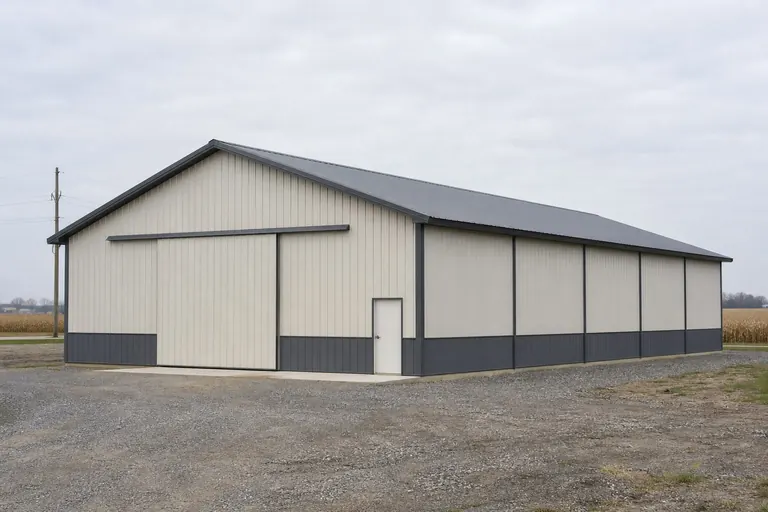 Equipment and machinery storageSized for the larger equipment a 242-acre-average operation tends to run; door height and clear span matter more here than in a small-acreage state.Irrigation and utility supportA secondary bay or attached room for pumps, controllers and fittings, particularly on Sussex County's irrigated acreage.
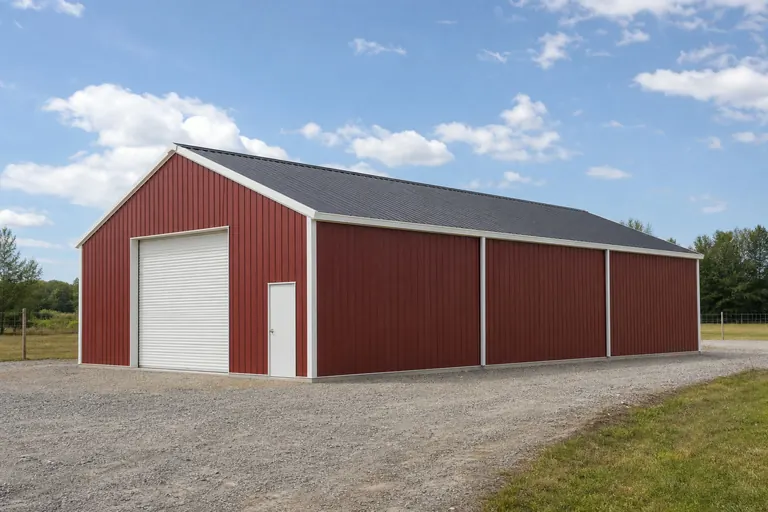 Grain, produce or general storageGeneral agricultural storage scaled to Kent and Sussex county production, kept separate from equipment bays for access reasons.
Example Configuration — for planning purposes only.
Footprint
Sizes that suit a Delaware farm building
Larger average acreage than a small-farm state pushes Delaware pole barn footprints toward the wider end of the common range.
40′ × 60′
2,400 sq ft
A working baseline for equipment storage sized to Kent and Sussex county operations.
40′ × 80′
3,200 sq ft
Where equipment storage and irrigation-support space need to be separated within one envelope.
60′ × 100′
6,000 sq ft
For larger consolidated operations, particularly where Kent County's farm-consolidation trend applies.
Example Configuration — for planning purposes only.
Footprint pages carry the layout and door detail for each of these; this page only explains why the Delaware brief lands in this range.
Preparation
Before you request a Delaware pole barn quote
Four things resolved in advance make the difference between a comparable quote and a re-quote.
Step 1
Contact your local building department
Delaware permit and setback rules are set locally; ask what your parcel and use require before finalizing the specification.
Step 2
Name your equipment, not just square footage
The size and turning radius of the machinery you run drives door and clear-span sizing more than acreage does.
Step 3
Disclose any irrigation infrastructure
Pumps, wellheads and controllers near the site can affect siting, access and whether a dedicated utility bay makes sense.
Step 4
Check the county-level Census of Agriculture profile
The USDA NASS county profiles for Kent, Sussex and New Castle counties are a useful reference point for describing your operation's scale to a builder.
Questions
Delaware pole barn questions
Questions we can answer honestly at state level, with the ones we cannot routed to whoever actually owns them.
Delaware's 2022 Census of Agriculture recorded 2,158 farms averaging 242 acres. That is a larger average holding than some neighbouring states, which is part of why Delaware pole barn briefs often call for larger equipment-storage spans.
Permit requirements depend on your jurisdiction, parcel and agricultural use classification. Your local building department is the only reliable source; we do not state permit thresholds on this page.
It can affect siting and whether you want a dedicated utility bay. Sussex County alone reports 32% of farmland-in-use irrigated, so pumps, controllers and fittings are common building-adjacent equipment worth naming when you brief a builder.
There is no official typical size. Delaware's 242-acre average farm size, larger than many neighbouring states, tends to favor equipment-storage footprints from 40x60 up to 60x100 rather than smaller mixed-use buildings.
We do not publish state-level prices, because a credible number depends on specification, site work and current material pricing. Our cost pages cover what drives the number; a quote covers your building.
USDA NASS and the Delaware Department of Agriculture jointly publish an annual Agricultural Statistics Bulletin summarizing statewide production and Census of Agriculture highlights, which is a better source for current-year detail than this page.
Sources for the Delaware facts on this page
This page states no code requirement, wind speed, snow load, permit rule, price or supplier claim. The state-specific facts it does use are listed with their publisher below.
Delaware had 2,158 farms in 2022, covering 522,834 acres of land in farms, an average farm size of 242 acres.
USDA National Agricultural Statistics Service (NASS) · 2022 · Tier 1
https://www.nass.usda.gov/Publications/AgCensus/2022/Online_Resources/Congressional_District_Profiles/cd1001.pdfSussex County, Delaware's largest county by farmland, had 1,053 farms on 262,079 acres in 2022, with 32% of farmland-in-use acres reported irrigated.
USDA NASS · 2022 · Tier 1
https://www.nass.usda.gov/Publications/AgCensus/2022/Online_Resources/County_Profiles/Delaware/cp10005.pdfKent County, Delaware had 770 farms on 187,248 acres in 2022, with land in farms up 3% since 2017 even as farm count fell 6%.
USDA NASS · 2022 · Tier 1
https://www.nass.usda.gov/Publications/AgCensus/2022/Online_Resources/County_Profiles/Delaware/cp10001.pdfThe Delaware Geological Survey states the entire state lies within two physiographic provinces, the Appalachian Piedmont and the Atlantic Coastal Plain, separated by the Fall Line; only the hills of northern New Castle County lie within the Piedmont, with the rest of the state in the low-relief Coastal Plain.
Delaware Geological Survey, University of Delaware · DGS reference material · Tier 2
https://www.dgs.udel.edu/delaware-geology/summary-geologic-history-delawareWilmington's 1991-2020 annual climate normal precipitation is about 45.3 inches with roughly 20.2 inches of annual snowfall.
NOAA National Centers for Environmental Information (NCEI) · 1991-2020 · Tier 1
https://www.ncei.noaa.gov/access/services/data/v1?dataset=normals-monthly-1991-2020&dataTypes=MLY-PRCP-NORMAL,MLY-SNOW-NORMAL&format=csv&stations=USW00013781The Delaware Department of Agriculture and USDA NASS jointly issue an annual Agricultural Statistics Bulletin summarizing statewide farm production and the 2022 Census of Agriculture highlights for Delaware.
USDA NASS / Delaware Department of Agriculture · 2022-2023 · Tier 2
https://www.nass.usda.gov/Statistics_by_State/Delaware/Publications/Annual_Statistical_Bulletin/2022/DE-2022-2023-Ag-Stats-Bulletin.pdf