
Barndominium · MD
Barndominiums in Maryland
A Maryland barndominium is planned against a state that packs an unusual amount of terrain variety into a small footprint. The Maryland Geological Survey describes the state as spanning three distinct physiographic regions — the Coastal Plain, the Piedmont, and the combined Blue Ridge, Valley and Ridge, and Appalachian Plateau provinces — from the Atlantic coast to the western mountains, so a parcel's siting, drainage and foundation questions genuinely depend on which third of the state it sits in. Layered on that terrain split is a farm base averaging 158 acres across 12,550 operations in 2022, which means most Maryland barndominium shop halves are sized for a working hobby farm rather than a large commodity ranch, and the project happens inside a residential construction market that authorized 16,823 new housing units in 2024.
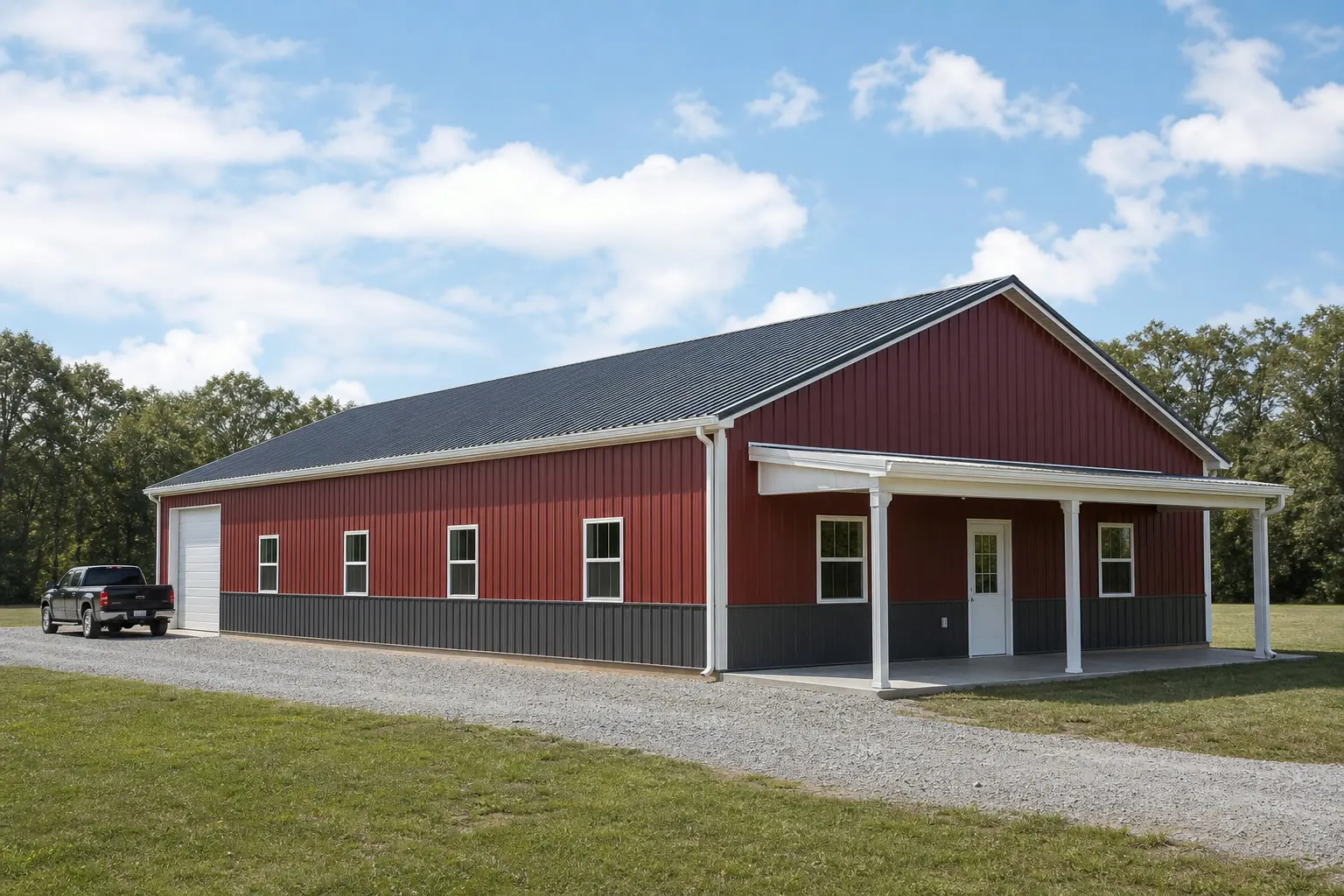
The intersection
What Maryland's three regions ask of a barndominium
The building type does not change across a county line, but Maryland compresses an unusual amount of terrain variety into a small state, and that changes the siting conversation before a plan is drawn.
The Maryland Geological Survey describes the state as spanning three distinct physiographic regions: the low, flat Coastal Plain from the Atlantic coast and Chesapeake Bay inland, the rolling Piedmont through the state's center, and the combined Blue Ridge, Valley and Ridge, and Appalachian Plateau provinces toward the western mountains. A barndominium sited on Coastal Plain ground is dealing with flat terrain and a shallow water table; one sited in the Piedmont or western mountains is dealing with slope, rock and a different drainage picture entirely. That means the honest first step for a Maryland barndominium buyer is identifying which of the three regions the parcel sits in, not assuming a single statewide condition.
Layered on top of that terrain split is a farm base that is genuinely small by national standards. USDA's 2022 Census of Agriculture counted 12,550 farms in Maryland working 1,978,036 acres, for an average operation of 158 acres — a fraction of the scale seen in Midwest or Plains ranch country. That average matters directly for barndominium planning: the shop half of the building is far more often sized for a truck, a tractor and general hobby-farm equipment than for full commodity machinery, which keeps Maryland footprints, on average, toward the smaller end of the barndominium range compared to large-acreage states.
The Maryland Department of Planning's own tabulation of farms and acres by size range, built from the same 2022 Census data, breaks that picture down by jurisdiction, so a buyer in a more rural western or Eastern Shore county can check whether their local farm scale runs above or below the statewide 158-acre average before sizing the shop bay.
Site context
Why the same barndominium plan behaves differently across Maryland
Because the state's terrain genuinely changes across its width, the honest planning unit is the specific physiographic region a parcel sits in.
Coastal Plain (Eastern Shore and Southern Maryland)
Flat, low-lying ground near the Chesapeake Bay and Atlantic coast where drainage and a shallow water table are the recurring foundation questions, and FEMA's National Risk Index coastal flood and hurricane categories are worth checking before siting.
Piedmont (central Maryland)
Rolling terrain running through the state's center, where grading and pad leveling costs are more likely to show up in a site plan than they would on Coastal Plain ground.
Blue Ridge, Valley and Ridge, and Appalachian Plateau (western Maryland)
The state's mountainous western counties, where slope, rock excavation and access-road grading are the dominant site-work variables the Maryland Geological Survey's description implies for any large structure.
Construction market
Building inside an active permitting market
The Census Bureau's 2024 Building Permits Survey shows Maryland builders authorized 16,823 new privately-owned housing units, of which 10,885 were single-unit structures.
That figure describes the statewide residential permitting trend, not a barndominium-specific number, and it is not a basis for predicting price or a specific timeline. What it does suggest is that Maryland's building trades are actively engaged in single-unit residential work statewide, which is a different starting position than a state where permitting has recently contracted sharply.
Practically, that still argues for confirming a builder's current schedule directly rather than assuming availability, and for clarifying early who is handling the shell erection versus the interior residential build-out, since a barndominium project routinely spans both a steel erector and a residential finish crew.
- Confirm crew scheduling directly
- Ask builders about current lead times for combined residential-and-shop steel work in your county.
- Separate shell and finish scopes if needed
- The erector and the interior residential finisher are often different teams; sequencing them is your responsibility to manage.
- Check county permit and inspection timelines
- An active statewide market can still mean busy local inspection queues; ask your building department directly.
Get Maryland barndominium quotes
Tell suppliers your county, physiographic region, the equipment functions the shop half must hold, and your target living-space finish level. We route it with the Maryland and barndominium context already attached.
Configuration
What a Maryland barndominium is usually asked to do
With an average farm scale of 158 acres, the realistic brief separates hobby-farm or small-equipment functions from living space rather than sizing for large commodity operations.
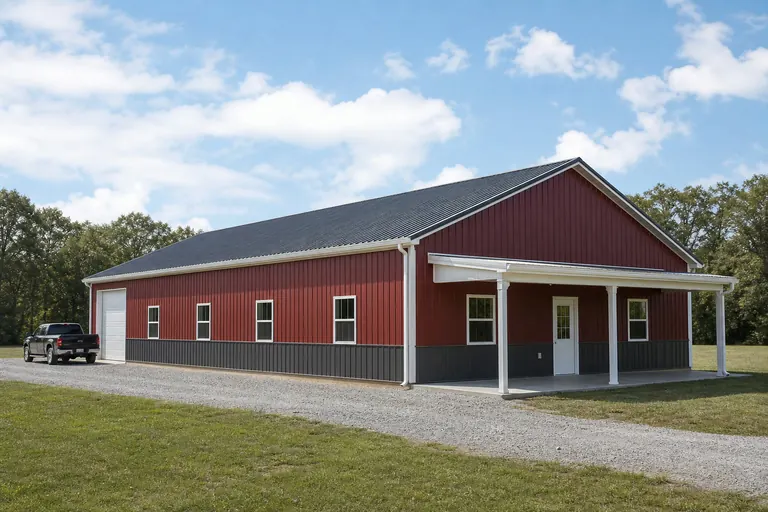 House plus small-equipment shopA finished residence at one end and a shop bay sized for a truck, tractor and general equipment at the other, consistent with Maryland's below-national-average farm scale.
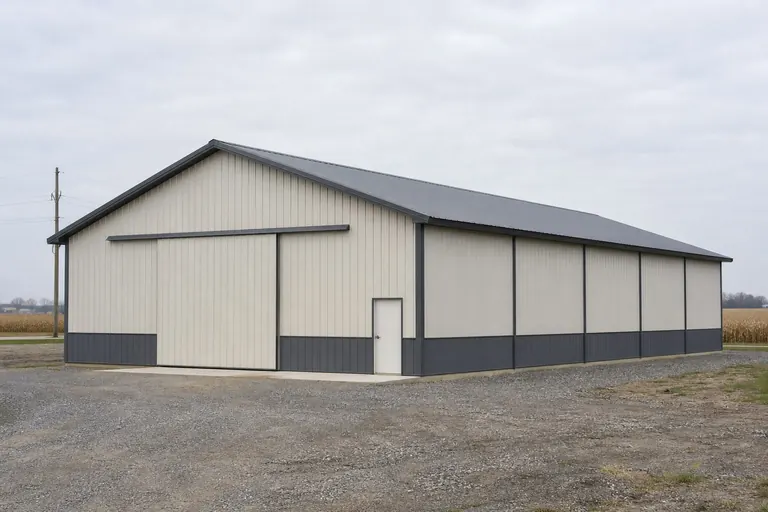 House plus hobby-farm storageWhere the shop half doubles as feed, tool or seasonal storage for a small hobby-farm operation rather than a full commodity barn.
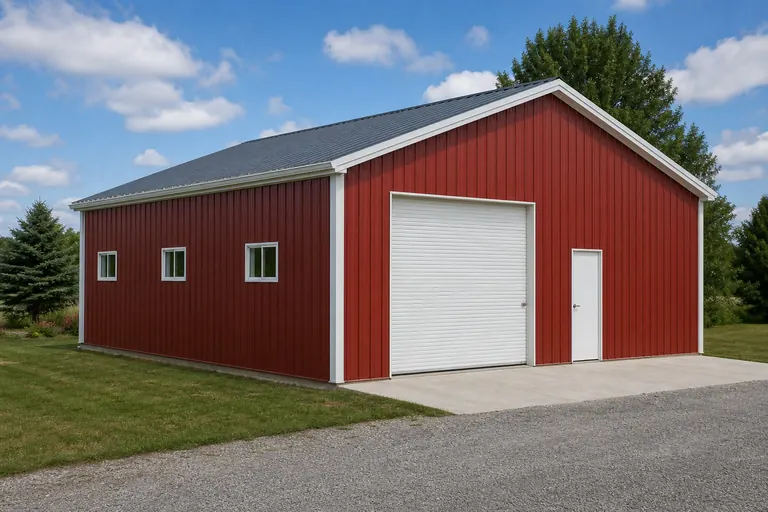 House plus workshopA simpler split favoring a dedicated workshop bay where the property does not carry agricultural equipment at all.
Example Configuration — for planning purposes only.
Footprint
Footprints that suit Maryland's small-farm scale
Maryland's below-national-average farm size is a reason footprints here often run smaller than in large-acreage ranch states.
30′ × 60′
1,800 sq ft
A compact balance of living quarters and a single equipment bay for a small hobby-farm property.
40′ × 80′
3,200 sq ft
The common Maryland scale, sized for a truck, a tractor and general hobby-farm equipment alongside full living quarters.
40′ × 100′
4,000 sq ft
Where a workshop, storage and living space all need to coexist under one roof on a larger Eastern Shore or western county parcel.
Example Configuration — for planning purposes only.
Set shop door width and eave height from your actual equipment list before fixing the overall footprint.
Preparation
Before you request a Maryland barndominium quote
Five things resolved before the quote is requested keep the process from restarting mid-design.
Step 1
Identify your physiographic region
Confirm whether your parcel sits on Coastal Plain, Piedmont, or Blue Ridge/Appalachian ground — the Maryland Geological Survey's three-region description directly changes the drainage and foundation conversation.
Step 2
Size the shop from actual equipment
List every vehicle and implement the shop half must hold; Maryland's 158-acre average farm size means the shop volume needed here is often smaller than a large-acreage state's plan book assumes.
Step 3
Check FEMA's National Risk Index for your jurisdiction
Coastal Plain properties near the Chesapeake Bay or Atlantic coast should check flood and hurricane hazard scores directly rather than assume a statewide condition.
Step 4
Confirm crew and schedule availability
With 16,823 units authorized statewide in 2024, ask builders directly about current lead times in your specific county rather than assuming uniform availability.
Step 5
Ask about dwelling classification early
How your county treats a residence attached to an agricultural-style structure affects inspections and sometimes financing; confirm before design, not during permitting.
Questions
Maryland barndominium questions
Honest state-level answers, with anything jurisdiction- or lender-specific routed to who actually owns it.
Yes, in a way that is unusually direct for a small state. The Maryland Geological Survey describes three distinct physiographic regions — Coastal Plain, Piedmont, and the combined Blue Ridge/Valley-and-Ridge/Appalachian Plateau provinces — and a parcel's foundation and drainage plan should be set from its actual region rather than a statewide assumption.
Size it from your actual equipment list. USDA's 2022 Census of Agriculture puts Maryland's average farm at 158 acres, well below the scale seen in large ranch states, so most Maryland shop bays need less volume than a plan book built for a bigger-acreage state would suggest.
It can be, particularly on Coastal Plain parcels near the Chesapeake Bay or Atlantic coast. FEMA's National Risk Index scores 18 hazard types, including coastal flooding and hurricane, across all 24 Maryland jurisdictions; check your specific jurisdiction on the official NRI tool rather than relying on a general statement here.
The state's residential market was active in 2024, with 16,823 new housing units authorized statewide by the Census Bureau, including 10,885 single-unit structures. That does not guarantee availability in your specific county, so confirm current lead times directly with builders.
Permit requirements depend on your county and how the building is classified. Your local building department is the only reliable source for that answer, and it is worth asking before you finalize the split between living space and shop.
Sources for the Maryland facts on this page
This page states no code requirement, wind speed, snow load, permit rule, price or supplier claim. The state-specific facts it does use are listed with their publisher below.
The Maryland Geological Survey describes the state as spanning three distinct physiographic regions -- the Coastal Plain, the Piedmont, and the combined Blue Ridge, Valley and Ridge, and Appalachian Plateau provinces -- extending from the Atlantic coast to the western mountains.
Maryland Geological Survey · MGS reference material · Tier 2
https://www.mgs.md.gov/geology/geology_of_maryland.htmlMaryland had 12,550 farms in 2022, up from 12,429 in 2017.
USDA National Agricultural Statistics Service (NASS) · 2022 (with 2017 comparison) · Tier 1
https://www.nass.usda.gov/Publications/AgCensus/2022/Full_Report/Volume_1,_Chapter_1_State_Level/Maryland/st24_1_001_001.pdfMaryland had 1,978,036 acres of land in farms in 2022, an average farm size of 158 acres.
USDA NASS · 2022 · Tier 1
https://www.nass.usda.gov/Publications/AgCensus/2022/Full_Report/Volume_1,_Chapter_1_State_Level/Maryland/st24_1_001_001.pdfThe Maryland Department of Planning tabulates farms and acres by size range across Maryland's jurisdictions using 2022 Census of Agriculture data.
Maryland Department of Planning (Maryland State Data Center) · 2022 · Tier 2
https://planning.maryland.gov/MSDC/Documents/census_agriculture/farms_farmlands/Table_4_farms_size_acreage_22.pdfBuilders in Maryland were authorized to construct 16,823 new privately-owned housing units in 2024, of which 10,885 were single-unit structures.
U.S. Census Bureau · 2024 (final annual estimates) · Tier 1
https://www.census.gov/construction/bps/stateannual.htmlFEMA's National Risk Index is the federal tool for county- and state-level natural hazard exposure data for Maryland's 24 jurisdictions, covering 18 hazard types including coastal flooding, hurricane, and winter weather.
Federal Emergency Management Agency (FEMA) · Current NRI release · Tier 1
https://www.fema.gov/flood-maps/products-tools/national-risk-indexThe BWI Airport (Baltimore/Annapolis area) NOAA 1991-2020 climate normals show total annual precipitation of roughly 44-46 inches spread fairly evenly across the year.
NOAA National Centers for Environmental Information (NCEI) · 1991-2020 · Tier 1
https://www.ncei.noaa.gov/access/services/data/v1?dataTypes=MLY-TMAX-NORMAL%2CMLY-TMIN-NORMAL%2CMLY-TAVG-NORMAL%2CMLY-PRCP-NORMAL%2CMLY-SNOW-NORMAL&dataset=normals-monthly-1991-2020&format=pdf&stations=USW00013752