
Carport · MD
Carports in Maryland
A Maryland carport's first siting question depends on which of the Maryland Geological Survey's three named physiographic provinces the lot sits in — Coastal Plain, Piedmont, or the combined Appalachian provinces to the west — because only the flattest of the three lets orientation-and-drainage stand in for a real grading decision. Maryland's farm base, 12,550 operations averaging 158 acres in 2022, adds a working-equipment dimension to carport demand beyond passenger-vehicle cover, and the state's active residential construction market — 16,823 new housing units authorized in 2024 — means a carport permit application is often filed alongside a busy local caseload rather than a quiet one.
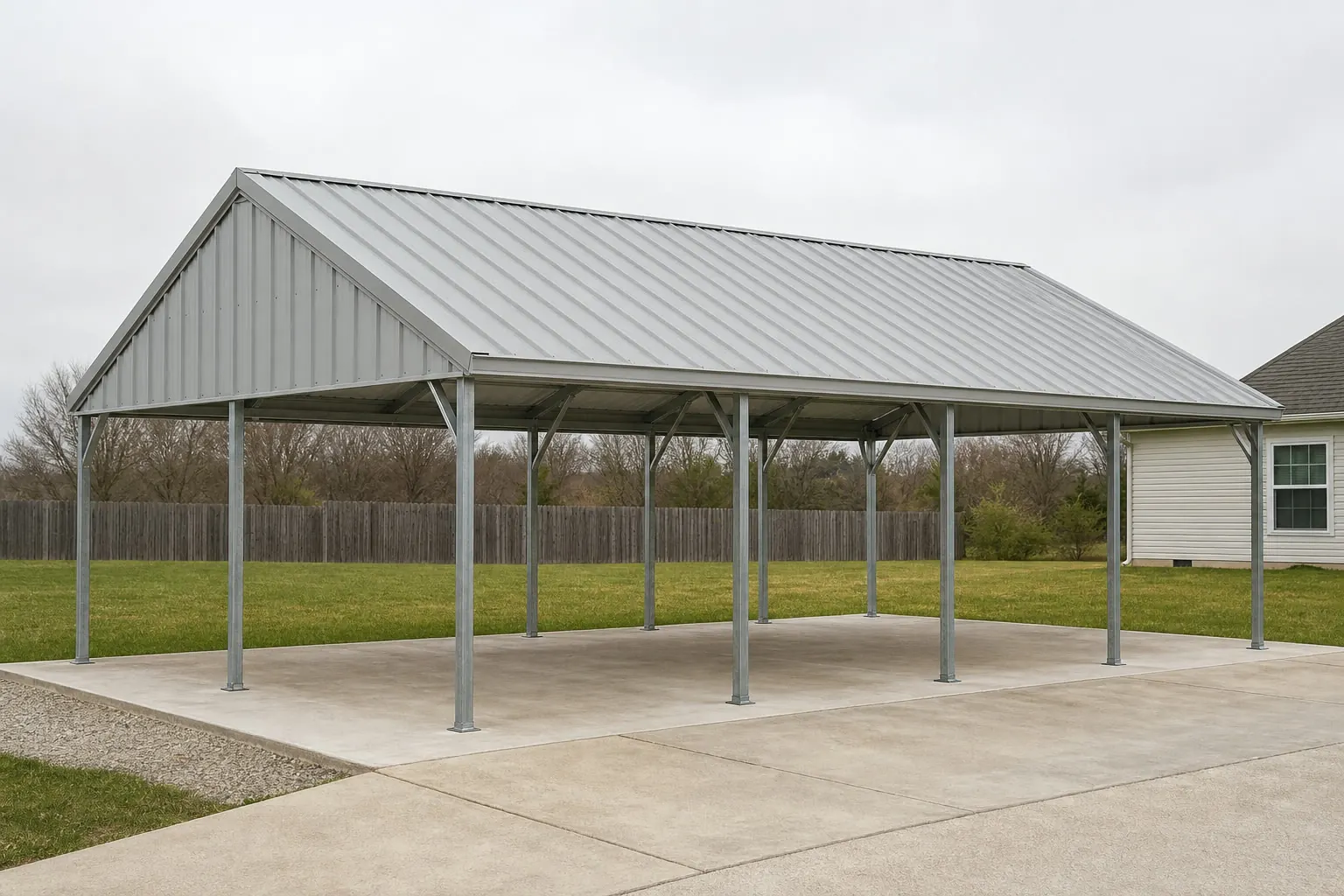
Three Provinces, Three Different First Questions
The Maryland Geological Survey splits the state into three physiographic provinces: the Coastal Plain covering the Eastern Shore and Southern Maryland, the Piedmont running through central Maryland including Baltimore and the Washington suburbs, and the combined Blue Ridge, Valley and Ridge, and Appalachian Plateau provinces to the west. That split matters for an open-sided carport in a way it would not for an enclosed building, because there are no walls to make up the difference between a flat lot and a sloped one. On the Coastal Plain, orientation and drainage are the main levers. In the Piedmont and western counties, grading the pad often comes first.
Terrain
What Each Maryland Province Actually Changes
The three-province split changes which siting question is first, not the carport itself.
Coastal Plain (Eastern Shore and Southern Maryland)
Flat, low-relief ground where there is rarely a natural windbreak or slope; the open bays' orientation relative to prevailing wet weather is the decision that changes outcomes.
Piedmont (central Maryland)
Rolling terrain through Baltimore and the Washington suburbs where a carport pad may need real grading before placement rather than a drainage-first approach.
Western Maryland mountains
Higher-elevation, sloped ground in the state's western counties where pad leveling and clear access for a truck or trailer both need confirming before ordering.
Configuration
What Maryland Carports Are Usually Protecting
Maryland's mix of dense suburban corridors, small farms, and coastal communities produces a few recurring carport uses.
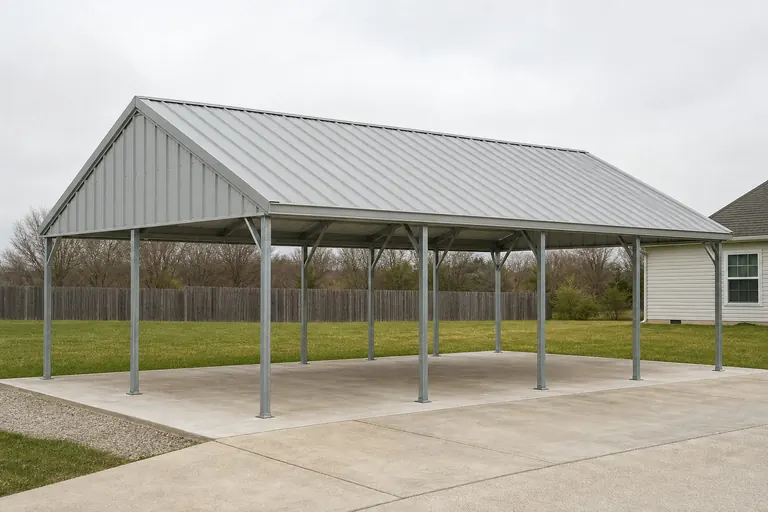 Daily-driver vehicle coverKeeping one or two vehicles out of direct rain on a suburban lot near Baltimore or Washington, D.C., sized to the household's vehicle count.Small-farm equipment and truck coverOn Eastern Shore or western county operations, open-sided cover for a truck, tractor, or small implement that does not need a fully enclosed building.
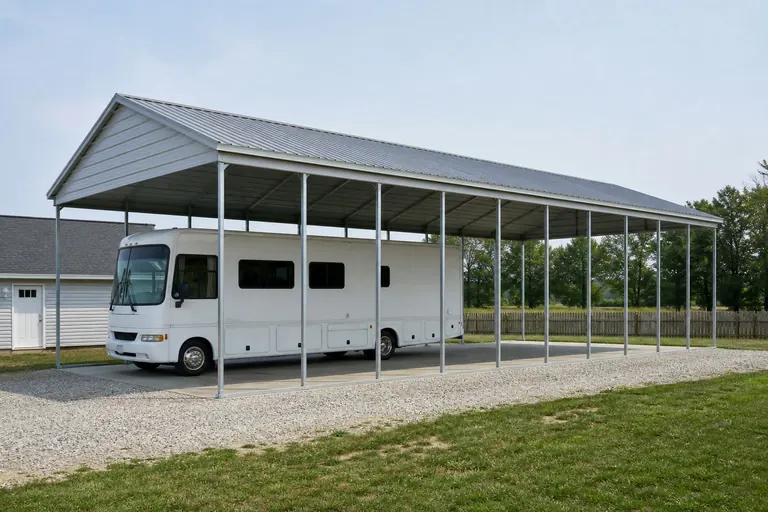 Boat storageNear Maryland's Chesapeake Bay communities, taller carports sized for boats kept close to home between trips.
Example Configuration — for planning purposes only.
Get Maryland carport quotes
Tell us your vehicle or equipment needs, physiographic province, and rough size. We route it with the Maryland and carport context already attached.
The intersection
Why Maryland Carport Demand Includes a Working-Farm and a Busy-Permit-Office Story
A meaningful share of Maryland carport enquiries come from working land, and nearly all of them enter a genuinely active residential permitting environment.
Maryland's farm base — 12,550 operations averaging 158 acres in 2022 — means a stand-alone carport enquiry is not always a suburban vehicle-cover project. On these properties an open-sided structure often needs to clear a loaded pickup or a tractor with an attached implement, not just a passenger car, so confirming the tallest and widest item that will use the carport before ordering matters more here than on a typical residential lot.
Maryland's residential construction market was active in 2024, with 16,823 new housing units authorized statewide, including 10,885 single-unit structures. A stand-alone carport permit application in a busy county often moves through the same review queue as that broader residential caseload, which is a reason to bring a clear site plan and a specific use description to the first conversation with the building department, regardless of which of the three provinces the lot sits in.
Properties near the Chesapeake Bay or Atlantic coast carry an additional, separate consideration: FEMA's National Risk Index scores coastal flooding and hurricane among the 18 hazard types tracked across Maryland's 24 jurisdictions, and checking that tool for your specific jurisdiction is worth doing before finalizing placement rather than assuming a general inland condition applies.
Preparation
Four Confirmations Before a Maryland Carport Order
Resolving these before ordering avoids a second site visit once posts are ready to set.
- Name your physiographic provinceAsk your contractor whether the parcel sits on Coastal Plain, Piedmont, or Appalachian ground, since that decides whether grading or drainage is the first cost to plan for.
- Check your jurisdiction's own farm-size profileThe Maryland Department of Planning tabulates farms and acreage by size range for each of the state's 24 jurisdictions; a rural buyer can use it to see whether their county runs larger or smaller than the 158-acre statewide average before sizing equipment cover.
- Ask about the current residential permitting queueWith 16,823 housing units authorized statewide in 2024, a busy jurisdiction may take longer to review even a small accessory structure; ask directly rather than assuming a quiet process.
- Pull your jurisdiction's FEMA hazard score if coastalProperties near the Chesapeake Bay or Atlantic coast should check FEMA's National Risk Index for their specific one of Maryland's 24 jurisdictions rather than relying on a general inland assumption.
Footprint
Sizes That Suit Maryland's Typical Uses
Carport sizing in Maryland tracks vehicle count and use rather than any site constraint on flat Coastal Plain lots, since grading is rarely a limiting factor there.
18′ × 20′
360 sq ft
A standard two-vehicle footprint for a suburban Maryland home.
20′ × 30′
600 sq ft
Common where a truck or small farm equipment needs cover alongside a passenger vehicle.
24′ × 36′
864 sq ft
A larger option for boat or multi-vehicle cover near Chesapeake Bay coastal properties.
Example Configuration — for planning purposes only.
Footprint pages carry the bay layout and clearance detail for each of these; this page explains why Maryland buyers land in this range.
Questions
Maryland Carport Questions
Questions we can answer honestly at state level, with anything jurisdiction-specific routed to the right office.
Yes. The Maryland Geological Survey names Coastal Plain, Piedmont, and Blue Ridge/Appalachian provinces as distinct regions; flat Coastal Plain lots prioritize orientation and drainage, while Piedmont and western county lots may need grading first.
Permit thresholds and setback rules are set locally and often depend on footprint and whether the structure is anchored. Your local building or zoning department is the only reliable source for your specific lot.
Maryland authorized 16,823 new housing units in 2024. A stand-alone carport permit in a busy jurisdiction can share a review queue with that broader caseload, so a clear site plan up front is worth the effort.
It can be near the Chesapeake Bay or Atlantic coast. FEMA's National Risk Index scores coastal flooding and hurricane among 18 hazard types across Maryland's 24 jurisdictions; check yours before finalizing placement rather than relying on a statewide assumption.
There's no single statewide answer, but the Baltimore-Washington area's climate normal of about 44-46 inches of annual precipitation supports orienting any partially enclosed side toward the yard's typical wet-weather direction, especially on the flat Coastal Plain lots that cover most of eastern and southern Maryland.
We do not publish state-level prices, since cost depends on size, materials, anchoring, site work and, on Piedmont or western sites, any grading required. Our cost pages cover what drives the number; a quote covers your specific project.
Sources for the Maryland facts on this page
This page states no code requirement, wind speed, snow load, permit rule, price or supplier claim. The state-specific facts it does use are listed with their publisher below.
Maryland had 12,550 farms in 2022, up from 12,429 in 2017.
USDA National Agricultural Statistics Service (NASS) · 2022 (with 2017 comparison) · Tier 1
https://www.nass.usda.gov/Publications/AgCensus/2022/Full_Report/Volume_1,_Chapter_1_State_Level/Maryland/st24_1_001_001.pdfThe Maryland Geological Survey describes the state as spanning three distinct physiographic regions -- the Coastal Plain, the Piedmont, and the combined Blue Ridge, Valley and Ridge, and Appalachian Plateau provinces -- extending from the Atlantic coast to the western mountains.
Maryland Geological Survey · MGS reference material · Tier 2
https://www.mgs.md.gov/geology/geology_of_maryland.htmlThe BWI Airport (Baltimore/Annapolis area) NOAA 1991-2020 climate normals show total annual precipitation of roughly 44-46 inches spread fairly evenly across the year.
NOAA National Centers for Environmental Information (NCEI) · 1991-2020 · Tier 1
https://www.ncei.noaa.gov/access/services/data/v1?dataTypes=MLY-TMAX-NORMAL%2CMLY-TMIN-NORMAL%2CMLY-TAVG-NORMAL%2CMLY-PRCP-NORMAL%2CMLY-SNOW-NORMAL&dataset=normals-monthly-1991-2020&format=pdf&stations=USW00013752FEMA's National Risk Index is the federal tool for county- and state-level natural hazard exposure data for Maryland's 24 jurisdictions, covering 18 hazard types including coastal flooding, hurricane, and winter weather.
Federal Emergency Management Agency (FEMA) · Current NRI release · Tier 1
https://www.fema.gov/flood-maps/products-tools/national-risk-indexBuilders in Maryland were authorized to construct 16,823 new privately-owned housing units in 2024, of which 10,885 were single-unit structures.
U.S. Census Bureau · 2024 (final annual estimates) · Tier 1
https://www.census.gov/construction/bps/stateannual.htmlThe Maryland Department of Planning tabulates farms and acres by size range across Maryland's jurisdictions using 2022 Census of Agriculture data.
Maryland Department of Planning (Maryland State Data Center) · 2022 · Tier 2
https://planning.maryland.gov/MSDC/Documents/census_agriculture/farms_farmlands/Table_4_farms_size_acreage_22.pdf