
Carport · LA
Carports in Louisiana
A carport is a simple structure, but a Louisiana carport sits in a climate NOAA describes as being struck by a hurricane on average once every three years, inside a subtropical, Gulf-influenced weather pattern. That recurrence is the reason orientation, anchoring conversations with your builder, and a pre-siting check of FEMA's hazard data belong at the start of a Louisiana carport project, not as an afterthought.
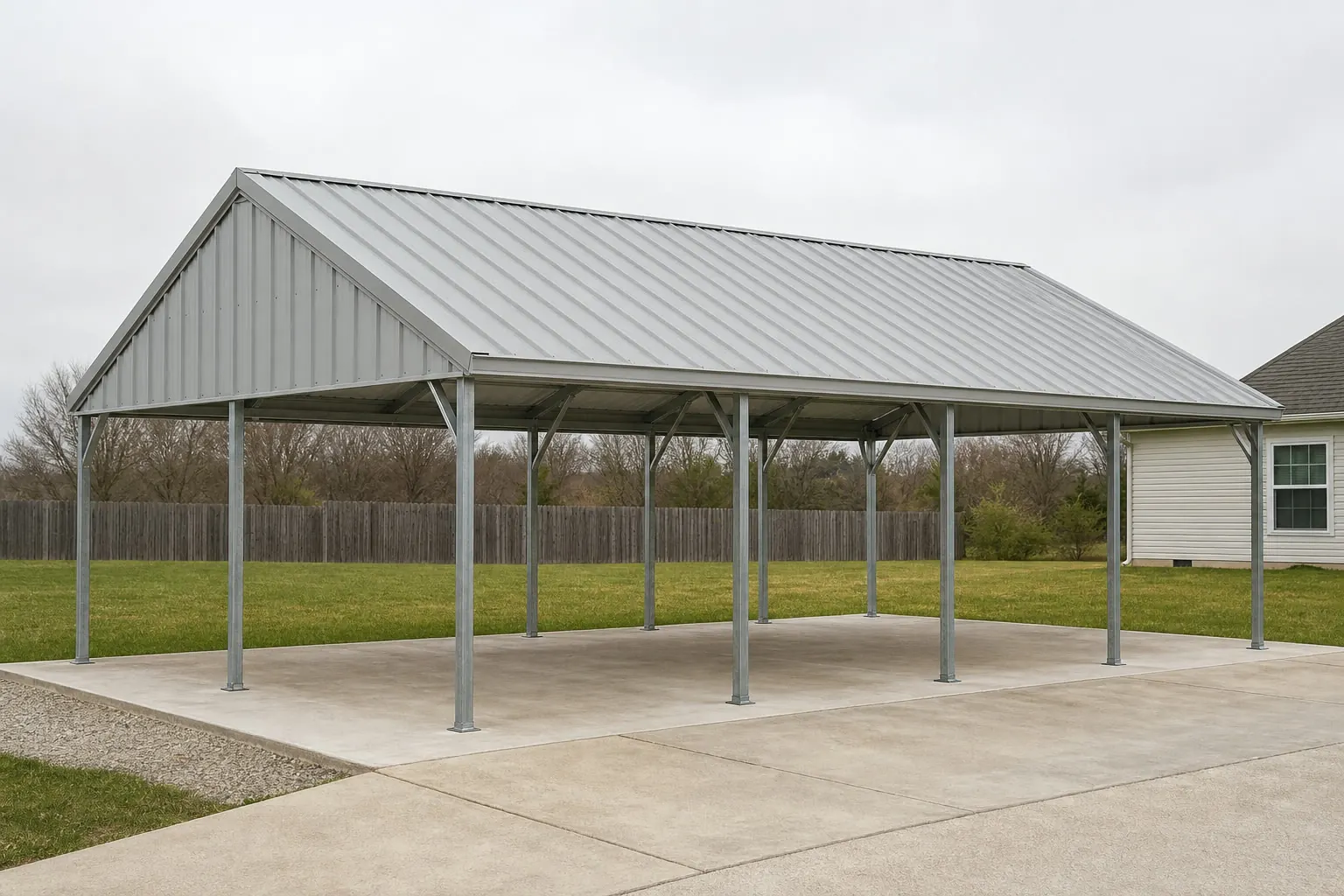
The intersection
What a Louisiana site actually changes about a carport
A carport's open-sided design makes it more exposed to wind-driven rain than an enclosed building, which is precisely the exposure NOAA's Louisiana climate data describes as recurring.
NOAA NCEI's state climate summary states hurricanes strike Louisiana on average once every three years. For an open structure whose main job is protecting a vehicle from sun and rain, that recurrence is the single most relevant state fact: anchoring, orientation and how the carport handles wind-driven rain are worth discussing with your builder at the design stage rather than after the first storm season.
NOAA's broader narrative, 'Climate of Louisiana', describes a subtropical, Gulf-influenced climate. That framing matters for a carport specifically because it is not fully enclosed — rain direction and humidity affect what is stored underneath more than they would inside a closed building.
None of this becomes a wind rating or an anchoring spec on this page. Those numbers belong to your builder's engineering and your local building department. What changes here is the order of operations: check hazard data for the parcel, discuss orientation and anchoring before finalizing the plan, and treat storm-season exposure as routine rather than exceptional.
Site context
Siting a Louisiana carport against hazard data
FEMA's National Risk Index publishes hurricane, coastal-flood and inland-flood data at the county and Census-tract level for Louisiana, a specific, checkable resource rather than a general coastal-risk assumption.
Coastal and southern parishes sit closest to the Gulf hazard profile FEMA's dataset highlights; central and northern parts of the state are further from direct coastal flood exposure but remain inside the same statewide hurricane-recurrence pattern NOAA describes.
For a carport, the practical outcome of checking that data is deciding where on the parcel the structure sits relative to drainage paths and prevailing storm direction, and confirming with your local building department whether your parcel's flood-zone status affects the pad or footing approach.
- Check the parcel-level hazard data
- Use FEMA's NRI tool rather than assuming risk from parish reputation alone.
- Discuss orientation with your builder
- Prevailing storm direction is worth factoring into which side of the structure is most open.
- Confirm anchoring approach locally
- Your local building department and builder's engineer set the actual requirement for your site.
Materials
Why humidity, not just wind, shapes a Louisiana carport's materials
An open-sided carport in Louisiana's subtropical, Gulf-influenced climate sees near-constant humidity exposure on its exposed steel framing, which is a different maintenance conversation than the storm-anchoring question above.
NOAA NCEI's narrative description of Louisiana's climate as subtropical and Gulf-influenced is relevant to carport materials for a reason distinct from wind: an open structure's steel framing and roof panels stay damp longer after rain than an enclosed building's, because there are no walls slowing airflow around the frame. That is worth raising with your builder when choosing coatings or finish options, not because this page can specify a coating system, but because the humidity exposure itself is a documented, year-round condition rather than a seasonal one tied only to hurricane season.
Louisiana's land area of 43,203.9 square miles, measured in the 2010 Census, includes both dense, humid parish clusters near the coast and drier interior stretches further north. A carport sited near the coast sits in a more consistently humid microclimate than one sited well inland, even within the same state, which is one more reason siting and material decisions should be checked against your specific parish rather than a single statewide assumption.
None of this becomes a coating spec or a warranty term here — that is a conversation for your builder and the manufacturer's product documentation. What changes at the Louisiana intersection is simply that humidity deserves the same up-front attention as wind, since both are routine, not occasional, conditions for an open-sided structure in this climate.
A practical habit that follows from this: ask your builder how the carport's fasteners and panel seams are treated, since an open structure sheds water less predictably than an enclosed one and standing moisture at a seam is where corrosion tends to start first. This is a maintenance and finish conversation, not a structural one, but it is worth having before install rather than after the first humid summer.
Get Louisiana carport quotes
Tell us your parish and what the carport needs to protect. We route it with the Louisiana and carport context already attached.
Configuration
What Louisiana carports are usually asked to do
Vehicle and light-equipment protection dominate, with storm-season durability as the recurring secondary requirement.
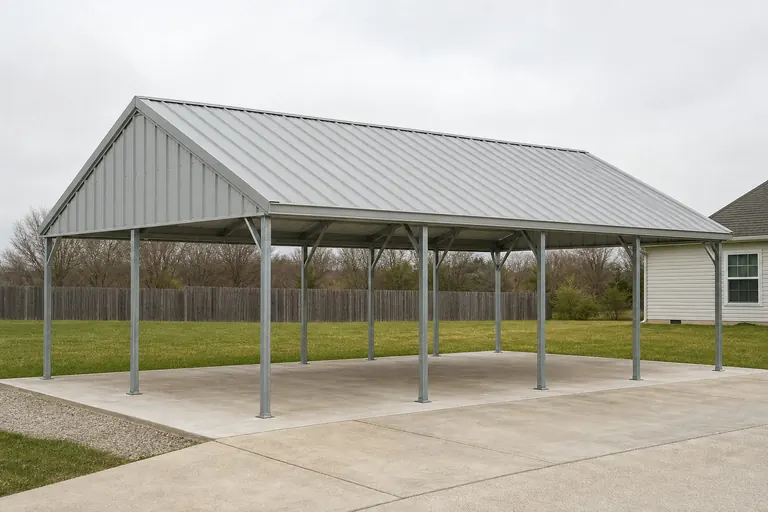 Vehicle protectionThe core use case: shade and rain protection for daily-driven vehicles, with anchoring discussed given recurring storm exposure.RV or boat storageTaller clearance carports for recreational vehicles common on Louisiana's many waterway-adjacent parcels.
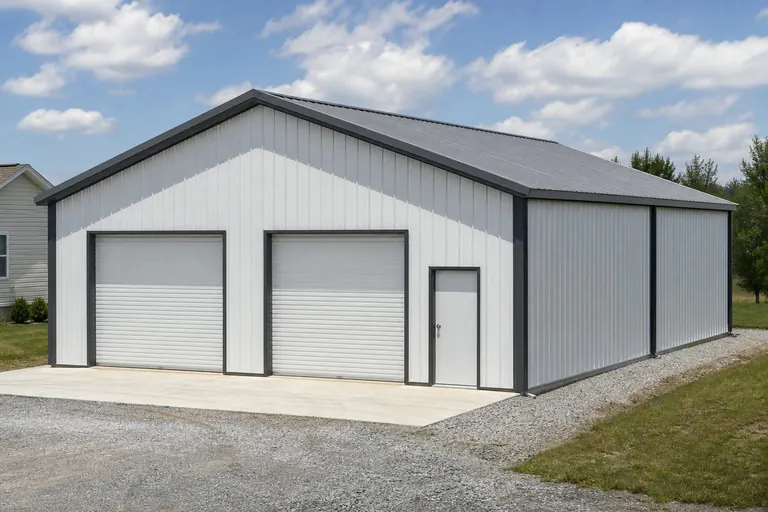 Partial enclosure upgradeSome buyers add partial walls after the fact for additional wind-driven rain protection; deciding this before install can save cost.
Example Configuration — for planning purposes only.
Footprint
Sizes that suit Louisiana vehicle and equipment protection
Most Louisiana carport enquiries are sized for one to three vehicles or a boat/RV, not large equipment fleets.
20′ × 20′
400 sq ft
A single-vehicle footprint sized for one daily-driven car or truck.
20′ × 30′
600 sq ft
Fits one vehicle plus a workbench or storage zone.
24′ × 40′
960 sq ft
Two-vehicle or one vehicle plus a boat/RV.
Example Configuration — for planning purposes only.
Footprint pages carry the layout detail for each of these; this page only explains why the Louisiana brief lands in this range.
Preparation
Before you request a Louisiana carport quote
A few things resolved in advance keep the quote comparable.
Step 1
Contact your local building department
Confirm what your parish and parcel require before finalizing anchoring or footing approach.
Step 2
Check FEMA's National Risk Index
Review hazard data for your specific parcel before you fix siting.
Step 3
Decide on partial enclosure now
Adding wind-driven rain protection later usually costs more than specifying it up front.
Step 4
State what the carport protects
Vehicle-only versus boat/RV clearance needs change dimensions.
Step 5
Ask about fastener and seam treatment
Louisiana's humidity makes this a routine maintenance question worth asking before install, not after the first season.
Step 6
Ask about gutter or drip-edge options
Directing runoff away from the pad reduces standing water pooling under the carport during Louisiana's heavier rain events, which also helps limit the humidity buildup discussed above.
Questions
Louisiana carport questions
Questions we can answer honestly at state level, with the ones we cannot routed to whoever actually owns them.
NOAA's data shows Louisiana experiences a hurricane roughly once every three years, a real recurrence worth planning around. What specific anchoring or wind rating your carport needs is set by your local building department and your builder's engineer; we do not state that requirement here.
Permit requirements depend on your parish and parcel. Your local building department is the only reliable source for that answer.
There is no official typical size, but most Louisiana enquiries fall between a single-vehicle footprint and a two-vehicle or boat/RV size.
We do not publish state-level prices; a credible number depends on your specification and site work. Our cost pages cover what drives the number.
Some owners add partial walls for additional protection from wind-driven rain, common in this climate. Whether that makes sense for you depends on use and budget; discuss it with your builder before installation.
Sources for the Louisiana facts on this page
This page states no code requirement, wind speed, snow load, permit rule, price or supplier claim. The state-specific facts it does use are listed with their publisher below.
NOAA NCEI's State Climate Summary for Louisiana states hurricanes strike Louisiana on average once every three years, and that Louisiana's temperatures have risen about 0.5°F since the beginning of the 20th century — less than a third of the warming for the contiguous United States as a whole.
NOAA National Centers for Environmental Information (NCEI) · State Climate Summaries series, 2022 · Tier 1
https://statesummaries.ncics.org/downloads/Louisiana-StateClimateSummary2022.pdfNOAA NCEI publishes a narrative 'Climate of Louisiana' describing the state's principal climatic features and providing climatological summaries for stations across its geographic regions.
NOAA National Centers for Environmental Information (NCEI) · Historical narrative (NCEI climate normals series) · Tier 1
https://www.ncei.noaa.gov/data/climate-normals-deprecated/access/clim60/states/Clim_LA_01.pdfFEMA's National Risk Index dataset assesses 18 natural hazards, including hurricane, coastal flooding, and inland flooding, which are especially relevant to Louisiana's Gulf Coast exposure, at the county and Census tract level via its interactive online tool.
Federal Emergency Management Agency (FEMA) · Current NRI release · Tier 1
https://www.fema.gov/flood-maps/products-tools/national-risk-indexLouisiana's total land area was measured at 43,203.9 square miles as of the 2010 Census.
U.S. Census Bureau · 2010 Census · Tier 1
https://www.census.gov/geographies/reference-files/2010/geo/state-local-geo-guides-2010/louisiana.htmlLouisiana had a total of 14,247 new privately-owned housing units authorized by building permits in 2023, rising slightly to 14,310 units in 2024.
U.S. Census Bureau · 2023-2024 · Tier 1
https://www2.census.gov/econ/bps/State/st2024a.txtLouisiana's total land area was measured at 43,203.9 square miles as of the 2010 Census.
U.S. Census Bureau · 2010 Census · Tier 1
https://www.census.gov/geographies/reference-files/2010/geo/state-local-geo-guides-2010/louisiana.html