Barndominium · IA
Barndominiums in Iowa
Building a barndominium in Iowa represents a unique intersection of residential comfort and agricultural utility, but success depends on navigating the state's decentralized permitting and varied terrain. With primary authority resting at the county level and geological features like the Loess Hills defining the western horizon, an Iowa project requires more than just a floor plan. It demands a site-specific engineering approach that accounts for -30°F record lows and the high-velocity wind events that sweep across the glaciated plains, ensuring your home is as resilient as it is functional.
Procedural
Navigating the Iowa county permit landscape
In Iowa, the first real hurdle for any barndominium project is identifying who owns the permitting authority for your specific parcel.
Unlike states with a unified residential building code, Iowa delegates much of this power to its 99 counties. This creates a patchwork of regulations. In a metropolitan-adjacent county like Polk or Dallas, a barndominium project will face rigorous plan reviews, energy audits, and frequent inspections. In more rural areas, the process might be simpler, but you are still bound by the state's residential minimums for life-safety items like smoke detectors and egress windows.
A common mistake for Iowa buyers is assuming a 'pole barn house' is exempt from these rules. While a shed for corn equipment might be exempt, once the building is intended for human habitation, it counts as a housing unit. The recent uptick in Iowa housing unit authorizations—reaching 12,544 in 2024—reflects a market that is increasingly scrutinized by local officials. You should contact the County Auditor or Zoning Administrator before signing any steel purchase contract to ensure your land is zoned for a residential-scale shop building.
Be prepared for the septic system permit. Iowa's county health departments are rigorous about wastewater management, especially in areas with high clay content. A soil test (percolation test) is almost always required before a building permit is issued. Given Iowa's documented drought risks highlighted by FEMA, local officials are also increasingly focused on water source reliability for new rural residences, so ensure your well or rural water connection is confirmed early.
Engineering
Foundation and framing for the Iowa climate
Iowa’s geography and climate demand a more robust structural approach than a 'one-size-fits-all' kit can provide.
If you are building in the western portion of the state, the Loess Hills present a unique challenge. With a 200-foot relief and steep, silt-based bluffs, the ground is prone to erosion and settling. A barndominium in this region often requires a more complex foundation—perhaps including deeper piers or a reinforced slab—to ensure that the heavy residential finishes inside don't crack due to soil movement. This isn't just a recommendation; it's a necessity in a state where the terrain can vary as much as Iowa's does.
The state's climate extremes are equally demanding. With a record high of 110°F and a low of -30°F, your barndominium must be a thermal fortress. Standard fiberglass batts are rarely sufficient for the large volumes of a steel building. Many Iowa owners prefer closed-cell spray foam, which provides a high R-value and an airtight seal, preventing the 'chimney effect' where warm air escapes through the roof during a sub-zero January night. This also helps with condensation, which is a significant issue in the humid Iowa summer.
Finally, don't ignore the wind. Iowa's open plains offer no protection from straight-line winds or the occasional derecho, and a barndominium's large gable ends behave differently than a compact home. Confirm the design wind speed and required bracing for your parcel with your local building department or a licensed engineer, since requirements vary by county and site exposure. For a barndominium, where interior drywall is sensitive to movement, a properly engineered, well-braced frame is the difference between a quiet home and one that 'creaks' during every storm.
Geography
Where you build in Iowa matters
Iowa's 55,857.1 square miles are not a uniform building site.
Loess Hills Corridor
A 200-mile band of silt-based hills along the Missouri River. Requires terrace-grading and specialized erosion control to protect foundations from the sharp bluffs' natural settling.
Des Moines Lobe
Flat but often poorly drained. Site preparation focuses on elevating the pad to manage surface water and avoiding the heavy clay pockets that can impede septic drainage.
Southern Rolling Hills
More varied topography that requires careful site access planning. You may need to invest in more extensive gravel or concrete driveways to handle construction traffic in the spring.
Start Your Iowa Barndominium
Connect with builders who understand Iowa's permitting and terrain challenges.
Configuration
How Iowa buyers configure a barndominium
The mix of row-crop agriculture, acreage living, and Iowa's climate produces a handful of recurring floor-plan strategies.
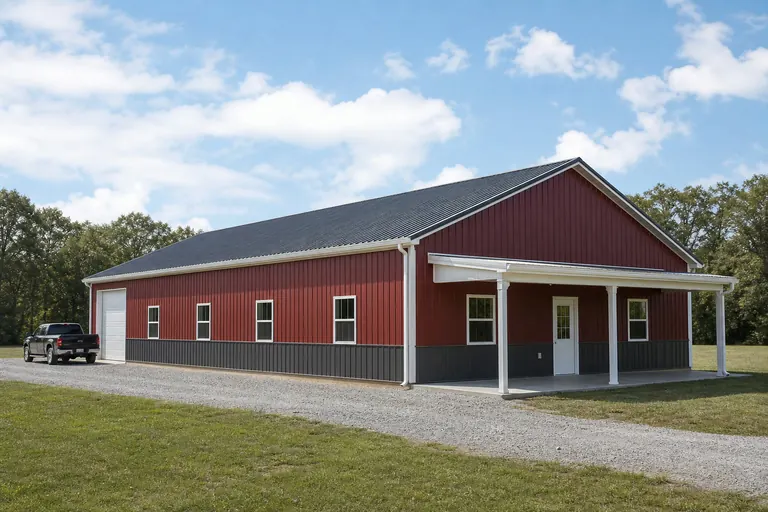 The Farm-Adjacent ResidenceA living wing paired with a shop bay sized for a tractor or truck, sited near existing grain infrastructure rather than replacing it.The Loess Hills Walk-OutA split-level layout that uses the natural grade of a bluff site to separate the shop floor from the living level, reducing the amount of cut-and-fill needed.The Metro-Edge Acreage BuildA smaller footprint on a few acres near Des Moines or Cedar Rapids, favoring residential finish quality over shop depth.
Example Configuration — for planning purposes only.
Footprints
Barndominium footprints suited to Iowa parcels
Iowa barndominium buyers generally fall into two groups: a rural full-time residence with an attached shop, or a smaller weekend/retirement build on acreage near a metro edge.
40′ × 60′
2,400 sq ft
A common starting footprint that splits roughly half living space and half shop, workable on a standard acreage parcel outside most Iowa counties' stricter residential subdivisions.
50′ × 80′
4,000 sq ft
Adds a larger equipment bay alongside a full residential wing, suited to buyers combining a farm-adjacent operation with a primary home.
60′ × 100′
6,000 sq ft
A large-format build for buyers running a substantial shop or storing multiple vehicles and implements alongside the residence; site work and septic sizing scale accordingly.
Example Configuration — for planning purposes only.
Confirm septic and lateral-field sizing with your county health department before finalizing a footprint; larger residential square footage changes wastewater design requirements.
Before You Order
A decision checklist for an Iowa barndominium
Because Iowa splits permitting authority across 99 counties and spans a wide range of terrain, a handful of early decisions save the most rework later.
Step 1
Confirm the parcel's zoning classification first
A residential classification triggers full code review; don't assume ag-zoned acreage automatically permits a residence.
Step 2
Get a soil and septic answer before you design the layout
Clay content and lateral-field sizing vary by county; a perc test result can change how much footprint is usable for living space.
Step 3
Ask your engineer for a site-specific wind and bracing plan
Iowa's open terrain and derecho history mean bracing depends on parcel exposure, not one statewide figure.
Step 4
Plan the shop-to-home thermal transition early
The insulation strategy at the shop-to-home wall is easier to specify before framing than to retrofit after drywall.
Questions
Iowa Barndominium FAQ
Honest answers for Iowa's residential steel building market.
Most counties allow them, but you must confirm the zoning for your specific parcel. Residential requirements for fire and life safety always apply.
The steep 200-foot relief and silty soil often require more extensive site prep and foundation engineering, which can increase the initial cost compared to a flat site.
Closed-cell spray foam is highly recommended due to Iowa's -30°F to 110°F temperature range and high humidity, as it provides an air seal and vapor barrier in one step.
Your local building department or a licensed engineer sets the design wind speed for your specific parcel. It varies by county and site exposure, so ask for this figure in writing before finalizing the structural package.
The residence itself is treated the same as any home for wastewater purposes, but combining it with a shop can add fixtures and water use that your county health department will want reflected in the lateral-field sizing.
Sources for the Iowa facts on this page
This page states no code requirement, wind speed, snow load, permit rule, price or supplier claim. The state-specific facts it does use are listed with their publisher below.
The Loess Hills of western Iowa rise roughly 200 feet above the flat Missouri River floodplain and form a narrow band running north-south for about 200 miles along the Missouri River, with steep angles and sharp bluffs on their western side.
U.S. Geological Survey (USGS) · USGS reference publication · Tier 1
https://www.usgs.gov/publications/geology-loess-hills-iowaNWS Des Moines climatological records (1878-present) list a record daily high of 110°F (July 25, 1936 and August 4, 1918) and a record low daily minimum of -30°F (January 5, 1884) at the Des Moines station.
National Weather Service (NOAA), Des Moines IA office · 1878-2025 period of record · Tier 1
https://www.weather.gov/media/dmx/Climate/DesMoinesOverallExtremesClimateData.pdfNWS Des Moines climatological records (1878-present) list a record daily high of 110°F (July 25, 1936 and August 4, 1918) and a record low daily minimum of -30°F (January 5, 1884) at the Des Moines station.
National Weather Service (NOAA), Des Moines IA office · 1878-2025 period of record · Tier 1
https://www.weather.gov/media/dmx/Climate/DesMoinesOverallExtremesClimateData.pdfIowa had a total of 11,230 new privately-owned housing units authorized by building permits in 2023, rising to 12,544 units in 2024.
U.S. Census Bureau · 2023-2024 · Tier 1
https://www2.census.gov/econ/bps/State/st2024a.txtFEMA's National Risk Index dataset covers 18 natural hazards (including drought, tornado, hail, cold wave, and severe winter weather relevant to Iowa) at the county and Census tract level; FEMA has cited Iowa specifically in a published case study describing drought's importance to the state's water-dependent farm economy.
Federal Emergency Management Agency (FEMA) · Current FEMA case study/NRI release · Tier 1
https://www.fema.gov/case-study/drought-hazard-use-case