
Equipment shed · IA
Equipment Sheds in Iowa
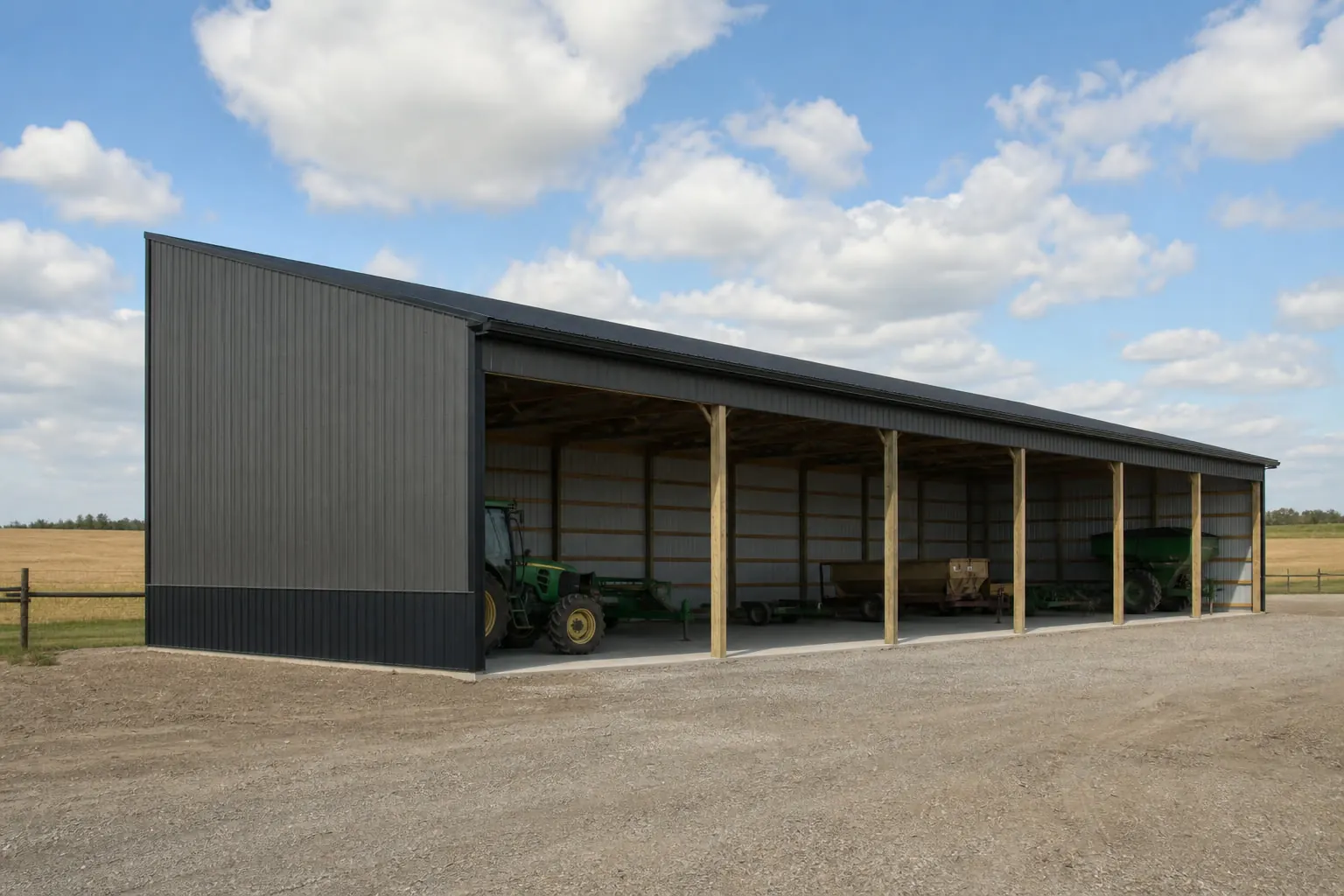
In a state where corn and soybean operations define the landscape, an equipment shed is more than simple storage—it is the hub of a multi-million dollar machinery program. Iowa's primary planning challenges for equipment sheds involve scaling footprints for modern 24-row planters, ensuring site stability in regions like the Loess Hills, and preparing for the high-velocity wind events that characterize the Iowa plains. Because Iowa delegates building permit authority to local jurisdictions, your project starts with identifying county-level zoning requirements for agricultural structures, which often differ significantly from residential codes.
Operations
Sizing for Iowa's row-crop scale
Iowa's status as a top corn and soybean producer means that equipment sheds must be sized for high-capacity machinery that often exceeds standard residential or hobby-farm scales.
When planning an equipment shed in Iowa, the first question is not about the building itself, but about the machinery that will inhabit it for the next twenty years. Modern 24-row planters, large combines with broad headers, and high-clearance sprayers require massive clear spans. A door width of 30 to 40 feet is often the baseline for central Iowa operations. Buyers frequently under-size their clear height, forgetting that future equipment iterations may require 16 to 18 feet of clearance to accommodate taller cab designs or foldable wings.
Consider the workflow of a typical Iowa spring or fall. You need enough interior depth to pull a tractor and planter in for maintenance without blocking the entire floor. In Iowa, where the planting window can be narrowed by wet springs, having a well-organized storage space that allows for quick equipment deployment is a competitive advantage for the farm operation. We recommend planning for a footprint that exceeds your current needs by at least 25% to account for the ongoing trend toward larger agricultural implements.
The interior layout should also account for the specialized electronics found in modern Iowa farm machinery. While an equipment shed is often an unheated 'cold' building, the significant temperature swings in Iowa—from summer highs of 110°F to winter lows of -30°F—create substantial condensation risk. Installing drip-stop felt or high-quality insulation in the roof is a standard practice here to protect expensive GPS units and sensors from moisture damage caused by overhead condensation dripping off the steel panels.
Procedural
Navigating Iowa's local permitting structure
Permitting an equipment shed in Iowa depends heavily on whether the structure is classified as agricultural-exempt or requires a full building permit under local county ordinances.
Iowa's 99 counties each have their own approach to agricultural building exemptions. In many rural counties, a building that is used purely for agricultural purposes—storing corn-production equipment or grain—may be exempt from certain building code requirements, though zoning and setback rules still apply. However, if the shed is intended to double as a workshop with significant electrical service or plumbing, the county may require a full permit and inspections.
It is vital to contact your County Auditor or Zoning Department before finalizing a contract. Don't assume that because your neighbor built a shed without a permit five years ago, the rules haven't changed. High-growth areas around Des Moines, Cedar Rapids, and Iowa City often have more stringent requirements than more isolated western or southern counties. Ask specifically about 'Agricultural Exemption' status and what documentation (such as proof of farm income or acreage) is required to qualify. This step can save thousands in permit fees and weeks of delays.
Even where the permit office confirms none is needed, the physical forces on the building don't change. Iowa's history with derechos—high-velocity straight-line wind storms—means an 'exempt' agricultural building is still subject to the same wind and snow exposure as a regulated one. Rather than relying on a generic spec sheet, ask your building supplier and a local engineer to confirm bracing and gauge choices against the wind and snow conditions typical for your county, then document that decision even if the county never asks to see it.
Site Context
Iowa terrain and site preparation
Site preparation for an equipment shed in Iowa varies significantly between the western Loess Hills and the central glaciated plains.
Loess Hills (Western Iowa)
The sharp bluffs and 200-foot relief along the Missouri River require extensive cut-and-fill work. The silt-based soil in this 200-mile band is uniquely stable when dry but prone to rapid erosion. Heavy equipment sheds here must have robust drainage systems and potentially deeper pier footings to prevent settling.
Central Glaciated Plains
The central part of the state is relatively flat but often has heavy, moisture-retaining clay soils. Site-prep focus here is on drainage and creating a solid gravel or concrete pad that can handle the weight of heavy machinery without sinking during wet Iowa springs.
Southern Rolling Hills
Sites in southern Iowa often involve more varied topography. Planning the approach lane is as important as the building pad itself, as steep or narrow access roads can make delivering steel kits or moving large machinery difficult during the winter months.
Get Iowa Equipment Shed Quotes
Ready to scale your operation? Connect with builders who understand Iowa's row-crop requirements and terrain.
Configuration
Common Iowa equipment shed layouts
Iowa operations tend to organize equipment storage around a handful of recurring layouts driven by machinery mix and farm scale.
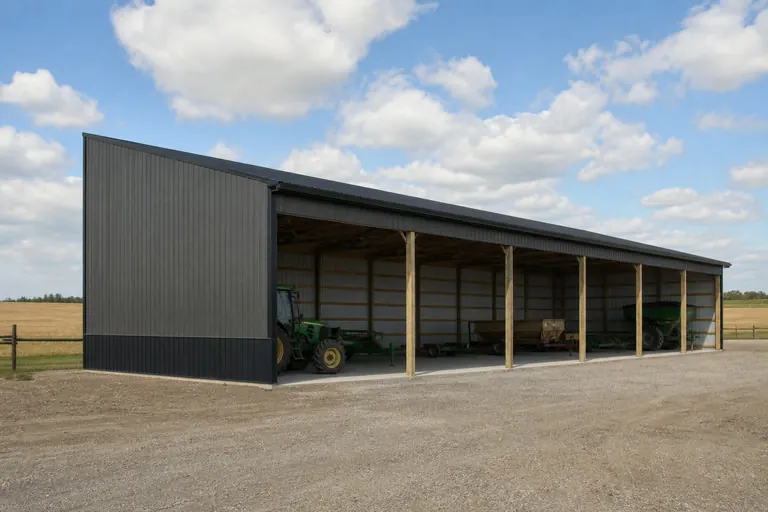 The Single-Bay Row Crop ShedOne long open bay sized for a combine and header cart, with a lean-to for smaller implements along one wall.The Multi-Bay Operation CenterSeveral bays separated by partial walls, splitting tillage, planting, and harvest equipment for easier seasonal rotation.
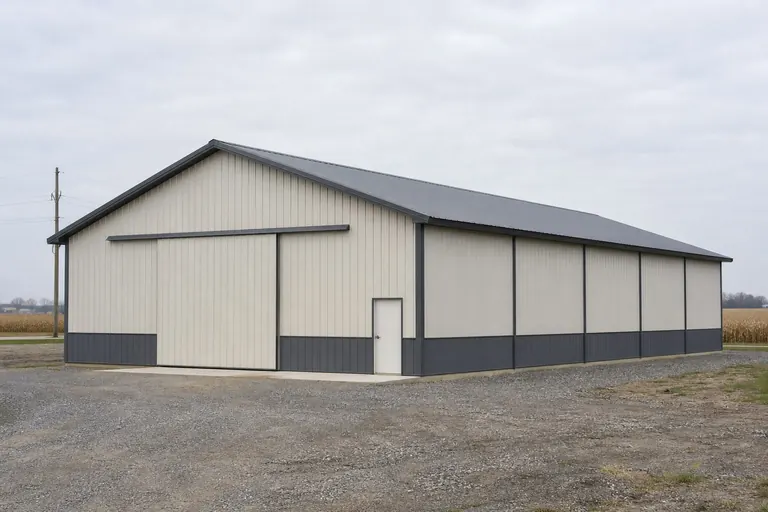 The Shed-With-Shop HybridA dedicated heated bay for maintenance and electronics work alongside unheated cold storage for the rest of the fleet.
Example Configuration — for planning purposes only.
Before You Order
A buyer checklist for an Iowa equipment shed
Because Iowa's exemption rules and terrain vary so widely, a short list of upfront confirmations prevents avoidable change orders.
- Confirm agricultural-exemption status in writingGet the county's exemption criteria and any acreage or income documentation requirements before you sign a purchase agreement.
- Size the door for tomorrow's equipment, not today'sClear height and door width are expensive to change later; plan for the next equipment upgrade cycle, not just your current fleet.
- Ask for a site-specific wind and snow bracing planEven on exempt agricultural buildings, confirm bracing and steel gauge against your county's typical wind and snow exposure with a local engineer or supplier.
- Plan roof condensation control before framingDrip-stop felt or insulation is far cheaper to install during construction than to retrofit once expensive electronics are already stored inside.
Questions
Iowa Equipment Shed FAQ
Honest answers for Iowa farm storage planning.
It depends on your county. Many Iowa counties offer agricultural exemptions for storage buildings, but you must verify this with your local zoning department. Setbacks and floodplain rules always apply.
A 24-row planter typically requires a door width of at least 30 to 40 feet to move through comfortably, depending on whether it is a front-fold or stack-fold design.
Iowa's temperature extremes (-30°F to 110°F) cause significant condensation. We recommend anti-drip coatings or insulation to protect equipment electronics from moisture.
No. An exemption typically waives the permit and inspection process, not the physical forces on the building. Confirm bracing and steel gauge with a local engineer or supplier regardless of exemption status.
Yes. The steep, silt-based bluffs USGS documents in this western Iowa corridor often require deeper pier footings and more robust drainage than the flatter central glaciated plains.
Sources for the Iowa facts on this page
This page states no code requirement, wind speed, snow load, permit rule, price or supplier claim. The state-specific facts it does use are listed with their publisher below.
The Loess Hills of western Iowa rise roughly 200 feet above the flat Missouri River floodplain and form a narrow band running north-south for about 200 miles along the Missouri River, with steep angles and sharp bluffs on their western side.
U.S. Geological Survey (USGS) · USGS reference publication · Tier 1
https://www.usgs.gov/publications/geology-loess-hills-iowaNWS Des Moines climatological records (1878-present) list a record daily high of 110°F (July 25, 1936 and August 4, 1918) and a record low daily minimum of -30°F (January 5, 1884) at the Des Moines station.
National Weather Service (NOAA), Des Moines IA office · 1878-2025 period of record · Tier 1
https://www.weather.gov/media/dmx/Climate/DesMoinesOverallExtremesClimateData.pdfNWS Des Moines climatological records (1878-present) list a record daily high of 110°F (July 25, 1936 and August 4, 1918) and a record low daily minimum of -30°F (January 5, 1884) at the Des Moines station.
National Weather Service (NOAA), Des Moines IA office · 1878-2025 period of record · Tier 1
https://www.weather.gov/media/dmx/Climate/DesMoinesOverallExtremesClimateData.pdfFEMA's National Risk Index dataset covers 18 natural hazards (including drought, tornado, hail, cold wave, and severe winter weather relevant to Iowa) at the county and Census tract level; FEMA has cited Iowa specifically in a published case study describing drought's importance to the state's water-dependent farm economy.
Federal Emergency Management Agency (FEMA) · Current FEMA case study/NRI release · Tier 1
https://www.fema.gov/case-study/drought-hazard-use-caseIowa's total land area was measured at 55,857.1 square miles as of the 2010 Census.
U.S. Census Bureau · 2010 Census · Tier 1
https://www.census.gov/geographies/reference-files/2010/geo/state-local-geo-guides-2010/iowa.html