
Metal garage · DE
Metal Garages in Delaware
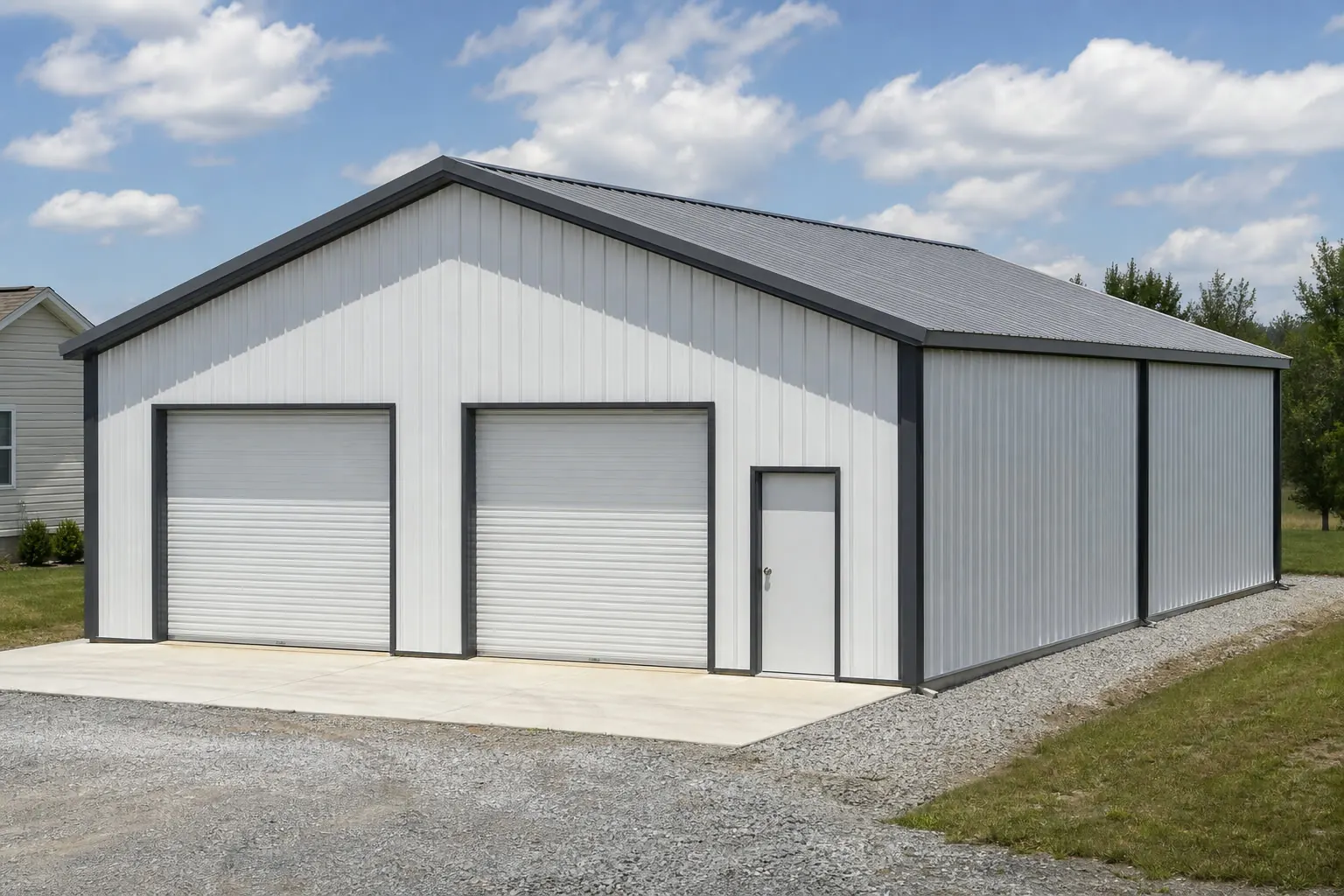
A metal garage is fully enclosed, which changes the climate conversation from open-air drainage to condensation and ventilation inside the box. The Delaware Geological Survey places nearly the whole state, outside the hills of northern New Castle County, in the low-relief Atlantic Coastal Plain, so most Delaware metal garage sites are flat and simple to prepare; the more relevant question is how Wilmington's consistently humid climate normal interacts with a sealed steel building storing vehicles or equipment.
The intersection
Why a sealed building changes what Delaware's climate means
An enclosed metal garage traps air inside it, which turns Delaware's humid climate into a condensation question rather than a simple weather-exposure one.
A carport lets moist air pass through; a metal garage, by design, does not. That distinction matters in Delaware because Wilmington's 1991-2020 climate normal runs about 45.3 inches of annual precipitation, a consistently wet pattern that keeps ambient humidity elevated much of the year. Inside a sealed steel building without ventilation, that humid air can condense on cool metal surfaces overnight, which is a slower but real threat to stored vehicles and tools than open-air rain ever is.
Site prep, by contrast, is usually straightforward. The Delaware Geological Survey's terrain map shows that apart from the hills of northern New Castle County within the Appalachian Piedmont, the rest of the state sits on low-relief Atlantic Coastal Plain ground. A flat, level pad is the norm for most Delaware metal garage sites, which shifts planning effort away from grading and toward the building's ventilation package instead.
Sussex County's farm base is a further reason a Delaware metal garage brief differs from a purely suburban one: 1,053 farms worked 262,079 acres there in 2022, and enclosed, lockable storage for tractors, implements and farm trucks is a recurring request distinct from simple passenger-vehicle cover. Sizing a garage for that use means measuring the tallest and widest piece of equipment expected to use it, not assuming a standard two-car footprint.
Kent County adds a related but distinct pattern: 770 farms worked 187,248 acres there in 2022, with land in farms up 3% since 2017 even as the farm count itself fell 6%. That combination points to the same consolidation dynamic Sussex County shows at a smaller scale — fewer operations covering steady or growing acreage — which keeps enclosed equipment storage relevant across both farm counties rather than being a Sussex-only consideration. The Delaware Department of Agriculture and USDA NASS jointly publish an annual Agricultural Statistics Bulletin summarizing this county-level detail alongside the state's Census of Agriculture highlights, a useful reference if you want more specific context on your county's farm profile before sizing a garage for equipment use.
Exposure
Ventilation and coastal hazard checks for a Delaware garage
A vent kit or ridge vent is a modest add relative to the building and directly addresses the condensation risk Delaware's humid climate creates.
Because Wilmington's climate normal reflects a persistently wet pattern rather than an occasional storm, a metal garage benefits from planned airflow even when it is not actively occupied. Static roof vents, gable vents or a small powered fan reduce trapped moisture around stored vehicles, tools and equipment far more reliably than opening the door occasionally.
For properties near Delaware's coastline, a separate check is worth making: FEMA's National Risk Index (hazards.fema.gov/nri) is the authoritative county- and tract-level source for hazard exposure, including coastal flooding, in a low-lying state like Delaware. This page does not assert a statewide flood or wind figure because that exposure varies sharply by parcel; checking the NRI for your specific county or tract before finalizing anchoring and floor elevation is the right next step.
Wilmington's normal also carries roughly 20.2 inches of average annual snowfall alongside its rainfall total, which is a second reason a sealed garage benefits from planned airflow: a closed building holding both winter cold and residual humidity is more prone to interior condensation on cool mornings than one with even minimal vent paths.
- Add ventilation by default
- Static or powered vents reduce condensation risk inside a sealed garage in Delaware's humid climate.
- Check coastal hazard exposure separately
- Properties near tidal water should consult FEMA's National Risk Index by county or tract rather than assume a generic figure.
- Confirm anchoring locally
- Anchoring and floor elevation requirements are set by your local building department, especially in flood-prone areas.
Configuration
What Delaware metal garages are usually used for
Enclosed, secure storage draws a few recurring uses across Delaware's suburban, farm and coastal properties.
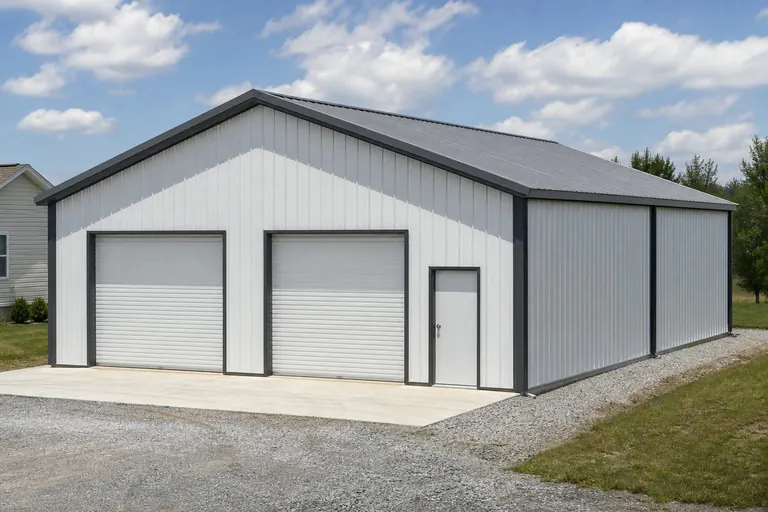 Multi-vehicle storageFully enclosed protection and security for two or more vehicles, common on New Castle and Kent county suburban lots.Farm equipment and tool storageOn Kent and Sussex county operations, an enclosed garage for equipment and tools that need protection from humidity, not just rain.Boat and recreational equipment storageNear Delaware's coastal communities, a sealed garage keeps boats, seasonal gear and equipment secure between uses.
Example Configuration — for planning purposes only.
Get Delaware metal garage quotes
Tell us your vehicle or equipment storage needs and rough size. We route it with the Delaware and metal garage context already attached.
Footprint
Sizes that suit a Delaware metal garage
Flat lots rarely constrain footprint, so Delaware metal garage sizing usually follows vehicle count and storage needs.
24′ × 30′
720 sq ft
A standard two-vehicle enclosed footprint for a suburban New Castle or Kent county lot.
30′ × 40′
1,200 sq ft
Common where equipment or tool storage is added alongside vehicles.
40′ × 60′
2,400 sq ft
A larger option for farm equipment or multi-vehicle storage on Sussex or Kent county acreage.
Example Configuration — for planning purposes only.
Footprint pages carry the door and bay layout for each of these; this page explains why Delaware buyers land in this range.
Preparation
Before you place a Delaware metal garage order
A short list resolved in advance keeps a sealed structure performing as intended.
- Confirm zoning, setbacks and anchoring locallyRequirements vary by jurisdiction and by whether the parcel sits in a flood-prone area; confirm with your local building department before finalizing placement.
- Decide on ventilation before deliverySpecify ridge, gable or powered venting up front rather than retrofitting it into a sealed steel shell later.
- Measure the tallest and widest item that will use itEspecially relevant for Sussex or Kent county buyers storing farm equipment alongside vehicles.
- Check coastal hazard exposure if applicableProperties near tidal water should reference FEMA's National Risk Index by county or tract before setting floor elevation.
- Review your county's farm profile if storing equipmentKent and Sussex county USDA data show different consolidation patterns; check the state's Agricultural Statistics Bulletin if you want more detail before sizing a garage.
Questions
Delaware metal garage questions
Questions we can answer honestly at state level, with jurisdiction-specific items routed to the right office.
Permit requirements depend on footprint, foundation type and local zoning. Your local building or zoning department is the only reliable source for your specific project.
Wilmington's 1991-2020 climate normal shows about 45.3 inches of annual precipitation, part of a consistently humid pattern. That makes ventilation, such as ridge or gable vents, a worthwhile addition to reduce condensation on stored vehicles and equipment inside a sealed garage.
It depends on the parcel. FEMA's National Risk Index (hazards.fema.gov/nri) provides county- and tract-level hazard scores; check yours, especially near tidal or low-lying areas, before finalizing floor elevation and anchoring.
There is no official typical size. A 24x30 footprint suits two vehicles, while 30x40 and larger sizes accommodate added equipment storage or farm use, particularly on Kent and Sussex county acreage.
We do not publish state-level prices, since cost depends on size, doors, ventilation and site work. Our cost pages cover what drives the number; a quote covers your specific project.
Sources for the Delaware facts on this page
This page states no code requirement, wind speed, snow load, permit rule, price or supplier claim. The state-specific facts it does use are listed with their publisher below.
The Delaware Geological Survey states the entire state lies within two physiographic provinces, the Appalachian Piedmont and the Atlantic Coastal Plain, separated by the Fall Line; only the hills of northern New Castle County lie within the Piedmont, with the rest of the state in the low-relief Coastal Plain.
Delaware Geological Survey, University of Delaware · DGS reference material · Tier 2
https://www.dgs.udel.edu/delaware-geology/summary-geologic-history-delawareWilmington's 1991-2020 annual climate normal precipitation is about 45.3 inches with roughly 20.2 inches of annual snowfall.
NOAA National Centers for Environmental Information (NCEI) · 1991-2020 · Tier 1
https://www.ncei.noaa.gov/access/services/data/v1?dataset=normals-monthly-1991-2020&dataTypes=MLY-PRCP-NORMAL,MLY-SNOW-NORMAL&format=csv&stations=USW00013781FEMA's National Risk Index platform (hazards.fema.gov) is the authoritative county/tract-level source for Delaware natural hazard exposure scores across 18 hazard types, including coastal flooding and hurricane categories relevant to a low-lying, low-elevation coastal state.
Federal Emergency Management Agency (FEMA) · Current NRI dataset · Tier 1
https://www.fema.gov/flood-maps/products-tools/national-risk-indexDelaware's total land area was measured at 1,948.5 square miles as of the 2010 Census, the second-smallest of any U.S. state.
U.S. Census Bureau · 2010 Census · Tier 1
https://www.census.gov/geographies/reference-files/2010/geo/state-local-geo-guides-2010/delaware.htmlSussex County, Delaware's largest county by farmland, had 1,053 farms on 262,079 acres in 2022, with 32% of farmland-in-use acres reported irrigated.
USDA NASS · 2022 · Tier 1
https://www.nass.usda.gov/Publications/AgCensus/2022/Online_Resources/County_Profiles/Delaware/cp10005.pdfKent County, Delaware had 770 farms on 187,248 acres in 2022, with land in farms up 3% since 2017 even as farm count fell 6%.
USDA NASS · 2022 · Tier 1
https://www.nass.usda.gov/Publications/AgCensus/2022/Online_Resources/County_Profiles/Delaware/cp10001.pdfThe Delaware Department of Agriculture and USDA NASS jointly issue an annual Agricultural Statistics Bulletin summarizing statewide farm production and the 2022 Census of Agriculture highlights for Delaware.
USDA NASS / Delaware Department of Agriculture · 2022-2023 · Tier 2
https://www.nass.usda.gov/Statistics_by_State/Delaware/Publications/Annual_Statistical_Bulletin/2022/DE-2022-2023-Ag-Stats-Bulletin.pdf