
Pole barn · AR
Pole Barns in Arkansas
Arkansas's farm count fell 11% between 2017 and 2022 to 37,756 farms, while the acreage those farms cover rose 12% to 13,722,525 acres — fewer operations, each one larger on average, at 363 acres. That consolidation is the backdrop for most Arkansas pole barn planning: equipment storage sized for a bigger operation, sited on ground that is either the flat, flood-prone Delta in the east or the higher Ozark Plateau and Ouachita Mountains ground in the west and north. Hazard exposure adds a third variable that has to be checked per county — FEMA's National Risk Index only resolves cleanly at that level across Arkansas's 75 counties.
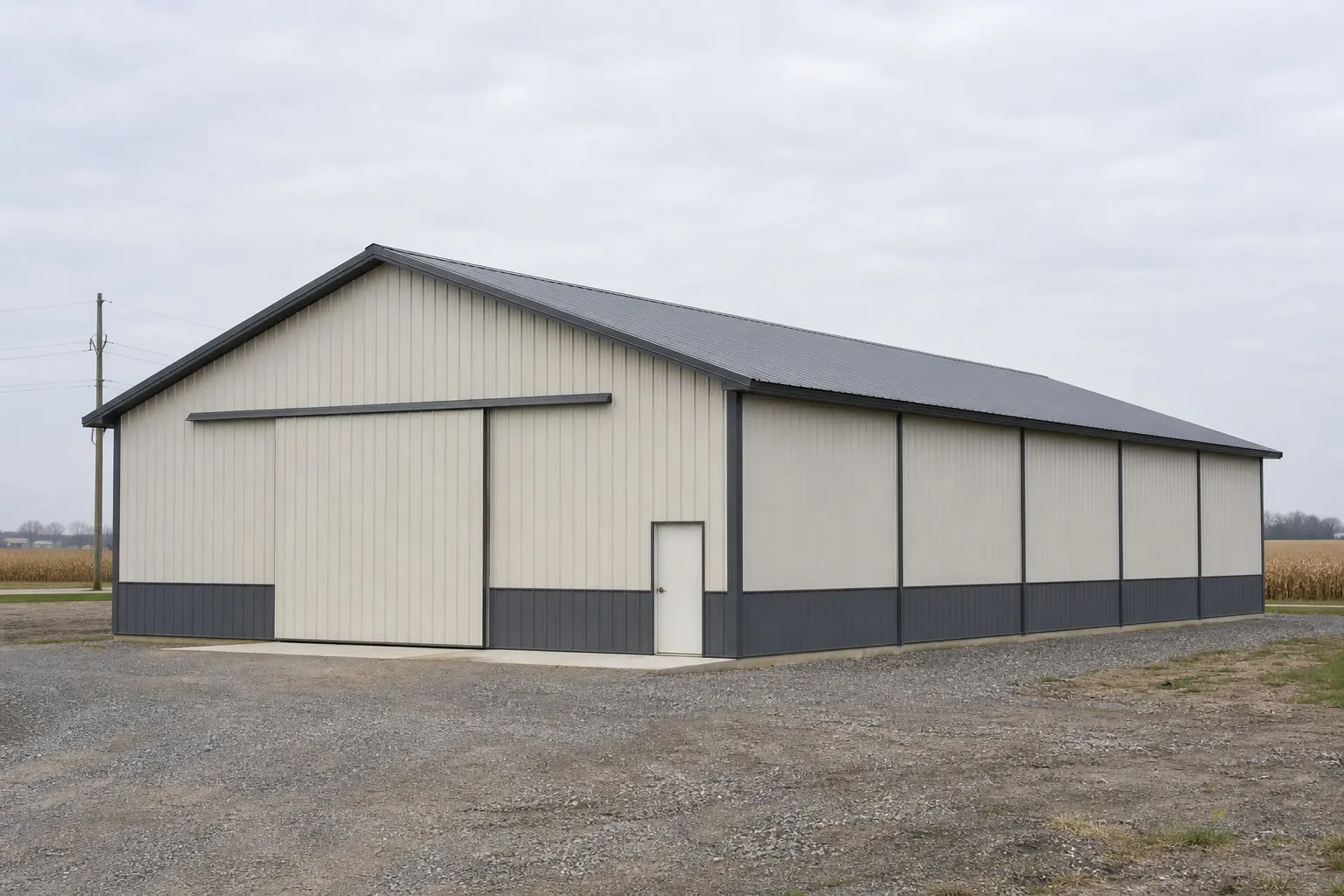
The intersection
A shrinking, larger Arkansas farm base
Arkansas's agricultural base is consolidating, and that trend is the most useful single fact for sizing a pole barn here.
USDA's 2022 Census of Agriculture recorded 37,756 Arkansas farms, down 11% from 2017, while land in farms rose to 13,722,525 acres, up 12% — meaning the state has fewer operations, each averaging more acreage (363 acres, up 12%) than five years earlier. Fewer, larger operations tend to run larger or additional equipment, which is a direct input into pole barn sizing even though it says nothing about wind loads or code requirements.
That consolidation does not mean every Arkansas buyer is farming at scale — plenty of pole barns here serve hobby, residential-acreage or light commercial storage use. But where the brief is genuinely agricultural, the 2022 trend is a reason to size for the operation you expect to have in five years, not just the equipment on hand today.
Site context
Delta lowland versus Ozark/Ouachita upland
Where the parcel sits inside Arkansas changes the pad-prep and access conversation before the building spec does.
Delta (east)
USGS classifies this area within the Mississippi Alluvial Plain: low, flat, historically flood-prone ground. Drainage away from the pad and floodplain status are worth confirming before foundation type is set.
Ozark Plateau (north)
Higher, more varied terrain than the Delta. Grading and equipment access for a truck-and-trailer delivery are the more likely site-prep cost drivers here.
Ouachita Mountains (west)
Also higher, folded terrain distinct from the Delta. Slope and cut-and-fill should be confirmed with a site visit before committing to a footprint on this ground.
Hazard data
Checking wind and flood exposure by county, not by state
FEMA's National Risk Index covers tornado, riverine flooding, earthquake and 15 other hazards for Arkansas, but the data only resolves cleanly at the county and tract level across the state's 75 counties.
That means a pole barn sited in a Delta county and one sited in an Ozark county are not necessarily reading the same hazard profile, even though both fall under the same statewide FEMA tool. Neither this page nor a general Arkansas hazard summary should substitute for pulling the specific county's data before finalizing bracing, anchoring or siting decisions with your builder.
None of that becomes a wind rating or a bracing spec here — that is a conversation for your builder's engineering and, where required, your local building department. What changes at the Arkansas intersection is the order of operations: check the county-level data first, then have the structural conversation with a specific site in mind.
- Pull county-level FEMA data before siting
- Do not assume a neighboring county's hazard profile applies to yours.
- Ask your builder about bracing for your specific hazard mix
- Tornado and riverine flood exposure are not the same design question.
Get Arkansas pole barn quotes
Tell us your county, what the building needs to store, and your rough footprint. We route it with the Arkansas and pole barn context already attached.
Configuration
What Arkansas pole barns are typically built to do
The consolidating farm base and split terrain push Arkansas briefs toward equipment- and commodity-scale storage more often than a small hobby shed.
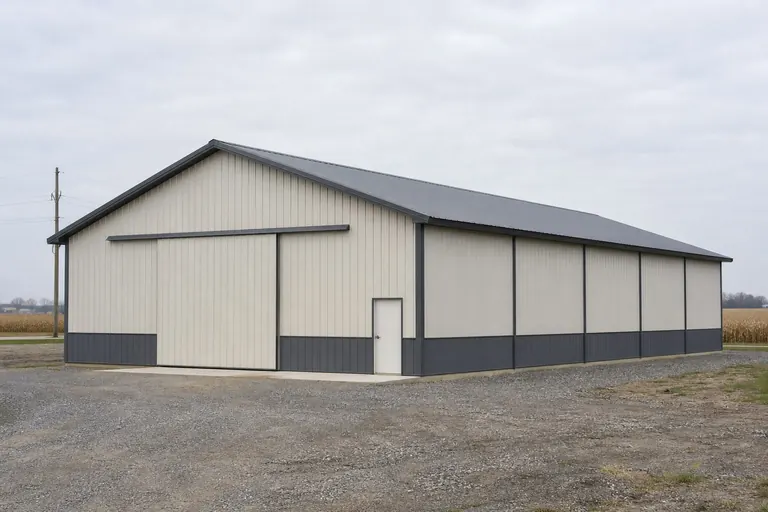 Equipment storageA clear-span bay sized to the operation's current and expected implement fleet, sited with truck-and-trailer access in mind.Grain or commodity storageRelevant on larger, consolidated Delta operations where drainage and a raised floor matter as much as square footage.Hay and livestock shelterOpen-sided or partially enclosed configurations common on both Delta and upland operations, with door placement worth checking against local wind exposure.
Example Configuration — for planning purposes only.
Footprint
Sizes that fit a consolidating farm base
Because the state's average farm has grown to 363 acres, Arkansas pole barn sizing skews toward equipment-scale rather than a small single-vehicle shed.
30′ × 40′
1,200 sq ft
A reasonable single-purpose start on a smaller parcel or hobby-acreage site.
40′ × 60′
2,400 sq ft
A frequent choice for a mid-size equipment fleet on a consolidated operation.
40′ × 80′
3,200 sq ft
Fits a dedicated equipment or hay building on a larger farm without doubling as anything else.
60′ × 100′
6,000 sq ft
A wide-span option sized for larger commodity or equipment storage on the state's larger farms.
Example Configuration — for planning purposes only.
Footprint pages carry layout and door detail; this page explains why the Arkansas brief tends toward these sizes.
Preparation
Before you request an Arkansas pole barn quote
A few things resolved in advance keep quotes comparable across builders.
Step 1
Confirm your county's hazard profile
Use FEMA's National Risk Index for your specific county rather than a regional assumption.
Step 2
Confirm whether the site sits in a Delta floodplain
Ask your local building department whether floodplain status affects foundation approach.
Step 3
Call your local building department about permits
This page does not state a statewide permit rule because no single verified one exists in the evidence used here.
Step 4
Size for the operation you expect in five years
Arkansas's farm base is consolidating toward larger holdings, which is worth factoring into today's footprint decision.
Step 5
Ask about ventilation for enclosed bays
A partially or fully enclosed pole barn benefits from ridge and gable ventilation sized to its volume, particularly for hay or commodity storage where trapped moisture is a real spoilage risk.
Questions
Arkansas pole barn questions
Answered honestly at state level; permit and structural specifics route to your local building department or your builder's engineer.
This evidence pack does not contain a single verified statewide permitting-authority record for Arkansas. Confirm requirements with your specific county or municipal building department rather than assuming a statewide rule.
USGS describes the eastern Delta as low, flat and historically flood-prone, distinct from the higher Ozark Plateau and Ouachita Mountains terrain. Drainage and floodplain status matter more in the Delta; grading and access matter more in the uplands. Confirm specifics with a site visit.
USDA's 2022 data shows Arkansas's farm base shrinking in count but growing in average size (363 acres, up 12% since 2017). It is background for why this page discusses equipment-scale sizing, not a rule about what you personally need.
FEMA's National Risk Index publishes county- and tract-level data across all 75 Arkansas counties for 18 hazards including tornado and riverine flooding. Query it for your specific county before finalizing bracing or siting decisions with your builder.
There is no official typical size. Because the state's average farm has grown to 363 acres, sizes on this page run from a compact 30x40 up through 60x100 depending on the equipment or commodity storage the building needs to serve.
Sources for the Arkansas facts on this page
This page states no code requirement, wind speed, snow load, permit rule, price or supplier claim. The state-specific facts it does use are listed with their publisher below.
Arkansas had 37,756 farms in 2022, down 11% from 2017.
USDA National Agricultural Statistics Service (NASS) · 2022 · Tier 1
https://www.nass.usda.gov/Publications/AgCensus/2022/Online_Resources/County_Profiles/Arkansas/cp99005.pdfArkansas had 13,722,525 acres of land in farms in 2022, an average farm size of 363 acres, up 12% from 2017.
USDA NASS · 2022 · Tier 1
https://www.nass.usda.gov/Publications/AgCensus/2022/Online_Resources/County_Profiles/Arkansas/cp99005.pdfThe Arkansas Delta in the eastern part of the state lies within the Mississippi Alluvial Plain, a low, flat, historically flood-prone floodplain region distinct from the higher Ozark Plateau and Ouachita Mountains to the west.
U.S. Geological Survey (USGS) · Originally published 1923; USGS reference · Tier 1
https://pubs.usgs.gov/bul/0730d/report.pdfFEMA's National Risk Index is an interactive county/tract-level tool covering 18 natural hazards, including tornado, riverine flooding, and earthquake, that can be queried for Arkansas's 75 counties.
Federal Emergency Management Agency (FEMA) · Current NRI release · Tier 1
https://www.fema.gov/flood-maps/products-tools/national-risk-indexArkansas's total land area was measured at 52,035.5 square miles as of the 2010 Census.
U.S. Census Bureau · 2010 Census · Tier 1
https://www.census.gov/geographies/reference-files/2010/geo/state-local-geo-guides-2010/arkansas.html