
Metal garage · MD
Metal Garages in Maryland
Maryland is a small state that still spans three genuinely different physiographic provinces, per the Maryland Geological Survey: the Atlantic Coastal Plain, the rolling Piedmont, and the combined Blue Ridge, Valley and Ridge, and Appalachian Plateau country to the west. A garage pad and approach on Eastern Shore Coastal Plain sand behaves nothing like one cut into Piedmont clay or western mountain slope, which makes provincial terrain the first real planning variable for a Maryland metal garage. Layer in 12,550 working farms recorded in the 2022 Census of Agriculture and 16,823 new privately-owned housing units authorized statewide in 2024, and the honest Maryland story is a garage market split between working-parcel equipment storage and suburban vehicle and workshop storage, not one uniform brief.
The intersection
Maryland's three provinces change what a garage pad sits on
The Maryland Geological Survey describes the state as spanning three distinct physiographic regions, and the difference between them is a real siting variable before a garage plan is finalized.
The Atlantic Coastal Plain covers Maryland's Eastern Shore and southern counties with generally flat, sandy, low-lying ground. It is often the easiest terrain for a garage pad to level, but sandy soil and a high water table in some low spots mean drainage away from the slab deserves early attention rather than an assumption that flat automatically means dry.
The Piedmont, running through central Maryland including much of the Baltimore-Washington corridor, is rolling ground with firmer clay-heavy soils. Grading a pad here is more about managing slope and runoff than about soil bearing, and a sloped driveway approach is common enough that access should be checked during the site visit, not after delivery.
To the west, Maryland's mountain country combines the Blue Ridge with the Valley and Ridge and Appalachian Plateau provinces named by the Maryland Geological Survey. This is the most demanding of the three for a garage site: steeper grades, more excavation, and longer or narrower access roads that can limit what a delivery truck can bring in one load.
None of this changes what a metal garage is. It changes how much site work sits between a quote and a finished slab, and how accurately a supplier can price that work without knowing which of the three provinces your parcel is actually in.
If your garage is meant to double as a workshop, say so at the quote stage regardless of province. Insulation, a heated slab and additional electrical provision are far easier to specify up front than to retrofit once the building is standing.
Site context
What each Maryland province means for a garage site
Terrain, soil and access vary enough across these three provinces that the same garage plan can mean very different site-prep costs depending on where it sits.
Atlantic Coastal Plain
Flat, sandy ground across the Eastern Shore and southern Maryland; generally easy grading, but check drainage and water table depth before siting a pad in a low spot.
Piedmont
Rolling terrain through central Maryland and the Baltimore-Washington corridor; clay-heavy soils and moderate slope make runoff management and driveway grade the main site questions.
Blue Ridge, Valley and Ridge, and Appalachian Plateau
Western Maryland's mountain provinces; steeper grades, more excavation, and access roads that can constrain delivery truck size and turning radius.
Quick reference
Maryland numbers this page relies on
Every figure below carries a named publisher and period; none of it is a design value or a code requirement.
| Measure | Figure | Source |
|---|---|---|
| Physiographic provinces | Three, named by the Maryland Geological Survey | Maryland Geological Survey |
| Farms (2022) | 12,550, up from 12,429 in 2017 | USDA NASS, 2022 Census of Agriculture |
| Land in farms (2022) | 1,978,036 acres; average 158 acres per farm | USDA NASS, 2022 Census of Agriculture |
| New housing units authorized (2024) | 16,823 total; 10,885 single-unit | U.S. Census Bureau |
| Hazard data coverage | 24 jurisdictions, 18 hazard types tracked | FEMA National Risk Index |
Physiographic provinces
- Figure
- Three, named by the Maryland Geological Survey
- Source
- Maryland Geological Survey
Farms (2022)
- Figure
- 12,550, up from 12,429 in 2017
- Source
- USDA NASS, 2022 Census of Agriculture
Land in farms (2022)
- Figure
- 1,978,036 acres; average 158 acres per farm
- Source
- USDA NASS, 2022 Census of Agriculture
New housing units authorized (2024)
- Figure
- 16,823 total; 10,885 single-unit
- Source
- U.S. Census Bureau
Hazard data coverage
- Figure
- 24 jurisdictions, 18 hazard types tracked
- Source
- FEMA National Risk Index
Get Maryland metal garage quotes
Tell us your county, which physiographic province you're in, and how many vehicles or bays you need. We route it with the Maryland and metal garage context already attached.
Configuration
What a Maryland metal garage is usually asked to do
With a still-growing small-farm base and steady suburban construction near Baltimore-Washington, Maryland garage briefs split cleanly between rural equipment storage and suburban vehicle or workshop use.
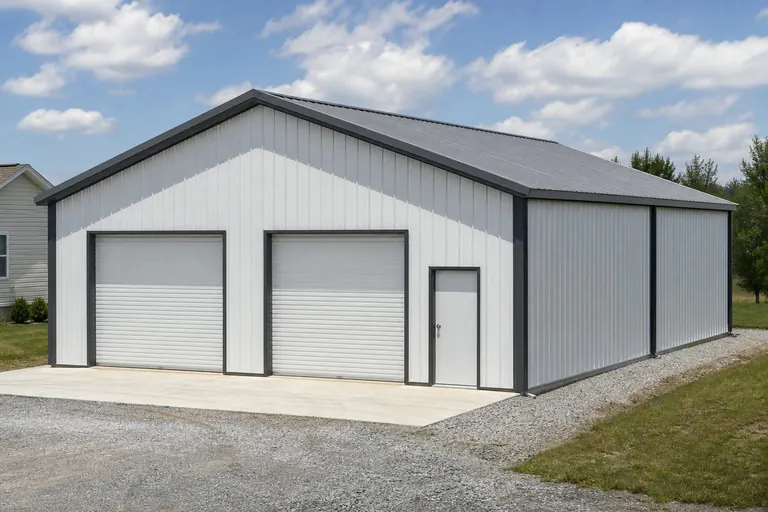 Farm equipment and vehicle storageA common brief on Maryland's roughly 158-acre average farm parcel, sized around tractors, implements and a truck or two rather than a large fleet.Suburban multi-vehicle storageCovered parking for personal vehicles on a Piedmont or Coastal Plain suburban lot, sized around door width and turning room.Workshop plus storageA garage split between a finished workshop end and open vehicle storage, common on smaller residential parcels near the Baltimore-Washington corridor.
Example Configuration — for planning purposes only.
Footprint
Sizes that fit a Maryland garage brief
These are the footprints that recur once province, parcel size and vehicle or equipment count are factored in; none replaces a site-specific plan.
12′ × 20′
240 sq ft
The smallest single-vehicle footprint, useful on tight suburban lots.
18′ × 26′
468 sq ft
A step up for a vehicle plus modest workshop space.
20′ × 30′
600 sq ft
A common two-vehicle configuration on a typical suburban or exurban parcel.
24′ × 30′
720 sq ft
Adds width for easier door clearance and turning room.
30′ × 30′
900 sq ft
A square footprint suited to mixed vehicle and equipment storage on a working parcel.
30′ × 40′
1,200 sq ft
Room for multiple vehicles plus a dedicated shop bay.
40′ × 40′
1,600 sq ft
A larger multi-bay configuration for several vehicles or larger equipment.
40′ × 60′
2,400 sq ft
The upper end of this cluster, suited to fleet-style or combined equipment and vehicle storage on Maryland's larger farm parcels.
Example Configuration — for planning purposes only.
Footprint-level layout and door detail live on the size pages; this page only explains why Maryland briefs cluster here.
Preparation
Before you request a Maryland garage quote
Four steps specific to how Maryland's terrain and buyer mix actually work.
Step 1
Name your physiographic province
Coastal Plain, Piedmont or the western mountain provinces behave differently underfoot; telling your builder which one you're in helps the site conversation start correctly.
Step 2
Check drainage and water table on low Coastal Plain ground
Flat, sandy terrain is easy to grade but can hold water; confirm drainage away from the slab before pouring.
Step 3
Confirm access on Piedmont or mountain terrain
Slope and narrower roads can limit delivery truck size; a site visit before ordering avoids a delivery-day surprise.
Step 4
Confirm vehicle and equipment mix up front
Door height and width decisions depend on exactly what will be stored, whether that's farm equipment or personal vehicles.
Questions
Maryland metal garage questions
Answered honestly at the state level, with anything requiring local judgment routed to the people who own that answer.
Yes in practical terms. The Maryland Geological Survey names three physiographic provinces — Atlantic Coastal Plain, Piedmont, and the western mountain provinces — and site prep differs meaningfully between them, from drainage on flat Coastal Plain ground to grading and access on Piedmont or mountain terrain.
Permit requirements depend on your specific county or municipality. That is a question for your local building department, not something this page can answer generically.
Maryland recorded 12,550 farms in the 2022 Census of Agriculture, up from 12,429 in 2017, with an average farm size of 158 acres. That is a modest scale compared to larger agricultural states, which shapes the size of equipment-storage garages typically requested.
There is no official typical size. Maryland's mix of working farms and suburban growth near Baltimore-Washington points toward briefs that commonly land between 20x30 and 30x40, but your vehicle or equipment count should set the number.
We do not publish state-level prices; the real number depends on your specification, site work and current material costs. Our cost pages explain what drives the number, and a quote covers your specific building.
Sources for the Maryland facts on this page
This page states no code requirement, wind speed, snow load, permit rule, price or supplier claim. The state-specific facts it does use are listed with their publisher below.
The Maryland Geological Survey describes the state as spanning three distinct physiographic regions -- the Coastal Plain, the Piedmont, and the combined Blue Ridge, Valley and Ridge, and Appalachian Plateau provinces -- extending from the Atlantic coast to the western mountains.
Maryland Geological Survey · MGS reference material · Tier 2
https://www.mgs.md.gov/geology/geology_of_maryland.htmlMaryland had 12,550 farms in 2022, up from 12,429 in 2017.
USDA National Agricultural Statistics Service (NASS) · 2022 (with 2017 comparison) · Tier 1
https://www.nass.usda.gov/Publications/AgCensus/2022/Full_Report/Volume_1,_Chapter_1_State_Level/Maryland/st24_1_001_001.pdfMaryland had 1,978,036 acres of land in farms in 2022, an average farm size of 158 acres.
USDA NASS · 2022 · Tier 1
https://www.nass.usda.gov/Publications/AgCensus/2022/Full_Report/Volume_1,_Chapter_1_State_Level/Maryland/st24_1_001_001.pdfBuilders in Maryland were authorized to construct 16,823 new privately-owned housing units in 2024, of which 10,885 were single-unit structures.
U.S. Census Bureau · 2024 (final annual estimates) · Tier 1
https://www.census.gov/construction/bps/stateannual.htmlFEMA's National Risk Index is the federal tool for county- and state-level natural hazard exposure data for Maryland's 24 jurisdictions, covering 18 hazard types including coastal flooding, hurricane, and winter weather.
Federal Emergency Management Agency (FEMA) · Current NRI release · Tier 1
https://www.fema.gov/flood-maps/products-tools/national-risk-index