
Metal garage · NC
Metal Garages in North Carolina
North Carolina asks a metal garage to do a different job depending on which of its three physiographic provinces it sits in. NOAA's own narrative on the state's climate describes a progression from the Atlantic coastal plain, through the rolling Piedmont, to the Appalachian mountains in the west, and a vehicle shelter built for a flat sandy lot near Wilmington answers a different set of problems than one anchored into mountain soil near Asheville. Add in a hurricane season that NOAA flags as highly variable year to year but capable of intense rainfall, and the honest starting point for a North Carolina garage project is: match the design to your specific province and county, not a single statewide template.
Terrain-First Planning
One state, three very different garage sites
A metal garage plan that works in Wilmington rarely transfers cleanly to Asheville, because the ground underneath it is fundamentally different.
NOAA's descriptive narrative on North Carolina's climate traces a path from the Atlantic coastal plain, through the Piedmont, to the Appalachian mountains in the west. That same path matters enormously for a garage foundation. On the coastal plain, sandy, low-lying ground drains quickly but sits closer to the water table, so a slab needs to be graded and set to shed water rather than collect it near the vehicle bay.
Move inland to the Piedmont and the ground changes to reddish clay that expands and contracts with moisture. A garage slab here needs joint control and a compacted base that won't crack as the clay swells after rain and shrinks in a dry spell. Further west, in the Blue Ridge foothills and mountains, the challenge shifts again to slope: a garage often needs a cut-and-fill pad or retaining work before the concrete ever goes down, and access road grade becomes part of the design conversation, not an afterthought.
None of this is decorative detail. USGS research on North Carolina's physiographic provinces treats the Coastal Plain, Piedmont and Blue Ridge as distinct regional geologic settings, which is exactly why a single 'North Carolina garage spec sheet' does not exist in practice — the right spec depends on which third of the state the slab sits in.
Footprints
Sizing a North Carolina garage around use, not just vehicle count
Garage dimensions in North Carolina tend to track how the building is actually used across the year, not just how many cars need to fit.
20′ × 20′
400 sq ft
A compact two-car footprint that fits many suburban Piedmont lots around Charlotte or Greensboro.
24′ × 36′
864 sq ft
Adds a workbench bay, a common choice where a garage doubles as light workshop space.
30′ × 50′
1,500 sq ft
Sized for a truck, a boat, and farm implements on larger coastal plain or Piedmont acreage.
Example Configuration — for planning purposes only.
Mountain-county lots with limited buildable pad area sometimes favor a narrower, deeper footprint to fit the available flat ground.
Storm Exposure
Anchoring against a hurricane season that varies year to year
North Carolina's hurricane exposure is real but uneven, which changes how a garage owner should think about risk.
NOAA's state climate summary is explicit that the number of landfalling hurricanes affecting North Carolina swings widely from year to year, and that storm intensity and rainfall rates associated with these systems are projected to increase. For a metal garage, that variability argues against assuming a 'quiet' storm season will repeat. Anchoring, fastener quality, and door hardware are cheap to specify correctly at build time and expensive to retrofit after a storm has already tested a weak point.
Because FEMA's National Risk Index is the authoritative county-level source for hazard exposure, a garage buyer anywhere in North Carolina — not just along the immediate coast — should pull their own county's report before finalizing a build spec, since inland counties along a storm's path can see damaging wind well after landfall.
- Confirm your county's FEMA NRI profile
- County-level detail, not a statewide guess, should drive anchoring decisions.
- Specify anchoring for a bad year, not an average one
- Hurricane frequency in North Carolina is documented as highly variable year to year.
- Grade the apron to shed water fast
- Rainfall rate, not just wind, is the growing concern NOAA flags for the state.
Get your North Carolina garage quote
Tell us your county and how you plan to use the garage, and we'll connect you with builders who understand your specific terrain.
Configuration
Garage layouts that match North Carolina's land use
How the state's farm base and mixed terrain show up in real garage requests.
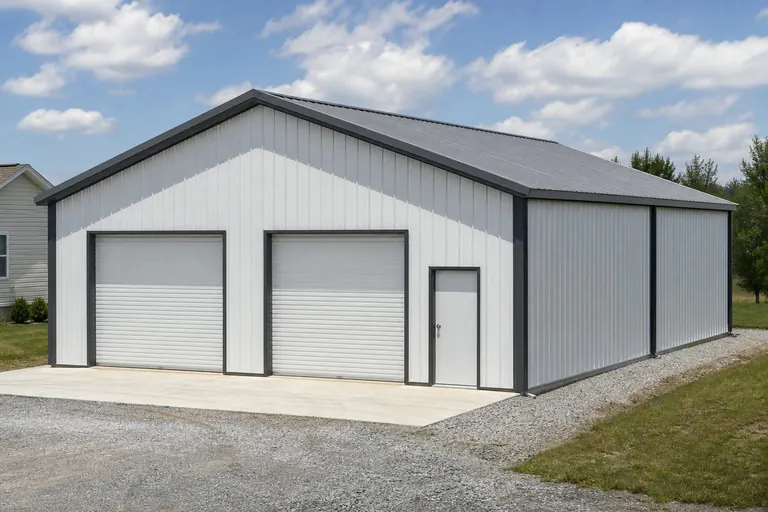 The Farm-Adjacent GarageSized to also house a utility vehicle or small tractor on North Carolina's working farms, of which USDA counted 42,817 in 2022.The Piedmont Commuter GarageA standard two-bay build on clay-soil suburban lots around the state's fast-growing metro counties.The Mountain Slope GarageBuilt on a graded or retained pad in Blue Ridge terrain, with access grade planned before the slab.
Example Configuration — for planning purposes only.
Rural Use
What changes on a working North Carolina farm
Garages built on North Carolina's agricultural land carry a few extra planning steps beyond a residential build.
- Check average parcel size before finalizing footprintNorth Carolina farms averaged 190 acres across 8,128,136 acres of farmland in 2022, so rural garage sites often have more siting flexibility than a suburban lot.
- Plan for mixed-use storage, not just vehiclesA garage on a working farm frequently needs to share space with implements or seasonal equipment, which pushes door width and clear height decisions.
- Confirm groundwater depth before excavationNC State Extension material on the Piedmont and Blue Ridge notes that over half the state's population depends on groundwater, a signal that well and water-table conditions vary locally and are worth checking before you dig a footing.
- Route permit questions to the local building officeWith statewide permit volume climbing toward 98,853 authorized units in 2023, confirming your county's current timeline directly avoids relying on a generic statewide estimate.
Questions
North Carolina Metal Garage Questions
Straight answers for buyers comparing garage plans across North Carolina's terrain.
The underlying concern differs: coastal and inland-storm-path sites plan around hurricane-related wind and rain, while mountain sites focus more on slope stability and pad drainage. Confirm the specific requirement for your address with the local building department.
No. NOAA describes landfalling hurricane counts as highly variable year to year, and exposure differs by county. Use FEMA's National Risk Index to look up your specific county rather than assuming a single statewide level of risk.
In nearly all jurisdictions, yes, since a garage is a structural building. Confirm the exact threshold and inspection steps with your county or municipal building office, as requirements are set locally.
USGS research separates the state into Coastal Plain, Piedmont and Blue Ridge provinces with distinct geologic settings. Sandy coastal soil, expansive Piedmont clay, and mountain slope conditions each call for different slab and grading details.
Yes, and it's common on the state's working farms. Just size door width and clear height for the largest implement you expect to store, not only for passenger vehicles.
Sources for the North Carolina facts on this page
This page states no code requirement, wind speed, snow load, permit rule, price or supplier claim. The state-specific facts it does use are listed with their publisher below.
NOAA NCEI publishes a narrative 'Climate of North Carolina' describing the state's climate progression from the Atlantic coastal plain through the Piedmont to the Appalachian mountains in the west.
NOAA National Centers for Environmental Information (NCEI) · Historical narrative (NCEI climate normals series) · Tier 1
https://www.ncei.noaa.gov/data/climate-normals-deprecated/access/clim60/states/Clim_NC_01.pdfNOAA's State Climate Summaries note that the number of landfalling hurricanes in North Carolina is highly variable year to year, and hurricane-associated storm intensity and rainfall rates are projected to increase.
NOAA National Centers for Environmental Information (NCEI) · 2022 summary · Tier 1
https://statesummaries.ncics.org/downloads/NorthCarolina-StateClimateSummary2022.pdfUSGS-affiliated research (e.g., Scientific Investigations Report 2009-5149) characterizes North Carolina's Piedmont and Blue Ridge physiographic provinces, distinct from the state's Atlantic Coastal Plain province, based on differing regional geologic settings.
U.S. Geological Survey (USGS) · 2009 USGS report · Tier 1
https://pubs.usgs.gov/sir/2009/5149/FEMA's National Risk Index is the authoritative source for county- and state-level natural hazard exposure ratings across 18 hazard types, viewable via FEMA's own interactive report tool.
Federal Emergency Management Agency (FEMA) · Current NRI release · Tier 1
https://www.fema.gov/flood-maps/products-tools/national-risk-indexNorth Carolina's statewide total of privately-owned housing units authorized by building permits rose from 94,118 in 2022 to 98,853 in 2023, a 5.0% increase.
U.S. Census Bureau · 2023 (with 2022 comparison) · Tier 1
https://www.census.gov/construction/bps/pdf/2023annualhighlights.pdf