
Metal garage · GA
Metal Garages in Georgia
A metal garage in Georgia has to answer to two things at once: the state's busy residential construction pace and its varied ground conditions. With 63,621 new housing units authorized in 2023 alone, Georgia's building departments handle a steady flow of garage and accessory-structure permits every year, and the design that clears review often depends on which of Georgia's five physiographic provinces the lot sits in. From Coastal Plain sand to Piedmont clay, and with an Atlanta-area rainfall normal near 50.4 inches a year, a Georgia metal garage's slab and drainage plan needs to match its specific site, not a single statewide template.
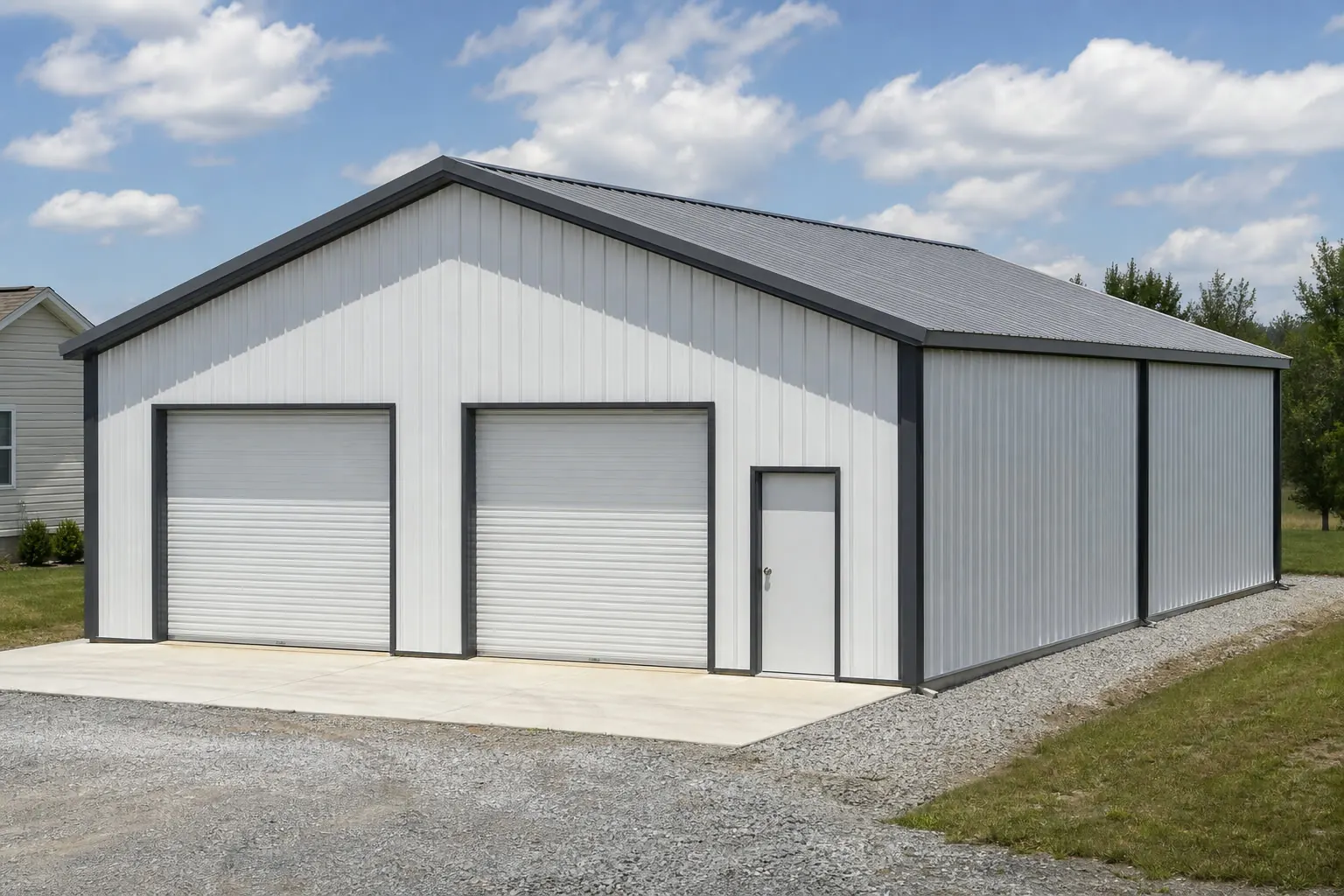
Protecting Your Assets
Garages sized for Georgia's provinces
Georgia's growth and terrain variety both push metal garage design decisions beyond a simple two-car box.
With 63,621 new housing units authorized statewide in 2023, Georgia's building departments are used to processing accessory-structure permits for garages alongside new home construction. That steady volume means the review process itself is predictable; what varies is the site work underneath it. A garage in the metro Atlanta Piedmont will need a different slab strategy than one in the flatter Coastal Plain to the south.
The Piedmont's red clay soil expands and contracts with the seasons enough that a garage slab needs proper reinforcement — rebar or wire mesh — to resist cracking. On the Coastal Plain, sandy soil drains well but offers less resistance to standing water during Georgia's wetter months, so grading the site to shed water away from the slab becomes the priority instead.
Rainfall itself is a constant design input statewide. Atlanta's 1991-2020 climate normal shows roughly 50.4 inches of annual precipitation, spread across the year rather than concentrated in one season. A garage apron and gutter system sized for that sustained rainfall pattern avoids the standing-water problems that shorten a slab's lifespan.
Door orientation is worth deciding alongside the slab, not after it is poured. On a sloped Piedmont lot, a door placed on the downhill side of the pad collects runoff at the threshold every time it rains; turning the approach toward the graded high side of the lot solves that before it becomes a recurring puddle. On flatter Coastal Plain and rural North Georgia sites, the apron's slope away from the door matters more than which side it faces, since there is less natural grade to work with.
Dimensions
Common Georgia garage footprints
Selecting a size that accounts for both daily drivers and, on rural tracts, farm equipment.
20′ × 20′
400 sq ft
A standard two-car garage suitable for suburban metro Atlanta lots.
24′ × 30′
720 sq ft
Provides extra depth for a workbench, popular in Piedmont commuter areas.
30′ × 40′
1,200 sq ft
A frequent choice on larger Georgia rural tracts, allowing for two vehicles plus a small tractor or trailer.
Example Configuration — for planning purposes only.
Larger footprints are more common in rural counties, where Georgia's average farm size of 253 acres gives owners the room to combine vehicle and equipment storage in one structure.
Configuration
Specialized Georgia garage setups
How owners tailor their garages to their specific province and use case.
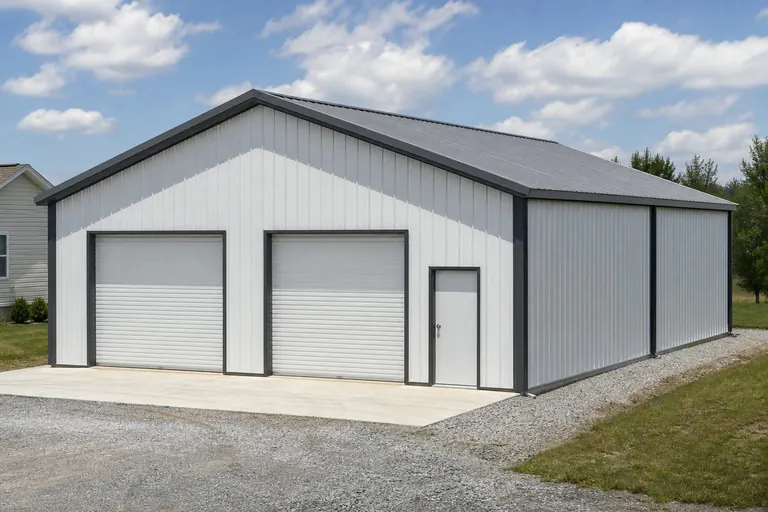 The Coastal Plain Utility GarageElevated apron and reinforced drainage to handle sandy soil and sustained seasonal rainfall.The Piedmont Commuter GarageReinforced slab designed to resist red clay expansion and contraction near metro Atlanta.The North Georgia Farm GarageA wide clear-span layout sited on a graded pad to handle sloped terrain and tractor storage.
Example Configuration — for planning purposes only.
Get your Georgia garage quote
Tell us your location and storage needs, and we'll connect you with local experts who understand Georgia's provincial conditions.
Foundation & Soil
The slab: your garage's most important component
Georgia's provincial soil diversity requires a tailored approach to concrete work.
In the Piedmont, expansive red clay is the defining challenge. A garage slab there benefits from a thicker, monolithic edge and proper reinforcement to resist seasonal soil movement. Skipping this step is a common source of slab cracking a few years after construction.
On the Coastal Plain, which covers the largest share of Georgia's 57,513.5 square miles, the priority shifts to keeping water away from the slab rather than resisting soil movement. A garage sited on a slightly elevated pad, with grading that carries runoff away from the foundation, holds up better through Georgia's wetter months than a flat, unelevated site.
- Reinforced Slab
- Recommended for Piedmont clay soils to resist seasonal expansion and contraction.
- Elevated Siting
- A practical measure on Coastal Plain sites given Georgia's sustained annual rainfall.
- Site-Specific Soil Check
- The most reliable way to confirm which approach fits your specific Georgia lot.
Door & Access Planning
Door orientation and access by province
Georgia's regional wind and rainfall patterns make garage door orientation and apron slope a practical planning decision, not an afterthought.
| Province | Access consideration | Door detail worth planning |
|---|---|---|
| Coastal Plain | Flat lots with slow-draining sandy soil in wet weather | Slope the apron away from the door threshold and choose corrosion-resistant hardware for sustained humidity |
| Piedmont | Sloped suburban and metro Atlanta lots | Position the door on the downhill or graded side to keep runoff from pooling at the threshold |
| North Georgia (Blue Ridge / Valley and Ridge) | Sloped or graded rural pads, sometimes with rock near the surface | A wider apron pad compensates for grading limits and keeps farm equipment clear of an uneven approach |
Coastal Plain
- Access consideration
- Flat lots with slow-draining sandy soil in wet weather
- Door detail worth planning
- Slope the apron away from the door threshold and choose corrosion-resistant hardware for sustained humidity
Piedmont
- Access consideration
- Sloped suburban and metro Atlanta lots
- Door detail worth planning
- Position the door on the downhill or graded side to keep runoff from pooling at the threshold
North Georgia (Blue Ridge / Valley and Ridge)
- Access consideration
- Sloped or graded rural pads, sometimes with rock near the surface
- Door detail worth planning
- A wider apron pad compensates for grading limits and keeps farm equipment clear of an uneven approach
Seasonal Readiness
Seasonal checks for a Georgia garage
A metal garage protects vehicles daily, but Georgia's storm season and provincial weather patterns each deserve a short checklist.
Step 1
Confirm your county's FEMA NRI hazard profile
FEMA's National Risk Index scores Georgia hazard exposure by county and tract across 18 hazard types; check yours before finalizing anchoring and wind-resistance specs.
Step 2
Regrade the apron for drainage
With an Atlanta-area annual rainfall normal near 50.4 inches, regrading the apron so water flows away from the garage entrance prevents standing water at the door threshold.
Step 3
Inspect door tracks and seals seasonally
Georgia's humidity and rainfall can accelerate wear on garage door tracks and rubber seals; a seasonal check catches failures before a storm arrives.
Step 4
Plan for severe thunderstorm season
Georgia sees regular severe thunderstorm activity statewide; secured anchoring and properly rated doors reduce wind-related damage risk.
Questions
Georgia Metal Garage FAQ
Answering local questions about building and owning a metal garage in Georgia.
Yes, in nearly all cases. Because a garage is a structural building often requiring a concrete slab and electrical service, local building departments will require a permit and inspections to confirm it meets safety standards.
Yes. Piedmont clay generally needs a reinforced slab to resist seasonal expansion and contraction, while Coastal Plain sand needs elevated siting and stronger drainage grading. A local soil check will confirm which applies to your lot.
With an Atlanta-area annual precipitation normal near 50.4 inches, gutters, downspouts, and apron grading should be sized for sustained wet-weather runoff, not just an occasional storm.
Choosing high-quality galvanized steel is the first step. Ensuring a vapor barrier under the slab and adequate ventilation reduces the condensation that leads to interior corrosion.
It's a good practice. FEMA's National Risk Index scores Georgia hazard exposure by county and tract across 18 hazard types, so checking your specific county gives a more accurate picture than assuming a single statewide risk level.
On a sloped Piedmont lot, yes. A door on the downhill side of the pad collects runoff at the threshold every time it rains, so orienting the approach toward the graded high side avoids a recurring drainage problem. On flatter Coastal Plain or rural sites, apron slope away from the door matters more than orientation.
Sources for the Georgia facts on this page
This page states no code requirement, wind speed, snow load, permit rule, price or supplier claim. The state-specific facts it does use are listed with their publisher below.
Georgia local building permit offices authorized 63,621 new privately-owned housing units in 2023, ranking 5th among states, down from 77,542 units in 2022.
U.S. Census Bureau · 2023 (with 2022 comparison) · Tier 1
https://www.census.gov/construction/bps/pdf/2023annualhighlights.pdfThe New Georgia Encyclopedia (citing University of Georgia geography scholarship) describes Georgia as encompassing parts of five distinct physiographic provinces: the Appalachian Plateau, the Valley and Ridge, the Blue Ridge, the Piedmont, and the Coastal Plain.
New Georgia Encyclopedia (University of Georgia Press / Georgia Humanities) · Reference overview · Tier 2
https://www.georgiaencyclopedia.org/articles/geography-environment/geographic-regions-of-georgia-overview/Atlanta's (Hartsfield-Jackson) 1991-2020 annual climate normal precipitation is about 50.4 inches with roughly 2.2 inches of annual snowfall.
NOAA National Centers for Environmental Information (NCEI) · 1991-2020 · Tier 1
https://www.ncei.noaa.gov/access/services/data/v1?dataset=normals-monthly-1991-2020&dataTypes=MLY-PRCP-NORMAL,MLY-SNOW-NORMAL&format=csv&stations=USW00013874Georgia's total land area was measured at 57,513.5 square miles as of the 2010 Census, the 21st largest of any U.S. state.
U.S. Census Bureau · 2010 Census · Tier 1
https://www.census.gov/geographies/reference-files/2010/geo/state-local-geo-guides-2010/georgia.htmlFEMA's National Risk Index platform (hazards.fema.gov) is the authoritative county/tract-level source for Georgia natural hazard exposure scores across 18 hazard types.
Federal Emergency Management Agency (FEMA) · Current NRI dataset · Tier 1
https://www.fema.gov/flood-maps/products-tools/national-risk-index