
Carport · SC
Carports in South Carolina
In South Carolina, a carport's most important job is fighting the sun. Across the state's 30,064.1 square miles, vehicle owners face a humid subtropical climate (Köppen Cfa) where UV radiation can rapidly degrade paint and interiors. A metal carport provides immediate, cost-effective relief from the heat, but in the Palmetto State, it must also be engineered for resilience. Whether you are sheltering a truck on a 201-acre Midlands farm or a boat in the Coastal Plain, a South Carolina carport requires proper anchoring to withstand the hurricane and tornado risks identified by FEMA NRI data for all 46 counties.
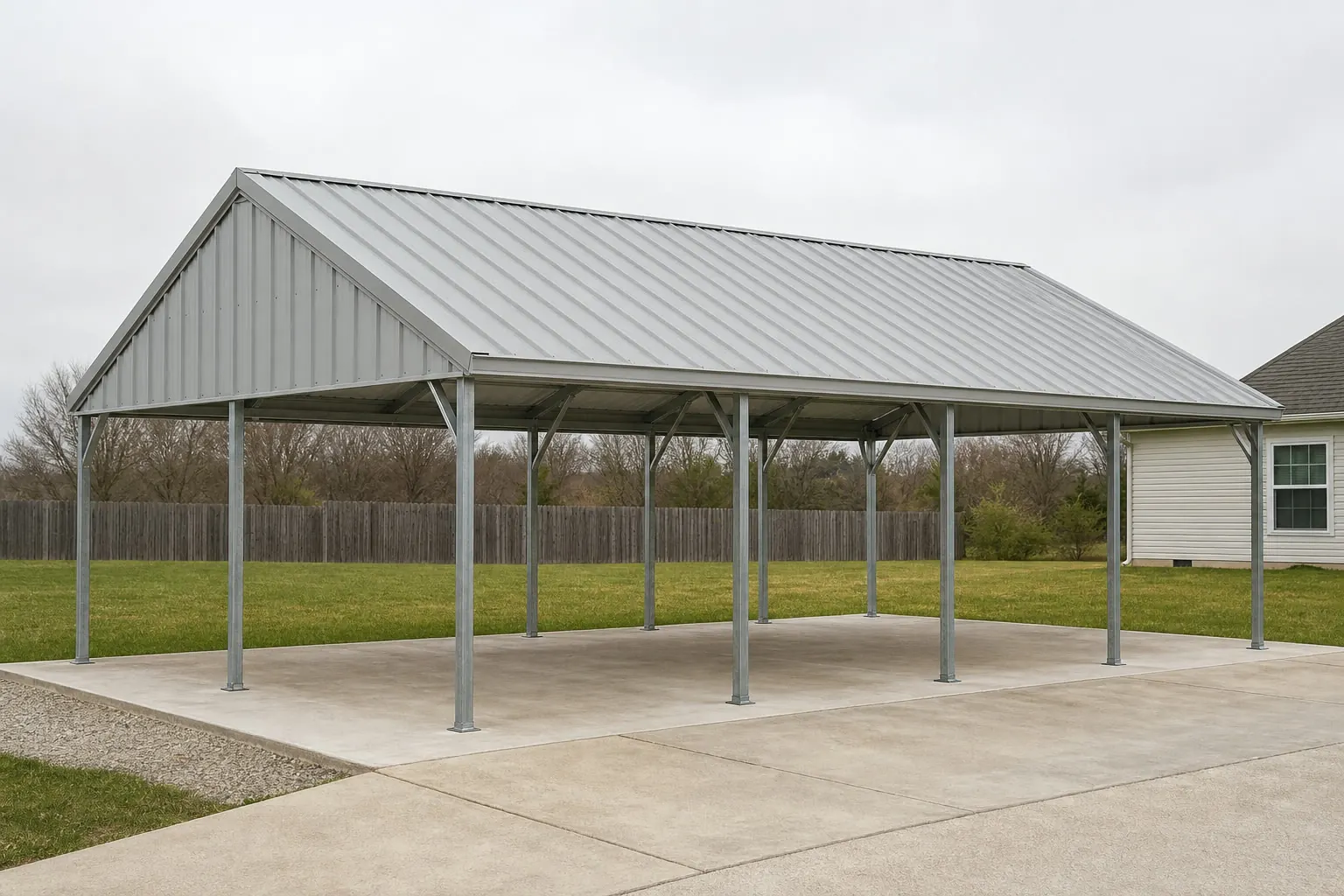
Sun & Shade
Why South Carolina vehicles need a carport
A metal carport is the most efficient way to combat the two biggest threats to South Carolina vehicles: heat and UV damage.
If you've spent a summer in the Midlands or the Lowcountry, you know that interior temperatures in a parked car can reach dangerous levels in minutes. The Palmetto State's humid subtropical climate produces some of the most consistent UV exposure in the Southeast. A steel carport doesn't just keep the rain off; it acts as a permanent umbrella that extends the life of your vehicle's upholstery, plastics, and paint.
Unlike a full garage, a carport allows for maximum airflow. This is a significant advantage in South Carolina, where trapped humidity can cause issues in enclosed spaces. By providing a roof but leaving the sides open, you get the benefit of shade while allowing the breeze to carry away heat and moisture, which is especially important for protecting classic cars or sensitive agricultural equipment.
However, the open design of a carport means it acts like a wing in high winds. With FEMA NRI identifying hurricane and tornado risks across the state, anchoring is not a step to skip. Whether you are anchoring into a concrete slab, asphalt, or the native South Carolina clay/sand, using the correct number and type of anchors is the difference between a durable shelter and a liability.
Regional Planning
How South Carolina regions change a carport build
A carport anchored on the coast faces a different threat profile than one anchored in the Piedmont, even though the structure looks identical.
Lowcountry & Coastal Plain
Salt-laden air accelerates corrosion on exposed fasteners and anchor hardware, and FEMA NRI hurricane and coastal-flooding designations mean deeper ground anchors or a bolted concrete pad are the default rather than the upgrade.
The Midlands
Heavy summer thunderstorms and intense UV load dominate here; a vertical-roof style that sheds rain quickly and light-colored panels that reflect heat both extend the useful life of vehicles parked underneath.
The Upstate
Piedmont clay soil holds water longer after rain, so footing drainage and anchor corrosion from trapped moisture matter more than salt exposure, while winter ice loading on the roof becomes an added seasonal factor that Coastal Plain owners rarely have to plan for.
Applications
Common South Carolina carport uses
Tailoring the carport to the specific needs of South Carolina residents.
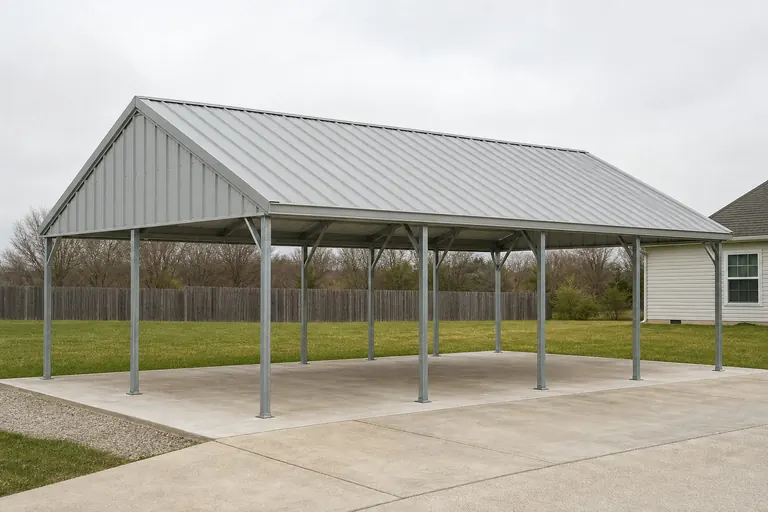 The Two-Car Daily CoverA 20x20 or 20x24 shelter for primary vehicles, common in suburban Lexington or Rock Hill.The Lowcountry Boat CoverTall, vertical-roof carports designed to protect center-console boats from the sun and bird debris.The Farm Equipment Lean-ToAffordable shelter for tractors and implements on SC's 201-acre average farms.
Example Configuration — for planning purposes only.
Protect your vehicles in South Carolina
Get a quote on a durable metal carport tailored to your property and the Palmetto State climate.
Design Choice
Why roof style matters in the Palmetto State
In South Carolina, your roof choice is about more than just aesthetics; it's about drainage and durability.
For most South Carolina projects, we recommend the Vertical Roof style. While it is more expensive than regular or boxed-eave designs, the panels run from the peak to the eave. This allows rain—which can be torrential in SC—and debris to slide off easily. In a state where pine needles and oak leaves are a constant presence, a roof that sheds debris prevents the organic buildup that can lead to rust. On a coastal or Lowcountry parcel, ask the supplier to confirm how the anchor pattern changes for a slab, gravel or ground-set installation, since the fastening detail matters more to a carport's storm performance than the panel style you choose.
Regular and Boxed Eave roofs have panels that run horizontally. These are perfectly functional for many areas of the Upstate, but in the heavily wooded Midlands or the storm-prone Coast, the vertical roof is the honest choice for long-term maintenance. When you factor in the rising temperatures and storm frequency noted in South Carolina's climate record, a stronger roof design is a wise investment.
- Vertical Roof
- Best for heavy rain and debris shedding; highly recommended for coastal SC.
- Boxed Eave
- An A-frame look that fits well with suburban residential architecture.
- Certified Anchoring
- Ensuring the structure is tied down to meet local wind-speed goals.
Storm-Season Readiness
Carport prep before hurricane season
An open-sided carport behaves differently in a named storm than an enclosed building, and coastal and Upstate owners face different pre-season tasks.
- Coastal anchor inspectionIn Charleston, Beaufort, and Horry County properties, FEMA NRI's hurricane and coastal flooding designations mean anchor bolts and ground augers deserve a physical check before June each year, since salt-laden air can quietly corrode fasteners faster than an inland site.
- Clear the debris fieldAlong the Coastal Plain, loose lawn furniture, trash cans, and grills near a carport become airborne hazards in tropical-storm-force wind; the carport itself is only as safe as the open ground around it.
- Upstate ice and limb loadIn the Upstate, the seasonal risk is different: winter ice storms can snap overhanging pine and oak limbs onto a carport roof, so pruning trees near the structure matters more than wind anchoring alone.
- Know your evacuation postureA carport is not a safe room. If your county issues an evacuation order for a tropical system, vehicles sheltered under a carport should be moved inland or to a garage bay, not left under an open structure.
Questions
South Carolina Carport FAQ
Practical advice for choosing a carport in SC.
No. Carports can be installed on level ground, gravel, or asphalt using specialized anchors. However, a concrete pad is the most stable and provides a cleaner environment for your vehicles.
Yes. Steel carports are highly effective at preventing hail damage, which can occur during South Carolina's spring thunderstorm season.
Most carports can be installed in a single day once the site is prepared. We do not provide specific lead times, as these vary by manufacturer and seasonal demand.
Where possible, orient the carport so the closed or upwind end faces the prevailing storm direction for your region, and confirm the recommended orientation with your installer based on your specific parcel and local wind exposure.
Coastal and near-coastal sites generally call for a heavier anchoring package because of combined wind and corrosion exposure. Ask your installer to spec anchors and hardware coatings appropriate for your specific distance from the shoreline.
Sources for the South Carolina facts on this page
This page states no code requirement, wind speed, snow load, permit rule, price or supplier claim. The state-specific facts it does use are listed with their publisher below.
The South Carolina State Climatology Office (SC DNR) states most of the state falls within the humid subtropical (Köppen Cfa) classification, producing hot, humid summers with mild winters, while portions of the Upstate mountains have a different, cooler climate regime.
South Carolina Department of Natural Resources (SC DNR), State Climatology Office · SC DNR reference publication · Tier 2
https://www.dnr.sc.gov/climate/sco/Publications/SCClimateOverview.pdfThe Census Bureau's current data profile lists South Carolina with a land area of 30,064.1 square miles and a water area of 1,959.4 square miles, ranking it the 39th largest state by area.
U.S. Census Bureau · Current Census Bureau geography data · Tier 1
https://data.census.gov/profile/South_Carolina?g=0400000US45FEMA's National Risk Index is the federal tool providing county-level natural hazard risk scoring (including hurricane, coastal flooding, tornado, and inland flooding categories) for all 46 South Carolina counties; a state-specific hazard narrative from FEMA itself was not directly retrieved in this session.
Federal Emergency Management Agency (FEMA) · Current NRI release · Tier 1
https://www.fema.gov/flood-maps/products-tools/national-risk-indexSouth Carolina had 4,553,922 acres of land in farms in 2022 (down 4% since 2017), with an average farm size of 201 acres (up 5%).
USDA NASS · 2022 · Tier 1
https://www.nass.usda.gov/Publications/AgCensus/2022/Online_Resources/County_Profiles/South_Carolina/cp99045.pdf