
Workshop · SC
Workshops in South Carolina
A workshop in South Carolina is where passion meets environmental resilience. Across the state's 30,064.1 square miles, from the woodworking shops of the Upstate to the boat-maintenance bays of the Lowcountry, a metal workshop must provide more than just space. In a humid subtropical (Köppen Cfa) climate, the honest challenge is creating a workspace that is comfortable to use during a Columbia summer while protecting tools from the persistent moisture that defines the Palmetto State.
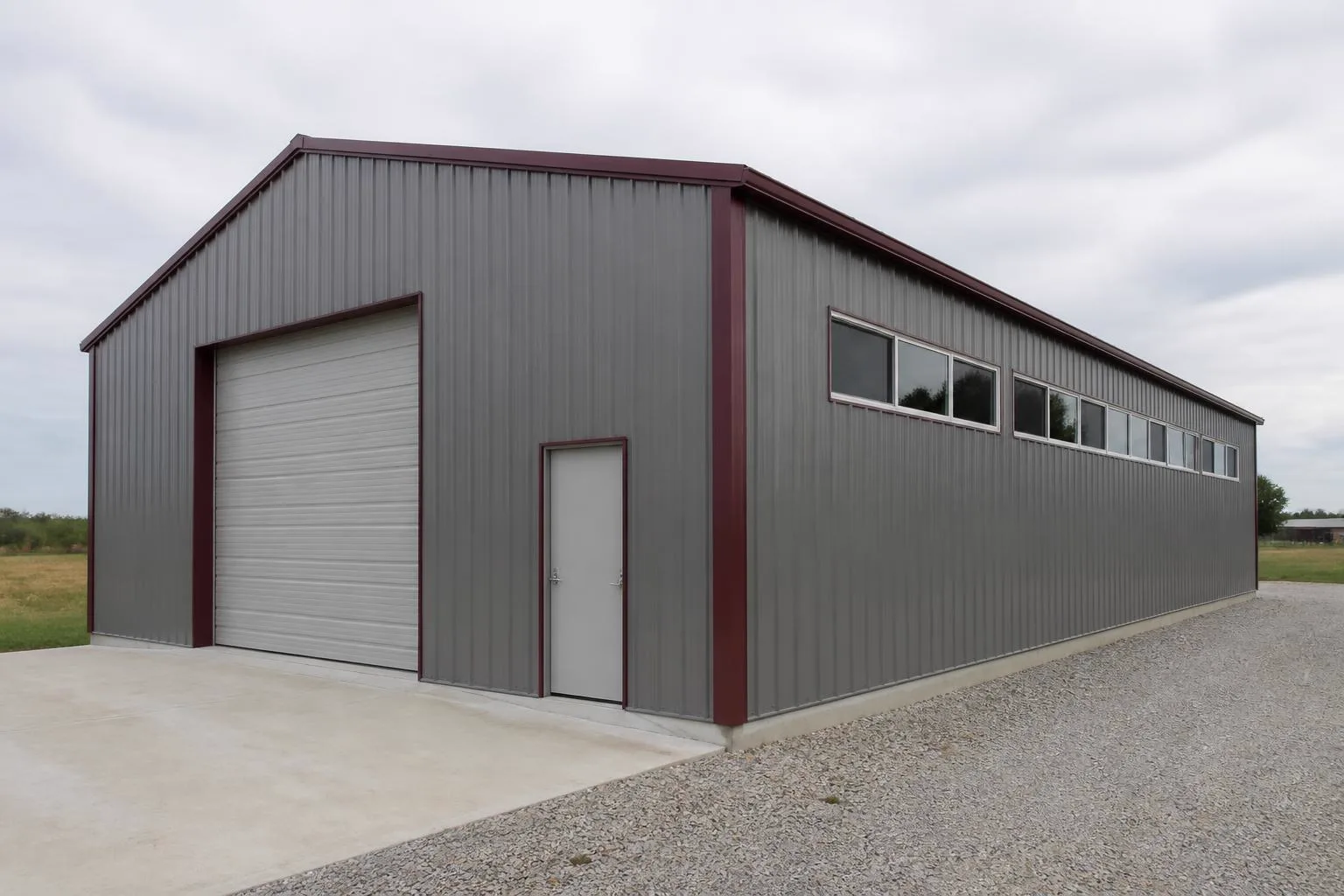
The Workspace
Building a shop that works in SC
A South Carolina workshop's success depends on how it handles heat and moisture.
If you are a woodworker in the Upstate or a mechanic in the Midlands, your shop's worst enemy is the humidity. South Carolina's humid subtropical climate means that on many summer days, the air is thick with moisture. In a metal workshop, this can lead to condensation on cool surfaces, including your tools and machinery. Without proper insulation and ventilation, a steel shop can become a damp environment that is both uncomfortable and damaging to your equipment.
The state's geographic variety—covering 30,064.1 square miles—also influences your site choice. In the Piedmont region, the dense red clay can be difficult to work with, but once properly graded and reinforced, it provides a very stable base for a heavy workshop. In the Coastal Plain, you are more concerned with drainage and keeping the building dry during the heavy tropical rains and flooding events noted in South Carolina's hazard profile.
Many South Carolina workshop owners also utilize the state's 201-acre average farm size to build 'dedicated' structures. Rather than folding a shop into a garage or barn, they build a standalone workshop that can be specifically insulated and climate-controlled, allowing for year-round productivity regardless of the Columbia or Greenville heat.
Door orientation is another detail that pays off across the state. Facing a large rollup door away from prevailing summer winds and afternoon sun reduces how much heat and blowing rain enters the shop each time it's opened, which matters more in South Carolina's long cooling season than it would in a milder climate. Pairing that orientation choice with a covered breezeway or overhang gives a place to stage materials without exposing them directly to a sudden Lowcountry downpour.
Specialized Uses
South Carolina workshop configurations
Tailoring the steel building to your specific trade or hobby.
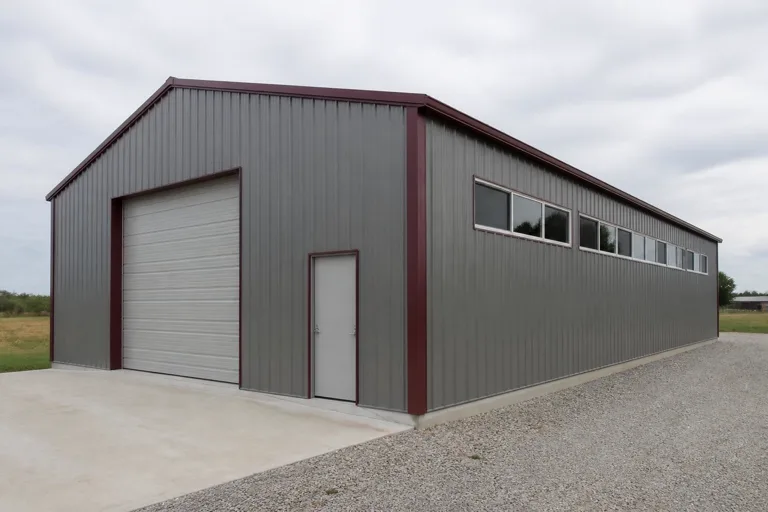 The Woodworker's StudioFocuses on dust collection and climate control to keep lumber stable in the humid SC air.The Coastal Maintenance ShopSized for boat trailers with corrosion-resistant panels to handle the salt air near the coast.The Farm Repair ShopA large clear-span bay with high-clearance doors for maintaining equipment on SC's 22,633 farms.
Example Configuration — for planning purposes only.
Dimensions
Footprints for South Carolina makers
Finding the balance between workspace and storage.
24′ × 30′
720 sq ft
A compact, efficient workshop for a single-hobbyist or residential property.
30′ × 40′
1,200 sq ft
A strong 'serious' workshop size for SC hobbyists and small businesses, providing room for multiple stationary tools.
40′ × 60′
2,400 sq ft
Common for commercial shops or farms where large equipment requires significant floor space.
Example Configuration — for planning purposes only.
Always allow for at least 10 feet of ceiling height if you plan to install a vehicle lift or large overhead storage.
Start your South Carolina workshop project
Get a quote on a custom metal workshop designed to handle the Palmetto State's climate.
Comfort & Care
Managing the Midlands heat
Climate control isn't just about comfort; it's about protecting your tools.
In South Carolina, a mini-split HVAC system is a frequent addition to new workshops. These systems are efficient at both cooling and dehumidifying, which is essential for preventing rust on iron tool surfaces like table saws and lathes. However, the HVAC system is only as good as the building's insulation. Closed-cell spray foam is the gold standard for South Carolina metal workshops because it provides a complete air seal and prevents condensation on the interior steel panels.
With South Carolina temperatures having risen more than 1°F since the early 1900s, the energy required to cool a large metal building is significant. By designing the shop with deep eaves or a porch to shade the south-facing walls, you can reduce the heat load and make the building much easier to maintain during the peak summer months.
- Insulation First
- Spray foam insulation is critical for preventing 'sweating' in SC workshops.
- Dehumidification
- A necessary addition for woodworking or precision metalwork in the humid subtropical climate.
- Strategic Openings
- Placing doors to take advantage of prevailing winds can provide natural cooling in the spring and fall.
Regional Comparison
Coastal vs. Upstate workshop priorities
The same workshop brief shifts its priorities depending on whether the site sits near the coast or in the Upstate.
| Factor | Coastal Plain / Lowcountry | Upstate / Piedmont |
|---|---|---|
| Corrosion risk | Salt-laden air accelerates rust on tool surfaces and fasteners | General humidity-driven surface rust, no salt load |
| Storm posture | Hurricane-season anchoring and power-loss planning | Winter ice-storm limb and power-line risk |
| Slab priority | Elevation and drainage on sandy soil | Reinforcement against red-clay expansion |
| Heating need | Minimal; occasional cold snaps | More frequent, especially in higher-elevation counties |
Corrosion risk
- Coastal Plain / Lowcountry
- Salt-laden air accelerates rust on tool surfaces and fasteners
- Upstate / Piedmont
- General humidity-driven surface rust, no salt load
Storm posture
- Coastal Plain / Lowcountry
- Hurricane-season anchoring and power-loss planning
- Upstate / Piedmont
- Winter ice-storm limb and power-line risk
Slab priority
- Coastal Plain / Lowcountry
- Elevation and drainage on sandy soil
- Upstate / Piedmont
- Reinforcement against red-clay expansion
Heating need
- Coastal Plain / Lowcountry
- Minimal; occasional cold snaps
- Upstate / Piedmont
- More frequent, especially in higher-elevation counties
Storm Resilience
Backup power for a hurricane-season workshop
A workshop that supports a business or serious hobby should plan for the power outages that follow a South Carolina hurricane, not just the storm itself.
FEMA's National Risk Index scores hurricane and coastal flooding hazards across all 46 South Carolina counties, and coastal and Midlands workshop owners routinely lose grid power for several days after a significant tropical system. For a workshop running dust collection, welding equipment, or refrigerant-based tools, a pre-wired generator transfer switch is worth specifying before the building is finished, since retrofitting one later means opening finished walls. This is a decision for a licensed electrician, but the building's electrical service size should account for it from the start.
Questions
South Carolina Workshop FAQ
Practical answers for SC shop builders.
A reinforced concrete slab is the standard. In the Piedmont's red clay, ensure the slab has a proper gravel base and vapor barrier to prevent moisture and soil movement from affecting the floor.
Yes. Most SC counties require building permits for any permanent structure over a certain size (usually 200 sq ft), especially if it has electrical service or plumbing.
Yes, if the building is not ventilated or insulated. Uninsulated metal buildings can reach very high humidity levels, which leads to rust. We recommend at least basic insulation and a way to move air consistently.
Generally yes. Salt-laden coastal air accelerates rust on tool surfaces and fasteners faster than the inland humidity found in the Piedmont and Upstate, so many coastal owners choose corrosion-resistant coatings and hardware even on an otherwise standard building package.
If your shop runs dust collection, welding equipment, or anything that can't sit idle for days, it's worth discussing a pre-wired generator transfer switch with your electrician during design, since hurricane-season outages in coastal and Midlands counties can stretch on for several days.
Sources for the South Carolina facts on this page
This page states no code requirement, wind speed, snow load, permit rule, price or supplier claim. The state-specific facts it does use are listed with their publisher below.
The South Carolina State Climatology Office (SC DNR) states most of the state falls within the humid subtropical (Köppen Cfa) classification, producing hot, humid summers with mild winters, while portions of the Upstate mountains have a different, cooler climate regime.
South Carolina Department of Natural Resources (SC DNR), State Climatology Office · SC DNR reference publication · Tier 2
https://www.dnr.sc.gov/climate/sco/Publications/SCClimateOverview.pdfThe Census Bureau's current data profile lists South Carolina with a land area of 30,064.1 square miles and a water area of 1,959.4 square miles, ranking it the 39th largest state by area.
U.S. Census Bureau · Current Census Bureau geography data · Tier 1
https://data.census.gov/profile/South_Carolina?g=0400000US45South Carolina had 4,553,922 acres of land in farms in 2022 (down 4% since 2017), with an average farm size of 201 acres (up 5%).
USDA NASS · 2022 · Tier 1
https://www.nass.usda.gov/Publications/AgCensus/2022/Online_Resources/County_Profiles/South_Carolina/cp99045.pdfFEMA's National Risk Index is the federal tool providing county-level natural hazard risk scoring (including hurricane, coastal flooding, tornado, and inland flooding categories) for all 46 South Carolina counties; a state-specific hazard narrative from FEMA itself was not directly retrieved in this session.
Federal Emergency Management Agency (FEMA) · Current NRI release · Tier 1
https://www.fema.gov/flood-maps/products-tools/national-risk-index