
Metal garage · FL
Metal Garages in Florida
A metal garage in Florida is an enclosed accessory building sitting in the one U.S. state with the longest recorded history of direct hurricane landfalls, and that record is not evenly distributed across the state. Broward and Miami-Dade counties fall inside the Florida Building Code's High-Velocity Hurricane Zone, a separate code track with its own product-approval and construction standards administered locally, while the rest of the state applies the standard Florida Building Code path through its own county or city building department. Add in terrain that USGS maps as low-lying across large portions of the state, and the practical Florida question for a metal garage is less about the garage itself and more about which code track applies to your parcel and how the slab handles water before it ever reaches the walls.
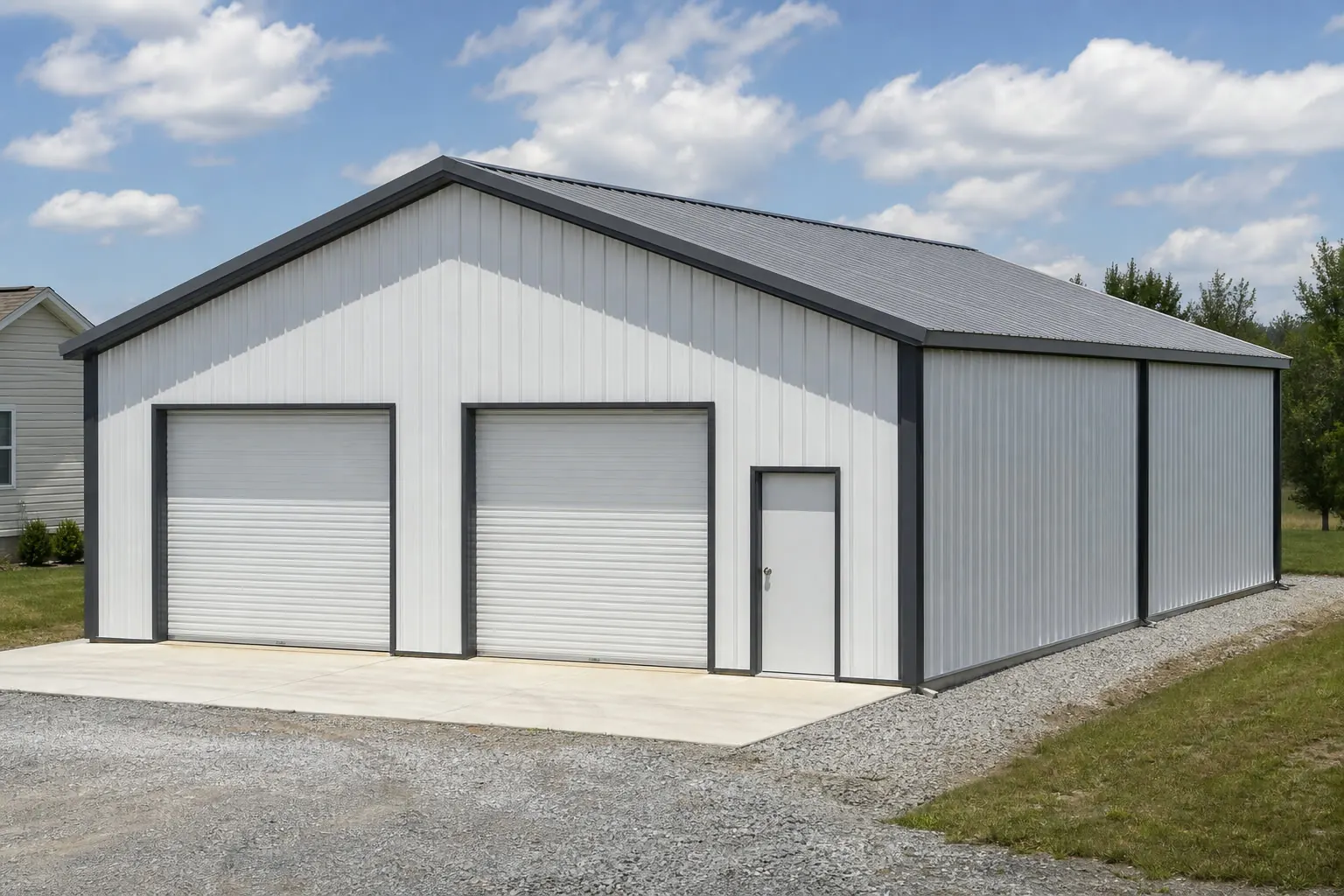
The intersection
Two code tracks, one state: the HVHZ line matters for a garage
A Florida metal garage is built under one of two code tracks depending on the county, and knowing which one applies changes conversations with your builder from day one.
The Florida Building Code defines a High-Velocity Hurricane Zone made up of Broward and Miami-Dade counties, a track with its own product-approval and construction requirements administered locally within the statewide code. Outside those two counties, the standard Florida Building Code path applies, still administered by your local building department. For an enclosed garage — which carries wind load through solid walls and closed doors rather than through open posts — knowing which side of that line a parcel sits on is worth confirming before a design is finalized, not after.
NOAA's Hurricane Research Division records Florida, across its 1851-2018 dataset, as the U.S. state with the most direct hurricane landfalls of any state. That is a historical pattern, not a design value, but it is a reasonable basis for treating door and wall anchoring as a conversation with a local, code-aware builder rather than an afterthought, whether or not a specific parcel sits inside the HVHZ.
The Florida Building Commission administers the statewide code, which means the rulebook itself is unified even where the HVHZ creates a stricter regional track. That single-commission structure is worth knowing because it means a Florida garage buyer is not dealing with dozens of unrelated local codes the way some states' buyers are — but the local building department is still the one issuing the permit and confirming which track applies to a given address.
Site context
How the code track changes what a Florida garage buyer confirms
The same enclosed garage shell is reviewed differently depending on which side of the HVHZ line the site sits on.
| Location | Code track | What to confirm locally |
|---|---|---|
| Broward or Miami-Dade County | High-Velocity Hurricane Zone (FBC) | HVHZ product approval and construction standards with the county building department |
| Any other Florida county | Standard Florida Building Code | Standard FBC permit and design review with your local building department |
| Low-lying or flood-prone parcel (either track) | FBC plus local site rules | Slab elevation, grading and drainage requirements with the local permit office |
Broward or Miami-Dade County
- Code track
- High-Velocity Hurricane Zone (FBC)
- What to confirm locally
- HVHZ product approval and construction standards with the county building department
Any other Florida county
- Code track
- Standard Florida Building Code
- What to confirm locally
- Standard FBC permit and design review with your local building department
Low-lying or flood-prone parcel (either track)
- Code track
- FBC plus local site rules
- What to confirm locally
- Slab elevation, grading and drainage requirements with the local permit office
Configuration
Common Florida metal garage configurations
Florida metal garage projects tend to sort into a few recurring configurations, shaped by the enclosed structure's role next to a house or on a working lot.
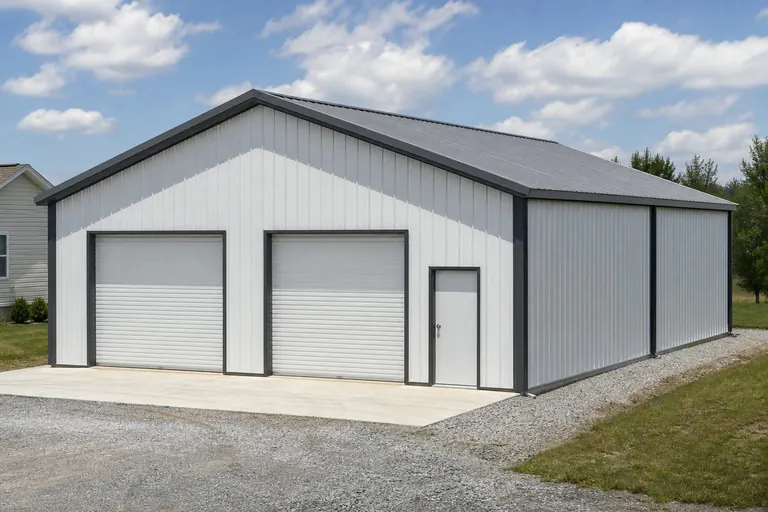 Single or double vehicle bayAn enclosed bay for one or two vehicles beside an existing home, a standard residential-lot configuration alongside workshop and boat-bay variants.
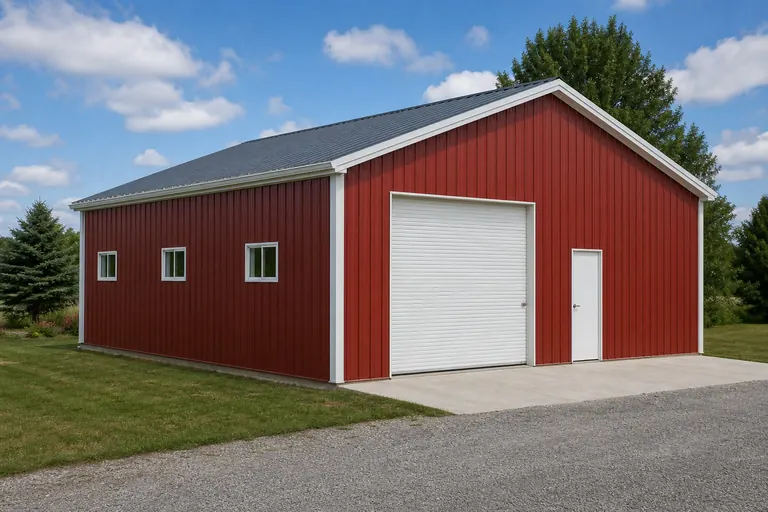 Vehicle bay plus workshopA partitioned combination of vehicle storage and workbench space, where anchoring and door detail matter for both zones.
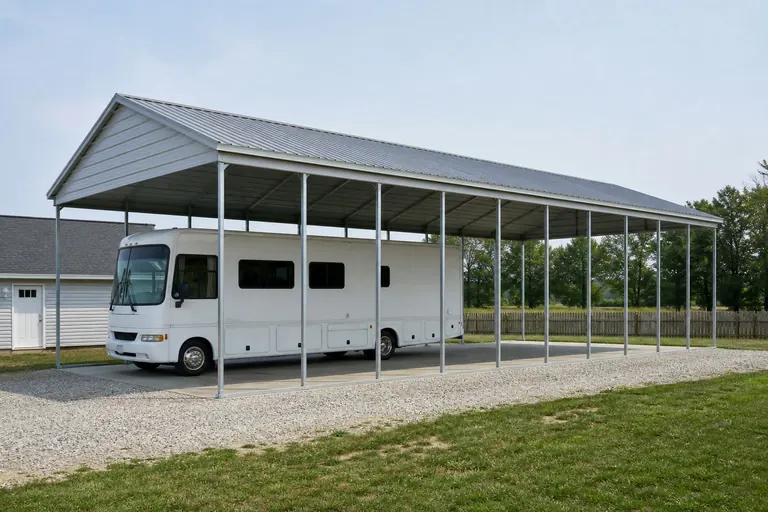 Boat or equipment bayA taller enclosed bay for a boat or larger equipment rather than a passenger vehicle, common given Florida's coastal geography.
Example Configuration — for planning purposes only.
Get Florida metal garage quotes
Tell us your county, vehicle count and intended use, and we route it with the HVHZ and drainage context already attached.
Footprint
Sizes common for a Florida residential-lot metal garage
Because most Florida metal garages sit on a residential or working lot rather than open acreage, footprints tend to follow vehicle count and lot space.
24′ × 30′
720 sq ft
A common footprint for a two-vehicle enclosed garage on a standard residential lot.
30′ × 40′
1,200 sq ft
Adds room for a workbench or a boat bay alongside vehicle storage.
40′ × 60′
2,400 sq ft
Suited to combined vehicle, equipment and workshop use on a larger lot.
Example Configuration — for planning purposes only.
Footprint pages carry bay and door allocation for each size; this page explains only why the Florida code split and terrain matter for these dimensions.
Preparation
Before you request a Florida metal garage quote
Five checks resolve the Florida-specific unknowns before a quote goes stale.
- Confirm whether your parcel sits inside the HVHZBroward and Miami-Dade counties apply a separate FBC track; every other county applies the standard FBC.
- Ask your local building department about product approval requirementsHVHZ and non-HVHZ parcels can carry different approval documentation for doors and wall assemblies.
- Plan slab elevation and site grading around drainageUSGS mapping shows large portions of the state as low-lying; confirm grading with your site contractor before the slab is poured.
- Ask your insurer how an enclosed garage is treated on your policyEnclosed structures can be rated differently from open carports; confirm before construction, not after.
- State every intended use up frontA garage priced for a single vehicle that later needs a boat bay or workshop power is a common cause of re-quoting.
- Ask whether your bay height accommodates a lift or tall equipmentA door and eave height sized only for a passenger vehicle can rule out a future lift or taller boat without a redesign.
Questions
Florida metal garage questions
Honest answers at the state level, with permitting, engineering and pricing questions routed to whoever actually owns them.
The HVHZ is a Florida Building Code zone covering Broward and Miami-Dade counties with its own product-approval and construction standards. If your parcel is in one of those two counties, ask your local building department how it applies to your garage.
Permitting is administered locally under the statewide Florida Building Code. Your county or city building department is the authority for your specific parcel and code track.
An enclosed garage carries wind load through solid walls and doors rather than open posts, so anchoring and door specification are worth confirming with a code-aware builder regardless of which side of the HVHZ line your parcel sits on.
USGS mapping shows large portions of Florida as low-lying. Slab elevation and site grading affect how quickly water sheds away from an enclosed structure, which is a site question for your contractor and local building department.
There is no official typical size. On a standard residential lot, 24x30 through 40x60 are common ranges depending on vehicle count and whether the garage also serves as a workshop or boat bay.
We do not publish state-level prices, since cost depends on size, specification, site work and current material pricing. Our cost pages explain what drives the number; a builder quote covers your specific project.
Sources for the Florida facts on this page
This page states no code requirement, wind speed, snow load, permit rule, price or supplier claim. The state-specific facts it does use are listed with their publisher below.
NOAA's Hurricane Research Division records Florida as the U.S. state with the most historical hurricane direct hits/landfalls, based on the 1851-2018 dataset.
NOAA Atlantic Oceanographic and Meteorological Laboratory (AOML), Hurricane Research Division · 1851-2018 · Tier 1
https://www.aoml.noaa.gov/hrd/tcfaq/E19.htmlThe Florida Building Code defines a High-Velocity Hurricane Zone (HVHZ) consisting of Broward and Miami-Dade counties.
Florida Building Commission (via UpCodes republication) · 2023 FBC, 8th edition · Tier 3
https://up.codes/d/high-velocity-hurricane-zone-hvhzThe Florida Building Commission administers the Florida Building Code statewide.
Florida Building Commission · 8th Edition (2023), effective Dec 31, 2023 · Tier 2
https://www.floridabuilding.org/FEMA's National Risk Index scores U.S. communities, including Florida counties, across 18 defined natural hazard types.
FEMA · current dataset · Tier 1
https://www.fema.gov/about/openfema/data-sets/national-risk-index-dataUSGS mapping highlights that large portions of Florida are low-lying, derived from USGS digital elevation models.
U.S. Geological Survey · n/a (map publication) · Tier 2
https://pubs.usgs.gov/sim/3047/