
Horse barn · FL
Horse Barns in Florida
A Florida horse barn is shaped less by any single number and more by where on the map it sits. The Florida Building Code, administered statewide by the Florida Building Commission, carves out a High-Velocity Hurricane Zone limited to Broward and Miami-Dade counties, so a barn proposed inside that boundary is reviewed under a materially different set of provisions than one proposed anywhere else in the state — and this page routes the specific engineering detail of that difference to your local building department rather than guessing at it. Underneath that zoning split sits a wetter, flatter physical reality: USGS mapping describes large portions of Florida as low-lying, and the Floridan aquifer system underlies the entire state, so water table and drainage decisions belong on the site plan before a single post goes in the ground. Florida's own farm base — 44,703 farms in 2022, averaging just 217 acres — also tells you that most Florida horse-barn buyers are working comparatively small acreage, not open Western range, which pushes the honest planning conversation toward footprint and drainage rather than scale.
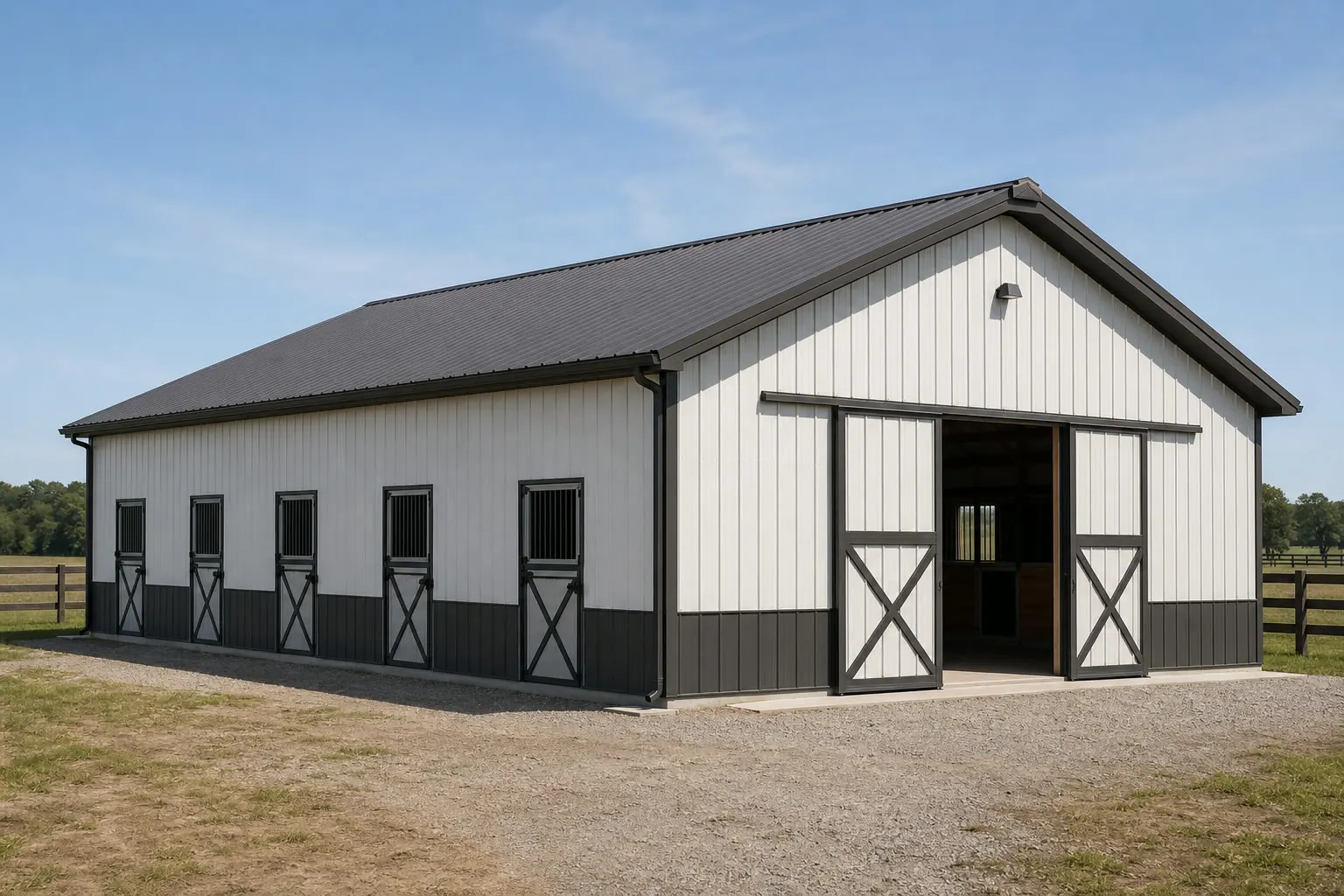
One state, two very different review paths
Florida is not one horse-barn market — it is at least two, split by a hard county line rather than a gradient. Inside Broward and Miami-Dade counties, the Florida Building Code applies its High-Velocity Hurricane Zone provisions; everywhere else in the state, the same Commission-administered code applies without that overlay. We are not going to tell you what that means numerically for your design; that is a job for a licensed engineer and your local building department. What we can tell you honestly is that the county line matters, and that Florida's water table and modest average farm size matter just as much to how a horse barn actually gets sited and used.
The intersection
The High-Velocity Hurricane Zone is a county boundary, not a coastal feeling
Florida's HVHZ is defined as Broward and Miami-Dade counties specifically — not a general 'coastal Florida' area — under the Florida Building Code administered statewide by the Florida Building Commission.
It is tempting to assume that any Florida property near the ocean faces the same review path, but the Florida Building Code's High-Velocity Hurricane Zone is defined by two named counties, Broward and Miami-Dade, not by proximity to the coast in general. A barn planned in a coastal county outside that boundary is reviewed under the standard statewide code; a barn planned inside it is reviewed under the HVHZ provisions layered on top. The practical takeaway for a buyer is simple and unglamorous: know which side of that county line your parcel sits on before you commission drawings, because it changes which provisions your engineer designs to.
One thing this page deliberately does not do is name a wind speed, a load value or an adopted code edition's specific numeric requirement. Those figures exist, they are real, and they are also exactly the kind of detail that changes with code cycles and site-specific factors that only a licensed design professional and your local building department can confirm for your parcel. What is safe to say at the state level is that the Florida Building Commission is the single statewide administering body, so unlike states where dozens of separate municipal code authorities each set their own rules, a Florida buyer is at least starting from one adopted code base, with the HVHZ carve-out as the one documented exception.
For a horse barn specifically, that regulatory split tends to show up first in the engineer's proposal rather than in the barn's floor plan. A barn brief that mentions the county up front lets an engineer scope the right review path from the first conversation, instead of discovering mid-project that the site falls inside HVHZ and the drawings need rework.
Site conditions
Low-lying ground and a statewide aquifer make drainage the first design decision
USGS elevation data describes large portions of Florida as low-lying, and the Floridan aquifer system underlies the entire state, so pad height and roof-water routing deserve attention before framing decisions.
A horse barn's biggest daily maintenance problem is rarely the structure itself — it is where the water goes. USGS digital elevation mapping calls out large stretches of Florida as low-lying ground, and the Floridan aquifer, one of the principal aquifer systems the USGS studies nationally, sits under the entire state and stretches across roughly 100,000 square miles of the Southeast. Neither fact tells you your parcel's specific water table depth; that is something a site visit or a soil test settles, not a statewide dataset. But together they are a solid reason to treat pad elevation, perimeter grading and roof-water discharge as first-order decisions on a Florida horse barn, not finishing touches.
For stalls specifically, standing water at the barn's low corner is worse than an inconvenience — it is a hoof-health and manure-management problem that compounds every week the barn is in use. Grading the pad so the barn sits slightly proud of the surrounding paddock, and routing gutter downspouts well clear of stall doors and the wash area, are inexpensive decisions on paper that are considerably more expensive to retrofit once the slab is down.
This is also where a Florida horse-barn buyer should be candid with the barn's design-build team about intended stocking density. A barn holding more horses concentrates more manure and more wash-down water in one footprint, which raises the stakes on getting drainage right the first time, particularly on ground that is already working against you.
Quick reference
Florida figures this page relies on
Every figure below carries a named publisher and period; none of it is a design load, a permit threshold, or a price.
| Measure | Figure | Source |
|---|---|---|
| HVHZ counties | Broward and Miami-Dade only | Florida Building Commission / Florida Building Code |
| Farms (2022) | 44,703 | USDA NASS Census of Agriculture |
| Land in farms (2022) | 9,701,400 acres | USDA NASS Census of Agriculture |
| Average farm size (2022) | 217 acres | USDA NASS Census of Agriculture |
| Total land area | 53,603 sq mi | U.S. Census Bureau, 2008 measurement |
| Statewide average precipitation/humidity | Recorded gap — not stated here | Evidence registry |
HVHZ counties
- Figure
- Broward and Miami-Dade only
- Source
- Florida Building Commission / Florida Building Code
Farms (2022)
- Figure
- 44,703
- Source
- USDA NASS Census of Agriculture
Land in farms (2022)
- Figure
- 9,701,400 acres
- Source
- USDA NASS Census of Agriculture
Average farm size (2022)
- Figure
- 217 acres
- Source
- USDA NASS Census of Agriculture
Total land area
- Figure
- 53,603 sq mi
- Source
- U.S. Census Bureau, 2008 measurement
Statewide average precipitation/humidity
- Figure
- Recorded gap — not stated here
- Source
- Evidence registry
Get Florida horse barn quotes
Tell us your county, your stall count, and any known drainage or grading concerns. We route it with the Florida HVHZ and terrain context already attached.
Configuration
What a Florida horse barn is usually asked to do
Given a small average farm size and a wet, flat physical landscape, most Florida horse-barn briefs cluster around a handful of recurring shapes.
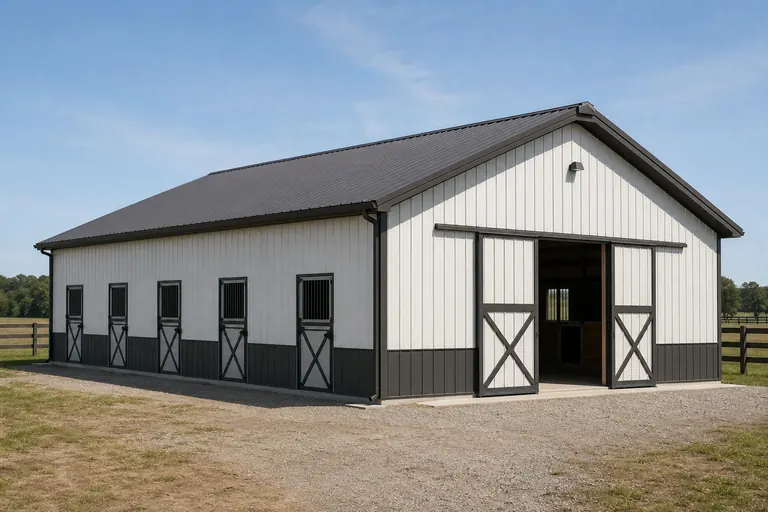 Compact stall barn with covered aisleA modest stall run under a covered center aisle, sized to a smaller Florida parcel rather than an open range layout.Stalls plus feed and tack roomAdds a dedicated feed and tack space, common where the barn also serves as the property's main equine-support building.Raised-pad barn on low groundWhere the parcel sits on documented low-lying terrain, the barn is designed around a raised, well-drained pad from the outset.
Example Configuration — for planning purposes only.
Footprint
Sizes that fit a Florida horse-barn brief
None of these is a recommendation independent of your program; they reflect the footprints that most often match a modest Florida acreage and a compact stall count.
30′ × 40′
1,200 sq ft
A compact starting point suited to a smaller Florida parcel and a handful of stalls.
36′ × 48′
1,728 sq ft
Center-aisle room with a feed or tack area, without requiring open acreage.
40′ × 60′
2,400 sq ft
Stalls plus a genuine wash bay or secondary storage use where the parcel allows.
Example Configuration — for planning purposes only.
Footprint-level layout and door detail live on the size pages; this page only explains why Florida briefs tend to land in this range.
Preparation
Before you request a Florida horse barn quote
Four steps that reflect Florida's specific structure rather than generic advice.
- Confirm whether your parcel sits inside Broward or Miami-Dade CountyThat determines whether HVHZ provisions apply to your review path; confirm the exact review requirements with your local building department.
- Get your site's actual grade and water table checkedStatewide low-lying terrain and the Floridan aquifer are context, not a substitute for a site-specific grading and drainage assessment.
- Plan roof-water routing before the pad is pouredDeciding where downspouts discharge relative to stall doors and the wash area is far cheaper on paper than after the slab is down.
- Size the barn to your actual herd, not a statewide averageFlorida's 217-acre average farm size describes the state's farm base broadly; it is not a sizing formula for your specific horses and program.
Questions
Florida horse barn questions
Answered honestly at the state level, with wind loads, permits and prices routed to the people who actually own those answers.
The HVHZ is defined as Broward and Miami-Dade counties under the Florida Building Code. Whether specific provisions apply to your exact parcel and structure type is a question for your local building department and a licensed engineer, not something this page can determine for you.
We do not state a wind speed here. Design wind loads depend on your exact location, exposure category and the adopted code edition in effect, and must be confirmed by a licensed engineer and your local building department.
No, but USGS mapping does describe large portions of Florida as low-lying, and the Floridan aquifer underlies the whole state, so pad elevation and drainage deserve real attention at the design stage. A site-specific grading assessment settles what your particular parcel needs.
There is no official typical size. Florida's average farm is 217 acres, smaller than many Western ranch states, which is one reason briefs commonly land between 30x40 and 40x60, but your own herd and program should set the number.
The 2022 Census of Agriculture counted 44,703 farms in Florida, but we have no data isolating how many specifically run horses, and we are not going to estimate one. Size your decision around your own operation.
We do not publish state-level prices; a real number depends on specification, site work including any drainage remediation, and current material costs. Our cost pages explain the drivers, and a quote covers your specific building.
Sources for the Florida facts on this page
This page states no code requirement, wind speed, snow load, permit rule, price or supplier claim. The state-specific facts it does use are listed with their publisher below.
The Florida Building Code defines a High-Velocity Hurricane Zone (HVHZ) consisting of Broward and Miami-Dade counties.
Florida Building Commission (via UpCodes republication) · 2023 FBC, 8th edition · Tier 3
https://up.codes/d/high-velocity-hurricane-zone-hvhzThe Florida Building Commission administers the Florida Building Code statewide.
Florida Building Commission · 8th Edition (2023), effective Dec 31, 2023 · Tier 2
https://www.floridabuilding.org/USGS mapping highlights that large portions of Florida are low-lying, derived from USGS digital elevation models.
U.S. Geological Survey · n/a (map publication) · Tier 2
https://pubs.usgs.gov/sim/3047/The Floridan aquifer system, a principal USGS-studied aquifer, underlies all of Florida and covers about 100,000 square miles across the southeastern U.S.
U.S. Geological Survey · n/a · Tier 2
https://fl.water.usgs.gov/floridan/intro.htmlFlorida had 44,703 farms in 2022 per the USDA Census of Agriculture.
USDA National Agricultural Statistics Service (NASS) · 2022 · Tier 1
https://www.nass.usda.gov/Publications/AgCensus/2022/Full_Report/Volume_1,_Chapter_1_State_Level/Florida/The average farm size in Florida was 217 acres in 2022.
USDA NASS · 2022 · Tier 1
https://www.nass.usda.gov/Publications/AgCensus/2022/Full_Report/Volume_1,_Chapter_1_State_Level/Florida/