
Horse barn · MD
Horse Barns in Maryland
Maryland packs three genuinely different landscapes into one of the country's smaller states: a flat, humid Coastal Plain along the Chesapeake, a rolling Piedmont belt through the Baltimore exurbs and central counties, and a mountainous western strip combining the Blue Ridge, Valley and Ridge, and Appalachian Plateau. A horse barn sited on Eastern Shore tidal flatland is not fighting the same drainage and orientation problem as one sited on a Piedmont slope near Frederick or Carroll County, and this page treats that difference as the actual planning question rather than folding Maryland into one generic climate story. It also matters that Maryland's average farm is 158 acres, a comparatively tight parcel that puts real limits on where a barn, its paddocks, and its access drive can go.
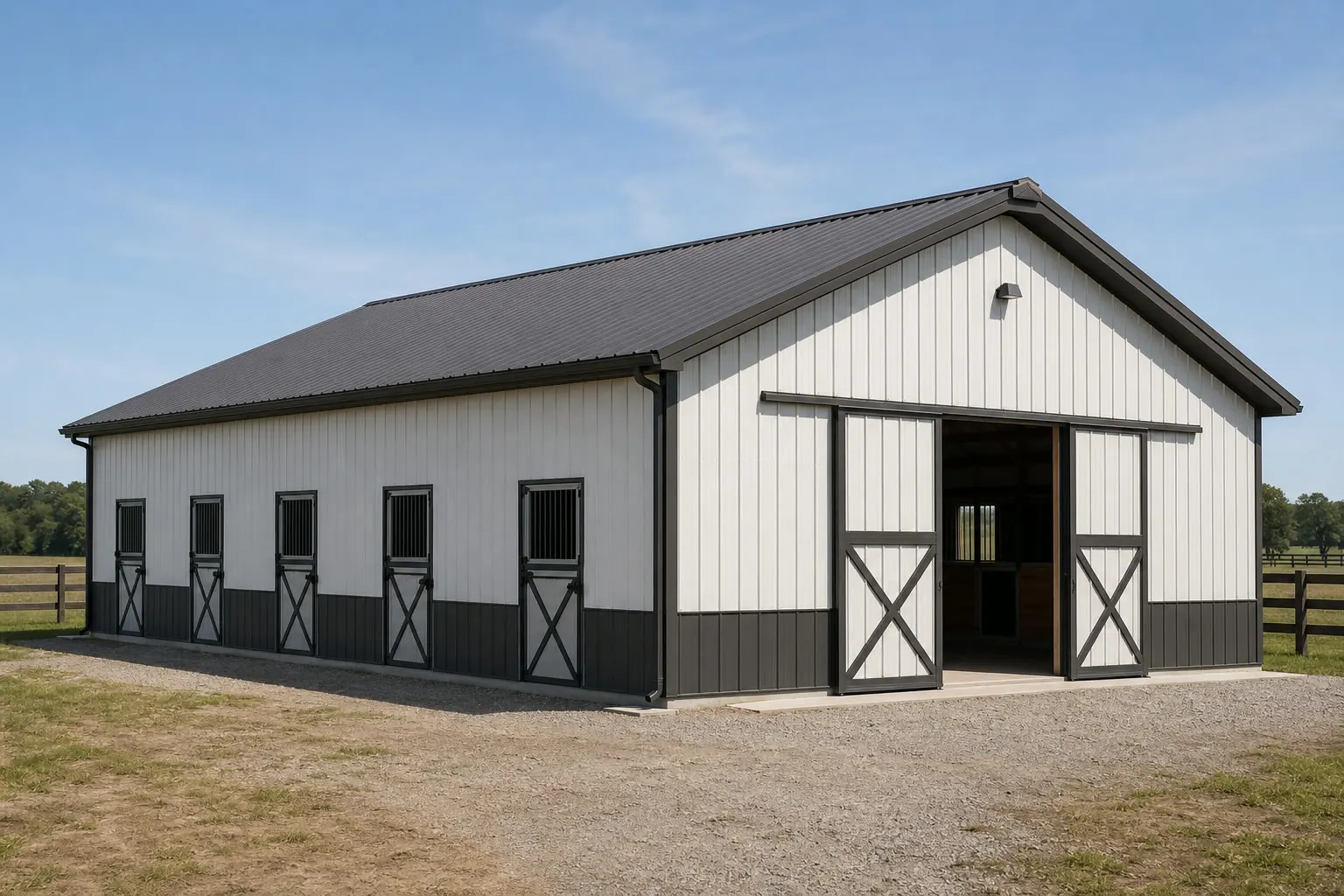
One small state, three different sites
Maryland is small enough to drive across in a few hours, but that distance can cross from tidal Chesapeake flatland to Piedmont hills to mountain terrain. A horse barn plan that works on one of those landscapes does not automatically work on another, and this page is built around that fact rather than around a single statewide climate or terrain claim.
The intersection
Why Maryland's three physiographic regions change the site plan
The Maryland Geological Survey maps the state across the Coastal Plain, the Piedmont, and the combined Blue Ridge, Valley and Ridge, and Appalachian Plateau provinces, running from the Atlantic coast to the western mountains.
A barn sited on the Eastern Shore or in the tidal reaches of the Coastal Plain is usually dealing with flat ground, a high water table, and slow-draining soils. The planning priority there is getting the pad above grade and giving roof water a clear route away from the building rather than letting it pool against a foundation that already sits close to the water table. Manure and wash-water management also deserve early attention on flat coastal-plain ground, since water that cannot run off has to be managed rather than assumed away.
Move into the Piedmont belt through central Maryland and the problem flips: instead of managing flat, slow-draining ground, you are managing grade. Siting a barn on a Piedmont slope means choosing a pad location that does not turn the approach drive into a washout during heavy rain, and orienting the building so that roof runoff sheds away from paddocks rather than through them. A barn built into a hillside without that thought put into it becomes an annual mud-and-erosion project.
In Maryland's western counties, where the Blue Ridge, Valley and Ridge, and Appalachian Plateau provinces come together, terrain and elevation both increase, and access itself becomes the constraint. A steep or narrow rural access route changes what size of trailer or delivery vehicle can actually reach a build site, which is worth confirming with your builder before a floor plan is finalized rather than after materials are already staged.
None of this is a substitute for a site visit. The Geological Survey's regional description tells you which broad category your land falls into, not the specific grade, soil, or drainage of your parcel. Use the regional framing to ask better questions of your local department and your builder, not as a design spec in itself.
Because these three landscapes sit so close together in Maryland, it is common for a buyer to compare notes with a neighbor or relative on the opposite side of the state and find their barn advice does not transfer. That is not a sign that either build was wrong; it is a sign that Maryland's compressed geography makes 'ask your local department' more literally true here than in a large, geographically uniform state.
Finally, plan the seasonal use of the barn around your specific region. Coastal Plain humidity argues for aggressive ventilation and rot-resistant details at ground level; Piedmont and western sites see more temperature swing and benefit from a more insulated approach for any attached tack or work area.
Quick reference
Maryland numbers this page actually relies on
Every figure below carries a named publisher and a period; nothing here is a design value or a requirement.
| Measure | Figure | Source |
|---|---|---|
| Physiographic regions | Coastal Plain, Piedmont, and combined mountain provinces | Maryland Geological Survey |
| Farms (2022) | 12,550, up from 12,429 in 2017 | USDA NASS |
| Average farm size (2022) | 158 acres | USDA NASS |
| Precipitation (BWI-area station) | ~44-46 in/yr, 1991-2020 normal | NOAA NCEI |
| Housing units authorized (2024) | 16,823 total, 10,885 single-unit | U.S. Census Bureau |
| FEMA NRI hazard types tracked | 18, across 24 jurisdictions | FEMA |
Physiographic regions
- Figure
- Coastal Plain, Piedmont, and combined mountain provinces
- Source
- Maryland Geological Survey
Farms (2022)
- Figure
- 12,550, up from 12,429 in 2017
- Source
- USDA NASS
Average farm size (2022)
- Figure
- 158 acres
- Source
- USDA NASS
Precipitation (BWI-area station)
- Figure
- ~44-46 in/yr, 1991-2020 normal
- Source
- NOAA NCEI
Housing units authorized (2024)
- Figure
- 16,823 total, 10,885 single-unit
- Source
- U.S. Census Bureau
FEMA NRI hazard types tracked
- Figure
- 18, across 24 jurisdictions
- Source
- FEMA
Get Maryland horse barn quotes
Tell us your region of the state, how many stalls you need, and your rough footprint. We route it with the Maryland and horse barn context already attached.
Configuration
What a Maryland horse barn is usually being asked to do
Given a tight average parcel size and three distinct regional siting problems, the practical Maryland brief varies more by region than it does by farm size alone.
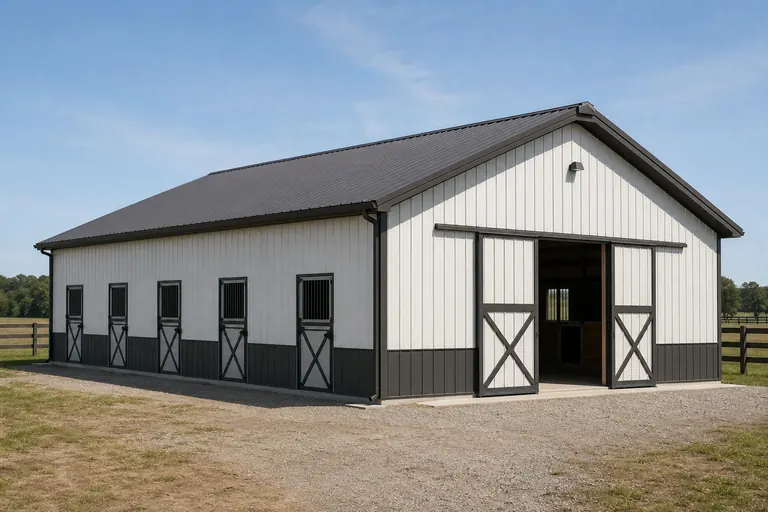 Coastal Plain stall barnPad raised above grade with an emphasis on ventilation and drainage away from a naturally flat, slow-draining site.Piedmont hillside barnSited and oriented to control roof runoff on sloped ground, with the approach drive routed to avoid becoming a wash channel.Western Maryland small-acreage barnBuilt around access constraints in mountain terrain, sized to a genuinely tight parcel rather than an open Midwestern-style spread.
Example Configuration — for planning purposes only.
Footprint
Sizes that fit a Maryland horse barn on a 158-acre-average parcel
None of these is a recommendation independent of your program; they are the footprints that most often show up once a smaller average Maryland parcel and a regional siting constraint are both accounted for.
30′ × 40′
1,200 sq ft
A compact starting point suited to a tighter Coastal Plain or Piedmont lot.
36′ × 48′
1,728 sq ft
Center-aisle room without requiring the open acreage common in larger farm states.
40′ × 60′
2,400 sq ft
Space for stalls plus a genuine storage bay where the parcel can accommodate it.
Example Configuration — for planning purposes only.
Footprint-level layout and door detail live on the size pages; this page only explains why Maryland briefs tend to land in this range.
Preparation
Before you request a Maryland horse barn quote
Four steps that reflect Maryland's specific regional structure rather than generic advice.
Step 1
Identify your physiographic region
Knowing whether your site sits on the Coastal Plain, the Piedmont, or in the western mountain provinces changes the drainage and grading conversation before a floor plan is drawn.
Step 2
Check your county's FEMA NRI hazard profile
Maryland's 24 jurisdictions carry different exposure across 18 tracked hazard types; a Coastal Plain county's flood exposure is not the same as a western county's winter-weather exposure.
Step 3
Confirm access for your build site
Western Maryland terrain and narrow rural roads can constrain what delivery or crane access is realistic; confirm this with your builder before committing to a footprint.
Step 4
Size the barn to your actual parcel
At a 158-acre state average, Maryland sites often have less spare acreage than farm states further west; plan paddock and drive layout around your real parcel, not an assumed large spread.
Questions
Maryland horse barn questions
Answered honestly at the state level, with anything requiring local or regional judgment routed to the people who actually own that answer.
No. Maryland spans a flat, humid Coastal Plain, a rolling Piedmont belt, and a mountainous western strip. The only precipitation figure we can cite comes from a Baltimore-Washington area station, not a single statewide normal, and it is treated here as a regional reference rather than a state average.
USDA's 2022 Census of Agriculture puts Maryland's average farm size at 158 acres across 12,550 farms, which is a tighter parcel than the large farm holdings common further west and worth planning around.
It can, especially near the Chesapeake. FEMA's National Risk Index tracks 18 hazard types across Maryland's 24 jurisdictions, and exposure varies a great deal between coastal and inland counties, so check your specific county rather than assuming a statewide risk level.
There is no official typical size. Because Maryland's average parcel is comparatively tight, briefs commonly land between 30x40 and 40x60, but your program and your specific parcel should set the number.
We do not publish state-level prices; a real number depends on your specification, site work, region-specific grading needs, and current material costs. Our cost pages explain what drives the number, and a quote covers your specific building.
Enforcement runs through local jurisdictions. Confirm requirements with your county or municipal building department before finalizing a plan, since Maryland's 24 jurisdictions administer permitting locally.
Sources for the Maryland facts on this page
This page states no code requirement, wind speed, snow load, permit rule, price or supplier claim. The state-specific facts it does use are listed with their publisher below.
The Maryland Geological Survey describes the state as spanning three distinct physiographic regions -- the Coastal Plain, the Piedmont, and the combined Blue Ridge, Valley and Ridge, and Appalachian Plateau provinces -- extending from the Atlantic coast to the western mountains.
Maryland Geological Survey · MGS reference material · Tier 2
https://www.mgs.md.gov/geology/geology_of_maryland.htmlMaryland had 12,550 farms in 2022, up from 12,429 in 2017.
USDA National Agricultural Statistics Service (NASS) · 2022 (with 2017 comparison) · Tier 1
https://www.nass.usda.gov/Publications/AgCensus/2022/Full_Report/Volume_1,_Chapter_1_State_Level/Maryland/st24_1_001_001.pdfMaryland had 1,978,036 acres of land in farms in 2022, an average farm size of 158 acres.
USDA NASS · 2022 · Tier 1
https://www.nass.usda.gov/Publications/AgCensus/2022/Full_Report/Volume_1,_Chapter_1_State_Level/Maryland/st24_1_001_001.pdfThe BWI Airport (Baltimore/Annapolis area) NOAA 1991-2020 climate normals show total annual precipitation of roughly 44-46 inches spread fairly evenly across the year.
NOAA National Centers for Environmental Information (NCEI) · 1991-2020 · Tier 1
https://www.ncei.noaa.gov/access/services/data/v1?dataTypes=MLY-TMAX-NORMAL%2CMLY-TMIN-NORMAL%2CMLY-TAVG-NORMAL%2CMLY-PRCP-NORMAL%2CMLY-SNOW-NORMAL&dataset=normals-monthly-1991-2020&format=pdf&stations=USW00013752FEMA's National Risk Index is the federal tool for county- and state-level natural hazard exposure data for Maryland's 24 jurisdictions, covering 18 hazard types including coastal flooding, hurricane, and winter weather.
Federal Emergency Management Agency (FEMA) · Current NRI release · Tier 1
https://www.fema.gov/flood-maps/products-tools/national-risk-indexBuilders in Maryland were authorized to construct 16,823 new privately-owned housing units in 2024, of which 10,885 were single-unit structures.
U.S. Census Bureau · 2024 (final annual estimates) · Tier 1
https://www.census.gov/construction/bps/stateannual.html