
Horse barn · OH
Horse Barns in Ohio
Search demand for a horse barn built specifically in Ohio is thin and scattered across long, differently worded queries rather than one dominant phrase, and we are not going to pretend otherwise. What is not thin is the actual planning difference: Ohio's Board of Building Standards sets and adopts the codes statewide but does not enforce them itself, instead certifying separate municipal, county and township departments to do that job, so an Ohio horse-barn buyer is dealing with two layers, not one. Combined with 76,500 farms working 13.1 million acres in a state whose economy still leans harder on manufacturing than agriculture, the honest Ohio story is about who administers the project and who is likely asking for it, not about loads or a single typical size.
Why this page exists even though the numbers are small
We would rather tell you the truth about a thin keyword than dress up a page to look busier than the demand actually is. 'Horse barn ohio' does not measure meaningfully on its own; the cluster around it is small. What follows is kept because two things genuinely change the planning conversation in Ohio, and a buyer who lands here deserves that answer regardless of how many other people searched for it this month.
The intersection
Ohio runs code adoption and code enforcement as two separate jobs
The Ohio Board of Building Standards formulates, adopts and amends the state's building, mechanical, plumbing, elevator, boiler and pressure-piping codes, and then certifies municipal, county and township building departments to enforce them.
That is a structural detail, not a requirement, and this page does not turn it into one. What it means in practice is that an Ohio horse-barn buyer is dealing with a state-level rulebook and a locally certified department that applies it, which is a different shape than a state that both writes and enforces its own code, or a state with no statewide code body at all. Knowing which certified department covers your parcel, before you fix a floor plan, is the single most useful procedural step this page can point you toward.
The second Ohio-specific fact worth carrying into that conversation is scale. Ohio counted 76,500 farms working 13.1 million acres in the 2022 Census of Agriculture, a base that shrank by about 400,000 acres from the prior census. A large but slowly contracting farm base, sitting inside a state where manufacturing remains the single biggest private-sector GDP contributor at roughly 16.5%, points toward a horse-barn buyer who is frequently running horses as one part of a working property rather than as a full-time agricultural operation. That changes how a barn gets specified: it is often asked to double as general storage or a small workshop, not just stalls.
That dual-purpose brief is worth naming explicitly when you request quotes, because it changes the building rather than just its size. Stalls want ventilation, a durable wall surface at horse height and a manageable manure route. A storage or workshop bay wants clear height, a wide door and somewhere to run power. Combining them is entirely normal, but the aisle width, the door placement and the position of the dividing wall all follow from admitting up front that the building is doing two jobs.
The other item Ohio buyers frequently leave until too late is water and drainage. A barn that sheds roof water toward the paddock gate creates a mud problem that no amount of interior specification will fix, and the fix after the fact is earthworks rather than carpentry. Deciding where roof water goes, where the wash area drains to and how the approach surface is built is cheaper as a line on the site plan than as a second season of work.
Finally, plan the conversation with your certified local department around a drawing rather than a description. Departments answer specific questions well and vague ones cautiously, so arriving with a footprint, a proposed location on the parcel and an honest description of use tends to produce a clearer answer than asking in the abstract what is allowed.
One more thing worth settling early is how the barn will be used across the seasons. Ohio winters push more of the daily routine indoors, which raises the value of a wide, well-lit aisle and a genuinely usable working area at one end. Those are cheap decisions at the drawing stage and expensive ones later, so they belong in the first conversation rather than the last.
Quick reference
Ohio numbers this page actually relies on
Every figure below carries a named publisher and a period; nothing here is a design value or a requirement.
| Measure | Figure | Source |
|---|---|---|
| Farms (2022) | 76,500 | USDA NASS Great Lakes Region |
| Land in farms (2022) | 13.1 million acres | USDA NASS Great Lakes Region |
| Manufacturing share of private GDP | About 16.5% | Ohio Manufacturers' Association |
| Total land area | 44,826 sq mi | U.S. Census Bureau |
| Equine inventory | Recorded gap — not estimated here | Evidence registry |
Farms (2022)
- Figure
- 76,500
- Source
- USDA NASS Great Lakes Region
Land in farms (2022)
- Figure
- 13.1 million acres
- Source
- USDA NASS Great Lakes Region
Manufacturing share of private GDP
- Figure
- About 16.5%
- Source
- Ohio Manufacturers' Association
Total land area
- Figure
- 44,826 sq mi
- Source
- U.S. Census Bureau
Equine inventory
- Figure
- Recorded gap — not estimated here
- Source
- Evidence registry
Get Ohio horse barn quotes
Tell us how many stalls you need, what else the building has to do, and your rough footprint. We route it with the Ohio and horse barn context already attached.
Configuration
What an Ohio horse barn is usually being asked to do
Given a large but non-exclusive farm base sitting next to a manufacturing-heavy economy, the practical Ohio brief is often mixed rather than single-purpose.
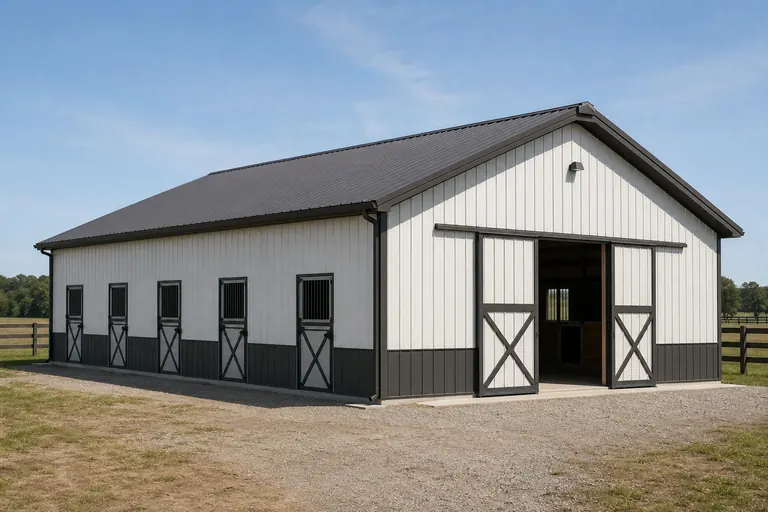 Stalls plus general storageA stall run at one end and an open storage or equipment bay at the other, because the site is a working small property rather than a dedicated equine operation.Boarding-scale stallsWhere the operation is larger, aisle width and stall count drive the plan more than the shell itself; that detail belongs on the type-level horse barn page, not here.Hobby and weekend-use barnsA smaller footprint serving a household with off-farm income, where the barn is one part of the property rather than its economic center.
Example Configuration — for planning purposes only.
Footprint
Sizes that fit an Ohio mixed-use horse barn
None of these is a recommendation independent of your program; they are the footprints that most often show up once stalls and a secondary use are both accounted for.
30′ × 40′
1,200 sq ft
A compact starting point for a handful of stalls plus a small tack or feed area.
36′ × 48′
1,728 sq ft
Room for a center aisle configuration without committing to a boarding-scale operation.
40′ × 60′
2,400 sq ft
Where stalls and a genuine storage or equipment bay both need real space.
Example Configuration — for planning purposes only.
Footprint-level layout and door detail live on the size pages; this page only explains why Ohio briefs tend to land in this range.
Preparation
Before you request an Ohio horse barn quote
Four steps that reflect Ohio's specific structure rather than generic advice.
Step 1
Identify your certified local department
Ohio's code is set at the state level but enforced by a certified municipal, county or township department; find out which one covers your parcel before you fix a plan.
Step 2
Describe every function the barn serves
If the building is also doing storage or shop duty, say so up front rather than after the first quote.
Step 3
Ask about your specific site, not the state map
We do not have confirmed, named physiographic region boundaries for Ohio to point you to, so treat your own site's drainage and access as something to verify locally.
Step 4
Don't expect a stated headcount to guide your sizing
Ohio's statewide equine inventory is an unresolved data gap; size the barn to your own horses and program, not to a state figure that does not exist in our sources.
Questions
Ohio horse barn questions
Answered honestly at the state level, with anything requiring local judgment routed to the people who actually own that answer.
No, and we're not going to claim otherwise. 'Horse barn ohio' measures close to zero on its own, with a small cluster of related long-tail terms around it. We keep this page because the planning differences are real, not because the keyword is busy.
Ohio's Board of Building Standards adopts the codes statewide, but certified municipal, county and township departments are the ones who enforce them. Your first call should be to find out which certified department covers your site.
We do not have a verified statewide equine inventory figure in our evidence, and this page does not estimate one. Size your barn to your own horses and planned use rather than a statewide number.
There is no official typical size. Because many Ohio sites mix stalls with general storage, briefs commonly land between 30x40 and 40x60, but your program is what should set the number, not a state average.
We do not publish state-level prices; a real number depends on your specification, site work and current material costs. Our cost pages explain what drives the number, and a quote covers your specific building.
Sources for the Ohio facts on this page
This page states no code requirement, wind speed, snow load, permit rule, price or supplier claim. The state-specific facts it does use are listed with their publisher below.
The Ohio Board of Building Standards formulates, adopts, and amends the state's Building, Mechanical, Plumbing, Elevator, Boiler, and Pressure Piping Codes, and certifies municipal, county, and township building departments to enforce them.
Ohio Department of Commerce, Division of Industrial Compliance · Current program page · Tier 2
https://com.ohio.gov/divisions-and-programs/industrial-compliance/boards/board-of-building-standardsNumber of farms in Ohio in 2022.
USDA National Agricultural Statistics Service · 2022 Census of Agriculture (released Feb 2023 preliminary/2024 full) · Tier 1
https://www.nass.usda.gov/Statistics_by_State/Ohio/Publications/Current_News_Releases/2023/nr2311oh.pdfLand in farms in Ohio in 2022.
USDA National Agricultural Statistics Service · 2022 Census of Agriculture · Tier 1
https://www.nass.usda.gov/Statistics_by_State/Ohio/Publications/Current_News_Releases/2023/nr2311oh.pdfManufacturing is Ohio's largest private economic sector by GDP share, per an Ohio Manufacturers' Association analysis of federal data.
Ohio Manufacturers' Association (OMA), citing BLS/BEA data · 2024/2025 edition · Tier 2
https://www.ohiomfg.com/wp-content/uploads/2026/02/OMA_ManufacturingCounts2025_CMYK-FINAL-2.25.26.pdfOhio's physiography is mapped and divided into named physiographic regions by the state geological survey.
Ohio Department of Natural Resources, Division of Geological Survey · 1998 edition · Tier 2
https://dam.assets.ohio.gov/image/upload/ohiodnr.gov/documents/geology/MiscMap_OhioPhysiographicRegions_1998.pdfOhio total land area per US Census Bureau state area measurements.
U.S. Census Bureau · 2010 measurement basis · Tier 1
https://www.census.gov/geographies/reference-files/2010/geo/state-area.html