
Pole barn · FL
Pole Barns in Florida
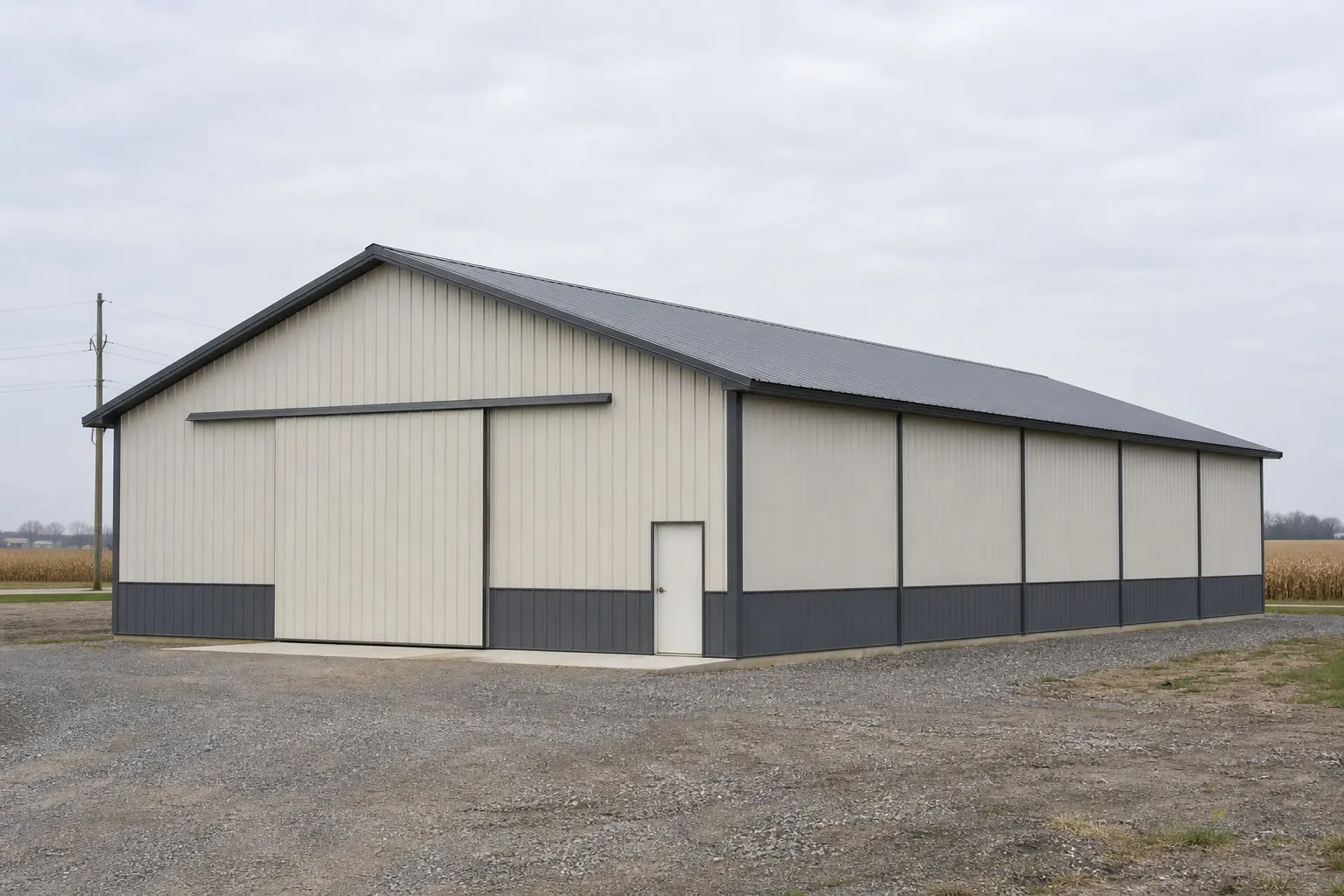
Post-frame construction in Florida answers to two persistent conditions before it answers to any farm-size assumption: ground that USGS elevation mapping describes as low-lying across large parts of the state, and a groundwater system — the roughly 100,000-square-mile Floridan aquifer — that sits under every county. A pole barn's post footings, drainage grading and ventilation design in Florida start from those two facts, then adjust for the property's specific place among the state's 44,703 farms, which the 2022 Census of Agriculture put at an average of 217 acres apiece — noticeably smaller than the sprawling operations common in some Midwestern states.
Site Conditions
The ground decides the footing before the frame does
A Florida pole barn's post footing design is driven by low elevation and a shallow water table more than by any single soil type.
Florida doesn't hand a pole barn builder a mountain grade or a rocky ridge to design around; the challenge is the opposite. USGS elevation data shows large parts of the state sitting low, and the Floridan aquifer system — spanning roughly 100,000 square miles across the southeastern U.S. and underlying the entire state — keeps the water table close to the surface in many places. A post set into ground that saturates seasonally needs either a deeper embedded footing, a poured concrete collar, or an engineered pier system, and that decision should follow an actual soil boring or percolation test on the specific site rather than a generic statewide assumption.
Where a barn owner in a hillier state might spend site-prep budget on grading a level pad into a slope, a Florida pole barn's site-prep budget more often goes toward drainage: swales, French drains, or simply raising the pad elevation a few inches above the surrounding grade to keep water moving away from the post bases during Florida's wet season.
None of this changes because the barn is agricultural rather than residential. A hay barn or equipment shed sitting on saturated ground for weeks at a time faces the same foundation-movement risk as a home, just with different consequences — a sagging pole barn floor is cheaper to fix than a cracked residential slab, but it still costs money that a proper footing spec avoids.
Land Context
Florida's farm profile versus a large-acreage assumption
Florida's average farm size sits below several major agricultural states, which affects how a pole barn's footprint is typically sized.
| Metric | Florida figure (2022 Census) | Planning implication |
|---|---|---|
| Number of farms | 44,703 | A broad base of demand for equipment and storage buildings across the state. |
| Total land in farms | 9,701,400 acres | Statewide agricultural footprint, concentrated more inland than coastal. |
| Average farm size | 217 acres | Supports a mid-size pole barn footprint on many properties rather than an assumption of very large acreage. |
Number of farms
- Florida figure (2022 Census)
- 44,703
- Planning implication
- A broad base of demand for equipment and storage buildings across the state.
Total land in farms
- Florida figure (2022 Census)
- 9,701,400 acres
- Planning implication
- Statewide agricultural footprint, concentrated more inland than coastal.
Average farm size
- Florida figure (2022 Census)
- 217 acres
- Planning implication
- Supports a mid-size pole barn footprint on many properties rather than an assumption of very large acreage.
Wind Exposure
Wind-readiness steps for a Florida pole barn
Florida's documented hurricane history means wind detailing deserves attention regardless of how far inland the site sits.
- Confirm the applicable Florida Building Code requirements locallyThe Florida Building Commission administers the code statewide, but your local building department runs the actual permit review and can confirm what applies to your specific site.
- Specify engineered truss-to-post connectionsGiven Florida's ranking as the U.S. state with the most historical hurricane landfalls, connection hardware between trusses and posts is worth over-specifying rather than treating as optional.
- Check your county's FEMA National Risk Index ratingFEMA scores 18 hazard types by community; pull your county's specific rating rather than assuming uniform exposure across the state.
- Plan roof overhang and eave detailing for wind upliftLarge overhangs common on pole barns can become uplift liabilities in high wind; discuss overhang length with your supplier's engineer before finalizing the design.
- Ask about ventilation ridge detailing alongside wind bracingA ridge vent that is not detailed with the same wind-resistance standard as the roof around it can become the weak point in an otherwise well-braced frame.
- Confirm gutter and downspout sizing with your supplierUndersized gutters on a large roof area shed water poorly during heavy rain events.
Start your Florida pole barn project
Get connected with specialists who understand Florida's drainage, water-table and hurricane-bracing requirements.
Building Performance
Drainage and ventilation across Florida's growing regions
Ventilation and drainage priorities shift somewhat between Florida's flatwoods interior and its coastal-adjacent counties.
Interior flatwoods and citrus belt
Standing water after heavy rain events is the primary site-prep concern; grading the pad above surrounding elevation matters more here than post depth alone.
Coastal-adjacent counties
Salt-air corrosion resistance for fasteners and metal components becomes a relevant spec question alongside the standard drainage and wind concerns.
Panhandle and North Florida
Slightly higher average elevation in places, but the same statewide aquifer coverage means water-table checks are still worthwhile before footing design.
Dimensions
Sizes that suit Florida's farm scale
With an average farm size of 217 acres, Florida pole barns often run in the mid-size range rather than the largest multi-bay footprints seen on bigger Midwestern operations.
30′ × 40′
1,200 sq ft
A practical single-bay size for equipment storage on smaller Florida parcels.
40′ × 60′
2,400 sq ft
A common footprint for combined hay and equipment storage on mid-size operations.
40′ × 80′
3,200 sq ft
Suited to larger citrus, cattle or nursery operations needing multiple equipment bays.
Example Configuration — for planning purposes only.
Because Florida's average farm size is smaller than several major agricultural states, confirm the footprint against your parcel's actual usable acreage and local setback rules rather than defaulting to the largest available size.
Questions
Florida Pole Barn Questions
Direct answers scoped to what actually changes for post-frame construction in Florida.
Possibly. Because the Floridan aquifer underlies the entire state and much of Florida's terrain sits at low elevation, a site-specific soil and water-table check often leads to a deeper footing, a concrete collar, or an engineered pier rather than a standard-depth post everywhere.
In some ways yes, since there's little slope to grade around, but flat, low ground brings drainage challenges instead. Pad elevation and positive drainage away from post bases are usually the bigger design questions than terrain slope.
It doesn't set a single statewide wind speed you can assume; that's determined locally through the Florida Building Code. But given Florida's documented history of frequent hurricane landfalls, engineered truss-to-post connections and wind-uplift detailing are worth specifying regardless of exact location.
With Florida's average farm size at 217 acres in the 2022 Census of Agriculture, a 40x60 or 40x80 footprint suits many mid-size operations, though the right size depends on your parcel's usable acreage and intended use.
The Florida Building Commission administers one code statewide, but your local building department runs permitting and inspection, and some counties add local amendments. Confirm requirements with your specific jurisdiction before finalizing plans.
Agricultural exemption rules vary by county and by the building's use. Check directly with your county building or zoning department, since exemption eligibility is a local determination, not a statewide rule.
Sources for the Florida facts on this page
This page states no code requirement, wind speed, snow load, permit rule, price or supplier claim. The state-specific facts it does use are listed with their publisher below.
USGS mapping highlights that large portions of Florida are low-lying, derived from USGS digital elevation models.
U.S. Geological Survey · n/a (map publication) · Tier 2
https://pubs.usgs.gov/sim/3047/The Floridan aquifer system, a principal USGS-studied aquifer, underlies all of Florida and covers about 100,000 square miles across the southeastern U.S.
U.S. Geological Survey · n/a · Tier 2
https://fl.water.usgs.gov/floridan/intro.htmlFlorida had 44,703 farms in 2022 per the USDA Census of Agriculture.
USDA National Agricultural Statistics Service (NASS) · 2022 · Tier 1
https://www.nass.usda.gov/Publications/AgCensus/2022/Full_Report/Volume_1,_Chapter_1_State_Level/Florida/Land in farms in Florida totaled 9,701,400 acres in 2022.
USDA NASS · 2022 · Tier 1
https://www.nass.usda.gov/Publications/AgCensus/2022/Full_Report/Volume_1,_Chapter_1_State_Level/Florida/NOAA's Hurricane Research Division records Florida as the U.S. state with the most historical hurricane direct hits/landfalls, based on the 1851-2018 dataset.
NOAA Atlantic Oceanographic and Meteorological Laboratory (AOML), Hurricane Research Division · 1851-2018 · Tier 1
https://www.aoml.noaa.gov/hrd/tcfaq/E19.htmlThe Florida Building Commission administers the Florida Building Code statewide.
Florida Building Commission · 8th Edition (2023), effective Dec 31, 2023 · Tier 2
https://www.floridabuilding.org/