
Barndominium · FL
Barndominiums in Florida
A Florida barndominium sits on ground the U.S. Geological Survey maps as low-lying across large portions of the state, above the Floridan aquifer that underlies the entire peninsula, in a state NOAA's Hurricane Research Division ranks first nationally for historical hurricane landfalls. None of that changes the appeal of pairing a residence with an attached shop or equipment bay — Florida still counted 44,703 farms averaging 217 acres in the 2022 Census of Agriculture — but it does change what a buyer needs settled before the steel goes up: elevation and drainage, whether the parcel falls inside the Florida Building Code's High-Velocity Hurricane Zone, and how the humidity that defines the state year-round is managed inside a living space rather than a barn.
Site Reality
Why the ground comes before the floor plan in Florida
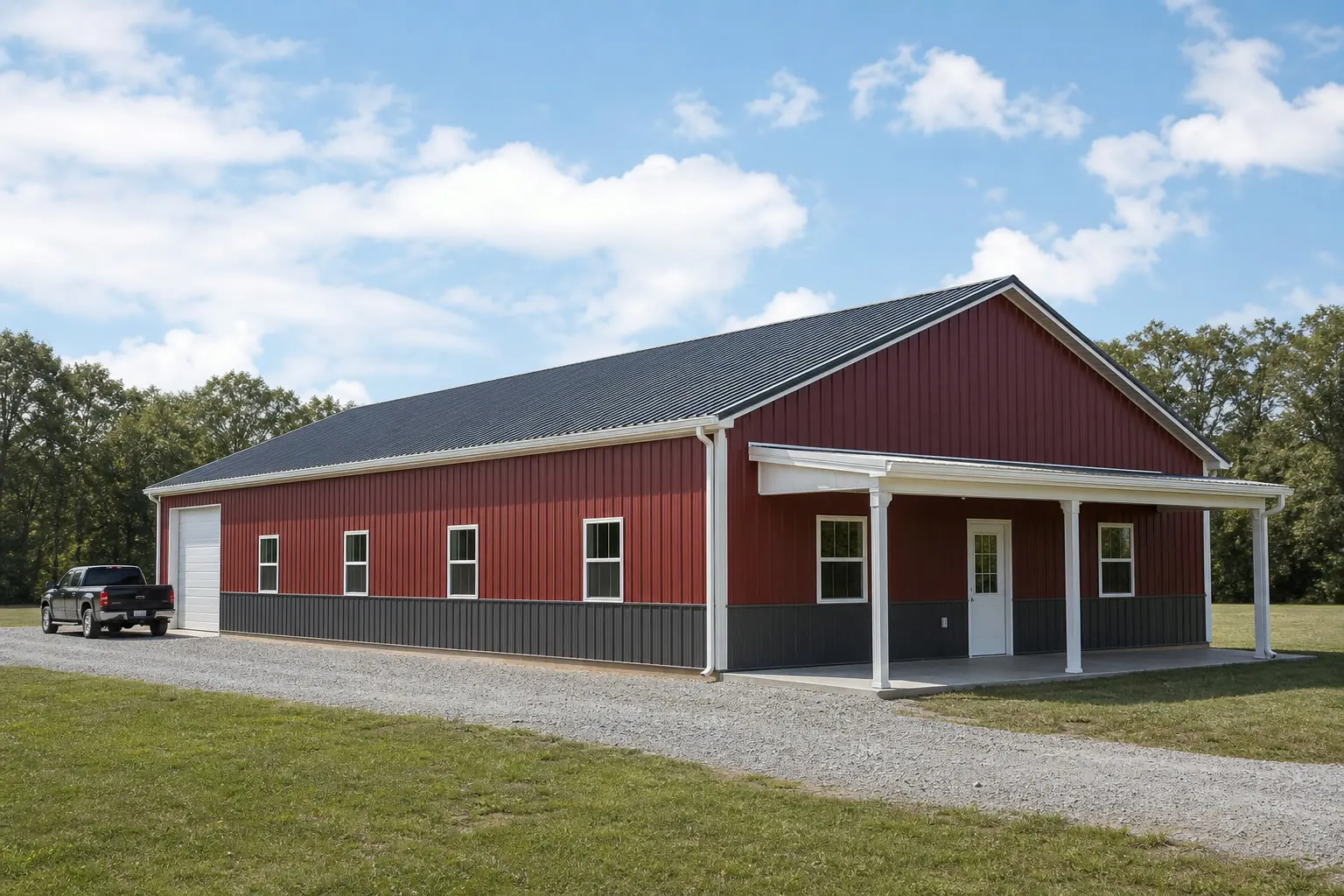
A Florida barndominium's foundation and drainage plan is set by elevation and water table before any layout decision is made.
Most of Florida's building conversation starts underground rather than at the roofline. USGS elevation mapping shows large stretches of the state sitting at low elevation, and the Floridan aquifer system — one of the country's most significant groundwater resources, spanning roughly 100,000 square miles — runs beneath every county. For a barndominium, that combination means the slab elevation and site grading plan matter as much as the steel frame specification: standing water at the foundation edge is a far more common failure point in Florida than any structural issue with the building itself.
This is not a coastal-only concern. A barndominium built inland near Ocala or in the citrus belt sits over the same aquifer system as one built near the coast, and a shallow water table can complicate septic drain-field design regardless of distance from open water. A pre-construction elevation certificate and a soil/percolation test are worth commissioning before finalizing a Florida barndominium's footprint, even on land that looks dry at first glance.
Florida's 53,603 square miles of land area pack in a wide range of local conditions — sandy well-drained ridges in places, low wet flatwoods in others — inside a state that otherwise reads as uniformly flat on a map. Treat the specific parcel's soil and elevation as the starting input, not the general reputation of the region it sits in.
Code Zones
HVHZ counties versus the rest of Florida
The Florida Building Code applies a materially different review track inside the High-Velocity Hurricane Zone than elsewhere in the state.
| Zone | Counties | What it means for a barndominium project |
|---|---|---|
| High-Velocity Hurricane Zone | Broward and Miami-Dade | Additional product approval and inspection steps under the Florida Building Code apply; confirm the current process with the county building department before design. |
| Rest of Florida | All other counties | The statewide Florida Building Code applies without the HVHZ overlay, though county-level amendments and permit processes still vary and should be confirmed locally. |
High-Velocity Hurricane Zone
- Counties
- Broward and Miami-Dade
- What it means for a barndominium project
- Additional product approval and inspection steps under the Florida Building Code apply; confirm the current process with the county building department before design.
Rest of Florida
- Counties
- All other counties
- What it means for a barndominium project
- The statewide Florida Building Code applies without the HVHZ overlay, though county-level amendments and permit processes still vary and should be confirmed locally.
Storm Season
Hurricane-season steps for a Florida barndominium
Because a barndominium is a full-time home, its storm-season posture deserves the same attention as its floor plan.
- Confirm HVHZ status with the county before designOnly Broward and Miami-Dade fall under the Florida Building Code's High-Velocity Hurricane Zone; every other county follows the standard statewide code path, so confirm which applies to your parcel first.
- Pull your county's FEMA National Risk Index ratingFEMA scores communities across 18 hazard types including hurricane, coastal flooding, and inland flooding; check your specific county rather than assume statewide exposure is uniform.
- Plan for a generator and fuel storageGiven Florida's documented history of frequent hurricane landfalls, wiring a transfer switch and reserving space for fuel storage during construction avoids retrofitting later.
- Verify elevation certificate and flood-zone statusBecause large portions of the state sit at low elevation, an elevation certificate for the specific lot should inform slab height decisions before the foundation is poured.
Start your Florida barndominium project
Get connected with specialists who understand Florida's HVHZ rules, elevation planning and hurricane-season detailing.
Living Comfort
Managing humidity inside a residential steel building
A Florida barndominium's insulation and ventilation strategy has to treat year-round humidity as a permanent condition, not a seasonal one.
Station-level 1991-2020 climate normals published for Florida stations, such as West Palm Beach's, describe a warm, humid profile that holds for much of the year across the peninsula. A barndominium's residential portion needs a vapor barrier and HVAC sizing strategy suited to a full-time living space, which is a different design target than a barn or storage building where moisture is a materials-protection issue rather than a comfort and mold-prevention issue.
There is no single statewide humidity or rainfall figure published by NOAA that applies evenly from the Panhandle to the Keys; only station-level normals exist. Owners should pull the normals for the weather station closest to their actual site rather than relying on a single number for 'Florida' as a whole.
Land Use
Sizing the shop-to-home ratio against Florida's farm profile
Florida's average farm size runs smaller than several major agricultural states, which shapes a more compact barndominium footprint for many buyers.
Inland agricultural counties
With Florida's 44,703 farms averaging 217 acres in the 2022 Census, many inland parcels support a barndominium with a modest attached shop rather than a large multi-bay equipment building.
Suburban and exurban lots
Zoning and lot size, not agricultural averages, are the binding constraint here; confirm allowed footprint and setbacks with the county before sizing the shop end.
Larger citrus or cattle operations
Where farm acreage runs above the statewide average, a barndominium's shop bay can reasonably scale up, but should still be checked against local agricultural exemption rules for the parcel.
Questions
Florida Barndominium Questions
Direct answers scoped to what actually changes for a residential steel build in Florida.
Only Broward and Miami-Dade counties fall inside the Florida Building Code's HVHZ. Every other county follows the standard statewide Florida Building Code path. Confirm with your county building department, since the HVHZ carries additional product-approval steps.
Possibly. USGS elevation mapping shows large portions of Florida sitting at low elevation statewide, and the Floridan aquifer underlies the entire state, so an elevation certificate and drainage plan matter even well inland.
The living portion needs an HVAC and vapor-barrier strategy sized for year-round humidity, not seasonal moisture control. Pull the 1991-2020 climate normals for your nearest weather station to size the system to your specific location.
There's no fixed minimum. Florida's average farm size was 217 acres in the 2022 Census of Agriculture, but many barndominium buyers build on far smaller suburban or exurban lots where local zoning allows the combined footprint.
No single wind speed applies statewide; specific structural requirements are set locally through the Florida Building Code and vary by jurisdiction and HVHZ status. Confirm the applicable design requirements with your local building department and engineer.
Often yes, but foundation and septic design need site-specific input. Because the Floridan aquifer underlies the whole state, a soil and water-table assessment before finalizing the foundation plan is worth the cost almost everywhere in Florida.
Sources for the Florida facts on this page
This page states no code requirement, wind speed, snow load, permit rule, price or supplier claim. The state-specific facts it does use are listed with their publisher below.
USGS mapping highlights that large portions of Florida are low-lying, derived from USGS digital elevation models.
U.S. Geological Survey · n/a (map publication) · Tier 2
https://pubs.usgs.gov/sim/3047/The Floridan aquifer system, a principal USGS-studied aquifer, underlies all of Florida and covers about 100,000 square miles across the southeastern U.S.
U.S. Geological Survey · n/a · Tier 2
https://fl.water.usgs.gov/floridan/intro.htmlThe Florida Building Code defines a High-Velocity Hurricane Zone (HVHZ) consisting of Broward and Miami-Dade counties.
Florida Building Commission (via UpCodes republication) · 2023 FBC, 8th edition · Tier 3
https://up.codes/d/high-velocity-hurricane-zone-hvhzNOAA's Hurricane Research Division records Florida as the U.S. state with the most historical hurricane direct hits/landfalls, based on the 1851-2018 dataset.
NOAA Atlantic Oceanographic and Meteorological Laboratory (AOML), Hurricane Research Division · 1851-2018 · Tier 1
https://www.aoml.noaa.gov/hrd/tcfaq/E19.htmlThe average farm size in Florida was 217 acres in 2022.
USDA NASS · 2022 · Tier 1
https://www.nass.usda.gov/Publications/AgCensus/2022/Full_Report/Volume_1,_Chapter_1_State_Level/Florida/Florida's total land area was 53,603 square miles per the 2008 Census Bureau state area measurements.
U.S. Census Bureau, Statistical Abstract of the United States: 2011 · 2008 · Tier 1
https://www2.census.gov/library/publications/2010/compendia/statab/130ed/tables/11s0355.pdf