
Carport · OK
Carports in Oklahoma
A carport in Oklahoma is built against a landscape that NOAA NCEI itself describes as split: a southern Great Plains character across most of the state, giving way to the Ouachita Mountains and Ozark Plateau edge in the east, where the Oklahoma Climatological Survey notes peaks rising up to 2,000 feet above their base. That split matters because open plains ground carries wind exposure with few natural breaks, while the mountainous east offers more shelter but rockier siting and drainage. On an average Oklahoma farm running to 467 acres, a carport is as likely to shield an implement or a camper as a passenger vehicle, and code questions start with one named body, the Oklahoma Uniform Building Code Commission, even though local jurisdictions still decide the specifics.
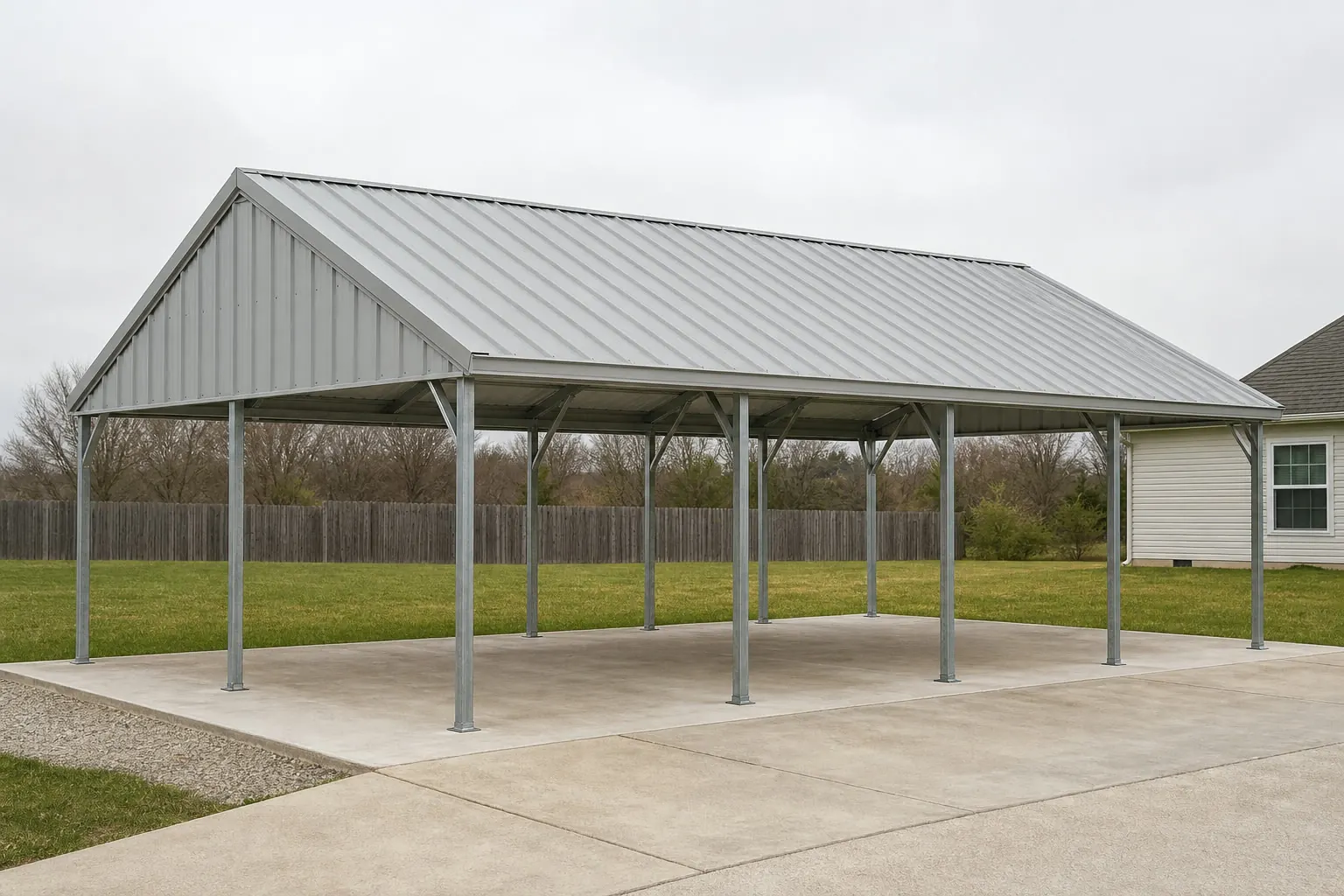
Site context
Two exposure conditions inside one state
NOAA NCEI's own descriptive narrative for Oklahoma pairs a southern Great Plains character with mountainous relief in the southeast, and those are genuinely different siting conditions for an open-sided carport.
NOAA's Climate of Oklahoma narrative describes the state's southern Great Plains location alongside the Ouachita Mountains, the Arkansas River Valley and the Ozark Plateau in the northeast — three distinct landscape features named in the same official document. The Oklahoma Climatological Survey goes further, describing Ouachita peaks rising up to 2,000 feet above their base. A carport on the open plains has no equivalent terrain feature to break the wind; a carport tucked into the Ouachita foothills may sit in genuine topographic shelter that a plains site simply does not have.
That difference is not a footnote. An open-sided structure behaves like a wing in sustained wind, and the amount of natural shelter around it changes how seriously anchoring needs to be treated. On the plains, anchoring is close to mandatory regardless of budget. In the more sheltered east, terrain may reduce — but not eliminate — that exposure, and a site visit is still the only reliable way to know which condition applies to a specific parcel.
The practical order of operations follows from that split rather than from a generic checklist. Start with the site, not the catalog: walk the parcel and note whether the open face of a planned carport would face a prevailing wind path with nothing to break it, or whether existing terrain, tree lines or an adjacent structure already does some of that work. Only after that walk does it make sense to call the local building or zoning department, since the same open-sided structure can trigger different setback or permit questions depending on whether it sits on a plains lot near Enid or a wooded parcel near Broken Bow. Ordering a size and anchoring package before that sequence is settled is how Oklahoma carport buyers end up re-quoting a project after the fact, rather than before it starts.
Program
Built for equipment as often as vehicles
On an average Oklahoma farm running to 467 acres, a carport is frequently asked to shelter equipment, not just a car.
USDA's 2022 Census of Agriculture puts Oklahoma's average farm size at 467 acres across 32,897,563 acres in farms. On a property that size, a carport is as likely to cover a tractor, a camper, a stock trailer or a utility vehicle as it is a passenger car, which pushes eave heights and bay widths beyond what a suburban driveway carport would need. Measuring the tallest and widest item you actually plan to store — not the smallest — before fixing a footprint avoids a costly resize after delivery.
Siting on a large parcel also means the nearest natural windbreak, if one exists at all, may be a considerable distance from where the carport makes the most sense functionally. Where no windbreak exists, orienting the open face away from the prevailing northwesterly winter wind does some of that protective work without adding a new structure to the property.
- Size for the equipment, not the vehicle
- Measure the tallest and widest item that will actually sit under the roof before ordering.
- Orient deliberately on open ground
- Face the open side away from the prevailing northwesterly winter wind where no windbreak exists.
- Treat anchoring as a line item
- On exposed plains sites, anchoring hardware belongs in the first quote, not an afterthought.
Site context
Where your carport sits changes the planning conversation
USGS and the Oklahoma Geological Survey both describe a state divided between open plains and folded mountain terrain.
Great Plains (west and central)
Classified by USGS within the interior Great Plains province — open, comparatively level ground with limited natural windbreaks.
Ouachita Mountains (southeast)
Described by the Oklahoma Geological Survey as resistant, folded, faulted rock; a carport site here may sit in genuine topographic shelter, but confirm with a site visit before assuming it.
Ozark Plateau (northeast, near Tulsa)
Shares rugged-terrain planning questions with neighboring Missouri and Arkansas on this corner of the state.
Get Oklahoma carport quotes
Tell us whether your site is open plains or more sheltered terrain, and what you plan to park under it. We route your request with that context attached.
Design
Carport configurations common in Oklahoma
The plains-versus-mountain split and farm-scale utility use point to a few recurring configurations.
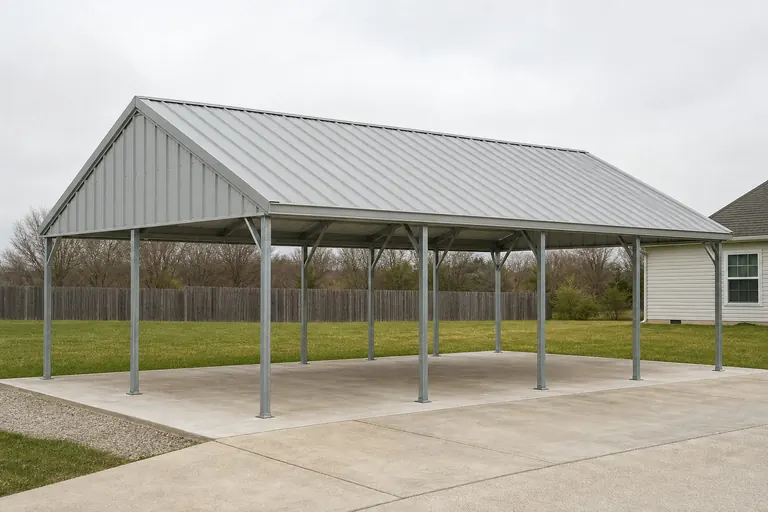 High-clearance equipment coverTaller eave heights sized for tractors or high-profile farm equipment on large plains parcels.RV and camper shelterLonger footprints, often with partial enclosure for added wind protection on exposed sites.Attached utility lean-toBuilt off an existing barn or shop to use the larger structure as a partial windbreak.
Example Configuration — for planning purposes only.
Dimensions
Common Oklahoma carport footprints
Sizes reflect the mix of vehicle and equipment coverage typical of Oklahoma's large-acreage properties.
12′ × 20′
240 sq ft
Single-vehicle coverage on a smaller or more compact lot.
24′ × 30′
720 sq ft
A common two-bay size covering a truck plus a piece of utility equipment.
30′ × 40′
1,200 sq ft
Sized for a camper, trailer or larger farm implement alongside a vehicle.
Example Configuration — for planning purposes only.
Confirm setback distance from property lines with your local jurisdiction before finalizing placement.
Questions
Oklahoma carport questions
Honest answers at the state level; permit and design-value specifics route to your local jurisdiction.
Yes. NOAA NCEI describes a southern Great Plains character across most of the state and mountainous terrain toward the Ouachitas and Ozarks in the east. Open plains sites generally have less natural wind shelter than sites tucked into the eastern terrain.
That depends on your local jurisdiction. The Oklahoma Uniform Building Code Commission governs how codes are adopted statewide, but the actual permit decision for an accessory structure like a carport is made by your county or city.
We do not publish specific engineering values on this page. Given the open, largely treeless character of much of the state described in NOAA's climate narrative, plan to discuss anchoring options with your builder and confirm any requirements with your local building department.
On open ground with no existing windbreak, orienting the open side away from the prevailing northwesterly winter wind is a reasonable no-cost siting choice. In more sheltered eastern terrain, existing topography may already provide some of that protection.
Many are sized for both. With an average farm size of 467 acres, Oklahoma carports frequently shelter tractors, trailers or campers alongside passenger vehicles, which is why eave heights here often exceed a standard suburban carport.
We do not state a specific wind design value here, since it depends on your exact site, the adopted code edition, and your jurisdiction's requirements. Confirm design values with your local building department or a licensed professional.
Sources for the Oklahoma facts on this page
This page states no code requirement, wind speed, snow load, permit rule, price or supplier claim. The state-specific facts it does use are listed with their publisher below.
NOAA NCEI publishes a narrative 'Climate of Oklahoma' noting the state's southern Great Plains location and topographic features including the Ouachita Mountains, the Arkansas River Valley, and the Ozark Plateau in the northeast.
NOAA National Centers for Environmental Information (NCEI) · Historical narrative (NCEI climate normals series) · Tier 1
https://www.ncei.noaa.gov/data/climate-normals-deprecated/access/clim60/states/Clim_OK_01.pdfThe Oklahoma Climatological Survey describes the Ouachita Mountains dominating southeast Oklahoma with peaks up to 2,000 feet above their base, and the Ozark Plateau marking the extreme northeast.
Oklahoma Climatological Survey, University of Oklahoma · OCS reference page · Tier 2
http://www.ou.edu/ocs/oklahoma-climate.htmlThe Oklahoma Uniform Building Code Commission (OUBCC) is the state body established by the Oklahoma Uniform Building Code Commission Act (59 O.S. §§ 1000.20-1000.30) that governs code matters and issues rules addressing code adoption by local jurisdictions and other political subdivisions.
State of Oklahoma (oklahoma.gov/oubcc) · Current statute/administrative rules · Tier 2
https://oklahoma.gov/oubcc/faqs.htmlOklahoma had 32,897,563 acres of land in farms in 2022, an average farm size of 467 acres.
USDA NASS · 2022 · Tier 1
https://www.nass.usda.gov/Publications/AgCensus/2022/Full_Report/Volume_1,_Chapter_1_State_Level/Oklahoma/st40_1_001_001.pdfOklahoma's total land area was measured at 68,594.2 square miles as of the 2010 Census.
U.S. Census Bureau · 2010 Census · Tier 1
https://www.census.gov/geographies/reference-files/2010/geo/state-local-geo-guides-2010/oklahoma.html