
Carport · FL
Carports in Florida
An open-sided carport puts more of the wind-load question on the posts and their footings than an enclosed building does, because there are no walls sharing the load. NOAA's Hurricane Research Division records Florida as the U.S. state with the most historical direct hurricane hits in its 1851-2018 dataset, so that structural reality is not theoretical here. The Florida Building Commission administers one statewide code, but that code also names a High-Velocity Hurricane Zone covering Broward and Miami-Dade counties — a defined area with its own documentation path, distinct from the rest of the state. Add ground that USGS mapping shows is low-lying across large stretches of Florida, sitting over the roughly 100,000-square-mile Floridan aquifer system, and a carport's footing depth and drainage plan deserve as much attention as its frame style. None of the specific figures a permit requires are stated here; your local building department and a licensed contractor confirm those for your parcel.
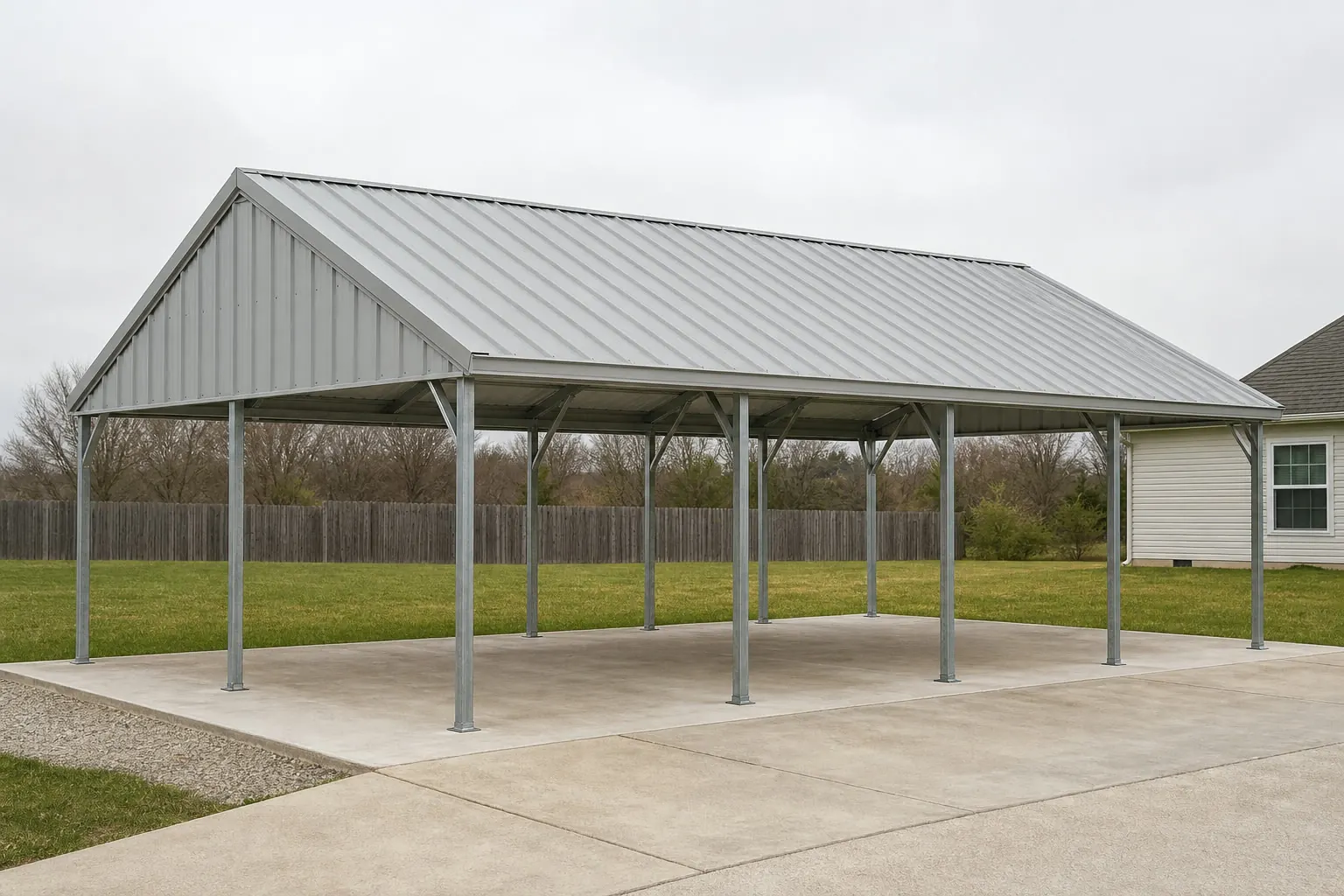
The intersection
Why an open carport gets extra attention in Florida
A carport's lack of walls means posts and footings carry proportionally more of the load story, in a state with the longest recorded hurricane history of any in the country.
NOAA's Hurricane Research Division tracks direct hurricane hits back to 1851, and in that dataset Florida leads every other U.S. state. That single fact does not tell a buyer what post spacing, footing depth or anchoring method their carport needs — this page is not an engineering document — but it is the reason a Florida carport plan benefits from an early conversation about anchoring rather than a late one, once materials are already ordered.
The Florida Building Commission administers one Florida Building Code across the state, which gives every carport buyer a consistent baseline framework. Inside that single code, though, is a named High-Velocity Hurricane Zone limited to Broward and Miami-Dade counties. That is a defined administrative boundary, not a wind number this page states, and it means the documentation and product-approval path a buyer in those two counties follows is genuinely different from the path followed in the other 65 counties, even though both fall under the same statewide code.
FEMA's National Risk Index separately scores communities, including Florida counties, across 18 defined hazard types — hurricane among them, alongside things like inland flooding and strong wind. Which of those 18 actually matter most for a given carport site is a county-level question this page does not answer; it is worth raising directly with your local building department when you apply for a permit.
Site conditions
Low ground and a shared aquifer change the footing conversation
Wind is not the only site factor; where the water sits below your parcel matters to a structure with concrete footings or a slab.
USGS mapping derived from digital elevation models highlights that large portions of Florida sit on low-lying ground, and the Floridan aquifer system — a principal USGS-studied aquifer covering roughly 100,000 square miles — underlies the entire state. Neither fact sets a specific footing depth or a flood-zone requirement; those come from your local building department and, where applicable, a floodplain administrator. What the combination does mean is that drainage around a carport's posts and slab, and how close the water table sits to grade on your specific parcel, are worth confirming before construction rather than assumed from a neighbor's project.
Because Florida's terrain and water-table conditions are not uniform county to county, a single statewide siting recommendation would understate the difference between, for example, a well-drained inland parcel and a coastal or low-lying one. Ask your builder and your local department how your specific site's conditions affect footing design.
Configuration
What a Florida carport is commonly asked to shelter
The right configuration follows what the carport protects and how exposed the site is, not budget alone.
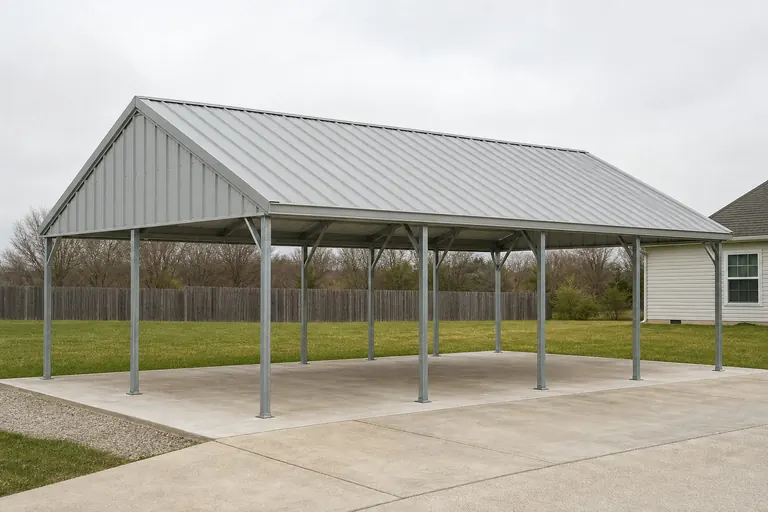 Single passenger vehicleThe smallest, least wind-sensitive footprint; still worth confirming anchoring with your local department on an open or coastal-adjacent lot.
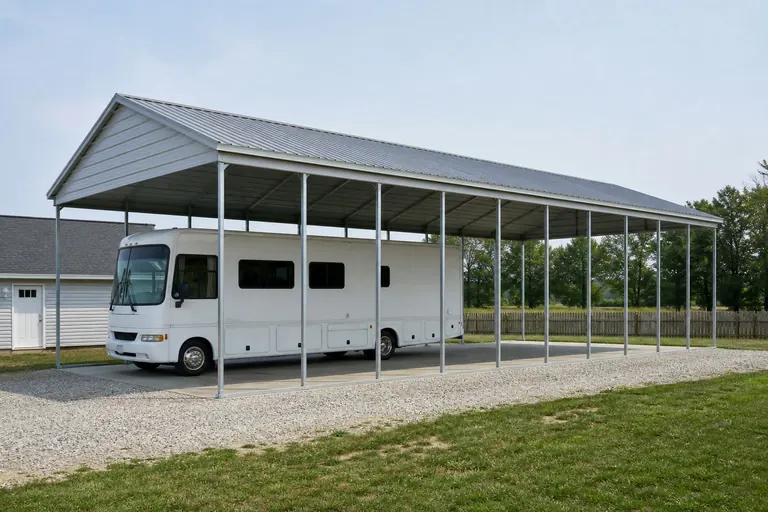 Boat or RV storageTaller clearance increases the roof plane's wind exposure; the dedicated RV carport guide covers that configuration in more depth.Farm or equipment storageOn Florida's larger agricultural parcels — the state's farms averaged 217 acres in the 2022 Census of Agriculture — an open equipment carport is a plausible accessory use alongside a residential one.
Example Configuration — for planning purposes only.
Get Florida carport quotes
Tell us your county, HVHZ status if known, and vehicle or equipment needs. We route it with the Florida and carport context already attached.
Footprint
Common Florida carport footprints
Size selection is primarily about vehicle or equipment count and clearance; wind and site siting are handled as separate anchoring decisions above.
20′ × 20′
400 sq ft
A single-vehicle footprint sized for one car or truck.
20′ × 30′
600 sq ft
Room for one vehicle plus storage along one side.
24′ × 36′
864 sq ft
A wider bay suited to a truck or a boat trailer.
30′ × 40′
1,200 sq ft
Multi-bay footprint for equipment or more than two vehicles.
Example Configuration — for planning purposes only.
Footprint pages carry post spacing and bay layout for each size; this page addresses only the Florida siting context.
Preparation
Before you request a Florida carport quote
Four steps that keep a hurricane-exposed, open structure from needing rework mid-project.
- Confirm whether your parcel sits in the HVHZBroward and Miami-Dade have a distinct product-approval documentation path under the Florida Building Code; ask your local building department which path applies to you.
- Ask about footing depth given local ground conditionsLow-lying terrain and a shallow water table in some areas make this a site-specific question, not a standard answer.
- Describe your site's exposure honestlyA coastal, open lot and a tree-sheltered inland lot are different wind environments even a short distance apart.
- Fix vehicle or equipment dimensions before orderingClearance height and bay count drive the footprint more than style preference, and getting this wrong is a common reorder reason.
Questions
Florida carport questions
Honest state-level answers, with anchoring, flood and permit specifics routed to the office that actually sets them.
Anchoring requirements follow the Florida Building Code and are confirmed by your local building department. Florida's recorded hurricane history is real, but specific anchoring values are not stated on this page — ask your department or a licensed contractor.
The HVHZ is a Florida Building Code-defined area covering Broward and Miami-Dade counties. If your parcel is inside it, expect a distinct product-approval documentation path; confirm the details with your county building department.
Requirements vary by jurisdiction even under the statewide code. Contact your local building department to confirm what applies to your structure and parcel.
It can. USGS mapping shows large low-lying portions of the state, and the Floridan aquifer underlies all of Florida, so footing depth and drainage are worth confirming with your builder and local department for your specific site.
We do not publish state-level prices. Cost depends on size, materials, site conditions and any HVHZ product-approval documentation. Our cost pages explain the drivers, and a builder quote covers your specific project.
Sources for the Florida facts on this page
This page states no code requirement, wind speed, snow load, permit rule, price or supplier claim. The state-specific facts it does use are listed with their publisher below.
NOAA's Hurricane Research Division records Florida as the U.S. state with the most historical hurricane direct hits/landfalls, based on the 1851-2018 dataset.
NOAA Atlantic Oceanographic and Meteorological Laboratory (AOML), Hurricane Research Division · 1851-2018 · Tier 1
https://www.aoml.noaa.gov/hrd/tcfaq/E19.htmlThe Florida Building Commission administers the Florida Building Code statewide.
Florida Building Commission · 8th Edition (2023), effective Dec 31, 2023 · Tier 2
https://www.floridabuilding.org/The Florida Building Code defines a High-Velocity Hurricane Zone (HVHZ) consisting of Broward and Miami-Dade counties.
Florida Building Commission (via UpCodes republication) · 2023 FBC, 8th edition · Tier 3
https://up.codes/d/high-velocity-hurricane-zone-hvhzUSGS mapping highlights that large portions of Florida are low-lying, derived from USGS digital elevation models.
U.S. Geological Survey · n/a (map publication) · Tier 2
https://pubs.usgs.gov/sim/3047/Land in farms in Florida totaled 9,701,400 acres in 2022.
USDA NASS · 2022 · Tier 1
https://www.nass.usda.gov/Publications/AgCensus/2022/Full_Report/Volume_1,_Chapter_1_State_Level/Florida/