
Carport · GA
Carports in Georgia
A carport is a simple, open-sided structure, but where it sits in Georgia changes the real planning questions. The New Georgia Encyclopedia describes the state as spanning five distinct physiographic provinces — the Appalachian Plateau, Valley and Ridge, Blue Ridge, Piedmont and Coastal Plain — so a carport pad in the north Georgia mountains and one on the humid Coastal Plain are not answering the same drainage or grading question. Georgia's local building permit offices authorized 63,621 new privately-owned housing units in 2023, the 5th-most of any state, which tells you local departments across the state process high volumes of residential work — but it does not tell you what any single office expects for an open accessory structure like a carport, since that is set office by office, not statewide.
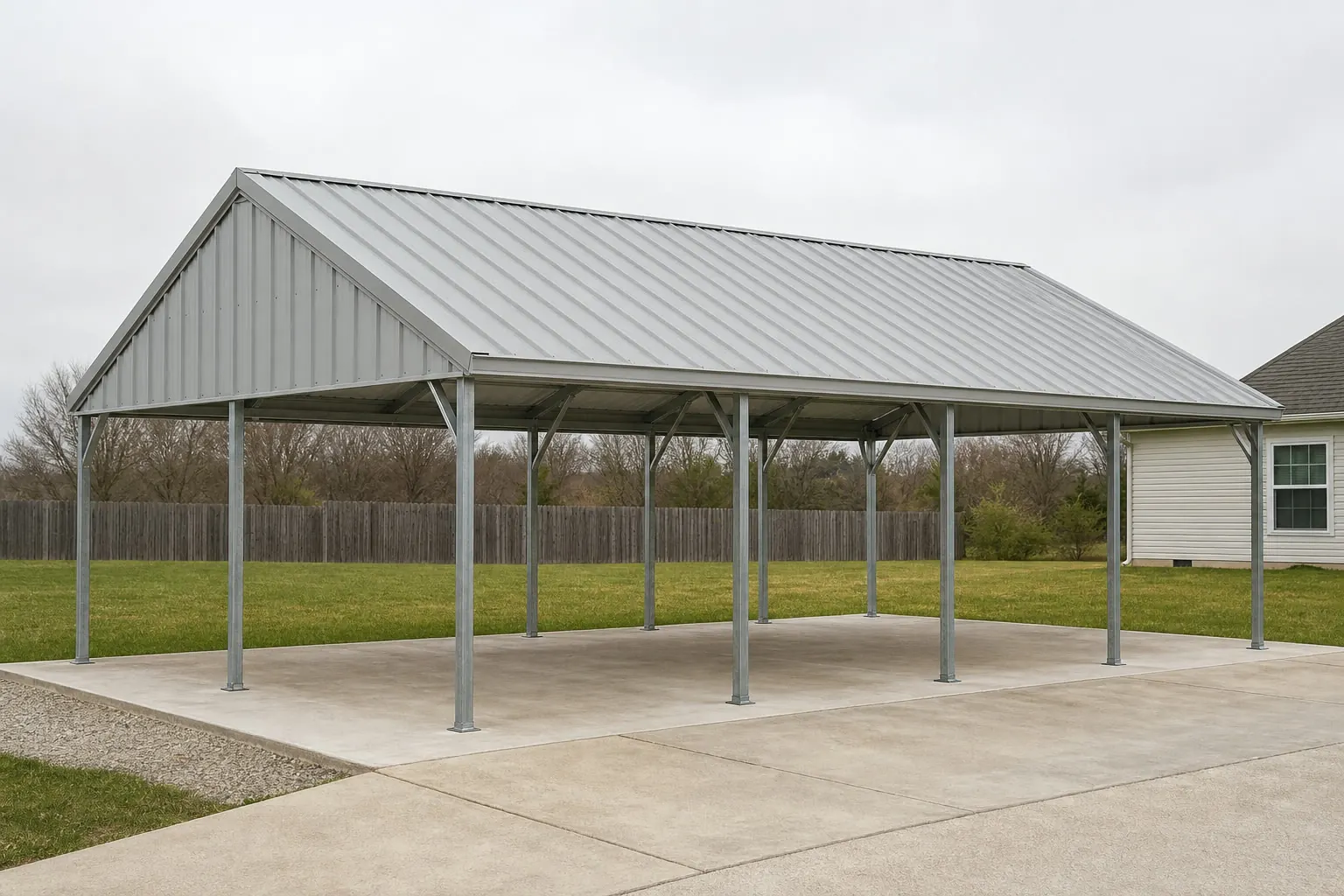
The intersection
Which of Georgia's five provinces the carport sits in matters first
An open structure's siting and drainage needs shift meaningfully across Georgia's mapped physiographic provinces.
The New Georgia Encyclopedia, citing University of Georgia geography scholarship, describes the state as encompassing parts of five distinct physiographic provinces: the Appalachian Plateau, the Valley and Ridge, the Blue Ridge, the Piedmont and the Coastal Plain. That is not trivia — a carport built in the Blue Ridge foothills is sited on sloped, often rocky ground where grading and drainage away from the slab are the first practical questions, while a Coastal Plain carport sits on flat, low-lying, often poorly-draining ground where standing water after heavy rain is the more likely concern.
The Georgia Environmental Protection Division's Geologic Survey goes further, mapping named sub-sections within these provinces, including the Lookout Mountain District in the state's northwest corner. The detail is worth knowing not because this page can tell you what your specific parcel needs structurally, but because it illustrates that even 'the Georgia mountains' is not one uniform siting condition — a site visit or a conversation with a local grading contractor matters more than a general regional label.
None of this changes the fact that permitting is a local matter. Georgia's local building permit offices authorized 63,621 new privately-owned housing units in 2023, ranking 5th among all states, which shows those offices handle substantial residential construction volume every year. It does not tell you what any specific office requires for an accessory structure like a carport — that is set jurisdiction by jurisdiction, and the only reliable way to know is to ask before you finalize a footprint or anchoring plan.
Humidity is the other quiet variable. Atlanta's Hartsfield-Jackson station recorded a 1991-2020 climate normal of about 50.4 inches of annual precipitation with roughly 2.2 inches of snow — a single-station figure, not a statewide average, but a fair proxy for the humid interior conditions many Georgia carport sites share. An open structure with metal posts and a roof but no walls still benefits from drainage planning and corrosion-aware fasteners in that kind of moisture environment, even though this page cannot assert a specific spec without a local engineer's input.
Site context
How Georgia's provinces change carport siting
Provincial terrain shapes the practical siting conversation more than the carport's design does.
Blue Ridge / Appalachian Plateau
Sloped, sometimes rocky ground in the north, where grading cost and access for delivery are the recurring planning items.
Valley and Ridge
Alternating ridgelines and valleys in the northwest, where a level pad may require more site prep than the carport footprint suggests.
Piedmont
Rolling clay-soil uplands across the state's middle, where drainage away from the slab is worth planning before a heavy rain season.
Coastal Plain
Flat, low-lying and often humid ground in south Georgia, where standing water and post corrosion protection are the practical concerns.
Siting
Provincial conditions to plan around in Georgia
General planning context only — not an engineering value or a code requirement.
| Province | Typical planning concern | Who confirms specifics |
|---|---|---|
| Blue Ridge / Appalachian Plateau | Slope grading and delivery access | Local building department / site contractor |
| Valley and Ridge | Level-pad preparation on uneven terrain | Local building department |
| Piedmont | Clay-soil drainage away from the slab | Local building department |
| Coastal Plain | Standing water and humid-air corrosion protection | Local building department |
Blue Ridge / Appalachian Plateau
- Typical planning concern
- Slope grading and delivery access
- Who confirms specifics
- Local building department / site contractor
Valley and Ridge
- Typical planning concern
- Level-pad preparation on uneven terrain
- Who confirms specifics
- Local building department
Piedmont
- Typical planning concern
- Clay-soil drainage away from the slab
- Who confirms specifics
- Local building department
Coastal Plain
- Typical planning concern
- Standing water and humid-air corrosion protection
- Who confirms specifics
- Local building department
Get Georgia carport quotes
Tell us your region, terrain and vehicle count. We route it with the Georgia and carport context already attached.
Configuration
What a Georgia carport is usually asked to shelter
Configuration should follow what the structure protects and the site's terrain, not budget alone.
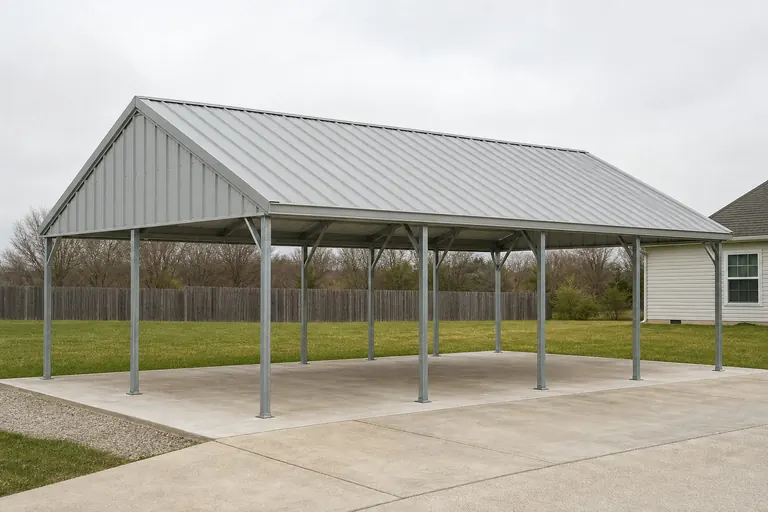 Single passenger vehicleThe smallest footprint, still worth confirming grading and drainage with the local department on a sloped or Coastal Plain site.
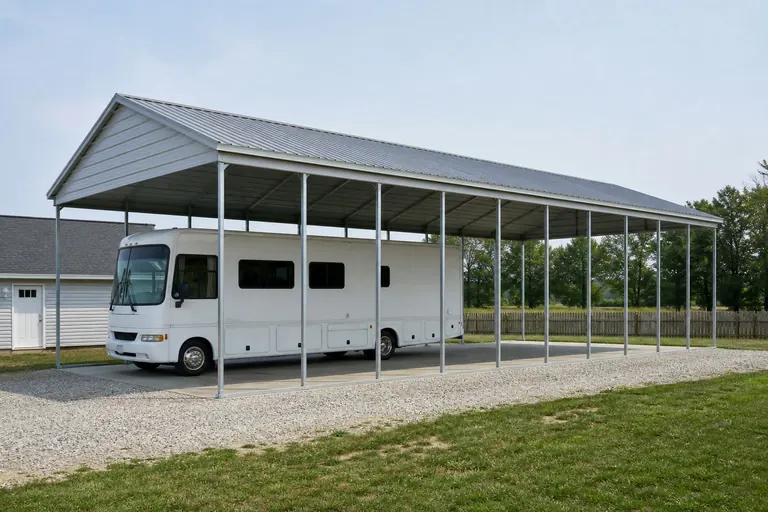 RV or boat storageTaller clearance changes the roof-plane exposure; this is covered in more depth on a dedicated RV-carport guide when available.
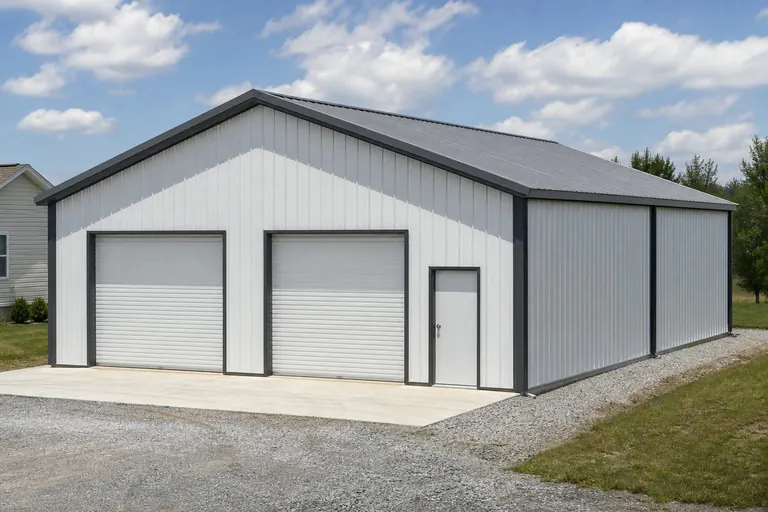 Multi-bay vehicle and equipmentWider spans put more roof area on fewer posts, which is exactly the detail a local reviewer will want addressed.
Example Configuration — for planning purposes only.
Footprint
Common Georgia carport footprints
Size selection is about vehicle count and clearance, with terrain handled as a siting decision rather than a size decision.
20′ × 20′
400 sq ft
A single-vehicle footprint sized for one car or truck.
20′ × 30′
600 sq ft
Room for one vehicle plus storage or a workbench along one side.
24′ × 40′
960 sq ft
A two-bay footprint suited to a truck and a second vehicle.
Example Configuration — for planning purposes only.
Footprint pages carry post spacing and bay layout for each size; this page explains only the Georgia siting context.
Preparation
Before you request a Georgia carport quote
Four steps that keep a simple structure from becoming a re-grading job mid-project.
Step 1
Ask your local building department about permit and setback rules
Requirements are set locally in Georgia, so confirm before ordering, and ask what documentation the office wants at inspection.
Step 2
Identify your parcel's physiographic province
Blue Ridge, Piedmont and Coastal Plain sites have different grading and drainage starting points, even for identical footprints.
Step 3
Plan drainage before the slab is poured
Standing water on Coastal Plain ground and runoff on sloped Blue Ridge ground are different problems that both need addressing up front.
Step 4
Confirm vehicle height and count before fixing dimensions
Clearance and bay count drive the footprint more than aesthetic preference.
Questions
Georgia carport questions
Honest state-level answers, with permit and engineering specifics routed to the authority that actually sets them.
Permit requirements are set by your local building department, not by a single statewide rule. Confirm with your city or county before finalizing your order.
Yes, in practical terms. Georgia spans five physiographic provinces from the Blue Ridge to the Coastal Plain, and grading and drainage needs differ across them, though the specific requirement for your site is a local determination.
Atlanta's climate normal shows a humid interior climate with roughly 50.4 inches of annual precipitation, which is a reasonable factor in drainage and corrosion-aware planning, though it is a single-station figure rather than a statewide guarantee.
We do not publish state-level prices. Cost depends on size, materials and site conditions; our cost pages explain the drivers and a builder quote covers your specific project.
There is no official typical size. 20x20 for a single vehicle and 24x40 for a two-bay layout are common starting points, but your vehicle count and clearance needs should set the final dimensions.
Sources for the Georgia facts on this page
This page states no code requirement, wind speed, snow load, permit rule, price or supplier claim. The state-specific facts it does use are listed with their publisher below.
The New Georgia Encyclopedia (citing University of Georgia geography scholarship) describes Georgia as encompassing parts of five distinct physiographic provinces: the Appalachian Plateau, the Valley and Ridge, the Blue Ridge, the Piedmont, and the Coastal Plain.
New Georgia Encyclopedia (University of Georgia Press / Georgia Humanities) · Reference overview · Tier 2
https://www.georgiaencyclopedia.org/articles/geography-environment/geographic-regions-of-georgia-overview/The Georgia Environmental Protection Division / Georgia Geologic Survey publishes a detailed physiographic map and regional descriptions of Georgia, including named sections such as the Lookout Mountain District of the Appalachian Plateau province in the state's northwest corner.
Georgia Environmental Protection Division, Georgia Geologic Survey · 1988 (state reference map) · Tier 2
https://epd.georgia.gov/document/publication/sm-4-physiographic-map-georgia-12000000-1988/downloadGeorgia local building permit offices authorized 63,621 new privately-owned housing units in 2023, ranking 5th among states, down from 77,542 units in 2022.
U.S. Census Bureau · 2023 (with 2022 comparison) · Tier 1
https://www.census.gov/construction/bps/pdf/2023annualhighlights.pdfAtlanta's (Hartsfield-Jackson) 1991-2020 annual climate normal precipitation is about 50.4 inches with roughly 2.2 inches of annual snowfall.
NOAA National Centers for Environmental Information (NCEI) · 1991-2020 · Tier 1
https://www.ncei.noaa.gov/access/services/data/v1?dataset=normals-monthly-1991-2020&dataTypes=MLY-PRCP-NORMAL,MLY-SNOW-NORMAL&format=csv&stations=USW00013874FEMA's National Risk Index platform (hazards.fema.gov) is the authoritative county/tract-level source for Georgia natural hazard exposure scores across 18 hazard types.
Federal Emergency Management Agency (FEMA) · Current NRI dataset · Tier 1
https://www.fema.gov/flood-maps/products-tools/national-risk-indexGeorgia's total land area was measured at 57,513.5 square miles as of the 2010 Census, the 21st largest of any U.S. state.
U.S. Census Bureau · 2010 Census · Tier 1
https://www.census.gov/geographies/reference-files/2010/geo/state-local-geo-guides-2010/georgia.html