
Carport · NV
Carports in Nevada
Nevada is the driest state in the country according to NOAA's own State Climate Summary, but 'dry' does not mean 'the same everywhere.' The two long-record NOAA stations that anchor the state's climate data tell almost opposite stories: Las Vegas McCarran averages just 4.18 inches of precipitation and 0.2 inches of snow a year, while Reno-Tahoe averages 7.35 inches of precipitation and 20.9 inches of snow — a divide the Nevada State Climate Office attributes to the Sierra Nevada wringing moisture from Pacific storms before it reaches the south. For a carport, which has no walls to buffer either sun or snow, that split changes the real conversation: shade and heat management dominate in the south, while snow shedding off an open roof deserves more thought in the north. Add Nevada's average farm size of 1,889 acres, among the largest in the country, and it's clear many Nevada carports sit on wide-open, genuinely exposed land rather than a tight suburban lot.
Climate Reality
Driest State, Two Very Different Stations
NOAA calls Nevada the driest state in the country, but its two long-record stations tell almost opposite stories about precipitation and snow.
NOAA's State Climate Summaries 2022 names Nevada the driest state in the United States. That's true on average, but the state's own two reference stations show how unevenly that dryness is distributed: Las Vegas McCarran's 1991-2020 normal is about 4.18 inches of precipitation and just 0.2 inches of snow a year, while Reno-Tahoe's normal is about 7.35 inches of precipitation and 20.9 inches of snow — nearly two feet of snow in an average year. The Nevada State Climate Office attributes that split to the Sierra Nevada wringing moisture out of Pacific storms before they can reach the south, while the Rocky Mountains block Gulf of Mexico moisture from reaching the state at all.
For a carport — a structure with no walls to buffer either condition — that divide is the real design conversation. A southern Nevada carport is mostly a heat and sun-exposure project: shade orientation and material choice for a roof baking under direct desert sun for much of the year. A northern Nevada carport, especially near Reno or into the Sierra foothills, is more of a snow-shedding project, where roof pitch and load deserve a conversation with a local engineer rather than an assumption borrowed from the desert south.
Site Selection
Where Your Site Sits Changes the Conversation
A brief, honest note for each broad Nevada region — none of these are design values.
Southern Nevada (Las Vegas area)
Very low precipitation and negligible snow; heat and UV exposure on an open roof are the more relevant siting questions than snow load.
Northern Nevada (Reno-Tahoe area)
Meaningfully wetter and snowier than the south; ask a local engineer about roof pitch and snow-shedding for an open-sided structure.
Rural interior parcels
With farms averaging 1,889 acres and pastureland covering roughly 4.82 million of the state's farm acreage, many sites are remote with little natural windbreak, making orientation to the prevailing wind a free design decision worth making early.
State Reference
Nevada Figures Behind This Page
Sourced figures only; none of these implies a specific design value.
| Metric | Value | Source |
|---|---|---|
| Las Vegas annual normal | 4.18 in precip / 0.2 in snow | NOAA NCEI, 1991-2020 |
| Reno annual normal | 7.35 in precip / 20.9 in snow | NOAA NCEI, 1991-2020 |
| Statewide warming since ~1900 | +2.4°F | NOAA State Climate Summaries 2022 |
| Average farm size (2022) | 1,889 acres | USDA NASS |
| Housing units authorized (2024) | 19,994 | U.S. Census Bureau |
Las Vegas annual normal
- Value
- 4.18 in precip / 0.2 in snow
- Source
- NOAA NCEI, 1991-2020
Reno annual normal
- Value
- 7.35 in precip / 20.9 in snow
- Source
- NOAA NCEI, 1991-2020
Statewide warming since ~1900
- Value
- +2.4°F
- Source
- NOAA State Climate Summaries 2022
Average farm size (2022)
- Value
- 1,889 acres
- Source
- USDA NASS
Housing units authorized (2024)
- Value
- 19,994
- Source
- U.S. Census Bureau
Plan Your Nevada Carport
Tell us whether your site is closer to the southern desert or the Sierra foothills, and we'll route the right siting questions to you.
Scale and Exposure
Building on Nevada's Wide-Open Land
At 1,889 acres average, among the largest farm sizes in the country, many rural Nevada carports sit on land with no adjacent structure for wind or sun protection.
Nevada's 3,122 farms in 2022 covered 5,896,654 acres, averaging 1,889 acres each — a scale driven largely by the 4,819,992 acres of pastureland in that total. On that kind of ground, the nearest barn, home, or tree line may be a considerable distance from where a carport actually needs to sit, often near a driveway, a well, or a working area rather than beside another building.
That absence of a natural windbreak or shade source makes orientation decisions carry more weight than they would on a tighter suburban lot. Facing the open bay away from prevailing wind, and thinking through which side of the structure gets the most direct summer sun in southern Nevada, are both free decisions if made before the foundation is set. Confirm with the local building department whether any agricultural-use exemption or setback rule applies on rural or agriculturally zoned land.
- Orient for wind, not just looks
- Without a nearby windbreak, decide which way the open bay faces before you decide on size.
- Plan for sun in southern Nevada
- Shade orientation matters more than snow load for most Las Vegas-area sites.
- Plan for snow in northern Nevada
- Ask a local engineer about roof pitch near Reno and the Sierra foothills.
Configurations
Carport Configurations Common to Nevada Sites
Three configurations that respond to the climate divide and parcel scale above.
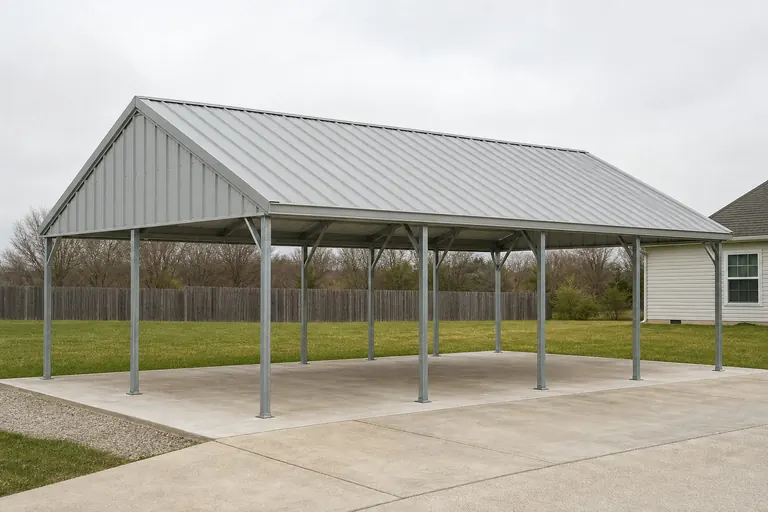 Desert Shade CarportOriented for sun and heat management, suited to Las Vegas-area properties with minimal snow exposure.Sierra-Adjacent CarportSteeper roof pitch and a conversation with a local engineer about snow, given Reno's much higher snowfall normal.Rural Ranch CarportA stand-alone structure sized and oriented for exposed, windbreak-free land on large Nevada parcels.
Example Configuration — for planning purposes only.
Footprint
Common Nevada Carport Footprints
A starting range before a site-specific plan accounts for your region and exposure.
18′ × 20′
360 sq ft
A compact single-vehicle carport for an urban or suburban lot.
20′ × 30′
600 sq ft
Room for a vehicle plus general storage on a standard rural parcel.
24′ × 40′
960 sq ft
A longer bay suited to trucks, trailers, or ranch equipment.
Example Configuration — for planning purposes only.
Confirm any local snow-load, wind, or setback requirement with your building department before finalizing a size.
Questions
Nevada Carport Questions
Honest answers, with technical or local specifics routed to the right office.
Not necessarily. NOAA's 1991-2020 normal for Reno shows about 20.9 inches of annual snowfall, versus just 0.2 inches in Las Vegas. If your site is in northern Nevada or near the Sierra foothills, ask a local engineer about roof pitch and snow load rather than relying on the statewide dryness label.
The Nevada State Climate Office explains that the Sierra Nevada wrings moisture out of Pacific storms before they reach the south, while the Rocky Mountains block Gulf of Mexico moisture, producing a rain-shadow effect across the state.
On many rural Nevada parcels, where farms average 1,889 acres, a carport is more often a stand-alone structure sited near a driveway or working area than an attachment to the home, though attached residential carports are also common in Nevada's cities.
Use FEMA's National Risk Index (hazards.fema.gov) for county-level hazard scoring rather than relying on a general statewide claim; this page's own evidence pack could not directly retrieve FEMA's state-level narrative for Nevada in this session.
Nevada authorized 19,994 new housing units in 2024, per the Census Bureau's Building Permits Survey, which reflects a base of ongoing residential construction; many carports are added during or shortly after new-home building, but confirm your own permit timeline with your local building department.
Sources for the Nevada facts on this page
This page states no code requirement, wind speed, snow load, permit rule, price or supplier claim. The state-specific facts it does use are listed with their publisher below.
Las Vegas McCarran station 1991-2020 annual normal precipitation is 4.18 inches with 0.2 inches of annual snowfall.
NOAA National Centers for Environmental Information (NCEI) · 1991-2020 · Tier 1
https://www.ncei.noaa.gov/access/services/data/v1?dataset=normals-annualseasonal-1991-2020&dataTypes=ANN-PRCP-NORMAL,ANN-SNOW-NORMAL&stations=USW00023169&format=jsonReno International Airport station 1991-2020 annual normal precipitation is 7.35 inches with 20.9 inches of annual snowfall, illustrating Nevada's sharp north-south climate divide.
NOAA National Centers for Environmental Information (NCEI) · 1991-2020 · Tier 1
https://www.ncei.noaa.gov/access/services/data/v1?dataset=normals-annualseasonal-1991-2020&dataTypes=ANN-PRCP-NORMAL,ANN-SNOW-NORMAL&stations=USW00023185&format=jsonNOAA's State Climate Summaries 2022 states Nevada is the driest state in the United States, with temperatures having risen almost 2.4°F since the beginning of the 20th century.
NOAA National Centers for Environmental Information (NCEI) · State Climate Summaries 2022 · Tier 1
https://statesummaries.ncics.org/chapter/nv/Nevada had 5,896,654 acres of land in farms in 2022, an average farm size of 1,889 acres, among the largest average farm sizes in the country.
USDA NASS · 2022 · Tier 1
https://www.nass.usda.gov/Publications/AgCensus/2022/Online_Resources/County_Profiles/Nevada/cp99032.pdfThe Nevada State Climate Office (University of Nevada, Reno) explains the Sierra Nevada wrings moisture from Pacific storms while the Rocky Mountains block Gulf of Mexico moisture, and the resulting dry air contributes to Nevada's extreme temperature swings.
Nevada State Climate Office, University of Nevada, Reno · Extension reference page · Tier 2
https://www.unr.edu/nevada-climate-office/about-our-climateLocal building permit offices in Nevada authorized 19,994 new privately-owned housing units in 2024.
U.S. Census Bureau · 2024 (full calendar year) · Tier 1
https://www.census.gov/construction/bps/stateannual.html