
Steel home · AZ
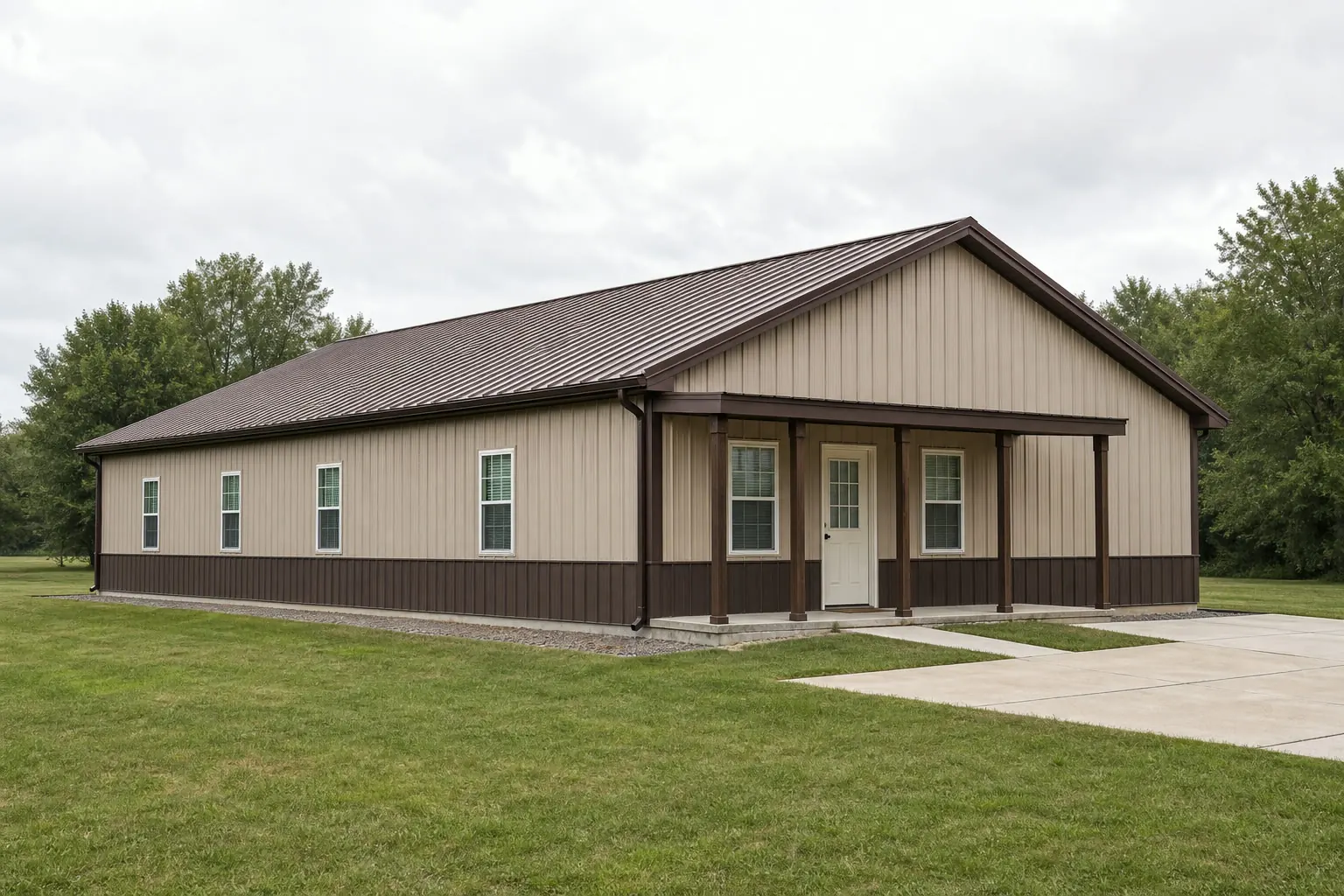
Steel Homes in Arizona
A residential steel build in Arizona starts with a jurisdiction question rather than a climate question. UpCodes documents that Arizona has no single statewide building-code agency for a structure like a home; construction codes are adopted and enforced locally by cities and counties, with only the Fire Code applied uniformly statewide, and Arizona Revised Statutes confirm that counties adopt codes by reference under their own authority. Layer that onto Congressional Research Service data showing roughly 28.1 million of Arizona's approximately 34.4 million acres are federally owned, plus more than 9 million surface acres held as Arizona State Trust land — a combination that makes land jurisdiction and access questions unusually central before a steel home design even starts. The monsoon's fixed June 15 to September 30 calendar window then shapes when to schedule exterior work and anchoring checks once the site question is settled.
The dividing line
Arizona sends residential code questions to the local level, not a state office
There is no single statewide building-code agency to check for a steel home in Arizona; the review path is set by whichever city or county covers the parcel.
UpCodes documents that Arizona building codes are governed at the local jurisdiction level rather than by one statewide building-code agency, and that the state's uniform statewide code adoption applies only to the Fire Code. For a residential steel build, that means there is no single Arizona rulebook to reference before drawings start — the applicable code edition, plan review process and inspection sequence come from the city or county building department covering the parcel.
Arizona Revised Statutes back this up directly: A.R.S. §11-861 addresses how counties adopt construction codes by reference, confirming that code adoption for a residential structure is a county-level function under the state's own statutory framework, not a statewide default. Practically, that means a buyer comparing two Arizona counties for a steel home site should expect the permit sequence, not just the price of land, to differ.
This page does not assign a code edition, wind design value or engineering requirement to any Arizona location — those come from the local building department and the project's engineer of record, based on the specific parcel.
Process
How the planning conversation differs by Arizona site type
Locally set codes and land-ownership context change the starting point depending on where the parcel sits.
| Planning question | Rural / land-adjacent site | Urban or suburban site |
|---|---|---|
| Who to contact first | County building department, plus land-status check if near federal or trust land | City building department for standard residential permit review |
| Utilities | Well, septic and longer service runs are common on large rural holdings | Typically connected to municipal utilities |
| Access | Confirm delivery route and any easement across federal or trust land boundaries | Standard residential street access |
| Seasonal timing | Schedule exterior work and anchoring checks around the June 15 to September 30 monsoon window | Same monsoon window applies, with less land-access complexity |
Who to contact first
- Rural / land-adjacent site
- County building department, plus land-status check if near federal or trust land
- Urban or suburban site
- City building department for standard residential permit review
Utilities
- Rural / land-adjacent site
- Well, septic and longer service runs are common on large rural holdings
- Urban or suburban site
- Typically connected to municipal utilities
Access
- Rural / land-adjacent site
- Confirm delivery route and any easement across federal or trust land boundaries
- Urban or suburban site
- Standard residential street access
Seasonal timing
- Rural / land-adjacent site
- Schedule exterior work and anchoring checks around the June 15 to September 30 monsoon window
- Urban or suburban site
- Same monsoon window applies, with less land-access complexity
Land
Arizona's land ownership pattern shapes where a steel home sits
Federal and State Trust acreage cover a large share of Arizona, which makes jurisdiction and access questions more central here than in states with mostly private land.
Federal land-adjacent parcels
CRS data lists roughly 28.1 million federal acres of Arizona's approximately 34.4 million total acres (2013 figures); confirm access easements and utility routing early for parcels bordering public land.
State Trust land boundaries
The Arizona State Land Department reports more than 9 million surface acres of State Trust land, about 13% of the state's surface area, governed by its own leasing framework distinct from private ownership.
Large rural agricultural holdings
The 2022 Census of Agriculture recorded an average Arizona farm size of 1,528 acres; a residential steel build on this scale of land typically needs its own well, septic and service-run plan.
Established metro and suburban parcels
The most straightforward case: standard city permit review with municipal utilities already in place and no adjacent federal or trust-land question to resolve.
Get Arizona steel home quotes
Tell us your county, whether the parcel borders federal or State Trust land, and the living area you have in mind. We pass the Arizona context through with the enquiry.
Timing
The monsoon calendar is a scheduling tool, not a design spec
Arizona's fixed monsoon window is most useful for sequencing exterior construction and anchoring checks around a known date range.
The National Weather Service defines the North American Monsoon in Arizona as running from June 15 through September 30 each year — a calendar definition rather than a rainfall-triggered event. For a residential steel build, that fixed window is a practical scheduling anchor: exterior work, roof attachment and site grading are worth completing or inspecting ahead of June 15 where the construction timeline allows it, rather than mid-window.
This page does not assert a wind speed, snow load or seismic value for any Arizona site — those figures depend on your exact parcel and are set by your engineer of record and local building department. What is fair to say is that scheduling around a documented, fixed seasonal window is a reasonable planning step regardless of the specific engineering numbers involved.
- Sequence exterior work around June 15
- Where the build timeline allows it, target exterior completion before the monsoon window opens.
- Confirm land status before design
- Federal or State Trust land adjacency can affect access and utility planning well before construction starts.
- Ask your county about its specific code path
- Arizona's locally adopted codes mean the review sequence is set by your specific jurisdiction.
Footprint
Footprints that suit an Arizona residential brief
Single-level living with an efficient footprint is a common driver across Arizona's metro and rural sites alike.
30′ × 60′
1,800 sq ft
A common single-level layout with room for three defined zones along the length.
40′ × 60′
2,400 sq ft
Adds width for a genuinely open central living area rather than a corridor plan.
30′ × 70′
2,100 sq ft
Length instead of width where the site favors a long, narrow building footprint.
40′ × 80′
3,200 sq ft
Where the brief includes an attached shop or garage bay under the same roofline.
Example Configuration — for planning purposes only.
Each footprint page carries layout detail; this page only explains why an Arizona brief lands in this range.
Sequence
The order to do things in Arizona
Getting the order right matters more here than in states with a single statewide code to reference.
Step 1
Confirm your specific city or county's code adoption and process
Arizona has no single statewide building-code agency; the applicable path comes from your local jurisdiction.
Step 2
Check land status if near federal or trust land
Access easements, utility routing and leasing rules differ from standard private-parcel permitting.
Step 3
Plan utilities alongside the building on rural acreage
Well, septic and service connection routinely set the schedule on larger parcels, and Arizona's average farm size of 1,528 acres suggests this is common, not rare.
Step 4
Sequence exterior work around the monsoon calendar
June 15 to September 30 is the defined window; complete or inspect exterior work ahead of it where possible.
Step 5
Decide house versus shop-house before drawings
A steel home and a combined living-and-workshop building diverge early; choosing late is the expensive version.
Questions
Arizona steel home questions
What we can answer at state level, and where the rest properly belongs.
No single statewide building-code agency covers residential construction; UpCodes documents that Arizona codes are adopted and enforced locally by city and county building departments, with only the Fire Code applied uniformly statewide.
Roughly 28.1 million of Arizona's approximately 34.4 million acres are federally owned, and more than 9 million more surface acres are State Trust land. Parcels near those boundaries can involve additional access, easement or leasing questions before standard residential permitting even applies.
It's a reasonable idea for exterior work: the monsoon runs on a fixed June 15 to September 30 calendar window per the National Weather Service, so completing or inspecting exterior work ahead of that date range is a practical scheduling step.
It can be, and it's common: the 2022 Census of Agriculture recorded an average Arizona farm size of 1,528 acres. On that scale, well, septic and service-run planning typically drive the schedule more than the building itself.
We do not publish state-level home prices. A steel home's cost depends heavily on interior finish level and site conditions, which is why a statewide number would mislead. Our cost pages explain the drivers; a quote reflects your specification.
Not quite. A barndominium brief usually combines living space with a working shop or storage area under one roof. If that describes your project, the barndominium pages are the better starting point.
Sources for the Arizona facts on this page
This page states no code requirement, wind speed, snow load, permit rule, price or supplier claim. The state-specific facts it does use are listed with their publisher below.
Arizona building codes are governed at the local jurisdiction level rather than by a single statewide building code agency; the state's uniform statewide adoption applies only to the Fire Code.
UpCodes (citing Arizona State Fire Marshal statewide fire code adoption) · current, accessed 2024/2025 · Tier 3
https://up.codes/codes/arizonaArizona Revised Statutes govern how counties and municipalities adopt construction codes by reference, confirming code adoption is a local government function.
Arizona State Legislature · current statute text · Tier 2
https://www.azleg.gov/ars/11/00861.htmCRS's federal land ownership dataset lists Arizona federal acreage at roughly 28.1 million acres (2013 data) against total state acreage of approximately 34.4 million acres.
Congressional Research Service · data as of FY2013, report dated March 3, 2017 · Tier 1
https://www.everycrsreport.com/files/20170303_R42346_95ce191e74ed8e08054bb5476971544bc55823f2.htmlArizona has more than 9 million surface acres of State Trust land, about 13% of the state's total surface land ownership.
Arizona State Land Department · current, accessed 2024 · Tier 2
https://land.az.gov/our-agency-missionAverage Arizona farm size in the 2022 Census was 1,528 acres, up about 12% from 2017.
USDA NASS · 2022 · Tier 1
https://www.nass.usda.gov/Publications/AgCensus/2022/Online_Resources/County_Profiles/Arizona/cp99004.pdfThe North American Monsoon in Arizona runs from June 15 to September 30 each year (a fixed calendar definition, not a rainfall trigger).
NOAA/National Weather Service (Tucson office) · current/ongoing definition · Tier 1
https://www.weather.gov/media/twc/Monsoon.pdf