
Barndominium · NC
Barndominiums in North Carolina
North Carolina does not have one barndominium climate — it has three. NOAA NCEI's own narrative of the state's climate tracks a progression from the Atlantic coastal plain, through the Piedmont, into the Appalachian mountains in the west, and a barndominium built near Wilmington answers to a different set of pressures than one built near Asheville. Layer in a documented, year-to-year variable exposure to landfalling hurricanes and a farm base of 42,817 operations averaging 190 acres each, and the real planning question for a North Carolina barndominium becomes where on that coast-to-mountain line your site sits, and what that placement does to your foundation, envelope and storm posture.
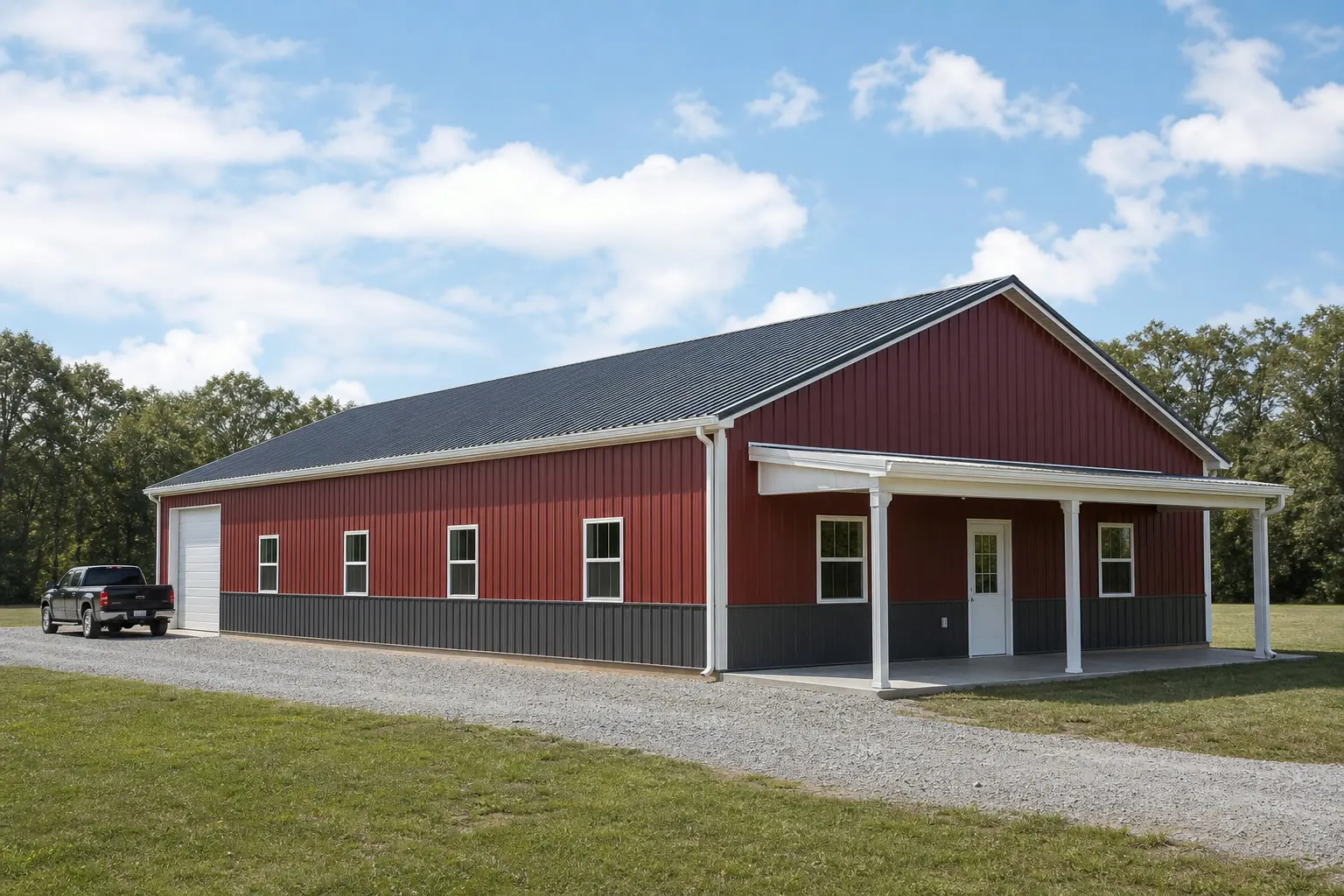
Reading the Map First
One state, three barndominium climates
North Carolina's documented coastal-plain-to-mountain progression means the first planning decision is not floor plan — it's which of the three zones your lot sits in.
Most barndominium marketing treats a state as one climate. NOAA's own descriptive narrative of North Carolina's climate refuses to do that: it explicitly tracks a progression from the Atlantic coastal plain, through the Piedmont, and up into the Appalachian mountains in the west. That progression is not scenery — it is the reason two barndominiums built 250 miles apart inside the same state need different roof pitches, different vapor-drive assumptions, and different foundation depths.
A barndominium near the coast is fighting salt-laden, humid air and storm exposure. One in the Piedmont is contending with clay soils and a more moderate but still humid summer. One in the western mountains is dealing with steeper terrain, colder winters, and a heating season that a coastal buyer never budgets for. None of this is a reason to avoid the state — it's a reason to stop treating 'North Carolina barndominium' as a single spec.
This is why the honest first conversation with a builder or engineer is about province and county, not square footage. Get that right, and every downstream decision — slab design, insulation package, window rating — follows logically instead of being guessed at.
Site Conditions
Foundation and siting by physiographic province
USGS mapping identifies three physiographic provinces across North Carolina, each with a distinct geologic setting that affects how a barndominium foundation should be engineered.
Coastal Plain
Sandy, often higher-water-table soils near the coast call for a site-specific evaluation before committing to a standard slab; combined with the state's documented but variable hurricane exposure, elevation and drainage detailing deserve early attention, not late-stage retrofitting.
Piedmont
The rolling Piedmont's clay-heavy soils behave differently than coastal sand, and USGS research treats it as a distinct geologic setting from the Coastal Plain; a geotechnical evaluation here focuses on soil movement and drainage around the slab perimeter rather than storm surge.
Blue Ridge (Mountains)
Western sites bring steeper grades and a cooler climate; site work often centers on grading a level pad and orienting the building envelope for a longer heating season rather than the ventilation-first thinking that dominates coastal planning.
Storm Exposure
Designing the envelope around a variable hurricane season
NOAA describes North Carolina's landfalling hurricane count as highly variable, which is a planning argument for building to the severe season, not the typical one.
A barndominium is a full-time residence, which raises the stakes of storm exposure well above what an unoccupied outbuilding faces. NOAA's state climate summary is explicit that the number of hurricanes making landfall in North Carolina swings widely from year to year, and that storm intensity and rainfall rates associated with these systems are projected to increase over time. That variability is precisely why coastal-plain and near-coastal barndominium owners should not design around a 'normal' year.
In practice, that means treating engineered roof-to-wall connections, documented fastener schedules, and window/door impact ratings as core decisions for any coastal-plain or near-coastal build, confirmed against your county's adopted requirements rather than assumed from a neighboring state's practice. Moving inland toward the Piedmont, wind exposure typically eases but heavy-rain drainage around the foundation remains a live concern given the same storm systems can still deliver significant inland rainfall.
- Confirm wind design locally
- Wind design requirements vary by county and jurisdiction in North Carolina; confirm the applicable standard with your local building department rather than assuming a statewide figure.
- Document connections
- Ask for written confirmation of roof-to-wall and wall-to-foundation connection specs, especially for coastal-plain and near-coastal builds.
- Plan for inland rainfall
- Even Piedmont and mountain sites should plan drainage around storm systems that retain heavy rainfall well after landfall.
Start your North Carolina barndominium project
Get connected with builders who can plan around your specific coastal-plain, Piedmont, or mountain site conditions.
Application
How North Carolina owners are using barndominiums
The state's large average farm parcel size supports a range of combined living-and-working layouts.
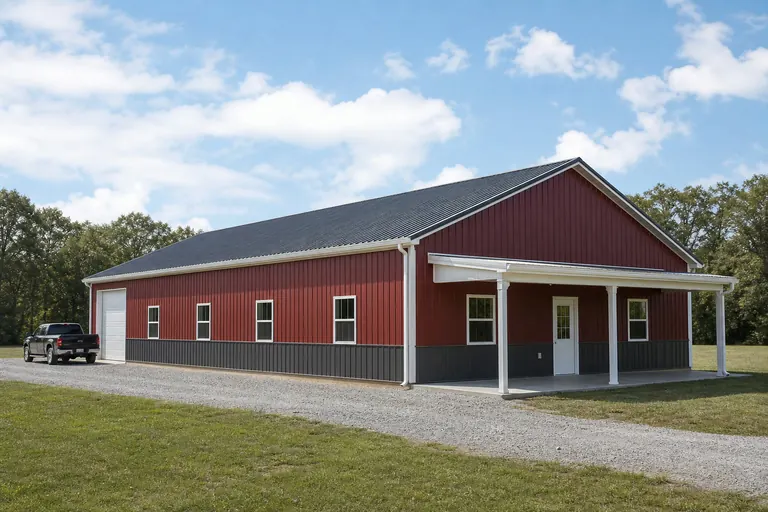 The Working HomesteadA residence attached to equipment and livestock space, sized to North Carolina's 190-acre average farm parcel and the equipment that comes with it.The Mountain RetreatA smaller-footprint, heavily-insulated build in the western Blue Ridge province, oriented for a longer heating season and steeper site grading.The Coastal-Plain Primary HomeA residence engineered around documented hurricane variability, with elevated detailing and confirmed wind connections appropriate to the county.
Example Configuration — for planning purposes only.
Utilities & Site Prep
Well, septic and groundwater planning for a full-time residence
Because a barndominium is lived in daily, water and waste planning carries more weight here than it would for an outbuilding.
- Verify groundwater dependence locallyNC State Extension notes that more than half of North Carolina's population depends on groundwater for drinking water; confirm with your county health department whether your site requires a new well and its required setback from any septic field.
- Size septic to the whole householdA barndominium's bedroom and bathroom count, not just its footprint, drives septic system sizing; get this confirmed by the local environmental health office before finalizing the floor plan.
- Check county farm/agricultural building rules against residential useBecause North Carolina's rural parcels often carry existing agricultural exemptions, confirm with your county building department whether a residential barndominium on a farm parcel triggers different permitting than a purely agricultural structure.
- Plan drainage around the whole pad, not just the foundationWhichever physiographic province you're in, grade the full building pad — not just the footprint — to shed water away from the structure before backfilling.
Questions
North Carolina Barndominium FAQ
Direct answers for buyers weighing a residential steel build across North Carolina's varied geography.
Yes, in practice. Coastal-plain and near-coastal counties carry documented but variable hurricane exposure, which typically drives stronger roof-to-wall connections and impact-rated openings. Confirm the specific requirements with your county building department, since they vary by jurisdiction.
Often, yes — North Carolina has a large base of working farms averaging 190 acres, and many owners integrate a residence with shop or livestock space. Whether the residence triggers different permitting than a purely agricultural structure depends on your county, so check before finalizing plans.
No. USGS research treats the Coastal Plain, Piedmont, and Blue Ridge as distinct physiographic provinces with different geologic settings. A foundation plan appropriate for sandy coastal soil should not be assumed to work in Piedmont clay or mountain terrain without a site-specific geotechnical evaluation.
Many rural North Carolina parcels require both, particularly since over half the state's population relies on groundwater. Contact your county environmental health office early, since well and septic siting can constrain where the building itself can go.
Start with your local building department for adopted wind design requirements, and pull FEMA's National Risk Index report for your specific county to see its rated exposure across the 18 hazard types FEMA tracks. Avoid relying on statewide generalizations for either figure.
Sources for the North Carolina facts on this page
This page states no code requirement, wind speed, snow load, permit rule, price or supplier claim. The state-specific facts it does use are listed with their publisher below.
NOAA NCEI publishes a narrative 'Climate of North Carolina' describing the state's climate progression from the Atlantic coastal plain through the Piedmont to the Appalachian mountains in the west.
NOAA National Centers for Environmental Information (NCEI) · Historical narrative (NCEI climate normals series) · Tier 1
https://www.ncei.noaa.gov/data/climate-normals-deprecated/access/clim60/states/Clim_NC_01.pdfNOAA's State Climate Summaries note that the number of landfalling hurricanes in North Carolina is highly variable year to year, and hurricane-associated storm intensity and rainfall rates are projected to increase.
NOAA National Centers for Environmental Information (NCEI) · 2022 summary · Tier 1
https://statesummaries.ncics.org/downloads/NorthCarolina-StateClimateSummary2022.pdfNorth Carolina had 42,817 farms in 2022, down 8% since 2017.
USDA National Agricultural Statistics Service (NASS) · 2022 · Tier 1
https://www.nass.usda.gov/Publications/AgCensus/2022/Online_Resources/County_Profiles/North_Carolina/cp99037.pdfNorth Carolina had 8,128,136 acres of land in farms in 2022, an average farm size of 190 acres.
USDA NASS · 2022 · Tier 1
https://www.nass.usda.gov/Publications/AgCensus/2022/Online_Resources/County_Profiles/North_Carolina/cp99037.pdfUSGS-affiliated research (e.g., Scientific Investigations Report 2009-5149) characterizes North Carolina's Piedmont and Blue Ridge physiographic provinces, distinct from the state's Atlantic Coastal Plain province, based on differing regional geologic settings.
U.S. Geological Survey (USGS) · 2009 USGS report · Tier 1
https://pubs.usgs.gov/sir/2009/5149/FEMA's National Risk Index is the authoritative source for county- and state-level natural hazard exposure ratings across 18 hazard types, viewable via FEMA's own interactive report tool.
Federal Emergency Management Agency (FEMA) · Current NRI release · Tier 1
https://www.fema.gov/flood-maps/products-tools/national-risk-index