
Barndominium · GA
Barndominiums in Georgia
Georgia's 57,513.5 square miles stretch across five distinct physiographic provinces, so a barndominium plan that works on the Coastal Plain rarely transfers unchanged to the Blue Ridge foothills. With 39,264 farms averaging 253 acres apiece, Georgia barndominium buyers frequently have the acreage to combine a full residence with a working shop or equipment bay under one steel roof. The honest planning question in Georgia is never a generic 'how big should it be' but 'which province is this lot in, and what does that terrain and climate change about the foundation, ventilation, and layout?'
The Georgia Context
Why a barndominium fits Georgia's working land
Georgia's mix of large farm tracts and a fast-growing residential permit volume makes barndominiums a practical middle ground between a farmhouse and a shop building.
In Georgia, a barndominium usually starts as a land-use decision before it becomes an architectural one. With 39,264 farms covering close to 10 million acres statewide, many owners already have the acreage to justify a combined home-and-shop structure rather than two separate buildings. The 253-acre average farm size, which grew even as the number of farms declined between 2017 and 2022, points to fewer but larger operations — exactly the kind of property where a steel barndominium's shop bay earns its keep housing tractors, trailers, or a small herd's feed.
Georgia's steady residential construction pace, with 63,621 units authorized in 2023 alone, means local building departments across the state process a high volume of standard residential permit applications every year. A barndominium filed as a primary residence should expect the same inspection sequence as any custom home: footing, framing, rough-in, and final — it is the site and foundation work that varies by province, not the permit process itself.
The bigger variable is where in Georgia the lot sits. The state's five physiographic provinces run from the Appalachian Plateau in the extreme northwest corner down through the Valley and Ridge, the Blue Ridge, the Piedmont, and finally the Coastal Plain in the south. Each of these hands a barndominium builder a different soil profile and grading challenge before the steel frame is even ordered.
Regional Planning
Designing by physiographic province
A barndominium foundation plan should follow the province it sits in, not a single statewide template.
Coastal Plain (South Georgia)
Georgia's largest province by area, with generally flat terrain and sandy soils. Grading for positive drainage away from the slab matters more here than slope stabilization, since the land itself offers little natural runoff assistance.
Piedmont (Central Georgia, including metro Atlanta)
Rolling hills and red clay soils dominate. Clay's tendency to swell and shrink across wet and dry seasons means slab reinforcement and footing depth deserve a site-specific soil check rather than a copy-paste spec from a Coastal Plain build.
Blue Ridge & Valley and Ridge (North Georgia)
Steeper terrain and cooler winters shift the priority toward site grading and a higher-performance insulation package. The Georgia Geologic Survey's physiographic mapping names sections like the Lookout Mountain District in the far northwest, where slope and rock outcrop can add real site-prep cost before framing starts.
Weather Resilience
Building for Georgia's sustained rainfall pattern
The Atlanta area's climate normal of roughly 50.4 inches of annual precipitation is a planning input, not a footnote.
Atlanta's Hartsfield-Jackson climate station recorded a 1991-2020 annual precipitation normal of about 50.4 inches, with roughly 2.2 inches of snow in a typical year. That rainfall total, distributed across the year rather than concentrated in a short season, means a barndominium's roof pitch, gutter capacity, and site grading all need to handle sustained wet-weather runoff rather than just an occasional cloudburst.
Because a barndominium is a full-time residence with a steel skin, condensation control matters as much as exterior drainage. Warm, humid Georgia air meeting a cooler interior steel surface can produce interior condensation if the envelope isn't managed with a continuous thermal break. This is especially relevant in the Piedmont and Coastal Plain, where summer humidity is highest for the longest stretch of the year.
- Continuous Thermal Break
- Prevents interior condensation where warm, humid air meets the cooler steel envelope.
- Gutter & Grading Capacity
- Sized for sustained annual rainfall rather than isolated storm events.
- Province-Specific Foundation
- Piedmont clay, Coastal Plain sand, and North Georgia slope each call for a different footing approach.
Start your Georgia barndominium project
Get connected with specialists who understand Georgia's province-specific climate and site requirements.
Application
Typical Georgia barndominium layouts
How Georgia owners use the flexibility of a residential steel building across the state's provinces.
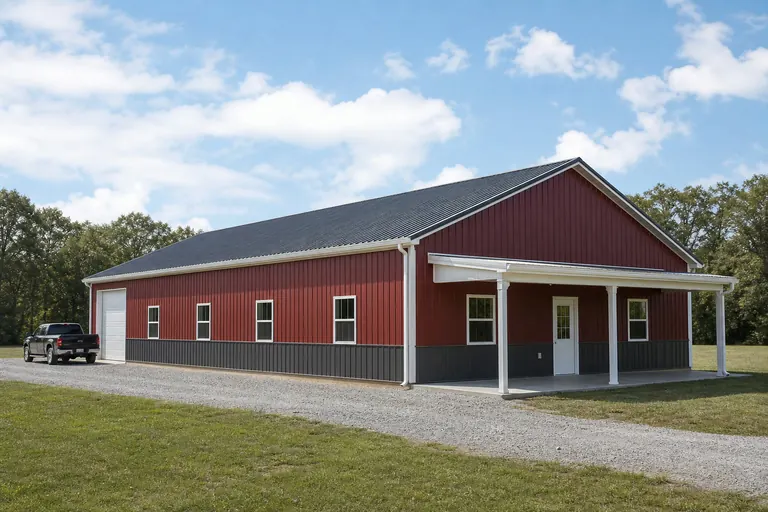 The Coastal Plain Working FarmA wide, single-story layout with an attached equipment bay, sized to fit a property near Georgia's 253-acre average farm size.The Piedmont Commuter HomesteadA residence-forward barndominium near metro Atlanta, balancing a smaller shop with full living space on a rolling-hill lot.The North Georgia Mountain RetreatA compact footprint with upgraded insulation and larger site-prep budget to handle Blue Ridge slope and cooler winters.
Example Configuration — for planning purposes only.
Storm Season & Insurance
Severe-weather readiness for a Georgia barndominium
Because a barndominium is a full-time residence, its seasonal weather posture matters as much as its floor plan.
- Confirm hazard exposure with FEMA's National Risk IndexFEMA's National Risk Index (hazards.fema.gov) is the authoritative county/tract-level source for Georgia hazard scores across 18 hazard types; check your specific county before finalizing structural specs rather than assuming a single statewide risk level.
- Plan a generator transfer switchSevere thunderstorms and occasional tropical remnants can knock out power across multiple Georgia counties at once; wiring a transfer switch during construction avoids opening finished walls later.
- Size gutters for sustained rainfallWith an Atlanta-area normal near 50.4 inches of annual precipitation, undersized gutters and downspouts are a common source of foundation moisture problems in Georgia barndominiums.
- Verify soil-specific footing depthPiedmont clay and Coastal Plain sand behave differently under a barndominium's slab; a local soils check before the footing is poured prevents cracking or settling issues down the road.
Questions
Georgia Barndominium FAQ
Practical answers for buyers planning a residential steel building in Georgia.
Most Georgia counties allow residential steel buildings when they meet local residential building codes, but zoning and HOA rules vary widely between metro Atlanta counties and rural agricultural counties. Confirm with your local planning department before finalizing a design.
Yes. Georgia's five physiographic provinces carry different soil types and terrain, from Coastal Plain sand to Piedmont clay to Blue Ridge slope, and each changes the foundation and site-prep approach even if the steel structure itself stays similar.
It is generally treated the same as a standard custom home permit. You will need engineered plans, a site plan, and proof of utilities. Georgia's local departments processed 63,621 new housing unit authorizations in 2023, so most offices are well practiced at residential review.
There's no fixed minimum, but Georgia's average farm size of 253 acres shows many owners have room to spare; a barndominium with an attached shop can also work on far smaller suburban or exurban lots if local zoning allows the footprint.
Sometimes, if the local health department confirms the existing system has capacity for the added bedrooms and fixtures. On larger Georgia rural tracts, many owners instead install a dedicated well and septic system sized for the barndominium alone.
Sources for the Georgia facts on this page
This page states no code requirement, wind speed, snow load, permit rule, price or supplier claim. The state-specific facts it does use are listed with their publisher below.
The New Georgia Encyclopedia (citing University of Georgia geography scholarship) describes Georgia as encompassing parts of five distinct physiographic provinces: the Appalachian Plateau, the Valley and Ridge, the Blue Ridge, the Piedmont, and the Coastal Plain.
New Georgia Encyclopedia (University of Georgia Press / Georgia Humanities) · Reference overview · Tier 2
https://www.georgiaencyclopedia.org/articles/geography-environment/geographic-regions-of-georgia-overview/Georgia's total land area was measured at 57,513.5 square miles as of the 2010 Census, the 21st largest of any U.S. state.
U.S. Census Bureau · 2010 Census · Tier 1
https://www.census.gov/geographies/reference-files/2010/geo/state-local-geo-guides-2010/georgia.htmlGeorgia had 39,264 farms in 2022, down 7% from 2017, covering 9,939,313 acres of land in farms with an average farm size of 253 acres (up 8% since 2017).
USDA National Agricultural Statistics Service (NASS) · 2022 · Tier 1
https://www.nass.usda.gov/Publications/AgCensus/2022/Online_Resources/County_Profiles/Georgia/cp99013.pdfGeorgia had 39,264 farms in 2022, down 7% from 2017, covering 9,939,313 acres of land in farms with an average farm size of 253 acres (up 8% since 2017).
USDA National Agricultural Statistics Service (NASS) · 2022 · Tier 1
https://www.nass.usda.gov/Publications/AgCensus/2022/Online_Resources/County_Profiles/Georgia/cp99013.pdfAtlanta's (Hartsfield-Jackson) 1991-2020 annual climate normal precipitation is about 50.4 inches with roughly 2.2 inches of annual snowfall.
NOAA National Centers for Environmental Information (NCEI) · 1991-2020 · Tier 1
https://www.ncei.noaa.gov/access/services/data/v1?dataset=normals-monthly-1991-2020&dataTypes=MLY-PRCP-NORMAL,MLY-SNOW-NORMAL&format=csv&stations=USW00013874Georgia local building permit offices authorized 63,621 new privately-owned housing units in 2023, ranking 5th among states, down from 77,542 units in 2022.
U.S. Census Bureau · 2023 (with 2022 comparison) · Tier 1
https://www.census.gov/construction/bps/pdf/2023annualhighlights.pdf