
Steel home · SC
Steel Homes in South Carolina
A steel home in South Carolina represents a shift toward permanent, climate-resilient housing. Across the state's 30,064.1 square miles, from the hurricane-exposed Coastal Plain to the cooler mountainous Upstate, residential steel provides a durable alternative to traditional wood framing. In a humid subtropical (Köppen Cfa) environment where temperatures have risen more than 1°F since the early 20th century, a South Carolina steel home offers superior resistance to rot and pests while providing a flexible canvas for open-concept living on the state's 22,633 farms and growing suburban tracts.
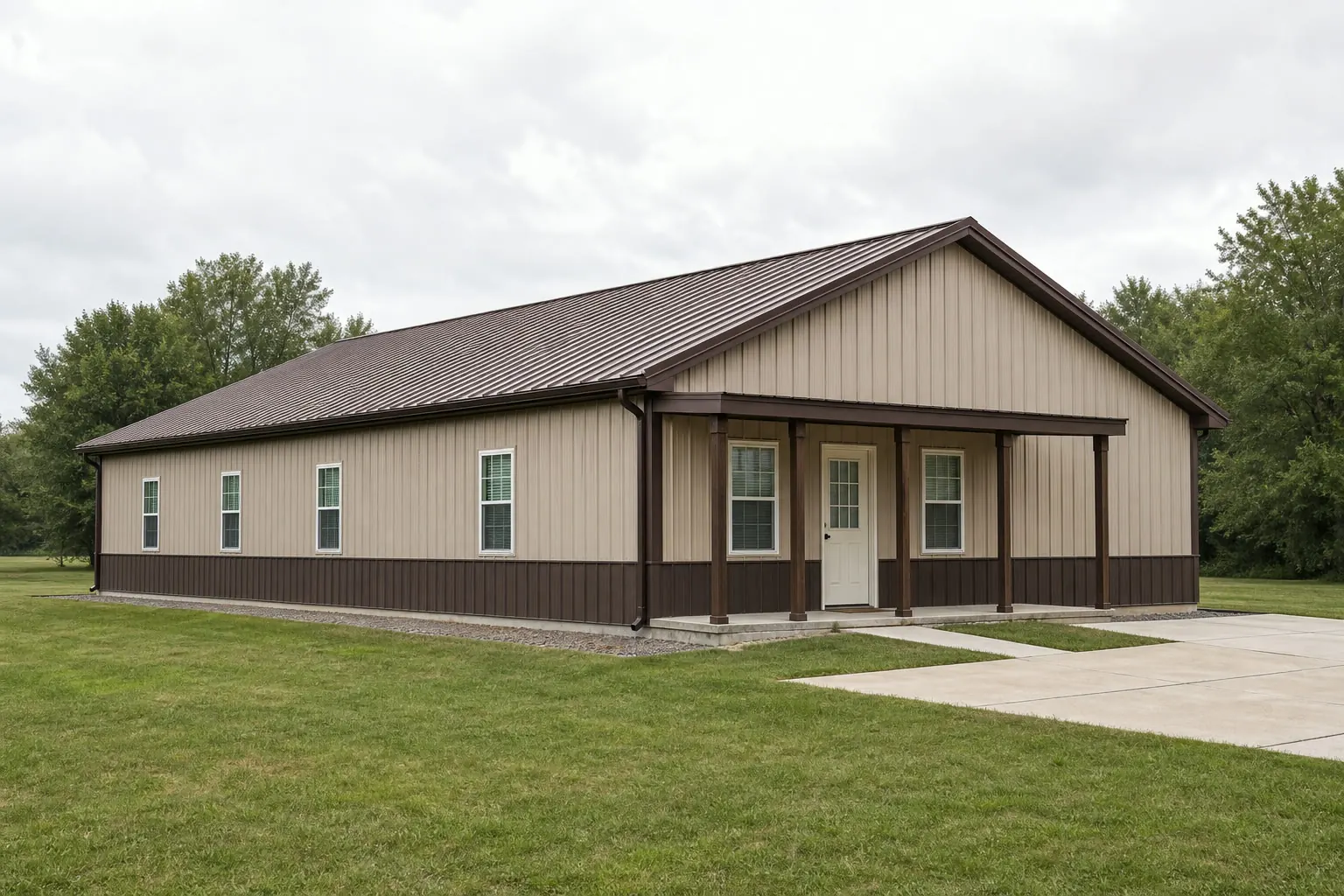
Modern Living
Why South Carolina is choosing residential steel
Steel homes are becoming a staple of the South Carolina landscape, offering a level of durability that traditional homes struggle to match in a humid subtropical climate.
Building a home in South Carolina means preparing for heat, humidity, and the occasional severe storm. While traditional wood-frame homes have served the state for centuries, they are vulnerable to the Palmetto State's specific environmental pressures: moisture-driven rot and aggressive termite populations. Steel framing eliminates these risks from the core structure of the home, providing a frame that is dimensionally stable and won't warp or degrade in the humid Midlands or Lowcountry air.
The state's geographic diversity—covering over 30,000 square miles—means that a steel home in Greenville faces different challenges than one in Beaufort. In the Upstate, homeowners prioritize thermal efficiency to handle the cooler winters and mountainous terrain. Along the coast, the focus shifts to wind resistance and the use of corrosion-resistant coatings to handle salt-laden air. In both cases, the strength-to-weight ratio of steel allows for larger open-concept layouts and bigger windows to take advantage of South Carolina's natural beauty.
Regional Design
Designing for South Carolina's diverse zones
How geography dictates the engineering of a Palmetto State steel home.
Lowcountry (Coastal)
Focus on wind-load engineering and flood-resistant siting. Steel homes here often use elevated foundations to meet FEMA requirements and high-grade Galvalume coatings to prevent salt-air corrosion.
The Midlands (Central)
The primary challenge is managing the peak heat and humidity of a humid subtropical (Köppen Cfa) climate. High-performance insulation systems are essential to keep cooling costs manageable.
Upstate (Mountainous)
Site preparation involves navigating slopes and red clay. Steel homes here are often designed with walk-out basements or tiered foundations to fit the rugged Piedmont terrain.
Performance
The thermal break: a South Carolina necessity
In a steel home, the frame itself can become a thermal bridge, bringing South Carolina's outdoor heat into your living room.
One of the biggest misconceptions about steel homes is that they are difficult to cool. In reality, a properly insulated steel home can be more efficient than a traditional one. The key in South Carolina is the 'thermal break.' Because steel conducts heat, the exterior siding and the interior drywall must be separated from the steel frame by a layer of insulation that prevents heat transfer.
Most South Carolina builders recommend closed-cell spray foam for residential steel. This material not only provides a high R-value for the humid subtropical heat but also acts as a vapor barrier and adds structural rigidity. With temperatures in the state rising by more than 1°F since the 20th century, investing in a superior insulation package is the single best way to ensure long-term comfort and lower utility bills.
- Closed-Cell Spray Foam
- The preferred insulation method for SC steel homes to manage heat and moisture.
- Vapor Barrier Slabs
- Essential to prevent ground moisture from migrating into the home's living space.
- Strategic Shading
- Utilizing deep porches—a classic SC architectural feature—to keep direct sun off the steel exterior.
Plan your South Carolina steel home
Connect with residential steel specialists who can design a home for the Palmetto State's unique climate and terrain.
Regional Comparison
Coastal Lowcountry vs. Upstate: what changes in a steel home brief
The same steel home shell resolves into two very different specifications depending on which half of South Carolina it sits in.
| Consideration | Coastal Lowcountry | Upstate |
|---|---|---|
| Primary hazard | Hurricane wind and coastal flooding (FEMA NRI) | Winter storms and steeper terrain grading |
| Envelope focus | Salt-air corrosion resistance on fasteners and trim | Higher-performance insulation for cooler winters |
| Foundation approach | Elevated slab or pier system on sandy soil | Engineered slab or walk-out basement on clay/slope |
| Humidity load | Near-constant, year-round dehumidification demand | Seasonal, concentrated in summer months |
Primary hazard
- Coastal Lowcountry
- Hurricane wind and coastal flooding (FEMA NRI)
- Upstate
- Winter storms and steeper terrain grading
Envelope focus
- Coastal Lowcountry
- Salt-air corrosion resistance on fasteners and trim
- Upstate
- Higher-performance insulation for cooler winters
Foundation approach
- Coastal Lowcountry
- Elevated slab or pier system on sandy soil
- Upstate
- Engineered slab or walk-out basement on clay/slope
Humidity load
- Coastal Lowcountry
- Near-constant, year-round dehumidification demand
- Upstate
- Seasonal, concentrated in summer months
Storm Resilience
Planning for hurricane-season power loss
A steel home's structural resistance to wind does not solve the more common hurricane-season problem: losing utility power for days.
FEMA's National Risk Index scores hurricane and coastal flooding hazards across South Carolina's 46 counties, and the practical consequence for most homeowners is not structural failure but extended power outages after a tropical system passes through. A steel home's tight, well-insulated envelope actually helps here: it holds a comfortable interior temperature longer without air conditioning than a leaky wood-frame house, which matters when a Lowcountry or Midlands outage stretches into a hot, humid week.
Homeowners planning a steel home in a hurricane-exposed county should raise backup power, whether a portable generator hookup or a whole-home standby unit, with their electrical contractor during design rather than after the first storm season. This is a handoff item, not a structural one, but the steel envelope's efficiency changes the sizing conversation, and Upstate buyers should have the same conversation framed around winter ice-storm outages rather than hurricane season.
Site Planning
Foundation and site prep before the frame goes up
A steel home's finished quality depends heavily on the site work that happens before the frame ever arrives, and South Carolina's soil variety makes this step less optional than it might be elsewhere.
Because the state runs from sandy Coastal Plain soils to expansive Piedmont clay, a soil test at the building site is worth doing before finalizing a foundation design rather than after. Sandy Lowcountry soils generally drain well but may need deeper footings near tidal or low-lying parcels, while Upstate clay can swell and contract enough across wet and dry seasons to stress a slab that wasn't engineered for it. A geotechnical or foundation contractor familiar with the specific county's soil behavior can flag these issues early, before concrete is poured.
Grading matters just as much as the foundation itself. South Carolina's heavy seasonal rainfall means a site that looks flat and dry in spring can pond water after a summer thunderstorm if it wasn't graded to shed water away from the slab. Builders in the Midlands and Lowcountry commonly add a few inches of positive slope around the perimeter specifically to handle this, an extra step that Upstate sites on sloped terrain may not need in the same way.
Questions
South Carolina Steel Home FAQ
Addressing common questions for prospective metal home owners in SC.
While we do not provide specific pricing, steel homes often offer long-term savings through reduced maintenance and lower insurance premiums due to their fire and storm resistance. The initial cost is generally comparable to a custom wood-frame home once all residential finishes are included.
Yes. In fact, many owners of South Carolina's 22,633 farms are choosing steel homes because they can be easily integrated with shop or agricultural space (commonly known as barndominiums).
Steel is one of the strongest residential framing materials available, but the specific wind-load design still has to be engineered for your parcel; confirm the design wind speed for your address with your local building department before finalizing plans.
Generally yes. Coastal and Midlands homes prioritize humidity control and dehumidification, while Upstate homes need a higher-performance insulation package to manage cooler winters and mountain terrain.
It's a good idea across most of the state, since soils range from sandy Coastal Plain ground to expansive Piedmont clay. A soil test lets your foundation contractor size footings and reinforcement correctly for your specific parcel rather than relying on a generic slab spec.
Sources for the South Carolina facts on this page
This page states no code requirement, wind speed, snow load, permit rule, price or supplier claim. The state-specific facts it does use are listed with their publisher below.
The South Carolina State Climatology Office (SC DNR) states most of the state falls within the humid subtropical (Köppen Cfa) classification, producing hot, humid summers with mild winters, while portions of the Upstate mountains have a different, cooler climate regime.
South Carolina Department of Natural Resources (SC DNR), State Climatology Office · SC DNR reference publication · Tier 2
https://www.dnr.sc.gov/climate/sco/Publications/SCClimateOverview.pdfNOAA's 2022 State Climate Summary reports South Carolina temperatures have risen more than 1°F since the beginning of the 20th century, less than the warming observed for the contiguous United States overall.
NOAA National Centers for Environmental Information (NCEI) · 2022 summary, trend since 1900 · Tier 1
https://statesummaries.ncics.org/downloads/SouthCarolina-StateClimateSummary2022.pdfThe Census Bureau's current data profile lists South Carolina with a land area of 30,064.1 square miles and a water area of 1,959.4 square miles, ranking it the 39th largest state by area.
U.S. Census Bureau · Current Census Bureau geography data · Tier 1
https://data.census.gov/profile/South_Carolina?g=0400000US45South Carolina had 22,633 farms in 2022, down 9% since 2017.
USDA National Agricultural Statistics Service (NASS) · 2022 · Tier 1
https://www.nass.usda.gov/Publications/AgCensus/2022/Online_Resources/County_Profiles/South_Carolina/cp99045.pdfFEMA's National Risk Index is the federal tool providing county-level natural hazard risk scoring (including hurricane, coastal flooding, tornado, and inland flooding categories) for all 46 South Carolina counties; a state-specific hazard narrative from FEMA itself was not directly retrieved in this session.
Federal Emergency Management Agency (FEMA) · Current NRI release · Tier 1
https://www.fema.gov/flood-maps/products-tools/national-risk-index