
Garden shed · MD
Garden Sheds in Maryland
A garden shed is one of the lowest-stakes structures a Maryland property owner will ever site, which is exactly why the state-specific questions worth answering are about the property, not the building. Maryland's 12,550 farms averaged 158 acres each in 2022, a scale small enough that a shed on working land is frequently the overflow tool building rather than the property's only storage, and the Maryland Geological Survey's three-region description of the state — Coastal Plain, Piedmont, and the combined Blue Ridge, Valley and Ridge, and Appalachian Plateau provinces — still decides whether a shed's first site question is drainage or grading.
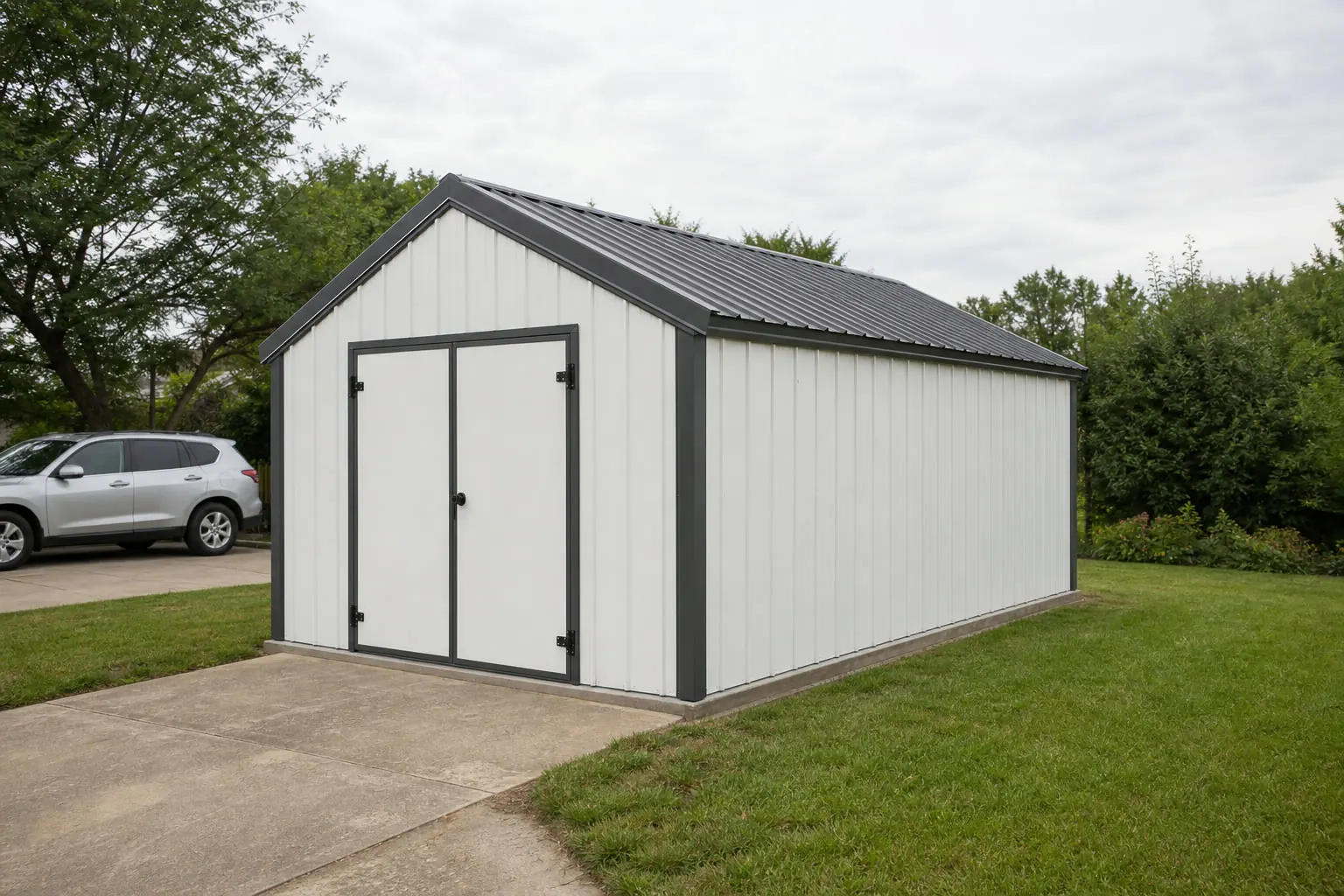
Property context
Why a Maryland shed's real story is the property, not the building
A garden shed does not need engineering-level analysis, but the property it sits on — its farm scale, its region, its distance from tidal water — decides how it gets used and sited.
Maryland counted 12,550 farms in 2022 spread across 1,978,036 acres, for an average operation of 158 acres. That is a genuinely small working-land scale, and it shapes what a garden shed is actually for on many Maryland properties: rather than the household's only outdoor storage, it is more often a second, smaller building set apart from the main barn or equipment shed, holding hand tools, chemicals, or seasonal gear that the owner would rather keep separate from bulk equipment storage.
On a standard suburban lot near Baltimore or Washington, the same shed serves a simpler purpose — mowers, trimmers, and seasonal items kept out of the garage — but the siting logic underneath it is still set by the region the lot sits in, not by the shed itself.
Because a shed is small enough to place almost anywhere on a typical lot, the property-level questions worth resolving before ordering are which physiographic region the backyard falls into and whether the site sits close enough to tidal water to warrant a hazard check, both covered next.
Terrain
What each Maryland region asks of a shed pad
The Maryland Geological Survey's three-region description changes the first practical question a shed buyer should ask about their own lot.
Coastal Plain (Eastern Shore and Southern Maryland)
Flat, low-relief ground where drainage is the recurring concern; a shed pad needs to manage standing water since the ground itself offers little natural runoff slope.
Piedmont (central Maryland)
Rolling terrain through Baltimore and the Washington suburbs where a level pad may need to be built rather than assumed, shifting the priority from drainage to grading.
Western Maryland mountains
Steeper, higher-elevation ground in Garrett and Allegany counties, where pad leveling and, on working farms, straightforward equipment access to the shed door both matter.
Exposure
Rainfall on flat ground, and when to check FEMA's hazard tool
At roughly 44-46 inches of annual precipitation for the Baltimore-Washington area, a flat-lot shed benefits from a deliberate pad, and a coastal-adjacent lot benefits from a separate hazard check.
That figure is NOAA's 1991-2020 climate normal for the BWI area station, not a design value for any specific yard. What it supports is a simple habit: on flat Coastal Plain ground, water sitting under or beside a shed floor is a longer-term problem than the modest cost of a gravel, paver, or small concrete pad addresses up front. Deciding where the shed's roof runoff goes, before the unit is placed rather than after, avoids a wet strip along one side of the structure that can outlast the rain itself.
A separate consideration applies to properties near the Chesapeake Bay or Atlantic coast. FEMA's National Risk Index scores 18 hazard types, including coastal flooding, across Maryland's 24 jurisdictions, and it is the right tool to check jurisdiction-level exposure rather than assuming a statewide condition applies evenly to every Maryland backyard.
On Piedmont or western Maryland lots, the priority shifts away from drainage. Instead, the shed site may need actual grading or a built-up level spot before the pad goes in, which is worth budgeting for separately from the cost of the shed itself.
- Pad choice on flat ground
- A gravel, paver, or small concrete pad is inexpensive relative to the shed and helps avoid a floor that stays damp.
- Roof water direction
- Site the shed so roof runoff drains away from foundations, fences, and neighboring property lines.
- Coastal exposure check
- Properties near the Chesapeake Bay or Atlantic coast should reference FEMA's National Risk Index by jurisdiction before finalizing placement.
Get Maryland garden shed quotes
Tell us your lot type, physiographic region, intended use, and rough size. We route it with the Maryland and garden shed context already attached.
Configuration
What Maryland garden sheds are usually used for
On the state's mix of suburban lots and small-acreage properties, garden sheds tend to split into a few recurring uses.
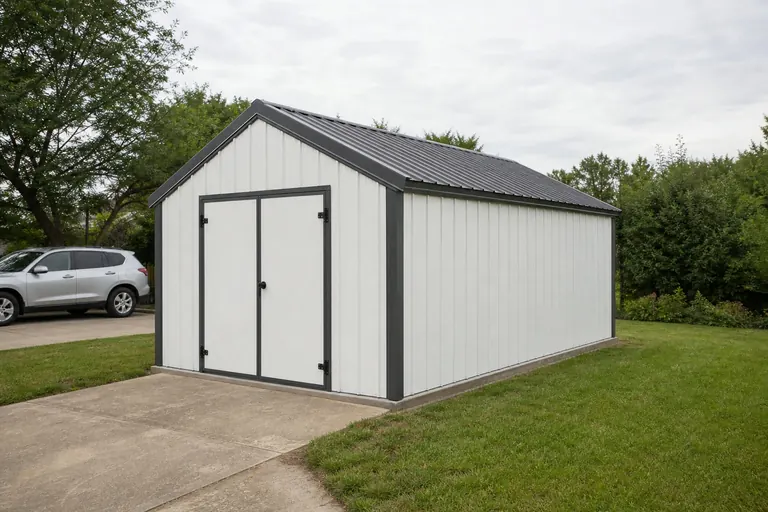 Lawn and garden equipmentA frequent use on a standard suburban lot: mowers, tools, and seasonal equipment kept dry and out of the main garage.
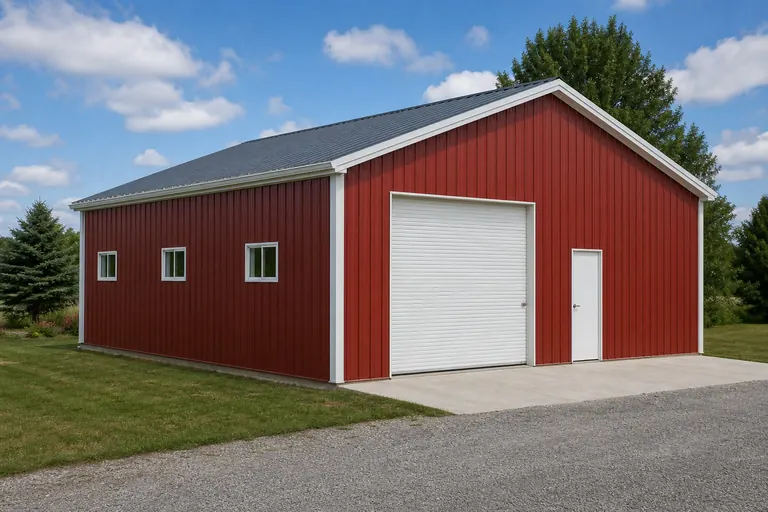 Small workshop or hobby spaceA slightly larger shed used for light hobby work, common on larger Eastern Shore or western county lots.Small-farm overflow storageFeed, tools, or chemicals kept apart from the main barn on Maryland's typically small-acreage farm properties, averaging 158 acres statewide.
Example Configuration — for planning purposes only.
Footprint
Sizes that suit a Maryland backyard
Flat lots rarely force a smaller footprint, so on Coastal Plain sites Maryland shed sizing is usually driven by intended use rather than site constraints.
8′ × 10′
80 sq ft
A compact footprint for basic lawn and garden equipment on a standard suburban lot.
10′ × 16′
160 sq ft
Common where the shed also serves as light hobby or workshop space.
12′ × 20′
240 sq ft
A larger option for properties with more yard space, common on larger small-farm parcels.
Example Configuration — for planning purposes only.
Footprint pages carry the layout and door detail for each of these; this page only explains why Maryland buyers land in this range.
Preparation
Before you place a Maryland garden shed order
A few things resolved in advance keep a small project simple.
Step 1
Identify your physiographic region
Coastal Plain, Piedmont, and western Maryland ground each ask a different first question — drainage versus grading.
Step 2
Check local zoning setbacks
Setback distances from property lines and easements are set locally; confirm with your local building or zoning department before finalizing placement.
Step 3
Decide on a pad before delivery
Flat Coastal Plain lots benefit from a gravel, paver, or concrete pad chosen before the shed arrives, not after.
Step 4
Check coastal hazard exposure if applicable
Properties near the Chesapeake Bay or Atlantic coast should reference FEMA's National Risk Index by jurisdiction.
Questions
Maryland garden shed questions
Questions we can answer honestly at state level, with the ones we cannot routed to whoever actually owns them.
Permit thresholds and setback rules are set locally and often depend on the shed's footprint. Your local building or zoning department is the only reliable source for your specific lot.
Yes. The Maryland Geological Survey describes three distinct physiographic regions — Coastal Plain, Piedmont, and the combined Blue Ridge/Appalachian provinces — so whether your first question is drainage or grading depends on which region your backyard sits in.
Maryland's average farm is 158 acres, well below large ranch-country scale, so a garden shed on working land is frequently used as separate tool or chemical storage kept apart from the main barn rather than as a primary equipment building.
It can be. FEMA's National Risk Index scores coastal flooding among 18 hazard types across Maryland's 24 jurisdictions; check yours before finalizing placement rather than assuming a statewide condition.
We do not publish state-level prices, since cost depends on size, materials, and site work. Our cost pages cover what drives the number; a quote covers your project.
Sources for the Maryland facts on this page
This page states no code requirement, wind speed, snow load, permit rule, price or supplier claim. The state-specific facts it does use are listed with their publisher below.
Maryland had 12,550 farms in 2022, up from 12,429 in 2017.
USDA National Agricultural Statistics Service (NASS) · 2022 (with 2017 comparison) · Tier 1
https://www.nass.usda.gov/Publications/AgCensus/2022/Full_Report/Volume_1,_Chapter_1_State_Level/Maryland/st24_1_001_001.pdfMaryland had 1,978,036 acres of land in farms in 2022, an average farm size of 158 acres.
USDA NASS · 2022 · Tier 1
https://www.nass.usda.gov/Publications/AgCensus/2022/Full_Report/Volume_1,_Chapter_1_State_Level/Maryland/st24_1_001_001.pdfThe Maryland Geological Survey describes the state as spanning three distinct physiographic regions -- the Coastal Plain, the Piedmont, and the combined Blue Ridge, Valley and Ridge, and Appalachian Plateau provinces -- extending from the Atlantic coast to the western mountains.
Maryland Geological Survey · MGS reference material · Tier 2
https://www.mgs.md.gov/geology/geology_of_maryland.htmlThe BWI Airport (Baltimore/Annapolis area) NOAA 1991-2020 climate normals show total annual precipitation of roughly 44-46 inches spread fairly evenly across the year.
NOAA National Centers for Environmental Information (NCEI) · 1991-2020 · Tier 1
https://www.ncei.noaa.gov/access/services/data/v1?dataTypes=MLY-TMAX-NORMAL%2CMLY-TMIN-NORMAL%2CMLY-TAVG-NORMAL%2CMLY-PRCP-NORMAL%2CMLY-SNOW-NORMAL&dataset=normals-monthly-1991-2020&format=pdf&stations=USW00013752FEMA's National Risk Index is the federal tool for county- and state-level natural hazard exposure data for Maryland's 24 jurisdictions, covering 18 hazard types including coastal flooding, hurricane, and winter weather.
Federal Emergency Management Agency (FEMA) · Current NRI release · Tier 1
https://www.fema.gov/flood-maps/products-tools/national-risk-index