
Steel home · GA
Steel Homes in Georgia
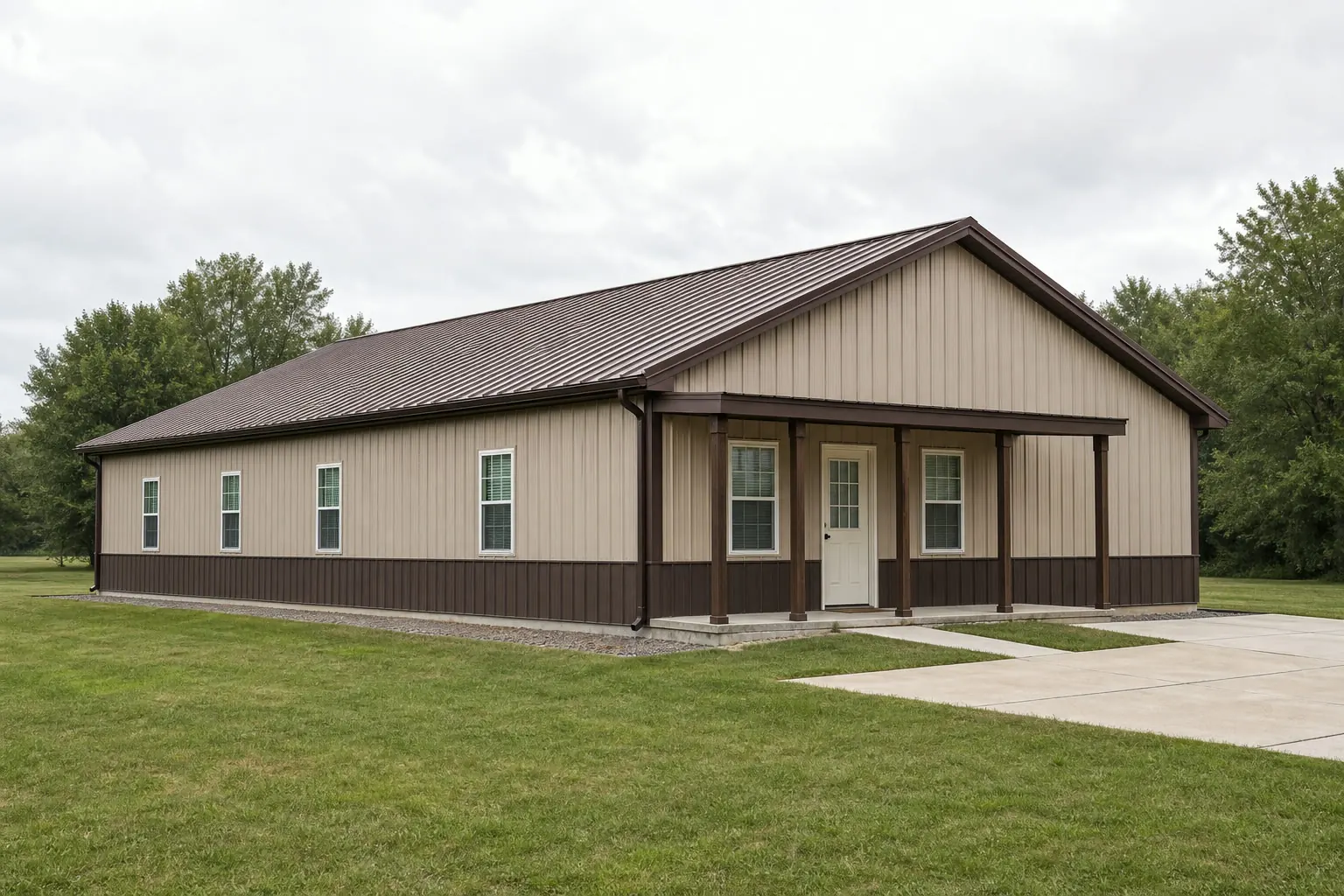
A steel home built in Georgia answers to the specific piece of ground it sits on before it answers to anything else. The New Georgia Encyclopedia maps the state across five physiographic provinces — Appalachian Plateau, Valley and Ridge, Blue Ridge, Piedmont, and Coastal Plain — and each hands a residential steel frame a different foundation problem, from Piedmont clay near metro Atlanta to sandy, low-lying ground on the Coastal Plain. Layer on Georgia's still-substantial rural land base, with 39,264 farms averaging 253 acres in the 2022 Census of Agriculture, and it becomes clear why a meaningful share of Georgia's steel homes sit on acreage large enough to combine a residence with an attached shop or barn rather than a standard suburban lot. This page works through what that combination of geography and land use actually changes about a Georgia steel home plan.
Start Here
What a Georgia steel home brief looks like, by province
The same steel shell resolves into a different foundation and siting plan depending on which Georgia province the lot is in.
| Province | Ground condition | What it changes in the brief |
|---|---|---|
| Coastal Plain (South Georgia) | Sandy, flat, low-lying | Grading and perimeter drainage take priority over soil-movement resistance |
| Piedmont (metro Atlanta and Central Georgia) | Red clay, rolling terrain | Slab reinforcement to resist seasonal clay expansion and contraction |
| Blue Ridge & Valley and Ridge (North Georgia) | Sloped, cooler winters | Site grading cost rises and insulation performance becomes the bigger envelope factor |
Coastal Plain (South Georgia)
- Ground condition
- Sandy, flat, low-lying
- What it changes in the brief
- Grading and perimeter drainage take priority over soil-movement resistance
Piedmont (metro Atlanta and Central Georgia)
- Ground condition
- Red clay, rolling terrain
- What it changes in the brief
- Slab reinforcement to resist seasonal clay expansion and contraction
Blue Ridge & Valley and Ridge (North Georgia)
- Ground condition
- Sloped, cooler winters
- What it changes in the brief
- Site grading cost rises and insulation performance becomes the bigger envelope factor
Land Use
Why so many Georgia steel homes share a lot with a shop or barn
Georgia's farm base is smaller than it was a decade ago, but the farms that remain tend to be larger, and that shift shows up directly in steel home floor plans.
The 2022 Census of Agriculture counted 39,264 farms in Georgia, down from prior counts, but average farm size climbed to 253 acres across 9,939,313 acres of land in farms. That combination — fewer, larger operations — means a real share of Georgia's steel home buyers are planning on acreage with room to spare, and many use that room to attach a shop, equipment bay, or barn to the residence in a single steel structure rather than building two separate buildings.
That land-use pattern changes the floor plan conversation before foundation or climate ever come up: a residence-plus-shop layout needs a service entry separate from the front door, a utility corridor that can carry both household and shop electrical loads, and often a taller eave line on the shop side than a stand-alone home would need. None of that is unique to steel construction, but steel's open-span capability makes the combined layout easier to execute than it would be in conventional framing.
Georgia's residential permit volume gives context for how routine this request is at the counter: local building departments authorized 63,621 new housing units in 2023, the 5th-highest total of any state, so a combined residence-and-shop steel plan is one of many custom layouts a Georgia building department reviews in a given year, not a novel submission.
Building Envelope
Managing sustained humidity inside a steel frame
Steel conducts heat and cold efficiently, which means a Georgia steel home's envelope has to actively manage moisture rather than rely on the frame to buffer it the way a thicker wood assembly might.
The practical risk in a humid climate is condensation forming on the inside face of an uninsulated or poorly insulated steel wall, where warm interior air meets a cold steel surface during Georgia's cooler months, or where cool conditioned air meets a hot exterior wall in summer. Left unmanaged, that condensation cycle can support mold growth inside the wall cavity long before any structural issue appears.
An Atlanta-area annual precipitation normal near 50.4 inches signals that this is a year-round concern rather than a seasonal one. Georgia builders typically separate the steel frame from the interior and exterior finishes with a continuous insulating layer and a vapor-retarding membrane sized to the specific climate zone, and pair that with mechanical ventilation sized to the home's volume rather than a fixed rule of thumb — a detail worth confirming with your HVAC contractor at design time, not after move-in.
- Continuous Insulation Layer
- Interrupts direct heat transfer through the steel frame, reducing the interior condensation risk that drives mold growth.
- Vapor-Retarding Membrane
- Placed according to Georgia's specific climate zone rather than a generic national default.
- Sized Mechanical Ventilation
- Matched to the home's volume and occupancy, a detail to confirm with an HVAC contractor at design time.
Plan your Georgia steel home
Connect with residential steel specialists who can design a home for your specific Georgia province and land use.
Site Planning
Siting notes across Georgia's terrain
Beyond the foundation table above, each province carries a secondary siting consideration worth raising with a builder early.
Coastal Plain
The state's largest province by land area. Flat, low-lying lots benefit from a slightly elevated pad so the home's finished floor sits above the surrounding grade during heavy rain events.
Piedmont
Rolling terrain around metro Atlanta means the building pad itself often needs cut-and-fill grading before slab work starts, in addition to the clay-soil reinforcement noted above.
North Georgia (Blue Ridge, Valley and Ridge, and named sections like the Lookout Mountain District)
Steeper sites can call for a walk-out lower level or engineered retaining work, which changes the project's site-prep scope more than its steel framing scope.
Preparation
Before you finalize a Georgia steel home design
These five items resolve the province, land-use, and climate variables above into concrete design inputs before drawings are locked.
- Confirm your physiographic provinceCheck whether the parcel sits on Coastal Plain sand, Piedmont clay, or North Georgia's sloped terrain, since that determines the foundation approach in the table above.
- Decide the shop-to-residence relationship earlyIf the property is among Georgia's larger farm parcels, settle whether the shop or barn shares the steel structure with the residence, since that changes the utility corridor and service-entry layout from the first draft.
- Plan the envelope for year-round humiditySpecify a continuous insulating layer and a climate-zone-appropriate vapor-retarding membrane rather than defaulting to a generic national assembly.
- Check your county's FEMA National Risk Index profileHazard exposure varies by county across Georgia's five provinces; confirm yours rather than assuming a single statewide condition.
- Ask your building department about review timingWith 63,621 units authorized statewide in 2023, most departments are practiced at reviewing steel-framed residential submissions, but current queue length still varies by county.
Questions
Georgia Steel Home FAQ
Addressing common questions for prospective steel home owners in Georgia.
We don't track builder-level or regional market share. What varies predictably by region is the foundation and siting approach, covered in the province table above; your local builder can speak to demand in your specific area.
Yes. Many owners among Georgia's 39,264 farms choose steel homes because the layout can combine a full residence with an attached shop or barn, sometimes called a barndominium layout.
Yes. Piedmont clay, Coastal Plain sand, and North Georgia's sloped terrain each call for a different foundation approach, as outlined in the province table above. A local soil check confirms which applies to your specific lot.
A continuous insulating layer and a climate-zone-appropriate vapor-retarding membrane are the standard way to prevent interior condensation, given Georgia's sustained annual rainfall and humid summers.
It is generally reviewed like any custom home permit. Georgia's building departments processed 63,621 new housing unit authorizations in 2023, so most local offices are well practiced at residential review, including non-traditional framing methods.
Sources for the Georgia facts on this page
This page states no code requirement, wind speed, snow load, permit rule, price or supplier claim. The state-specific facts it does use are listed with their publisher below.
The New Georgia Encyclopedia (citing University of Georgia geography scholarship) describes Georgia as encompassing parts of five distinct physiographic provinces: the Appalachian Plateau, the Valley and Ridge, the Blue Ridge, the Piedmont, and the Coastal Plain.
New Georgia Encyclopedia (University of Georgia Press / Georgia Humanities) · Reference overview · Tier 2
https://www.georgiaencyclopedia.org/articles/geography-environment/geographic-regions-of-georgia-overview/Georgia had 39,264 farms in 2022, down 7% from 2017, covering 9,939,313 acres of land in farms with an average farm size of 253 acres (up 8% since 2017).
USDA National Agricultural Statistics Service (NASS) · 2022 · Tier 1
https://www.nass.usda.gov/Publications/AgCensus/2022/Online_Resources/County_Profiles/Georgia/cp99013.pdfGeorgia had 39,264 farms in 2022, down 7% from 2017, covering 9,939,313 acres of land in farms with an average farm size of 253 acres (up 8% since 2017).
USDA National Agricultural Statistics Service (NASS) · 2022 · Tier 1
https://www.nass.usda.gov/Publications/AgCensus/2022/Online_Resources/County_Profiles/Georgia/cp99013.pdfAtlanta's (Hartsfield-Jackson) 1991-2020 annual climate normal precipitation is about 50.4 inches with roughly 2.2 inches of annual snowfall.
NOAA National Centers for Environmental Information (NCEI) · 1991-2020 · Tier 1
https://www.ncei.noaa.gov/access/services/data/v1?dataset=normals-monthly-1991-2020&dataTypes=MLY-PRCP-NORMAL,MLY-SNOW-NORMAL&format=csv&stations=USW00013874Georgia local building permit offices authorized 63,621 new privately-owned housing units in 2023, ranking 5th among states, down from 77,542 units in 2022.
U.S. Census Bureau · 2023 (with 2022 comparison) · Tier 1
https://www.census.gov/construction/bps/pdf/2023annualhighlights.pdf